|
|
|
|
|
|
|
|
|
Cranston Fine Arts  Aviation Art and Artists World War Two Countries Aviation Art and Artists World War Two Countries  UK UK |
[UP] - UK - US - Germany - Italy - Russia - Japan - France - Czechoslovakia - Poland - Netherlands - Romania - Finland - Australia - Canada - New Zealand - Norway - Malta |
| Navigation | |
| Page 4 of 49 | Previous .. Page 4 .. Next |
|
|
|
|
|
|
|
|
|
|
|
|
|
|
|
|
|
|
|
|
|
| Navigation | |
| Page 4 of 49 | Previous .. Page 4 .. Next |
| Text for the above items : |
Scramble by Gerald Coulson. A telephone rings at a typical flight dispersal: a call from Operations sends pilots and ground crew running for aircraft ready fuelled and armed. A mechanic starts the engine of the spitfire in the foreground and it explodes into life, blasting out blue exhaust gases, the slipstream flattening the grass and kicking up dust. A young sergeant pilot with feelings a mixture of fear and excitement, runs for his machine. The painting captures the tense atmosphere of a much repeated action from these crucial events of the Battle of Britain, as Spitfires of No.66 Squadron scramble. |
Dambusters - Breaching the Eder Dam by Robert Taylor. Mist and fog swirled eerily over the Eder Lake on the night of 16/17 May 1943 as four specially modified Lancasters of 617 Squadron, under the leadership of Wing Commander Guy Gibson, circled overhead. Their target, the mighty Eder Dam, was barely visible in the valley below. Immediately following the successful breach of the Mohne Dam, Gibson had led his remaining aircraft 50 miles to the south-east to hit their second target, the Eder Dam. Surrounded by high ground with thousand feet ridges, the Eder was altogether a more testing target. The Lancaster pilots would need to dive steeply into the gorge that formed the Eder lake before undertaking a steep turn towards the Dam itself. As if this were not demanding enough in the darkness of night, they then had to fly towards the target at precisely 60ft above the lake at the exact speed of 230mph, before releasing their Barnes Wallace designed hydrostatic bouncing bombs. Pilots Shannon and Maudsley tried time and again to position their laden bombers correctly before managing to release their weapons - but the dam still held. Now success depended solely on Knight carrying the last bomb! With time and fuel now a concern, Knights first effort to position, like Shannon and Maudsley before him, failed, but his second run favoured the brave. Knight released his bomb with absolute precision, striking the wall at precisely the crucial point. With a tremendous explosion the Eder Dam collapsed before their eyes. Robert Taylors sensational new painting vividly shows the dramatic moment of impact. In the cockpit Knight and flight engineer Ray Grayston fight the controls to clear the dam, combining their physical strength to haul the lumbering Lancaster up and over the dam and to clear the high ground that lies ahead. Below and behind them, the second of Germanys mighty western dams lies finally breached. |
Supermarine Spitfire MKVb W3458 YQ-X. by M A Kinnear. Aircraft History: First flight 11th July 1941, then onto 12 Maintenance Unit 16th July 1941. W3458 was delivered to 616 Squadron on 23rd July 1941. It failed to return from operations over Northern France on 9th August 1941. Squadron Leader LH Buck Casson DFC, AFC: Coming from Sheffield Lionel H Casson was one of the original volunteer pilots to join 616 (South Yorkshire) Auxiliary Air Force Squadron on its formation at Doncaster in 1938. After pilot training, he served briefly with 79 Squadron flying Hurricanes from Biggin Hill before rejoining Spitfire equipped 616 at Leconfield in July 1940. With the squadron he flew south to Kenley in mid-August and over the next three weeks was involved in fierce fighting during the Battle of Britain. On 30th August he was credited with a probable and a damaged HE111. Two days later he claimed a Bf109 followed by the destruction of a Do17. After suffering severe losses, the squadron was withdrawn to Kirton-in-Lindsay on 4th September and after a rest period, 616 moved to Tangmere in February to join the Bader Wing. On 5th May 1941, Casson shared in the destruction of a Ju88 but was hit by return fire and was forced to bale out. Flying on daily sweeps and bomber escorts over Northern France, he destroyed a Bf109 on 22nd June and he claimed a damaged two days later. He was made Flight Commander in July and claimed two Bf109s as probables. On 9th August as he was leading his flight over St Omer, his aircraft was hit and he was forced to crash land. He was soon captured and spent the rest of the war in the infamous Stalag Luft 3. Shortly after his capture he was awarded the DFC. After his release four years later, he rejoined the peacetime 616 Squadron, equipped at first with Mosquito night fighters and then Meteor jet fighters. He was appointed as Commanding Officer in December 1950 during which time the Squadron won the coveted Esher Trophy awarded to the top Auxiliary Air Force squadron. After three years in command, he retired having been awarded the AFC for his outstanding leadership. |
Tally Ho! by Thomas Gower. No text for this item |
Lucky Seven by Ivan Berryman. Another sortie completed, the crew of a Lancaster head for a well-earned cup of tea after a night raid over Germany in 1944. |
Tribute to Pete Brothers by Ivan Berryman. Pete Brothers is shown here in his Hurricane P2921 GZ-L of No.32 Squadron during the Battle of Britain. In one of 8 victories claimed before September 1940, he has peppered a marauding German Dornier Do.215, its port engine now trailing smoke and flame. In this incident, he had been attacked by Me110s and had stalled while turning to meet them. Spinning out of the stall he immediately sighted, engaged and shot down the Do.215. He claimed an Me109 later the same day. Pete Brothers is credited with a total of 16 victories during World War Two. He died aged 91 in December 2008. |
No Contest by Ivan Berryman. Whilst attacking a temporary airfield North of Stendal on 22nd April 1945, a group of 198 Sqn Typhoons led by Sqn Ldr N J Durrant were surprised to find themselves confronted by that rarest of fighters, Focke-Wulf's awesome Ta.152, one of them piloted by the great Willi Reschke of Stab / JG301, flying 'Black 13'. In the words of Sqn Ldr Durrant: 'The first wave of Typhoons had broken up the airfield surface with 500lb bombs and started some fires. I spotted some of the enemy trying to get airborne through the smoke and as I made a low pass, another Focke-Wulf passed me from behind at great speed. Thinking this would be an easy 'kill', I fired a short burst, but the enemy was gone. I remember thinking that there must be something wrong with my own machine because I felt like I was standing still. Only later did I learn what we had encountered. Thank God the war ended when it did.' |
Night Hawks by Philip West. The ever-vigilant crew of this Mosquito night-fighter successfully intercept a Luftwaffe Bf110 as it heads towards a bomber stream over target in Germany. |
Winter Warriors by Ivan Berryman. The Winter of 1943-44 saw Hawker Typhoons operating from Tangmere, equipped with 500lb or 1000lb bombs against radar installations and V1 sites in northern France. Wing Commander J R Baldwin is depicted getting airborne with others of his squadron for just such a mission early in 1944, before the squadron moved to Needs Oar Point in readiness for the D-Day landings. |
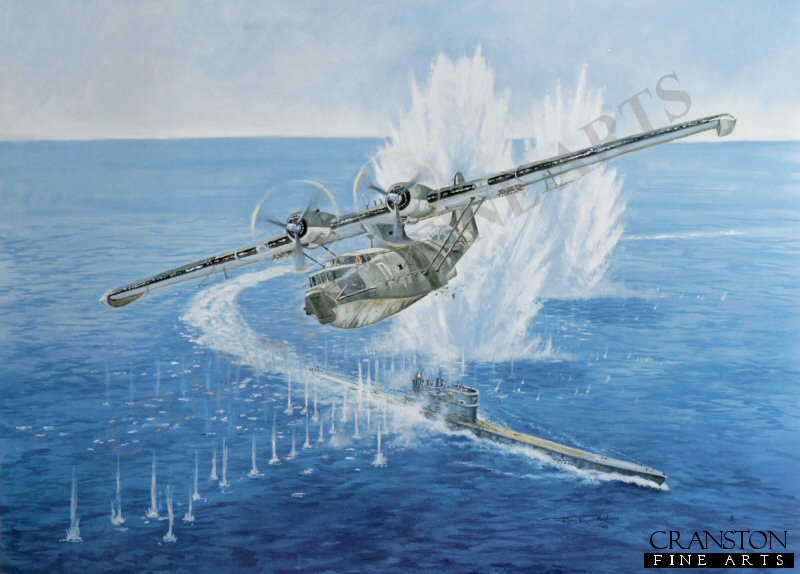
Catalina Attack by John Wynne Hopkins. D for Donald of 270 squadron, Royal Air Force, out of Freetown, West Africa operating in the Atlantic Ocean. It was during routine operation search that D for Donald surprised U515 on the surface and immediately attacked the submarine. U515 in putting up stiff resistance blew a large hole in the hull of D for Donald and the magazine of the starboard side 0.5 twin Browning was hit and the subsequent shrapnel wounded both blister gunners. U515 escaped but was sunk by an American naval hunter group a year later. D for Donald limped back to base and managed to make the beach before it would sink completely. |
Impossible Odds by Ivan Berryman. Outnumbered and outclassed, the aging Gloster Gladiators of 112 Sqn nonetheless put up a spirited defence in the skies above Crete as Germanys Operation Mercury gathered momentum in the Spring of 1941. Here, shark-mouthed Messerschmitt Bf.110s of ZG.76 menace a lone Gladiator during an evening encounter. |
Bader Bus Company by Robert Taylor. (GS) On Saturday, 9 August 1941 the unthinkable happened: the legendary Fighter leader Douglas Bader failed to return from a mission over northern France. Immediately, without thought for their own safety, the fiercely loyal pilots of his Tangmere Wing set out on a sweep to search for him, hoping that he may have successfully baled out into the Channel. By nightfall, however, there was no sign of him and everyone feared that their famous Wing Leader might have been lost. A few days later, however, the good news filtered into Tangmere; Bader, renowned as the Fighter Ace with artificial legs, had survived, albeit as a prisoner of war. |
Climbing Out by Keith Aspinall. A flight of Lancaster bombers from a Bomber Command squadron climb away from the British coastline on yet another bombing raid on Nazi held Europe. A superb painting and a great tribute to the crews of the Lancaster bomber squadrons. |
Merlin Roar by Anthony Saunders. The Hawker Hurricane powered by the powerful Rolls Royce Merlin engine is shown in combat with Luftwaffe aircraft during the Battle of Britain. The Hurricane played a major role in the aerial victory along with its companion the Spitfire. |
Their Finest Hour by Nicolas Trudgian. Situated on the south eastern tip of Kent, RAF Hawkinge was the most forward airfield in Fighter Command. It was not surprising therefore that when Reichmarshal Goering began his fierce attacks on airfields - part of his softening up campaign in preparation for Hitlers Adler Tag (Eagle Day) - Hawkinge would be among the first in his sights. The Luftwaffe were putting up massive raids - over 1700 aircraft crossed the coast on August 16th - and RAF bases in the south-east were taking a pounding. Hawkinge, a satellite of Biggin Hill sector station, and vital to front line defences, lay right in the path of the raiding Luftwaffe hordes. When on August 12th it was bombed for the first time, its effect was only to harden the resolve of its pilots and groundstaff. MkI Spitfires of No.610 County of Chester Squadron are seen scrambling out of RAF Hawkinge in late August 1940. refuelled and re-armed, with scarlet patches covering the gunports, all serviceable aircraft roar off the grass strip and head back to the fray. With aerial battles raging all the way from 2000 to 20,000 feet, within minutes they will be back in the action. Ground crews in the foreground work frantically to get more Spitfires airworthy. In the background Hurricanes from No.32 Squadron are at readiness, and will be called into action as the primitive radar picks up the next incoming raid. |
Mutual Support by Philip West. In the depths of winter, Halifax aircraft of 158 Squadron based at RAF Lissett, Yorkshire, make their final preparations before take off. A remarkable aircraft much loved by its crews. |
Tribute to Fl Off Tom Neil by Ivan Berryman. Flying Officer Tom Neil closes on a Dornier Do.17 on 15th September 1940, just one of four victories confirmed on that day, the others being two Bf.109s and another Dornier shared. He is depicted flying Hurricane Mk1 V7313 of 249 Sqn whilst based at North Weald. |
Bristol Beaufort by Ivan Berryman. A Bristol Beaufort Mk I of No 22 Squadron attacks a railway marshalling yard during raids on the French coast in the Autumn of 1940. |
First Light by Gerald Coulson. In Gerald Coulsons fine study First Light, Mk Vb Spitfires of 92 Squadron climb out of Biggin Hill at the outset of an early morning patrol on a cold winters morning in February 1941. Leaving the mist behind as the first beams of light streak across the heavens, they will turn to the east and steel themselves to meet the enemy, high in the dawn sky. |
First Strike by Ivan Berryman. The Avro Lancaster B MkIII ED932(G), AJ-G, of Wing Commander Guy Gibson was the first aircraft to make an attempt at breaching the Möhne Dam on the night of 16/17th of May 1943 as Operation Chastise got underway. Having already made one 'sighting' run over the target, Gibson turned and began his second run, the flak and 20mm fire from the shore and from the towers of the dam now throwing up a hail of fire. Undeterred, the Upkeep mine was released, skipping across the water as planned, but striking the dam wall off centre with no visible effect. Gibson made several passes over the Möhne, each time escorting the attacking aircraft in an attempt to draw the enemy fire. With the Möhne finally breached, he led the remaining aircraft on to the Eder dam with similar success before returning safely to Manston. |
Larry Lewis DFC by Graeme Lothian. At 3.30am on the 23rd June 1945, a Dakota of 357 (special duties) Squadron took off from Mingaladon airfield nr. Rangoon , to travel the 600 miles, 300 of them behind enemy lines, to rescue a downed American Liberator crew deep in the jungles of Siam . The Dakota was flown by pilot Fl Lt. Larry Lewis, who already held the DFM awarded to him for 33 ops as a rear gunner on Wellingtons in 1941. Two crews had already failed when Lewis was asked to attempt this hazardous mission. Flying between 5,000 - 6,000ft he flew over The Hump, a ridge of mountains running down the spine of Burma . Local villagers had cleared a rough airstrip 800yds long with Lewis finding it by the time dawn broke. With monsoon clouds gathering, the Liberator crew aboard and the Dakota sinking in the wet ground, he managed, just, to get airborne. Flying at zero feet and looking out for Japanese Zero fighters Lewis took a different course back. Although being fired on from the ground they managed to make it all the way to the airfield at Dum Dum nr. Calcutta , India . Lewis was awarded an immediate DFC. By the end of the war he had completed 63 ops, held the rank of Squadron Leader with his service from 1938-1945, and was awarded the Air Efficiency Medal. |
|
Contact Details |
Sign Up To Our Newsletter!
This website is owned by Cranston Fine Arts. Torwood House, Torwoodhill Road, Rhu, Helensburgh, Scotland, G848LE Contact: Tel: (+44) (0) 1436 820269. Email: cranstonorders -at- outlook.com
|