|
|
|
|
|
|
|
|
|
Cranston Fine Arts  Aviation Art and Artists World War Two Countries Aviation Art and Artists World War Two Countries  UK UK |
[UP] - UK - US - Germany - Italy - Russia - Japan - France - Czechoslovakia - Poland - Netherlands - Romania - Finland - Australia - Canada - New Zealand - Norway - Malta |
| Navigation | |
| Page 16 of 49 | Previous .. Page 16 .. Next |
|
|
|
|
|
|
|
|
|
|
|
|
|
|
|
|
|
|
|
|
|
| Navigation | |
| Page 16 of 49 | Previous .. Page 16 .. Next |
| Text for the above items : |
Target Peenemunde by Robert Taylor. On the evening of 17th August 1943, a total of 596 aircraft of RAF Bomber Command, spearheaded by the Pathfinder Force, set out on what called for, and what became, the most precise bombing raid of the war. Success was vital. The target was a secluded research establishment near the remote Baltic town of Peenemunde. There, a group of top German scientists were developing the V-2 rocket projectile, with which Hitler hoped to devastate London and other major English cities. When Allied Intelligence discovered the plan, the RAF was allotted the task of destroying the installation at Peenemunde, whatever the cost. Brilliantly navigated in darkness right over the target, the masterbombers aircraft, seen in the forefront of this painting, made nine dangerous passes over the target, directing operations. During the next 55 minutes Hitlers secret weapon establishment was almost totally destroyed by the bomber crews that followed his directions. The raid was completed with great gallantry but at heavy cost, and is today remembered as one of the greatest achievements of the RAF. The painting shows Lancasters of No. 83 Squadron Pathfinder Force as they climb out over the east coast of England en-route for Peenemunde on the warm summer evening of 17th August, 1943. |
Spitfire Maintenance Check by Graeme Lothian. (P) Spitfire JE-J of Spitfire Ace Johnnie Johnson is shown with the engine cowling removed during maintenance. |
Hawker Hurricane MkI P2725 TM-B. by M A Kinnear. Aircraft History: The Hawker Hurricane MkI was part of the first production batch of 500 built by Gloster Aircraft Co. Ltd, Brockworth during 1939/140 under contract number 962371/38/C.23A/ Delivered to 504 squadron, P2725 brought down the first enemy aircraft over London on 15th September 1940, piloted by Flight Sergeant R. T. Holmes. Ammunition exhausted he deliberately rammed a Dornier causing it to crash on Victoria Station, P2725 was badly damaged as a result of this action and Flight Sergeant Holmes had to leave the stricken aircraft by parachute. The Hurricane crashed in the vicinity of Victoria Station. Flight Lieutenant Raymond T Holmes: Born and raised on the Wirral Peninsula, Ray Holmes was the 55th volunteer for the RAFVR on its formation in 1936. As a sergeant pilot he was credited with being the first to bring down an enemy aircraft over London during the Battle of Britain whilst with 504 County of Nottingham Squadron flying Hawker Hurricane P2725. After flying convoy protection duties he was posted to Murmansk with 81 Fighter Squadron, escorting Russian Bombers over Finland. Upon his return to Britain he qualified as a flying instructor and spent two years at the Central Flying School. This was followed by a move to 541 Squadron at Benson, flying PR Spitfires, photographing targets such as Berlin, the Ruhr and Hitlers hideout at Berchtesgaden. At the end of the war he was appointed Kings Messenger flying mail for Winston Churchill. Ray was demobilized in October 1945 to return to the Wirral and his pre-war career of journalism. |
Shining the Way (Mosquito) by Ivan Berryman. One of the artists most haunting paintings, a Mosquito B.IX of the Light Night Striking Force, PFF, banks away from the target zone having released a cluster of green Christmas tree marker flares to light the way for the second wave of approaching bombers. Frought with enormous difficulties and dangers, perhaps the most surprising aspect of the PFF is that it was made up almost entirely of volunteers and was widely regarded as the elite within Bomber Command. A fact made even more staggering by the slim chances of any aircrew completing the sixty sorties tour of operations that was asked of them. Nevertheless, the PFF was never short of volunteers and their dedication and courage is celebrated in this stunning print. |
Wing Commander J R Baldwin - The Spoils of War by Ivan Berryman. Britain's highest scoring Typhoon ace, Wing Commander J R Baldwin climbs from the cockpit of his personalised Typhoon at a makeshift airfield in northern France after a sortie in support of the Allied forces' drive into mainland Europe following D-Day in June 1944. Baldwin was instrumental in the capture of a German General's Mercedes, a prize which he employed as his personal transport for the duration of his time in France. |
Constant Endeavour by Michael Rondot. No text for this item |
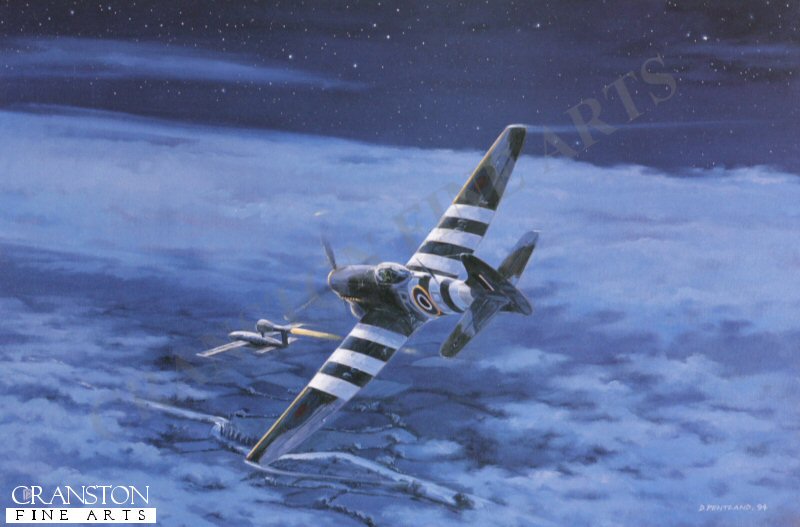
A Buzz for Beamont by David Pentland. Wing Commander Roland Beamont in his personal Tempest V, intercepted and downed his first V1 Buzzbomb on the night of June 22nd, 1944, over south east England. As Commander of 150 wing and others he went on to shoot down a total of 30 V1 flying bombs, 8 enemy aircraft and 35 locomotives destroyed plus one minesweeper sunk. |
Quartet by Gerald Coulson. The inspiration for this subject was principally the setting. A low sun turning the tops of towering cumulus to a soft ochre against a backdrop of azure. Through breaks in these massive clouds can be seen a landscape beginning to fade, greens and yellows changing to liquid blues and mauves. All that is now required to complete the picture are the lines of a beautiful aeroplane, provided here by four Spitfires on No.66 Sqn. The aircraft shown are LZ-M, LZ-N, LZ-K and LZ-X. LZ-X was flown by H R Dizzy Allen throughout the Battle of Britain. |
Winter Ops by Gerald Coulson. Up to 1942 Bomber Command operations were beset by many problems. The means they had to accurately pinpoint the target and assault it were totally lacking, in fact their Commander in Chief, Air Marshall Arthur Harris later wrote : It was glaringly obvious that the average crew in average weather could not find their way to the target. Between February and August 1942 an effort was made to rectify this through the development of a specialised target finding and target marking force, which became known as the Pathfinders. Activated on August 15 this new group was formed under the leadership of their AOC Air Commodore Don Bennett, himself a very experienced pre war pilot with exceptional navigational skills. The aircrews of No. 8 (PFF) Group were tasked with marking out the designated targets but the formation of this group was initially opposed by Harris. He felt that the ranks of his Main Force could be weakened if a high number of experienced and highly skilled crews were taken by this specialist unit, leading to a lessening of skills within the other bomber groups. He agreed however for an alternative scheme whereby complete units were assigned to the Pathfinder Force and the stage was then set for what was to become the Main Offensive of Bomber Command. The first four Squadrons - Nos. 7 (Stirlings) 35 (Halifax) 83 (Lancaster) and 156 (Wellingtons) - were based at a clutch of airfields between Cambridge and Huntingdon. In the absence of any specialist Target Markers the crews were initially forced to operate using standard flares and the early raids produced variable results, with cloud cover often proving the main obstacle in accurate marking. However during the winter of 1942 the introduction of the ground guided marking system, OBOE, marked a quantum leap in accurate target marking and by mid 1943 Pathfinder techniques had been developed for all forms of weather conditions, including nights when complete overcast existed.Pathfinder crews used a combination of personal skill and technical equipment such as H2S to locate their targets. Often flying against overwhelming odds and in appalling conditions they transformed the performance of a bomber force that in 1941 was dropping almost half its bombs on open countryside. This third and final painting in Gerald Coulsons Tribute to Bomber Command depicts Lancaster Bombers of No.8 (PFF) Group returning late after a gruelling operation over Berlin. It is Christmas 1943 and the winter landscape reflects the early morning sunrise as the weary crews approach the safety of their Cambridgeshire base. |
Handley Page Halifax Mk.III LV907 of No.158 Sqn - 'Friday the 13th' by G Henderson. The legendary Friday the 13th completed 128 missions, making it one of RAF Bomber Command's most successful aircraft, and marks the most operations by a Halifax aircraft. |
Returning from Caen by Graeme Lothian. Spitfires from 144 Wing RCAF 2nd TAF led by W/c Johnnie Johnson. Supplying air cover to a mixed force of 942 bombers over Normandy on Operation Goodwood, 18th July 1944. SR-Z of 101 (Special) squadron. Lancasters piloted by Flt Lt George Harris DFC. |
Duxford and Shuttleworth by John Wincentzen. No text for this item |
Hawker Typhoon Mk Ib R7752 PR-G. by M A Kinnear. Aircraft History: First delivered to 609 West Riding Squadron June 1942. It was the personal aircraft of Squadron Leader Roland Beamont whilst he was the Commanding Officer at 609. R7752 was damaged by enemy anti aircraft fire off Vissingen and crash landed at RAF Manston on 1st June 1943. The pilot, Squadron Leader A Ingle DFC, AFC, the Commanding officer of 609 at the time, was uninjured. R7752 was struck off charge 25th August 1943. Wing Commander Roland P Beamont, CBE, DSO and bar, DFC (USA) DL: Born 10th August 1920, Roland Beamont joined No. 87 squadron in France during November 1939. Returning to England 20th May 1940 (having destroyed a Do17 and an ME109) he went on to destroy a further three enemy aircraft during the Battle of Britain. In June 1941, he was posted to No.79 Squadron as Flight Commander. In December 1941 he went to Hawker Aircraft Ltd as a Service test pilot flying Hurricanes. On 29th June 1942, he was posted as Flight Commander to Hawker Typhoon equipped 609 Squadron at Duxford, and took command of the squadron in October. He returned to Hawker Aircraft during May 1943, to test fly the Tempest. In February 1944, he was tasked with forming the first Tempest Wing, No.150 at Castle Camps and later Newchurch. When leader of the five squadron Tempest Wing No.122 over Germany on 12th October 1944, Roland Beamont was shot down by ground fire and became a POW. During his time with No.150 and No.122 Wings he destroyed one Bf109, one Fw190, one Ju188 on the ground, and thirty two V1 flying bombs. After the war Roland Beamont became Chief Test Pilot for English Electric, test flying the Canberra, P1, Lightning and TSR2 aircraft. He was the first British pilot to fly a British aircraft at Mach 1 in level flight, and later Mach 2. After serving as Director of Flight Operations for the Tornado test programme he retired and became a respected author. |
Muscateer by Robert Tomlin. Squadron Leader John Plagis, Commanding Officer of 126 Squadron, in his Spitfire LFIX, returns from France on 24th July 1944 after shooting down an Me109. Plagis went on to score 15 aerial victories before the end of World War II. |
Operation Deadstick by Michael Turner At 0016hrs on 6th June 1944 three Airspeed Horsa gliders, flown with outstanding skill by pilots from the Glider Pilot Regiment, and carrying airborne troops from the Oxfordshire and Buckinghamshire Light Infantry and Royal Engineers, landed within yards of the bridge over the Caen Canal at Benouville, Normandy. The audacious attack achieved complete surprise, and some fifteen minutes later the bridge had been secured, an objective of vital importance to enable the advance of the Allied Liberation Forces on D-Day. |
Overdue by Gerald Coulson. The Vickers-Armstrong Wellington entered service life in the RAF in 1938 as a medium bomber. As the mainstay of the Bomber Command, it bore the initial brunt of the RAFs night offensive during 1940. Without the benefit of sophisticated navigation aids, the bomber crews had difficulty locating and hitting targets and also contending with rapidly improving German defences. The picture depicts an incident at sunrise on the morning of 26th July 1940. A Wellington 1c of 99 Squadron, based at Newmarket Heath, returns from a raid over Dortmund. An engine fails over the North Sea and the aircraft, captained by Squadron Leader Sarll, struggled almost to its home base and crashed just south of Cambridge. The crew survived. |
Can Openers by David Pentland. Two Hawker Hurricane Mk.IID tank busters of No.6 Shiny Six Squadron about to attack retreating axis mechanised units, November 1942 at El Alamein. |
Merlins Thunder by Gerald Coulson. The Avro Lancaster bomber of Bomber Command flies low over occupied Europe at speed thanks to the Merlin engines. |
The Jericho Boys by Ivan Berryman. On 18th February 1944, nineteen De Havilland Mosquito Mk.VIs and one photo-reconnaissance aircraft took off on a mission to attempt to free 120 French patriots being held captive by the Nazis in the prison at Amiens. Codenamed Operation Jericho, the attack on the jail was to be carried out in up to three waves - the first to break the prison walls in two places, the second to bomb the main building and a third standing by, should either of the first two fail. The mission was a complete success despite some losses on the ground and two aircraft destroyed. Here, the iconic moment is captured as a pair of Mosquitoes of 487 Sqn are seen breaching the wall at 12.03 hours. |
Avro Lancaster B.1 by Ivan Berryman. R5689 (VN-N) - a Lancaster B.1 of 50 Squadron based at Swinderby. This aircraft crash-landed in Lincolnshire while returning from a mission on 19th September 1942, after both port engines failed as the aircraft was preparing to land. The aircraft never flew again. The crew on the final mission were : Sgt E J Morley RAAF, P/O G W M Harrison, Sgt H Male, Sgt S C Garrett, Sgt J W Dalby, Sgt J Fraser and Sgt J R Gibbons RCAF, the sole member of the crew killed in the crash. |
Three Home Safely by Ivan Berryman (PC) Three Lancaster bombers break the dawn silence after a night raid in 1943. |
|
Contact Details |
Sign Up To Our Newsletter!
This website is owned by Cranston Fine Arts. Torwood House, Torwoodhill Road, Rhu, Helensburgh, Scotland, G848LE Contact: Tel: (+44) (0) 1436 820269. Email: cranstonorders -at- outlook.com
|