|
|
|
|
|
|
|
|
|
Cranston Fine Arts  Aviation Art and Artists World War Two Squadrons UK and Commonwealth No.225 Sqn to No.269 Sqn Aviation Art and Artists World War Two Squadrons UK and Commonwealth No.225 Sqn to No.269 Sqn  No.257 Sqn No.257 Sqn |
[UP] - No.225 Sqn - No.228 Sqn - No.229 Sqn - No.234 Sqn - No.235 Sqn - No.236 Sqn - No.238 Sqn - No.240 Sqn - No.242 Sqn - No.243 Sqn - No.244 Sqn - No.245 Sqn - No.247 Sqn - No.248 Sqn - No.249 Sqn - No.253 Sqn - No.254 Sqn - No.257 Sqn - No.261 Sqn - No.262 Sqn - No.263 Sqn - No.264 Sqn - No.266 Sqn - No.269 Sqn |
Thay myay gyee shin shwe hti - Death or glory
| No.257 Sqn Aviation Art Prints, Paintings and Drawings Aviation Prints |
|
|
|
|
|
| Text for the above items : |
Bob Stanford-Tuck Tribute Folio by Nicolas Trudgian. Bob Stanford-Tuck waits at dispersal in his 257 Squadron Hurricane during the Battle of Britain. Promoted to command 257 Squadron, Bob was one of the Battle of Britains leading Aces. |
Tribute to Bob Stanford Tuck by Ivan Berryman. Shown here stalking a marauding German bomber in Hurricane V6555 DA-T of No.257 Sqn, Bob Stanford Tuck was one of Britain's greatest Aces of the war, claiming 29 victories before being shot down and taken prisoner early in 1942. |
Winter's Day at Coltishall by John Young. Squadron Leader Stanford Tuck's Hawker Hurricane Mk.I of No.257 (Burma) Squadron being prepared for its next mission. |
Typhoons Over Normandy by Ivan Berryman. Wing Commander J R Baldwin is depicted flying Typhoon MN934 whilst commanding 146 Wing, 84 Group operating from Needs Oar Point in 1944, en route to a bombing raid on 20th June with other Typhoons of 257 Sqn in which both ends of a railway tunnel full of German supplies were successfully sealed. |
Hurricane Force by Robert Taylor. Sunday 15th September, 1940 - a date that will live forever in military history. The day the Luftwaffe made its final, massive effort to defeat the RAF, and pave the way for Hitler's invasion of England. The day the tremendous air battles between the RAF and the Luftwaffe came to a climax - when every single man and machine in Fighter Command climbed into battle. The day Churchill was told: 'There are no reserves!' 'Hurricane Force' puts us right into the midst of the Battle of Britain, some 12,000 feet over London, with the Hurricanes of 257 Squadron as they tear into a mass of Heinkel III Bombers and escorting Me109s. In the foreground a Hurricane pilot reels his machine around having knocked out one of the enemy while his wingman targets another. In the background and below, the fighting is everywhere. The whole sky is embroiled in a mass of aerial warfare. In the thick of the heaviest fighting, the brute force quality of the go-anywhere do-anything Hurricane is seen at its best, its pilots wreaking havoc amongst the massed formations of enemy raiders. The huge aerial contests of the Battle of Britain inevitably developed into a series of individual fights: one-on-one duels, squadron versus squadron. The British pilots, their confidence and morale on the upsurge from recent successes, had the fight of their lives. By the afternoon of 18th September the massed attacks by the Luftwaffe had been routed, and one by one, as the British returned to their bases, the significance of their victory began to dawn upon the sweat-soaked exhilarated pilots of the RAF. They had won the Battle of Britain! |
| No.257 Sqn RAF Aircraft details |
 Hurricane Manufacturer : Hawker Built : 14533 | Hurricane Royal Air Force Fighter, the Hawker Hurricane had a top speed of 320mph, at 18,200 feet and 340mph at 17,500, ceiling of 34,200 and a range of 935 miles. The Hurricane was armed with eight fixed wing mounted .303 browning machine guns in the Mark I and twelve .303 browning's in the MKIIB in the Hurricane MKIIC it had four 20mm cannon. All time classic fighter the Hurricane was designed in 1933-1934, the first prototype flew in June 1936 and a contract for 600 for the Royal Air Force was placed. The first production model flew ion the 12th October 1937 and 111 squadron of the Royal Air Force received the first Hurricanes in January 1938. By the outbreak of World war two the Royal Air Force had 18 operational squadrons of Hurricanes. During the Battle of Britain a total of 1715 Hurricanes took part, (which was more than the rest of the aircraft of the Royal air force put together) and almost 75% of the Victories during the Battle of Britain went to hurricane pilots. The Hawker Hurricane was used in all theatres during World war two, and in many roles. in total 14,533 Hurricanes were built. | |
 Meteor Manufacturer : Gloster Built : 3947 | Meteor The Gloster Meteor was the first British jet fighter and the Allies' first operational jet. Designed by George Carter, and built by the Gloster Aircraft Company, Armstrong-Whitworth, the Meteor first flew in 1943 and commenced operations on 27 July 1944 with 616 Squadron of the Royal Air Force (RAF). The Gloster Meteor was not an aerodynamically advanced aircraft but the Gloster design team succeeded in producing an effective jet fighter that served the RAF and other air forces for decades. Meteors saw action with the Royal Australian Air Force (RAAF) in the Korean War and other air forces used the Meteor. The Royal Danish Air Force, The Belgian Air Force and Isreali Air Force kept the Meteor in service until the early 1970's. A Total of 3947 meteors were built and two Meteors, WL419 and WA638, remain in service with the Martin-Baker company as ejection seat testbeds. | |
 Spitfire Manufacturer : Supermarine Built : 20351 | Spitfire Royal Air Force fighter aircraft, maximum speed for mark I Supermarine Spitfire, 362mph up to The Seafire 47 with a top speed of 452mph. maximum ceiling for Mk I 34,000feet up to 44,500 for the mark XIV. Maximum range for MK I 575 miles . up to 1475 miles for the Seafire 47. Armament for the various Marks of Spitfire. for MK I, and II . eight fixed .303 browning Machine guns, for MKs V-IX and XVI two 20mm Hispano cannons and four .303 browning machine guns. and on later Marks, six to eight Rockets under the wings or a maximum bomb load of 1,000 lbs. Designed by R J Mitchell, The proto type Spitfire first flew on the 5th March 1936. and entered service with the Royal Air Force in August 1938, with 19 squadron based and RAF Duxford. by the outbreak of World war two, there were twelve squadrons with a total of 187 spitfires, with another 83 in store. Between 1939 and 1945, a large variety of modifications and developments produced a variety of MK,s from I to XVI. The mark II came into service in late 1940, and in March 1941, the Mk,V came into service. To counter the Improvements in fighters of the Luftwaffe especially the FW190, the MK,XII was introduced with its Griffin engine. The Fleet Air Arm used the Mk,I and II and were named Seafires. By the end of production in 1948 a total of 20,351 spitfires had been made and 2408 Seafires. The most produced variant was the Spitfire Mark V, with a total of 6479 spitfires produced. The Royal Air Force kept Spitfires in front line use until April 1954. | |
 Typhoon Manufacturer : Hawker Built : 3330 | Typhoon Single engine fighter with a maximum speed of 412 mph at 19,000 feet and a ceiling of 35,200 feet. range 510 miles. The Typhoon was armed with twelve browning .303inch machine guns in the wings (MK1A) Four 20mm Hispano cannon in wings (MK!B) Two 1000ilb bombs or eight 3-inch rockets under wings. The first proto type flew in February 1940, but due to production problems the first production model flew in May 1941. with The Royal Air Force receiving their first aircraft in September 1941. Due to accidents due to engine problems (Sabre engine) The Hawker Typhoon started front line service in December 1941.The Hawker Typhoon started life in the role of interceptor around the cost of England but soon found its real role as a ground attack aircraft. especially with its 20mm cannon and rockets. This role was proved during the Normandy landings and the period after. The total number of Hawker typhoons built was 3,330. | |
| No.257 Sqn RAF Pilot and aircrew signature details |
  Air Commodore Peter Brothers CBE, DSO, DFC* Our estimated value of this signature : £65 Died : 2008 | Air Commodore Peter Brothers CBE, DSO, DFC* Learnt to fly at the age of 16 and joined the RAF two years later in 1936. He first saw action in 1940 when as a Flight Commander in 32 Squadron, based at Biggin Hill, he flew his Hurricane against the fighters and bombers of the Luftwaffe. He recalls this as an intensely busy period, during which he shot down an Me109 - his first enemy aircraft; by the end of August that same year his tally of enemy aircraft shot down increased to eight. Awarded the DFC, he was transferred to 257 Squadron where he joined Bob-Stanford Tuck as a Flight Commander. Promoted in 1941 to Squadron Leader, Pete Brothers then took command of 457 Squadron RAAF, equipped with Spitfires. A year later when 457 Squadron returned to Australia, Pete took command of 602 Squadron. In the early autumn of 1942 he went on to become Wing Leader of the Tangmere Wing, succeeding his old friend, Douglas Bader. By the end of the war Pete Brothers had amassed 875 operational hours over a 44-month period. He was credited with having personally shot down 16 enemy aircraft and damaged many more. He later went on to command 57 Squadron during the Malaya campaign. Upon return to the UK Pete Brothers joined the V-Force, flying Valiant-4 jet bombers. He retired in 1973. Sadly, Pete Brothers died 18th December 2008. | |
 Lieutenant Steve Crowe Our estimated value of this signature : £20 | Lieutenant Steve Crowe Steve Crowe flew Hurricanes with 257 Squadron RAF. and undertook his first combat operation in November 1941. Along with other Americans he was then posted to join 133 Eagle Squadron, flying Spitfires, transferring to the USAAF in September 1942 as the 336th Fighter Squadron. He flew over 70 combat missions in both the European and Mediterranean theatres of operations. | |
Wing Commander Jerry Eaton DFC Our estimated value of this signature : £30 | Wing Commander Jerry Eaton DFC Jerry Eaton learnt to fly in Oklahoma USA. Jerry Eaton Flew with 257 Sqn as part of the 2nd Tactical Air Force ( based at Warmwell in Dorset during 1943 ) and converted to Typhoon 1Bs in 1943 on escorts supporting troops as part of the Allied advances. Jerry Eaton was based at Tangmere, Lymington, Hurn, Normandy and the Low Countries. He remained in service with the RAF until 1972 and left the RAF as a Wing Commander. | |
 Squadron Leader Charles G Frizell Our estimated value of this signature : £50 | Squadron Leader Charles G Frizell Squadron Leader Charles George Frizell flew with RAF Squadron No. 257. His Hurricane fighter was shot down on Aug. 15, 1940, but Frizell bailed out of the burning aircraft and landed safely. Subsequently he fought in Africa and flew long-range shipping patrols from Gibraltar. He lives today in Tsawwassen, Canada. | |
  Flt. Lt. David Ince DFC Our estimated value of this signature : £55 Died : 2017 | Flt. Lt. David Ince DFC Flt. Lt. David Ince DFC was born in Glasgow and was educated at Aysgarth School and Cheltenham College. Failing to meet the eyesight standards for aircrew he became a gunner officer in 1940 and managed to pass a wartime RAF medical board at his third attempt. Seconded for Army Cooperation duties, he trained in Canada at 35 EFTS and 37 SFTS before returning to the UK to fly Hurricanes and Mustangs at 41 OTU. Subsequently converting to Typhoons he flew with 193 and 257 Squadrons, from Normandy until the end of hostilities in Europe, completing almost 150 sorties and being awarded an immediate DFC. He took a leading part in trials, demonstrations and the early operational use of Napalm. Almost shot down on one reconnaissance flight, he later devised and proved a camera installation for low level close up target photography, which was an immediate success. In the closing stages of the war he was leading 193 Squadron on shipping strikes in the Baltic. After attending the first post war course at The Empire Test Pilots School he returned to University to complete an engineering degree. He died in Winchester, Hampshire aged 96 on 2nd August 2017. | |
Flight Lieutenant Reginald C Nutter Our estimated value of this signature : £55 | Flight Lieutenant Reginald C Nutter 257 Squadron, Canada, Hurricanes. | |
 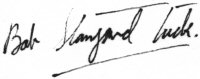 Wing Commander Bob Stanford Tuck DSO DFC** Our estimated value of this signature : £85 Died : 1987 | Wing Commander Bob Stanford Tuck DSO DFC** Bob Stanford Tuck was a flamboyant fighter pilot, his dashing good looks, courage, and success in the air coming to epitomise the young flyers who fought and won the Battle of Britain. To the British public he was a hero in the mould of the knights of old, and today his name is legend. In the early stages of the Battle of Britain Bob fought with 92 Squadron flying Spitfires, quickly becoming one of the leading aces. Promoted to command 257 Squadron, now flying Hurricanes, Bobs dashing style of leadership inspired his pilots to great success. He went on to command the Duxford and Biggin Hill Wings, taking his personal score to 29 air victories before being shot down by ground fire over Northern France in 1942. He died on 5th May 1987. | |
  Squadron Leader Basil Stapleton DFC Our estimated value of this signature : £65 Died : 2010 | Squadron Leader Basil Stapleton DFC Born in South Africa, Basil Gerald Stapleton joined the RAF in Jan 1939, being posted to 603 Sqn flying Spitfires. He first saw action off Scotland, sharing in the destruction of two bombers, before the Squadron was posted south to Hornchurch during the height of the Battle of Britain. By Nov 1940 his tally had risen to 6 and 2 shared victories and 8 probables. In March 1942 he was posted to 257 Sqn as flight commander. In August 1944 he commanded 247 Sqn flying Typhoons, taking part in the Arnhem operations. In December 1944, whilst attacking a train, debris hit his aircraft forcing him to land behind enemy lines where he was taken prisoner of war. Stapme Stapleton had scored 6 victories, plus 2 shared, 5 probable and 2 damaged. Sadly, we have learned that Basil Stapleton passed away on 13th April 2010. | |
  Flight Lieutenant Basil Tatters Tatham Our estimated value of this signature : £60 Died : 2007 | Flight Lieutenant Basil Tatters Tatham Basil Tatham was born on the 13th of March 1921 in Bardolfs, Knebworth and later went to St Edwards in 1936 following many months in Middlesex hospital with osteomyelitis, which nearly cost him his leg. Despite this he went on to follow his father in to the 1st XI cricket team, became captain of shooting, entered the Officer Training Corps and passed his school certificates. After finishing school in 1940 he could have gone on to university but felt duty bound to join the RAF. Basil was training in the Battle of Britain, but served through two tours as a pilot flying Hurricanes, Spitfires, Typhoons and Tempests. Tatters Tatham first flew Hurricanes with 79 Squadron, and then in 1941 on Atlantic convoys with the MSFU before being torpedoed. In May 1942 he was posted to 257 Squadron on Hurricane night fighters, before joining 247 Squadron on Typhoons. After a brief rest period instructing, he rejoined 247 Squadron the day before D-day, and spent the following months destroying German tanks and other ground targets. Basil Tatham ended the war as a Flight-Lieutenant, (he was an acting Squadron Leader) with a number of medals including the Croix de Guerre Avec Etoile de Vermeil (F). He survived being shot down twice. Sadly he passed away on 2nd December 2007. | |
| Aces for : No.257 Sqn RAF | ||
| A list of all Aces from our database who are known to have flown with this squadron. A profile page is available by clicking the pilots name. | ||
| Name | Victories | Info |
| Robert Stanford-Tuck | 29.00 | The signature of Robert Stanford-Tuck features on some of our artwork - click here to see what is available. |
| Peter Malam Brothers | 15.00 | The signature of Peter Malam Brothers features on some of our artwork - click here to see what is available. |
| Basil Gerald 'Stapme' Stapleton | 6.00 | The signature of Basil Gerald 'Stapme' Stapleton features on some of our artwork - click here to see what is available. |
|
Contact Details |
Sign Up To Our Newsletter!
This website is owned by Cranston Fine Arts. Torwood House, Torwoodhill Road, Rhu, Helensburgh, Scotland, G848LE Contact: Tel: (+44) (0) 1436 820269. Email: cranstonorders -at- outlook.com
|


