|
|
|
|
|
|
|
|
|
Cranston Fine Arts  Aviation Art and Artists World War Two Squadrons UK and Commonwealth No.225 Sqn to No.269 Sqn Aviation Art and Artists World War Two Squadrons UK and Commonwealth No.225 Sqn to No.269 Sqn  No.229 Sqn No.229 Sqn |
[UP] - No.225 Sqn - No.228 Sqn - No.229 Sqn - No.234 Sqn - No.235 Sqn - No.236 Sqn - No.238 Sqn - No.240 Sqn - No.242 Sqn - No.243 Sqn - No.244 Sqn - No.245 Sqn - No.247 Sqn - No.248 Sqn - No.249 Sqn - No.253 Sqn - No.254 Sqn - No.257 Sqn - No.261 Sqn - No.262 Sqn - No.263 Sqn - No.264 Sqn - No.266 Sqn - No.269 Sqn |
Be bold
| No.229 Sqn Aviation Art Prints, Paintings and Drawings Aviation Prints |
|
| Text for the above items : |
Maltese Falcons by Anthony Saunders. Depicting Spitfires of No.229 squadron as they pass over Malta in 1942, a tribute to the young pilots, regarded as the saviour of an Island. |
| No.229 Sqn RAF Aircraft details |
 Blenheim Manufacturer : Bristol Built : 4422 | Blenheim The Bristol Blenheim, the most plentiful aircraft in the RAFs inventory when WWII began, was designed by Frank Barnwell, and when first flown in 1936 was unique with its all metal monoplane design incorporating a retractable undercarriage, wing flaps, metal props, and supercharged engines. A typical bomb load for a Blenheim was 1,000 pounds. In the early stages of the war Blenheims were used on many daylight bombing missions. On the day that war was declared on Germany, a Blenheim piloted by Flying Officer Andrew McPherson was the first British aircraft to cross the German coast and the following morning 15 Blenheims from three squadrons set off on one of the first bombing missions The Blenheim units operated throughout the battle, often taking heavy casualties, although they were never accorded the publicity of the fighter squadrons. The Blenheim units raided German occupied airfields throughout July to December 1940, both during daylight hours and at night. Although most of these raids were unproductive, there were some successes; on 1 August five out of 12 Blenheims sent to attack Haamstede and Evere (Brussels) were able to bomb, destroying or heavily damaging three Bf 109s of II./JG 27 and apparently killing a Staffelkapitän identified as Hauptmann Albrecht von Ankum-Frank. Two other 109s were claimed by Blenheim gunners. Another successful raid on Haamstede was made by a single Blenheim on 7 August which destroyed one 109 of 4./JG 54, heavily damaged another and caused lighter damage to four more. There were also some missions which produced an almost 100% casualty rate amongst the Blenheims. One such operation was mounted on 13 August 1940 against a Luftwaffe airfield near Aalborg in north-western Denmark by 12 aircraft of 82 Squadron. One Blenheim returned early (the pilot was later charged and due to appear before a court martial, but was killed on another operation); the other 11, which reached Denmark, were shot down, five by flak and six by Bf 109s. Blenheim-equipped units had been formed to carry out long-range strategic reconnaissance missions over Germany and German-occupied territories, as well as bombing operations. In this role, the Blenheims once again proved to be too slow and vulnerable against Luftwaffe fighters and they took constant casualties While great heroism was displayed by the air crews, tremendous losses were sustained during these missions. The Blenhiem was easy pickings at altitude for German Bf-109 fighters who quickly learned to attack from below. To protect the vulnerable bellies of the Blenheims many missions were shifted to low altitude, but this increased the aircrafts exposure to anti-aircraft fire. In the German night-bombing raid on London on 18 June 1940, Blenheims accounted for five German bombers, thus proving that they were better-suited for night fighting. In July, No. 600 Squadron, by then based at RAF Manston, had some of its Mk IFs equipped with AI Mk III radar. With this radar equipment, a Blenheim from the Fighter Interception Unit (FIU) at RAF Ford achieved the first success on the night of 2–3 July 1940, accounting for a Dornier Do 17 bomber. More successes came, and before long the Blenheim proved itself invaluable as a night fighter. One Blenheim pilot, Squadron Leader Arthur Scarf, was posthumously awarded the Victoria Cross for an attack on Singora, Thailand, on 9 December 1941. Another bomber of No. 60 Squadron RAF was credited with shooting down Lt Col Tateo Katō's Nakajima Ki-43 fighter and badly damaging two others in a single engagement on 22 May 1942, over the Bay of Bengal. Katō's death was a severe blow to the Imperial Japanese Army Air Force. | |
 Hurricane Manufacturer : Hawker Built : 14533 | Hurricane Royal Air Force Fighter, the Hawker Hurricane had a top speed of 320mph, at 18,200 feet and 340mph at 17,500, ceiling of 34,200 and a range of 935 miles. The Hurricane was armed with eight fixed wing mounted .303 browning machine guns in the Mark I and twelve .303 browning's in the MKIIB in the Hurricane MKIIC it had four 20mm cannon. All time classic fighter the Hurricane was designed in 1933-1934, the first prototype flew in June 1936 and a contract for 600 for the Royal Air Force was placed. The first production model flew ion the 12th October 1937 and 111 squadron of the Royal Air Force received the first Hurricanes in January 1938. By the outbreak of World war two the Royal Air Force had 18 operational squadrons of Hurricanes. During the Battle of Britain a total of 1715 Hurricanes took part, (which was more than the rest of the aircraft of the Royal air force put together) and almost 75% of the Victories during the Battle of Britain went to hurricane pilots. The Hawker Hurricane was used in all theatres during World war two, and in many roles. in total 14,533 Hurricanes were built. | |
 Spitfire Manufacturer : Supermarine Built : 20351 | Spitfire Royal Air Force fighter aircraft, maximum speed for mark I Supermarine Spitfire, 362mph up to The Seafire 47 with a top speed of 452mph. maximum ceiling for Mk I 34,000feet up to 44,500 for the mark XIV. Maximum range for MK I 575 miles . up to 1475 miles for the Seafire 47. Armament for the various Marks of Spitfire. for MK I, and II . eight fixed .303 browning Machine guns, for MKs V-IX and XVI two 20mm Hispano cannons and four .303 browning machine guns. and on later Marks, six to eight Rockets under the wings or a maximum bomb load of 1,000 lbs. Designed by R J Mitchell, The proto type Spitfire first flew on the 5th March 1936. and entered service with the Royal Air Force in August 1938, with 19 squadron based and RAF Duxford. by the outbreak of World war two, there were twelve squadrons with a total of 187 spitfires, with another 83 in store. Between 1939 and 1945, a large variety of modifications and developments produced a variety of MK,s from I to XVI. The mark II came into service in late 1940, and in March 1941, the Mk,V came into service. To counter the Improvements in fighters of the Luftwaffe especially the FW190, the MK,XII was introduced with its Griffin engine. The Fleet Air Arm used the Mk,I and II and were named Seafires. By the end of production in 1948 a total of 20,351 spitfires had been made and 2408 Seafires. The most produced variant was the Spitfire Mark V, with a total of 6479 spitfires produced. The Royal Air Force kept Spitfires in front line use until April 1954. | |
| No.229 Sqn RAF Pilot and aircrew signature details |
  Wing Commander Paul Farnes DFM Our estimated value of this signature : £55 Died : 2020 | Wing Commander Paul Farnes DFM Paul Farnes was born in Boscombe, Hampshire, July 16, 1918. He joined the RAFVR in April 1938 and is mobilized in July 1939 before being posted to 501 Squadron, 14 September 1939. He accompanied the Squadron when it was sent to France in May 1940, winning his first victories in the campaign of France and during the Battle of Britain. In October, he was awarded the DFM after eight victories and was promoted to officer the following month. In February 1941 he was transferred to 57 OTU as an instructor and then to 73 OTU in November, in Aden. In late February 1942, he was posted to 229 Squadron in North Africa as Flight Commander. On March 27, 1942, he flew to Malta with the rest of the Squadron aboard the Hurricane IIc BN122. After a period of intense and difficult battles in which defenders of the island will lose many fighters, during which he took command of the Squadron, he returned to Egypt with the survivors of his unit May 27, 1942. He then transferred to Iraq where he joined the Headquarters and remained there until March 1945. He then returned to Great Britain and three weeks after upgrading to the UTO 53, he took command of 124 Squadron, a position he held until the end of the war. He joined the Tangmere before making command of 611 Squadron equipped Mustang IV July 7, 1945. In August, the Squadron was disbanded and it supports the 164 Squadron with Spitfire IX. 63 Squadron was designated in August 1946. In January 1947, he became an officer of Liaison with training centres with the Air Ministry until October 1948. He then became an instructor in various centres. He continued his career in the RAF until 1958 and left active service with the rank of Wing Commander. He returned to his civilian career in the industry. He died on 28h January 2020. | |
 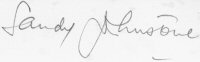 Air Vice Marshal Sandy Johnstone CB DFC AE DL Our estimated value of this signature : £60 Died : 2000 | Air Vice Marshal Sandy Johnstone CB DFC AE DL Early in 1938, Alexander Vallance Riddell Johnstone, known as Sandy, was a civilian navigation instructor at Scottish Aviation, moving later to the Civil Air Navigation School at Prestwick. In August 1939 he was called to full-time service with 602 Squadron. After some Spitfire engagements off the Scottish coast, he received command of 602 - he was still only 24 - and led it south to the tiny airfield at West Hampnett, in West Sussex, where it was stationed throughout the Battle of Britain. Sandy was in command of no. 602 squadron during the critical days of the Battle of Britain, flying with the squadron before the war though to 1941, when he was posted to the Middle east, he also served with 229 and 249 squadrons in Malta during the Islands most fateful days of the war. Sandy became a successful author and resided near Ipswich in Suffolk. Sandy Johnstone died 13th December 2000, aged 84. | |
  Flight Lieutenant Colin Parkinson DFC Our estimated value of this signature : £55 Died : 2006 | Flight Lieutenant Colin Parkinson DFC Australian Colin Parkinson joined the RAAF in 1940, arriving in England to join 19 Squadron flyin Spitfires. In March 1942 he shot down a Do217. In May he was posted to Malta, flying his Spitfire off HMS Eagle on 9th June, with 602 Squadron. After scoring several victories he flew to Gibraltar to lead in further Spitfires, taking off from HMS Furious to the island on 17th August. Commissioned, he now flew with 229 Squadron. On 9th October with Winco Donaldson and Screwball Beurling, he performed a low level beat up and acrobatics over the presentation of the George Cross to the people of Malta. He ended his tour of Malta in November 1942 with the DFC and 10.5 victories, plus probably 2 more. Colin Parkinson passed away aged 89 on 31st March 2006. | |
Squadron Leader Arthur Roscoe DFC Our estimated value of this signature : £55 | Squadron Leader Arthur Roscoe DFC American Art Roscoe joined the RAF in February 1941, through the Clayton Knight Committee that was recruiting American civilian pilots for the RAF. Arriving in England he joined 71 Eagle Squadron, where he made his first claims. In June 1942 he volunteered for service on Malta and flew off the carrier HMS Furious on 11th August to join 229 Squadron. During his final combat on 12th October he was shot down, wounded and evacuated from the island in a Liberator, which in turn crashed on landing in Gibraltar. On recovery, he was posted to join 165 Squadron, then 242 Squadron, and in May 1944 was given command of 232 Squadron. He had destroyed 4 enemy aircraft and probably 3 more. | |
| Aces for : No.229 Sqn RAF | ||
| A list of all Aces from our database who are known to have flown with this squadron. A profile page is available by clicking the pilots name. | ||
| Name | Victories | Info |
| Paul Farnes | 8.00 | The signature of Paul Farnes features on some of our artwork - click here to see what is available. |
|
Contact Details |
Sign Up To Our Newsletter!
This website is owned by Cranston Fine Arts. Torwood House, Torwoodhill Road, Rhu, Helensburgh, Scotland, G848LE Contact: Tel: (+44) (0) 1436 820269. Email: cranstonorders -at- outlook.com
|


