|
|
|
|
|
|
|
|
|
Cranston Fine Arts  Military Art and Artists More Military Artists T - Z Military Art and Artists More Military Artists T - Z  Turner, Graham Turner, Graham |
[UP] - Taylor, Richard - Tennant, Dudley - Terry, Francis - Thevenin, Charles - Trudgian, Nicolas - Trumble, John - Turner, Graham - Turner, Michael - Van Hamme - van Piloty, Karl Theodore - Vernet, Carl - von Kaulbach, Wilhelm - von Wagner, Alexander - Vrancx, Sebastiaen - Walker - Walker, James Alexander - Walker, Robert - Watteau, Francois Louis Joseph - Weatherstone, Marjorie - Werner - Wilkie - Wilson, Gordon - Wilson, Randall - Winner - Wood, Brian - Wood, Stanley - Wootton, John - Wright - Yeames - Yvon, Adolphe - Zimmer |
| Graham Turner |
Having been brought up surrounded by art and motor sport, it was perhaps not surprising that Graham Turner chose to follow a similar career to his father, Michael. While their work is inevitably compared, Graham has firmly established himself as a leading motorsport artist in his own right, creating a world wide reputation for his attention to detail, combined with dramatic compositions that convey the excitement of motor racing from all eras. Graham Turner also paints scenes from medieval history, recreating the events, battles and characters from this turbulent period in our past. |
|
|
|
|
|
|
|
|
|
|
|
|
|
|
|
|
|
| Text for the above items : |
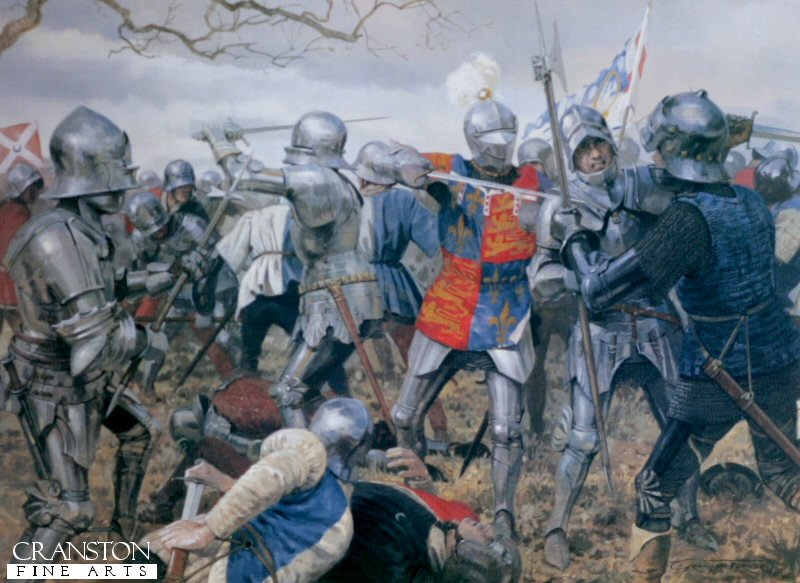
The Battle of Bosworth - the Melee - Norfolk versus Oxford by Graham Turner When Richard III succeeded his brother, Edward IV, in 1483, he found his throne threatened by the Lancastrian Henry Tudor, who was then exiled in France. Two years later, Henry landed in Wales with a small force and on the 22nd August 1485, he confronted the Royal army near Market Bosworth in Leicestershire. |
Whitecoats Defiant by Graham Turner The Marquis of Newcastles Whitecoat regiment stands firm as Parliamentarian cavalry press home their attack during the battle of Marston Moor on the 2nd July 1644. Their stand to the last man has gone down in history, the regiments final destruction bringing the battle to an end. |
The Battle of Wakefield by Graham Turner On December 30th, 1460, the heirs of the Lancastrian Nobles killed at St. Albans found themselves able to avenge their fathers deaths when their army trapped the Duke of York and Earl of Salisbury in Sandal Castle, near Wakefield. Lured out from the safety of the castle walls and into open battle, Yorks heavily outnumbered force found themselves surrounded and in the fierce melee that followed, York and many of his followers lost their lives, his son, Edmund, amongst them. |
The Arrivall by Graham Turner Edward IV enters London through Bishopsgate to reclaim the throne on the 11th April 1471. |
Investiture in York by Graham Turner King Richard III, Queen Anne and their son Edward, emerge from the gothic grandeur of York Minster on the occasion of Edwards Investiture as Prince of Wales on the 8th September 1483. |
The Relief of York by Graham Turner. George, Lord Goring leads his cavalry through Bootham Bar and into York, formally lifting the siege of the City the day before the battle of Marston Moor. |
Loyal Subjects - The Battle of Northampton by Graham Turner. Edward, Earl of March, kneels before Henry VI and proclaims his loyalty, having defeated the Royal army at Northampton on 10th July 1460. The Earl of Warwick and Yorkist troops look on, while one of the guns that failed to fire in the rain stands impotently in the foreground. |
The March from Leicester by Graham Turner King Richard III leads his army out of Leicester, past Austin Friars and over Bow Bridge, en-route to Bosworth and his fateful confrontation with the invading army of his adversary for the throne, Henry Tudor. |
Challenge in the Mist by Graham Turner. At dawn on Easter Sunday, 14th April 1471, the armies of Edward IV and his one time ally, Richard Neville, Earl of Warwick, confronted each other near Barnet, 10 miles outside London. A thick fog enveloped the battlefield, causing the opposing forces to misalign - Edwards right wing overlapping Warwicks left and visa versa. In the struggle that followed, the Yorkist left was outflanked and crumbled, its remnants being persued off the field by the Earl of Oxfords men. However, when Oxford managed to regroup some of his force and return to the fray, the misalignment of the armies had caused the whole battle line to rotate and in the confusion, they found themselves engaged against their allies. |
Towton - The Rout by Graham Turner. The defeated Lancastrian army flees from the battlefield, down Towton Dale towards the River Cock, pursued and cut down by the victorious Yorkists. |
The Battle of Towton by Graham Turner With the wind and driving snow at their backs, the Yorkist archers shoot their final deadly volleys of armour piercing arrows into the advancing Lancastrian army while Edward IV and his knights and men-at-arms move through the ranks to meet their oncoming foe. So began the battle of Towton, the biggest and bloodiest battle fought on British soil, contested by the armies of the two rival claimants for the throne of England; Edward IV, recently acknowledged as King and keen to avenge the deaths of his brother and father, killed at Wakefield three months before, and Henry VI, whose commanders the Duke of Somerset and Earl of Northumberland also sought vengeance in the vicious cycle that had been unleashed six years earlier at St Albans. In bitter conditions on that bleak Yorkshire plateau, many thousands would die in the long, violent struggle - and eventual rout of the Lancastrian army that occurred when re-enforcements finally swung the battle in the Yorkists favour. Their decisive victory would lead to the coronation of Edward IV as the first Yorkist King of England. |
Reverie by Graham Turner Sitting at the window of a great castle, a fashionably dressed Lady looks up from her book, her mind clearly lost in distant thoughts. |
The Battle of Bosworth - King Richard IIIs Charge by Graham Turner After three decades of civil strife between the Royal houses of Lancaster and York, now known as the Wars of the Roses, the army of the Yorkist King, Richard III, confronted the invading force of Henry Tudor, the Lancastrian claimant to the English throne, on the 22nd August 1485 near Market Bosworth in Leicestershire. With the two armies locked together in fierce hand to hand combat, Henry, surrounded by only a small body of men, becomes isolated from his main force. Seeing a chance to end the battle with one decisive stroke, Richard leads his household knights and retainers in a thunderous charge, seeking out his adversary. The unfortunate Sir William Brandon is unhorsed by the Kings lance and Tudors Red Dragon standard falls to the ground. To the left, Sir John Cheyney spurs his horse on to challenge the King and Henry Tudors mount rears up, startled by the deafening noise of battle. However, the hitherto uncommitted forces of Sir William Stanley can be seen approaching and their intervention on Tudors side will lead to the defeat and death of Richard III, the last Plantagenet King of England, and the succession of Henry Tudor as Henry VII. |
Richard Duke of Gloucester at Middleham Castle by Graham Turner Following the death of the Earl of Warwick at the battle of Barnet in 1471, Richard, Duke of Gloucester, was granted the Lordship of Middleham in Yorkshire. He had spent many formative years there as a boy, in the care of Warwick, and it is generally accepted that he preferred Middleham to his other castles. In 1472 he married Warwicks youngest daughter, Anne Neville, and their only son, Edward, was born in the castle in c.1473. |
The Battle of Tewkesbury, 4th May 1471 by Graham Turner. Fresh from his victory at the battle of Barnet, the Yorkist King, Edward IV, marched his forces from London to intercept those of Margaret of Anjou (wife of the Lancastrian Henry VI) and her son, Prince Edward, who had landed at Weymouth and were heading for Wales where supporters awaited them. Denied entry to Gloucester and its bridge over the River Severn, Margaret was forced to march her exhausted army to the next crossing point - at Tewkesbury. Here, with the Royal army hard on their heels and insufficient time to cross the river, they turned to confront their pursuers, the two armies meeting on the 4th May 1471. Following a heavy bombardment from the Kings artillery, Edmund Beaufort, Duke of Somerset, led the Lancastrian right wing through the deep ditches and hedges that intersected the battlefield and attacked the Yorkist left, under the command of Edwards younger brother Richard, Duke of Gloucester. However, the other Lancastrian divisions failed to support the attack and Somersets men were soon outflanked and routed, the rest of Margarets army disintegrating in defeat. Edward IVs victory at the battle of Tewkesbury and the subsequent death of Henry VI in the Tower of London shortly afterwards, secured the throne for the remaining twelve years of Edwards life. |
The Battle of St Albans - 22nd May 1455 by Graham Turner. On the 22nd May 1455, the struggle for control of the government of England boiled over into armed conflict in the first battle of what would become known as the Wars of the Roses. When King Herny VI regained his sanity in January 1455, the Duke of Yorks brief protectorate came to an end and his chief rival, the Duke of Somerset, regained his position of influence at court. York withdrew to the north and began mustering men, supported by his brother in law, the Earl of Salisbury, and Salisburys son, Richard Neville, later known as the Kingmaker. Advancing to meet the Yorkist force and block their route to London, the royal army, commanded by the Dukes od Somerset and Buckingham, the Earl of Northumberland and Lord Clifford, took up position in the small town of St Albans. At first the two sides negotiated, with the Yorkists protesting their loyalty to the King but demanding that Somerset be surrendered to them. The Lancastrians refused and Yorks men stormed the towns defences while Warwick broke into the market place through alleys and gardens, attacking the Lancastrian centre. Somerset, Northumberland and Clifford were amongst those killed in the fighting and the King was slightly wounded in the neck by an arrow. Pardoned by the King after the battle, the Duke of York became protector once again, but this unstable situation would not last for long before the old rivalries led to further bloodshed. The painting is set towards the end of the battle and shows the Earl of Warwick greeting the Duke of York in the market place, with the Abbey towering over the proceedings in the background. York is indicating in the direction of the Castle Inn, site of Somersets last stand. |
Joust - Pas d armes de l Arbre d Or by Graham Turner In July 1468, Margaret of York, sister to King Edward IV of England, was married to Charles the Bold, Duke of Burgundy. This great dynastic marriage was marked by processions, pageants and banquets, so magnificent that contemporaries marveled at the wealth and splendour of the Burgundian court. The highlight of the celebrations was undoubtedly the tournament - the Pas d armes de l Arbre d Or (tournament of the Golden Tree) - held in the Market Place at Bruges in the shadow of the famous tower of the Market Hall. |
|
Contact Details |
Sign Up To Our Newsletter!
This website is owned by Cranston Fine Arts. Torwood House, Torwoodhill Road, Rhu, Helensburgh, Scotland, G848LE Contact: Tel: (+44) (0) 1436 820269. Email: cranstonorders -at- outlook.com
|