|
|
|
|
|
|
|
|
|
Cranston Fine Arts  Aviation Art and Artists World War Two Countries Aviation Art and Artists World War Two Countries  Germany Germany |
[UP] - UK - US - Germany - Italy - Russia - Japan - France - Czechoslovakia - Poland - Netherlands - Romania - Finland - Australia - Canada - New Zealand - Norway - Malta |
| Navigation | |
| Page 3 of 21 | Previous .. Page 3 .. Next |
|
|
|
|
|
|
|
|
|
|
|
|
|
|
|
|
|
|
|
|
|
| Navigation | |
| Page 3 of 21 | Previous .. Page 3 .. Next |
| Text for the above items : |
End Game by Nicolas Trudgian. For bomber crews, any daylight-bombing mission almost certainly meant combat. If it werent the attentions of determined Luftwaffe fighter pilots, it would be an aerial carpet of flak that welcomed the bombers en route to the target - and again on the journey home. On most missions the Eighth Air Force aircrews had to contend with both. Enduring up to ten hours of concentrated flying under cramped conditions, extreme cold, with the constant noise and vibration produced by four powerful engines, made every mission uncomfortable enough without being shot at. But the USAAF aircrews confronted the odds - a one in three chance of completing a 25-mission tour of operations - cheerfully and with gallant resolve. Playing a major role in the great raids on Germany and other targets in occupied Europe from early in 1944, equipped with the Consolidated B-24 Liberator, the USAAF Second Air Division flew no fewer than 95,048 sorties. Based in Norfolk, England, the crews also attacked targets far distant in Norway, Poland and Rumania, unloading almost 100,000 tons of bombs and claiming over 1000 enemy fighters shot down. Published 2001. |
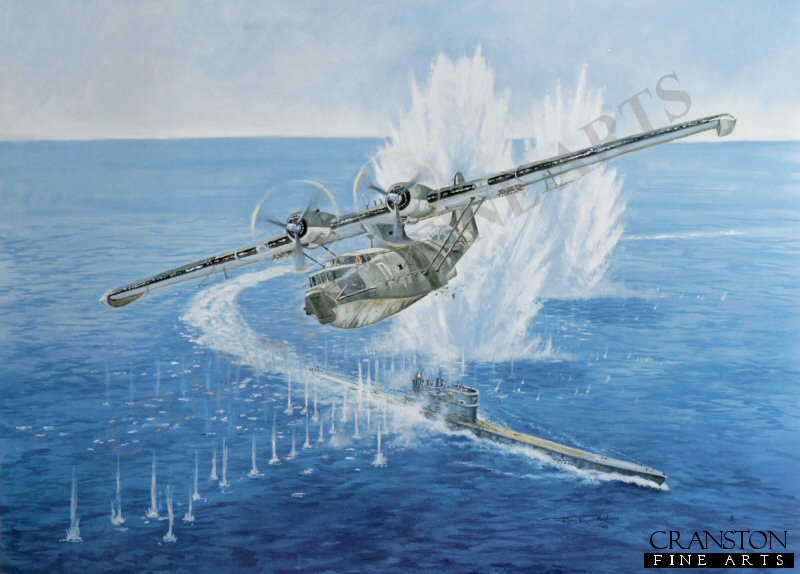
Catalina Attack by John Wynne Hopkins. D for Donald of 270 squadron, Royal Air Force, out of Freetown, West Africa operating in the Atlantic Ocean. It was during routine operation search that D for Donald surprised U515 on the surface and immediately attacked the submarine. U515 in putting up stiff resistance blew a large hole in the hull of D for Donald and the magazine of the starboard side 0.5 twin Browning was hit and the subsequent shrapnel wounded both blister gunners. U515 escaped but was sunk by an American naval hunter group a year later. D for Donald limped back to base and managed to make the beach before it would sink completely. |
A New Shape in the Sky by Ivan Berryman. The Junkers Ju.287 V1 bomber prototype was a typical example of Germany's research into advanced aerodynamics at the end of World War II. Featuring forward swept wings and four Jumo 004B-1 Orkan axial-flow turbojets, this extraordinary aircraft made several successful flights before the project was curtailed by the war's end. RS+RA is shown on a test flight, carrying a cine camera in front of the fin to record airflow by means of wool tufts glued to the wings and fuselage sides. The characteristics of forward swept wings are only now being re-evaluated, 70 years after Junkers' first tentative steps into the unknown. |
The Blond Knight by Robert Taylor. It is a record likely to stand for all time, Erich Hartmann's tally of 352 victories is more than any other pilot in history. Posted to JG52 over Russia in August 1942 his new Kommodore, Dieter Hrabak, placed the novice pilot under the guidance of Paule Rossman, one of the unit's most experienced and respected Aces. However, during his very first combat Hartmann became so disorientated that he got lost in cloud and ran out of fuel. His undoubted skill as a pilot enabled him to survive the inevitable crash-landing, but a few days later and just minutes after scoring his first ever victory, he was shot down - again crash-landing. This time he only just escaped from his burning aircraft before it exploded. Any other new pilot might have succumbed but Hartmann was made of sterner stuff and , with Rossman's help and guidance, it was not long before everyone in JG52 realised that he possessed exceptional skill. By the summer of 1943 the Blond Knight and his colleagues were flying up to six missions a day and having now perfected his technique, it was unusual for him to finish a day without a victory. Never claiming to be an expert marksman, his approach, which took nerves of steel and great flying skills, was to get as close to his enemy as possible before opening fire at the last minute. Often flying head on, the risks of collision and damage were great - of the sixteen times Hartmann was brought down, eight were as a result of flying into the debris of his victim! Hartmann's 352 victories were achieved with JG52 - all except one. It happened during a brief two week spell at the beginning of February 1945 when the top Ace was placed in temporary command of I./JG53. His new unit were based in Hungary where German Army Group South was in bitter retreat and the fighting was as tough and relentless as ever. The Blond Knightportrays Erich Hartmann climbing out of his Bf109 G-6 at Weszperem's snow-covered airfield after returning from another arduous mission leading Stab I./JG53 with whom, on 4th February he downed a Yak-9. It was his 337th victory. |
Sink the Bismarck by Stan Stokes. Commissioned on August 24, 1940, the German battleship Bismarck was the epitome of naval power. The great ship was 823 feet in length, had a beam of 118 feet, and a displacement of 50,000 tons. After nine months of sea trials the Bismarck embarked on its first mission accompanied by the cruiser Prinz Eugen on May 19, 1941. The Bismarcks mission was to destroy and disrupt convoys carrying war relief supplies to Britain from North America. On May 20th the Bismarck was spotted and reported to British intelligence as it passed through the narrow straits between Denmark and Sweden. The British presumed correctly that the Bismarck was headed for the North Atlantic, but by which route? Dividing its naval forces in an attempt to intercept the mighty German battleship, four ships were sent to patrol the Denmark strait, including the newly commissioned battleship Prince of Wales, and the H.M.S. Hood, a heavily armed battle cruiser, pride of the British fleet. On may 23rd the Bismarck was spotted by the H.M.S. Norfolk and the H.M.S. Suffolk. The Bismarck opened fire on the Norfolk, which was out gunned by the German ship, but fortunately was able to elude the Bismarck because of heavy fog and mist. With its position identified British Naval authorities ordered several other ships to the area including the H.M.S. Ark Royal, one of two aircraft carriers dispatched. On May 24th the Bismarck was engaged again. The H.M.S. Hood took a direct hit and exploded with the loss of all but three of its large crew. The Bismarck took two hits from the Prince of Wales during this battle, one of which had the effect of reducing the huge ships effective fuel capacity, and hence range. Later that evening a torpedo plane attack was launched at the German battleship, which sustained one hit with little damage. On May 25th the Bismarck separated from the Prinz Eugen, and set a course for the French coast in hopes of making repairs. On May 26th the Bismarck was located again by a British reconnaissance aircraft. In an attempt to prevent the ship from reaching the safety of Luftwaffe air cover, a second torpedo plane attack was launched from the Ark Royal. Utilizing Fairy Swordfish bi-plane torpedo bombers, two hits were achieved. The first was amidships and caused virtually no damage. The second hit was astern, and resulted in the jamming of the Bismarcks rudder. Unable to maneuver, the great German battleship had little choice that to continue steaming for the French coast. Four more British warships lay in its path including the H.M.S. Rodney, the H.M.S. King George V, the H.M.S. Dorsetshire, and the H.M.S. Norfolk. On the morning of May 27th an enormous sea battle took place, with the unmaneuverable Bismarck taking more than 1,000 direct hits. After losing its fire control system, the Bismarck became a defenseless target. At approximately 10:00 AM Bismarcks Captain gave the orders to scuttle the enormous ship, and about 40 minutes later the great vessel slipped quietly beneath the surface of the Atlantic. |
The Eagles Divide by Robert Taylor. P-51 Mustangs of the 357th Fighter Group clash with Me109s in close combat as they struggle for air superiority over the heart of Germany, during the desperate days of 1945. It had begun - the end game was inexorably in play. The final defeat of Germany and the end of Nazi tyranny was almost within sight but in the skies over Germany the defiant remnants of the Luftwaffe fought on with savage determination. Ever since the long-range American P-51 escort fighters had first appeared, the skies over the Reich had witnessed grim encounters with the Mustangs taking on the Luftwaffe as they tried to stop the heavy bombers of the USAAF reaching their targets. By early 1945 it was a losing battle, but still the Luftwaffe fought on and, in the resulting maelstrom of combat, the Mustang pilots still had their work cut out against these battle hardened, expert pilots. Robert Taylor's superb drawing dramatically reconstructs one such clash in early 1945 as P-51 Mustangs of the 357th Fighter Group have spotted a group of Bf109s heading their way. Without hesitation they dive head-on in an attempt to break-up the enemy formation and for the pilots on both sides the explosive encounter of close combat is suddenly upon them. Limited edition prints of this classic Robert Taylor Master Drawing have been signed over the last few years by some of the most respected USAAF P-51 and distinguished Luftwaffe pilots who duelled in those merciless skies over Europe. Since signing the prints some of these legendary names have very sadly passed away, making it one of the most collectible editions of recent years. |
Alpine Thunder by Nicolas Trudgian. By late April 1945 most of the Third Reich had been cut to shreds by the advancing Allied forces and those units remaining intact were regrouping in southern Germany and Austria. With American advance units nearing the outskirts of Munich, on 28th April Adolf Galland took the decision to evacuate his precious jets to Salzburg, deep in the mountains. Bad weather prevented their departure until the following morning and they only just managed to escape under the noses of the encircling Americans. Galland had hoped to battle on with JV44 but the unsuitable mountain airfields prevented the famous fighter wing from doing much to delay the inevitable. So the beautiful Alpine meadows became the final resting place for what was potentially the most formidable fighter unit of the war. In just a few days the jets were left abandoned. Their short, exhilarating war, consigned to history. |
African Expedition by David Pentland. Tunisia, North Africa, 4th January 1943. At 1600 hours, eight Fw190s from JG2 were scrambled from Kairouan airfield to intercept enemy aircraft flying recon over the Sbeitla and Fondouk areas. The Allied formation came from Thelepte airfield and consisted of 6 Spitfires from the US 4th Fighter Squadron, 52 Fighter Group, and 6 Spitfires from the US 5th Fighter Squadron, 52nd Fighter Group, escorting 5 P-39s. The Fw190s were south of Ousseltia when air combat with the escorting Spitfires began. It was during this engagement that Staffelkapitan Oberleutnant Rudorffer Yellow 1 of 6/JG2 claimed 2 of the American Spitfires. |
Messerschmitt versus Messerschmitt by David Pentland. Belgrade, Yugoslavia, 6th April 1941. While escorting Stukas at the start of the German Balkan campaign, the Me109Es of JG54 were engaged by Me109Es of the Yugoslav air force. During the ensuing melee, ObLt. Hans-Ekkehard Bob claimed his 20th victory. |
Gauntlet by Anthony Saunders. Portsmouth August 26th 1940, the lone spitfire of Squadron Leader Sandy Johnstone breaks the ranks and picks off one of the menacing Heinkels only to encounter an equally determined attack from a BF109. We were brought to readiness in the middle of lunch and scrambled to intercept mixed bag of 100+ Heinkel IIIs and DO 17s approaching Portsmouth from the South. The controller did a first class job and positioned us one thousand feet above the target. with the sun behind us, allowing us to spot the raiders from a long way off. No escorting Messchersmitts were in sight at the time, although a sizable force was to turn up soon after. then something strange happened. I was about to give a ticking off to our chaps for misusing the R/T when I realised I was listening to German voices. It appeared we were both using the same frequency and, although having no knowledge of the language it sounded from the monotonous flow of the conversation that they were unaware of our presence. as soon as we dived towards the leading formation, however we were assailed immediately to loud shouts of Achtung Spitfuern Spitfuern! as our bullets began to take their toll. In spite of having taken jerry by surprise our bag was only six, with others claimed as damaged, before the remainder dived for cloud cover and turned for home. In the meantime the escorting fighters were amongst us when two of our fellows were badly shot up. Hector Maclean stopped a cannon shell on his cockpit, blowing his foot off above the ankle although, in spite of his grave injuries, he managed to fly his spitfire back to Tangmere to land with wheels retracted. Cyril Babbages aircraft was also badly damaged in the action. forcing him to abandon it and take to his parachute. He was ultimately picked up by a rescue launch and put ashore at Bognor, having suffered only minor injuries. I personally accounted for one Heinkel III in the action (Sandy Johnson) . No. 602 City of Glasgow auxiliary squadron was a household name long before WWII began. It had been the first auxiliary squadron to get into the air in 1925, two of its members, Lord Clydeside and David McIntyre were the first to fly over Mount Everest in 1933: the squadron sweeped the board in gunnery and bombing in 1935, beating the regular squadrons at their own game. It was the first auxiliary Squadron to be equipped with Spitfire Fighters as far back as March 1939 and it was the first squadron to shoot down the first enemy aircraft on British soil. The squadron moved south from Drem airfield in East Lothian on August 14th 1940 to relieve the already battered no. 145 squadron at Westhampnett, Tangmeres satelitte station in Sussex. The squadron suffered 5 casualties during the battle. The squadron remained at Westhampnett until December 1940 to be replaced by no. 610 auxiliary airforce squadron. No 602 squadron itself remained active up until 1957 when it was put into mothballs. |
First Flap of the Day by Nicolas Trudgian. HM Stephen - one of the Battle of Britains top scoring fighter pilots, brings down two Me109s in quick succession over the White Cliffs of Dover, early on August 11, 1940. Flying a Spitfire with 74 Squadron, HM shot down five German aircraft on this day, and damaged a further three. The note in his log book starts First flap of the day at 0600 hrs ... Published 2000. Sadly, all of the pilots who signed this edition have since passed away. |
Victory Above Dover by Ivan Berryman. Adolf Galland claimed his 16th victory on the afternoon of 25th July 1940 when Spitfires of 54 Sqn were bounced by Messerschmitt Bf.109s of Gallands III/JG26. A fierce battle ensued off Dover during which F/Lt Basil Wonky Way, flying R6707, found himself the subject of the great German aces attention, his stricken aircraft being observed to plunge into the sea after receiving numerous hits from the Bf.109s guns. F/Lt Way lost his life in the crash, presumed drowned. |
Tribute to Erich Hartmann by Graeme Lothian. No text for this item |
High Summer by Anthony Saunders. On the 9th September 1940, No.92 Squadron was thrown into the Battle of Britain. They had fought bravely during the evacuation of Dunkirk, and after a spell on convoy patrol, they were thrust into the desperate climax of the greatest air battle in history. Flying Spitfires from Biggin Hill, they immediately went into action attacking massive Luftwaffe bomber formations and their escorting Me109s. Southern England was under severe threat, but the impact of 92 Squadron was immediate. During the next four months, its young pilots brought down no fewer than 127 enemy aircraft. This painting by Anthony Saunders portrays Spitfires from No.92 Sqn as they successfully engage an Me109 over the harvested fields of southern England, in August 1940. The desperate action of aerial combat is beautifully captured in this compelling and accurate reconstruction of a famous fighter squadron at war. |
Bf109 K-4 by Randall Wilson. (GL) Messerschmitts from Stabb 111/JG53 patrolling over Germany in the last days of WW2, piloted by Lt. Bernard Ernst Dieter April 1945. |
Atlantic Rendezvous by Robert Barbour. A U-boat wallows on the surface in typical Atlantic winter weather in February, 1944. approaching at low level is a Luftwaffe FW 200 C-8 Condor of 111KG 40 from the base at Bordeaux-Marignac in S.W. France. |
Total Commitment by Ivan Berryman. On the afternoon of 5th September 1940, Spitfires of 41 Sqn intercepted a large formation of Heinkel 111 bombers and their escorts over the Thames estuary, en route for London. Flying N3162 as Red 2, Flight Lieutenant Eric Lock attacked the bombers head on as they began to turn north. In a fraught combat, Lock was to destroy two He.111s and a Bf.109 on that single mission, setting him on course to become the highest scoring ace in the RAF during the Battle of Britain with sixteen confirmed victories and one shared. His final total at the end of the war was twenty six kills confirmed and eight probables. |
Erich Hartmann - The Ace of Aces by Ivan Berryman. The highest scoring fighter pilot of all time with a confirmed tally of 352 victories, Erich Hartmann is depicted getting airborne from a snowy airstrip in Czechoslovakia, late in 1944 in a Bf109G-6 of 6./JG 52. |
Ready for Combat by Ivan Berryman. Erich Rudorffer commanding I./JG7 flying the Me262. Erich Rudorffer was the master of multiple scoring - achieving more multiple victories than any other pilot. |
Eagle in the Snow, Petsamo, Finland, January 1943 by David Pentland. Walter Schuck of JG5 Eismeer prepares to take off on patrol in his Me109F. Schuck served with this unit from December 1942 to April 1945, and in that time claimed 198 victories. |
Night Hunters of the Reich by Nicolas Trudgian. The German High Command entered World War II with the notion that the war would be quickly won, and certainly without the need to fight at night. The RAF changed all that when Bomber Command, having suffered appalling losses in daylight, turned to attacking under the cloak of darkness. By mid-1940 the Luftwaffe was forced to hurriedly form its first night fighter wing utilising the Messerschmitt Bf110. Without specialised equipment, initially Luftwaffe pilots relied on visual acquisition, detecting enemy aircraft with the aid of searchlights. To combat intensifying RAF night attacks, new electronic methods of navigation and detection were developed, and by the end on 1942 the German night fighter force had almost 400 aircraft contesting the night skies. Almost 1300 British aircraft were destroyed in that year alone.The Bf110G-4 of 47-night victory pilot Oberleutnant Martin Drewes at dusk in March 1944, heading out to intercept in-bound British four-engined bombers over north west Germany. Equipped with the latest FuG220 and 218 radars, the experienced crew will lie in wait, carefully choose their prey, stalk and close for the kill. The deadly game of hide and seek is about to begin. |
|
Contact Details |
Sign Up To Our Newsletter!
This website is owned by Cranston Fine Arts. Torwood House, Torwoodhill Road, Rhu, Helensburgh, Scotland, G848LE Contact: Tel: (+44) (0) 1436 820269. Email: cranstonorders -at- outlook.com
|