|
|
|
|
|
|
|
|
|
Cranston Fine Arts  Aviation Art and Artists World War Two Countries Aviation Art and Artists World War Two Countries  US US |
[UP] - UK - US - Germany - Italy - Russia - Japan - France - Czechoslovakia - Poland - Netherlands - Romania - Finland - Australia - Canada - New Zealand - Norway - Malta |
| Navigation | |
| Page 4 of 18 | Previous .. Page 4 .. Next |
|
|
|
|
|
|
|
|
|
|
|
|
|
|
|
|
|
|
|
|
|
| Navigation | |
| Page 4 of 18 | Previous .. Page 4 .. Next |
| Text for the above items : |
Mustangs Over the Mediterranean by Nicolas Trudgian. Mustangs of the 31st Fighter Group pass low over an Italian fishing village, heading out on another combat patrol. |
Day Drop - Stick 21 by Robert Taylor. At 23.45 on the night of 5 June 1944, the 101st Airborne's most legendary unit of combat paratroopers - the notorious 'Filthy Thirteen' - jumped into France near the village of Sainte Mere Eglise, in the final hours before the D-Day landings. They were the Screaming Eagles' most notorious unit, a small bunch of raw, tough, ruthless young men. Hard drinking and savage fighting - and that was only in training - with scant regard for authority. And if the reputation of this unique bunch of renegades within the ranks of the 101st was formidable, for the Germans it became one of sheer terror. Officially they were the First Demolition Squadron, HQ Company, 506th PIR, 101st Airborne. Unofficially they were the 'Filthy Thirteen'. Superbly crafted in his unique blend of pencil and paint on tinted paper, Robert Taylor's classic new Master Drawing captures the moment on the night of 5 June 1944 when the 101st Airborne's legendary squad of elite paratroopers jump into battle in the vital hours before the D-Day landings commence. The pilots of the 440th Troop Carrier Group struggle to keep their Dakotas level as deadly flak pummels the formation. |
B-17 Memphis Belle by Keith Woodcock. The Memphis Belle, a Boeing-built B-17F-10-BO, manufacturer's serial number 3470, USAAC Serial No.41-24485, was added to the USAAF inventory on 15th July 1942 and delivered in September 1942 to the 91st Bombardment Group at Dow Field, Bangor, Maine. She deployed to Prestwick, Scotland, on 30th September 1942, moving to a temporary base at RAF Kimbolton on 1st October, and then finally to her permanent base at Bassingbourn, England, on 14th October. Each side of the fuselage bore the unit and aircraft identification markings of a B-17 of the 324th Bomb Squadron (Heavy); the squadron code 'DF' and individual aircraft letter 'A'. Captain Robert K. Morgan's crew flew 29 combat missions with the 324th Bomb Squadron, all but four in the Memphis Belle. The aircraft's 25 missions were: 7 November 1942 - Brest, France 9 November 1942 - St. Nazaire, France 17 November 1942 - St. Nazaire, France 6 December 1942 - Lille, France 20 December 1942 - Romilly-sur-Seine, France 30 December 1942 - Lorient, France (flown by Lt. James A. Verinis) 3 January 1943 - St. Nazaire, France 13 January 1943 - Lille, France 23 January 1943 - Lorient, France[ 14 February 1943 - Hamm, Germany 16 February 1943 - St. Nazaire, France 27 February 1943 - Brest, France 6 March 1943 = Lorient France 12 March 1943 - Rouen, France 13 March 1943 - Abbeville, France 22 March 1943 - Wilhelmshaven, Germany 28 March 1943 - Rouen, France] 31 March 1943 - Rotterdam, Netherlands 16 April 1943 - Lorient, France 17 April 1943 - Bremen, Germany] 1 May 1943 - St. Nazaire, France 13 May 1943 - Meaulte, France (flown by Lt. C.L. Anderson) 14 May 1943 - Kiel, Germany (flown by Lt. John H. Miller) 15 May 1943 - Wilhelmshaven, Germany 17 May 1943 - Lorient, France 19 May 1943 - Kiel, Germany (flown by Lt. Anderson) |
Doolittle Raider, Tokyo, April 18th 1942 by David Pentland. Aircraft number 2247, flown by Lt McElroy, attacks the Yokosuka Yard near Tokyo. He was one of the 18 B25 Mitchell bombers which took part in the famous retaliatory raid on Japan. |
Cat Among the Pigeons (FW190) by Ivan Berryman. It was in 1941 that the remarkable Focke-Wulfe FW190 first appeared in the skies of Europe, quickly establishing itself as a most formidable adversary. It proved to be the supreme weapon against all allied bomber forces. Here FW190A-8 of 1 Gruppe, Jagdgeschwader 1 is shown attacking a B17G of 381st Bomb Group during a critical defence of the Reich in 1944. |
Bite of the Black Widow by Stan Stokes. The Northrop P-61 Black Widow was the USAAFs first modern fighter aircraft which was specifically designed from the start to serve in the night fighter capacity. Designed by Jack Knudson Northrop, this aircraft was quite innovative. The Armys initial requirements for this night interceptor made no mention of radar, but stated that the aircraft would carry a device which would locate enemy aircraft in the dark. The P-61 indeed utilized radar, and about seven hundred of these large twin-engine aircraft were built. The recommendation to pursue development of an aircraft of this type came about from the recommendations of a special commission which visited Great Britain during the Battle of Britain. The commission identified the need for an effective night fighter capability to deter enemy night bombing raids. Although the first prototype flew in May of 1942, the Black Widow did not enter front-line service until 1944. The P-61 was the largest and most powerful fighter aircraft of WW II. The Black Widows bite was mean because of its four cannons and four machine guns. With a wingspan of sixty-six feet and a length of nearly fifty feet, this large aircraft was powered by twin 18-cylinder Double Wasp radial engines, capable of 2,000-HP each. The B model of the P-61 was capable of speeds in the 365-MPH range, and had an incredible range of 3,000 miles. This great range gave the P-61 added benefits in the Pacific theater of operations. The P-61 utilized 4-bladed, variable pitch props, and incorporated a tricycle landing gear configuration. With its distinctive double tail configuration, the Black Widow had a roughly similar appearance to the P-38 Lightning, which was sometimes utilized in the night fighter role prior to the P-61 becoming available. The XP-61 prototype took to the air in May of 1942, and the aircraft exhibited a maximum speed of 380 MPH. Despite good results from the initial flights, the P-61 took a long time to enter production. In July of 1943 the Army organized the 481st Night Fighter Operational Training Group at Orlando Field in Florida. This unit completed service tests on pre-production Black Widows, and was responsible for training flight crews. In his spectacular moon-lit painting entitled Bite of the Black Widow, aviation artist Stan Stokes depicts the P-61 flown by Major Carroll C. Smith of the 418th Squadron of the Fifth Air Force. Smith was one of two pilots in WW II to attain ace status in the Black Widow. Smith obtained a total of seven night victories. His first two were obtained while flying a night-fighter version of the P-38. Four of Smiths victories in the P-61 came on two missions during one evening in December 1944. |
Rocket Attack by Nicolas Trudgian. It required more than a little nerve to fly a fighter into the barrage of fire sprayed out by the gunners of a box of B17 bombers; it took even greater courage to do so in the rocket propelled Me163 Komet. With rocket science still in its infancy, these small aircraft were still in the experimental stage, and piloting what amounted to a flying bomb was in itself a perilous business, let alone flying them into combat. But these were desperate times. The day and night bombing assault on Germany was bringing the mighty war machine to its knees, and aything that might help stem the tide was thrown into battle. Powered by a mixture of two highly volatile chemicals, the slightest leak, or heavy landing could cause a huge explosion, and the mix was so corrosive that in the event of even a minor accident, the pilot could literally be dissolved. Sitting in a cramped cockpit, surrounded by dangerous chemicals and ammunition, the intrepid aviator would be launched into the sky on what was, at best, a four minute mission. After, hopefully, engaing the enemy, he would glide powerlessly back to the nearest airfield to be refuelled so as to attempt the hazardous operation all over again. Though limited to a handful of victories, the Komet did make the Allied crews wonder what else the Luftwaffe had hidden up its sleeve, and had the distinction of being the forerunner of aircraft technology that eventually took aircraft into space. Capable of nearly 600mph and climbing to 30,000ft in less than two minutes, this tiny rocket propelled Me163 Komet was typical of Germanys ingenuity in its desperate attempts to stem the havoc being wreaked by the USAAFs daylight bombers. |
Arnhem by Simon Smith Douglas C47 Dakotas fly into the landing and drop zone at Renkum Heath, September 17th 1944. |
Savage Skies by Robert Taylor. The weather on the morning of 31 December, 1944 was already unpleasant. In the Ardennes, hard-pressed German troops were battling Allied ground forces advancing through several inches of snow. Above, darkening skies heralded the arrival of more snow. At 10.45am, in deteriorating weather, a battle formation of 30 Fw190D fighters climbed out of Varrelbusch and headed south over the snowcovered landscape. Under the command of 12./JG54 Staffelkapitan, Oblt. Hans Dortenmann, and initially tasked to provide air cover to their beleaguered comrades below, the group was re-assigned to intercept enemy aircraft in the region of Limburg almost immediately the pilots were airborne. Flying south they ran directly into the oncoming weather, and with visibility dangerously reduced, Dortenmann elected to climb through the solid cloud into clear air. As the Fw190s broke cloud above the area of Koblenz they sighted a formation of nine 2nd Air Division B-24 Liberators and formed up for an attack. Some 6000 feet above, top-cover P-51 Mustangs had watched the Fw190s climbing through the banks of clouds, and turned 180 degrees to position behind the Luftwaffe fighters. Diving in from their height advantage, the Mustang pilots entered the fray and within seconds the sky was filled with swirling dogfights. |
Mustangs on the Prowl by Robert Taylor. Between 3 and 13 September 1944, the 55th Fighter Group flew eight arduous, highly successful, bomber escort missions to Germany for which the group received a Distinguished Unit Citation. Like those the group had flown before, and would fly again and again until the end of hostilities, each mission took them deep into enemy airspace, involved desperate combat with Luftwaffe fighters, and culminated in rapid descent to low level to strafe enemy airfields on the way home. In that ten day period of intense fighting the 55th covered themselves in glory, destroying large numbers of enemy fighters in the air and on the ground, one of their pilots becoming the top-scoring ground attack pilot of the campaign. Long-range combat missions were typical of the assignments flown by the fighters of the 8th Air Force during that period of the air war. Not content with dog-fighting at altitude, when escort duty was complete, the Eighths aggressive fighter pilots relished the opportunity to hurtle down to tree-top height and, ignoring the inevitable barrage of anti-aircraft fire, shoot up any target of opportunity upon which they could bring their guns to bear. Robert Taylors spectacular new limited edition print, the third in his acclaimed Collector Portfolio commemorating the great Air Commands of World War II, depicts the king of the Eighths ground attack Aces, Colonel Elwyn Righetti. Flying his P-51D Mustang, the 55ths CO of 338 Squadron, already with 20 plus victories to his credit, leads his pilots through the Rhine Gorge, skimming the ancient Castle of Stahleck standing above Bacharach, as they seek out enemy targets on their way back to base at Wormingford, England, in the spring of 1945. A classic Robert Taylor edition endorsed with the signatures of Aces who flew and fought the legendary P-51 Mustang in the greatest air war in history. |
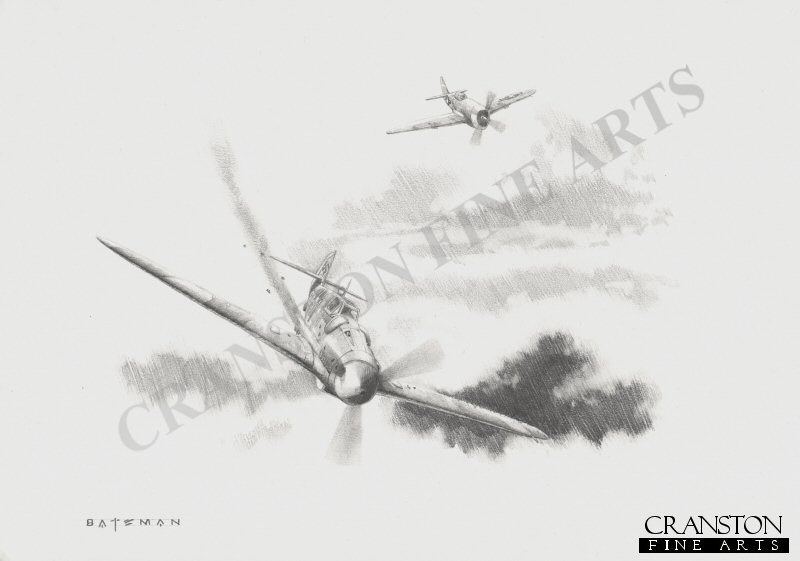
Victory for Red Section by Brian Bateman. Steve Pisanos, flying P-47 QP-D in Red Section, shoots down a German Me-109 near Sittard, Gemany. Here we see the 109 trailing smoke and banking down as Steve has hits near the engine and cockpit of the enemy combatant. Claim one Me-109. |
Final Roster by Anthony Saunders. On the evening of 5th June 1944, at a dozen airfields across southern England, more than 13,000 American paratroopers prepared themselves for a mission that would change the course of history. The next morning these brave young men found themselves at the forefront of the bitter fighting to secure the right flank of the Normandy beach-head. The odds against them were huge and, if they failed, the American amphibious landings on Utah and Omaha beaches would face disaster - the destiny of the US First Army rested squarely on the shoulders of the 82nd and 101st Airborne Divisions. |
Towards the Home Fires by Robert Taylor. As the New Year of 1945 dawned, the snow had already spread to blanket the southern half of England. The festivities of Christmas had passed and the relentless pounding of German cities and industrial targets continued unabated. On every front Hitler's once-fabled armies were in full retreat. The endgame was now in play. With dusk approaching, Robin Olds, flying his P-51K Scat VI, leads a flight of Mustangs of the 434th Fighter Squadron, 479th Fighter Group low over the historic estuary town of Maldon in Essex as they head home to their base at Wattisham, 14 February 1945. The mission saw Olds add three more German fighters to his tally south of Berlin, making him one of the foremost Aces of the unit. |
Greek Victory by Brian Bateman. Steve Pisanos, flying P-47 QP-D, is depicted pulling away swiftly after a victory over an FW-190 in late December 1944 over northern Germany. This was Steve's fourth victory, one victory short on an ace, which would come later in the P-51. |
Jet Hunters by Robert Taylor. On 10th April 1945, thirteen hundred bombers of the Mighty Eighth set out to destroy the last of the Luftwaffe's jet force. But, unknown to the bomber crews and their fighter escort, the enemy jets were already airborne and waiting to spring their deadly trap. As the war in mainland Europe entered its final, bloody phase, the German Armies defending Berlin fought on with a savage determination, slowly disintegrating before the mighty weapon of war unleashed against them. What remained of the Luftwaffe was mercilessly pounded from the air, their airfields hammered relentlessly. Aircraft, fuel, spare parts, ammunition and pilots all in short supply but still they fought on, with deadly effect. At the forefront of the German offensive and pivotal during the defence of the Reich, were the highly advanced jet fighters of the Luftwaffe, and in particular the legendary Me262. B17s of the First Air Division with streaming contrails in the cold clear air as they turn for home. Several Me262s have already torn through the massed formation, but a P-51 from the escorting 356th Fighter Group has quickly spotted his target and presses home his attack. The hunter becomes the hunted as the Mustang pilot, Wayne Gatlin, skillfully positions himself behind the Me262 ready for the kill. Throughout the final stages of the war there were many examples of the determination and skill of Allied pilots flying slower piston-engined fighters triumphing over the cream of the Luftwaffe in their highly advanced but often temperamental jet fighters. |
Wide Horizons by Robert Taylor. A superb study of the legendary P-38 Lightning, this print commemorates the American Air Forces that operated in the European Theater. |
American Patrol by Michael Turner. USAAF P-51s from 357th Fighter Group, led by Capt. Bud Anderson in Old Crow, over the D-Day beaches in the early morning of June 6th 1944. |
The Hunt for U-Boat 134 by David Pentland. Lockheed Vega PV-1 VB32 Squadron in the Santaren Channel. From this point on the U-boat was hunted and harassed only to be sunk in the Bay of Biscay. |
Duck Soup by Stan Stokes. The Grumman J2F Duck evolved from the early 1920s design of the Loening COA-1 amphibian. The Duck was one of many very successful aircraft designed by Leroy Grummans aircraft company based on Long Island, New York. Grumman, who was born in 1885 and was 18-years old at the time of the Wright Brothers first flight, had worked for the Loening Aircraft Engineering Company in New York. Loening was eventually acquired by Curtiss-Wright, but Grumman decided to leave the company in 1929 and form his own company. Initially, the new company focused on repair and subcontract work, including the development of a vastly improved retractable landing gear for Navy floatplanes. The first Grumman Duck was test flown by Paul Hovgard in 1933 utilizing a 700-HP radial. The Navy was impressed with Grummans design, and placed an initial order for 27 JF-1 aircraft. This aircraft evolved into the JF-2 and JF-3 variants, but by 1936 Grumman had improved the aircraft (now designated J2F) by extending the length of the float and shortening the engine cowling. The final variant of the Grumman-built Ducks was the J2F-5 which utilized a 950-HP Cyclone engine, and incoporated stronger bomb racks capable of supporting 325-pound bombs. A substantial number of Ducks (including the J2F-6) were also built by the Columbia Aircraft Corp. under license from Grumman. The aircraft had a 39-foot wingspan and was 34-feet in length. With the 1050-HP Wright R-1820-54 radial engine, the J2F-6 Duck would top out at a maximum speed just north of 180-MPH. It had an effective range of 850 miles, and with its slow cruising speeds could remain airborne for several hours longer than most fighter aircraft.While the Navy thought the Duck might be a useful torpedo plane or fighter, the slow speed of the aircraft in relation to more modern monoplane fighters resulted in the Duck serving primarily as a utility, reconnaisance, and rescue aircraft. The Ducks cockpit could accommodate two pilots, and there was sufficient room in the hull to carry 3-4 additional persons. In Stans painting, entitled Duck Soup, a USN J2F risks a landing in bad weather and rough seas to rescue a downed Navy fighter pilot. Serving with the Navy until the early 1950s, the Grumman Duck was the last biplane aircraft to be utilized in the Navys inventory. It was the beginning of a long legacy of Grumman-built aircraft utilized by the US Navy, including the family of Cat fighters which commenced with the F4F Wildcat and lives on today with the F-14 Tomcat. While arguably quite ungainly in appearance, the Grumman Duck had a starring role in the movie Murphys War. Only a few of these aircraft remain in flyable condition today. |
Valiant Vindicators by Stan Stokes. The Vought SB2U Vindicator represents one of those many 1930s era aircraft designs, that despite incorporating advanced aerodynamic design features when compared to earlier models, was technically obsolete at the start of WW II, and hence gets few favorable comments from a historical aviation combat perspective. The first production deliveries of the SB2U-1 dive-bomber took place in 1937. Powered by an 825-HP Pratt and Whitney radial, this aircraft carried a crew of two, and was capable of a maximum speed of 249-MPH and a maximum range of 1,300 miles. The Vindicators service ceiling was 27,500 feet. In early 1938 the Navy ordered 58 more Vindicators, designating this variant the SB2U-2. In 1939 Vought received a contract to supply the USMC with 57 additional Vindicators. These variants, designated the SB2U-3 would have greater fuel capacity and longer range. The 3s also were fitted with 4 forward firing machine guns instead of only one. Having advance knowledge of the Japanese plans to attack and occupy Americas Midway Islands base, the US Navy spent much of the month of May 1942 building-up the defenses on these tiny, but strategic islands. A mixed bag of USAAF, USN, and USMC aircraft had found their way to Midway in hopes of mounting an effective defense and possibly an offensive operational capability against the coming Japanese attack. The aircraft sent included many obsolescent types, but this was all that Admiral Nimitz had at his disposal. The Marine Corps Air Arm was used to getting USN pass alongs of used and worn aircraft as carrier-based units received more modern aircraft. At Midway, the Marines were no exception to this rule, and they found themselves in possession of F2A Buffalo and F4F Wildcat fighters assigned to VMF-221, and SB2U-3 Vindicators and SBD Dauntless dive bombers assigned to VMSB-241. The Vought Vindicators, nicknamed vibrators by their pilots, were technically obsolete USN hand me downs. The SB2Us were partially fabric covered, and in a power dive the wings had a nasty habit of shedding fabric, and hence lift. As a result these aircraft were patched up with a lot of tape, and the recent over painting of the rudder stripes and previous squadron markings gave them a rather ratty appearance. Warned by PBY patrol aircraft of the incoming Japanese air attack, MAG-22 scrambled all available aircraft just before 6:00AM on June 4, 1942. The 12 Vindicators available took off armed with 500-pound bombs mounted on their centerline bomb racks. In Stan Stokes painting a heavily laden Vindicator struggles for altitude in the first phase of the Battle of Midway. |
Final Assault by Stan Stokes. The largest and most powerful bomber of WW II, the Boeing B-29 Super Fortress, played a major role in bringing about the defeat of Japan. In addition to accelerating Japans surrender following the bombing of Hiroshima and Nagasaki with atomic bombs, thousands of B-29 crews flew tens of thousands of bombing missions against Japan from bases in China, India, and later in the War from recaptured islands in the Pacific. B-29s entered service in 1943 following a lengthy, problem-filled, development process of three years in response to the governments request for a long range strategic bomber. Only Boeing and Douglas (the B-32 Dominator) responded to the governments requests, and the B-32 had even greater development problems than the B-29. Powered by four giant Wright R-3350-23 radial engines generating a total horsepower of 8,924, the Super Fortresses typically carried crews of ten. They were capable of a top speed of 357-MPH, and at slower cruising speeds had a range of more than 3,200 miles. The B-29 was a large aircraft for its time with a wingspan in excess of 140 feet and a length of just under 100 feet. The Super Forts also had pressurized forward and aft hulls, which made the long distance missions a bit more comfortable for the flight crews. B-29s typically carried defensive armament which included ten machine guns and a single tail-mounted canon. Because of the pressurized hull, the guns were operated by remote control. The first operational B-29 wing was the 58th which flew out of the China-Burma-India theater. On March 9, 1945 General Curtis LeMay ordered an unusual low altitude attack on Tokyo by hundreds of B-29s carrying incendiary bombs. Five such low level missions were scheduled over a ten-day period, and the combined destruction of these missions exceeded that of either of the atomic bomb missions. B-29s were also effectively used to mine Japanese ports and shipping lanes. The Kawasaki Ki-45 Toryu heavy fighter, which is depicted attacking the B-29 in Stan Stokes painting, entered production in 1941 following a lengthy four year development. About 1,700 of these aircraft, code named Nick by the allies, were produced. The Ki-45 never proved effective as a long range daylight interceptor. It was, however, used effectively in ground attack and night fighter roles. It was one of only a few Japanese aircraft that had some success against the onslaught of B-29s because it was able to attain the high altitudes necessary to intercept the high-flying Super Fortresses. This print is dedicated to the thousands of B-29 officers and crewmen who hastened the end of the Pacific War. |
|
Contact Details |
Sign Up To Our Newsletter!
This website is owned by Cranston Fine Arts. Torwood House, Torwoodhill Road, Rhu, Helensburgh, Scotland, G848LE Contact: Tel: (+44) (0) 1436 820269. Email: cranstonorders -at- outlook.com
|