|
|
|
|
|
|
|
|
|
Cranston Fine Arts  Original Artwork Original Artwork |
| More Pages : Original Pencil Drawings |
| Navigation | |
| Page 7 of 55 | Previous .. Page 7 .. Next |
|
|
|
|
|
|
|
|
|
|
|
|
|
|
|
|
|
|
|
|
|
| Navigation | |
| Page 7 of 55 | Previous .. Page 7 .. Next |
| Text for the above items : |
Tribute to Clarence 'Bud' Anderson by Ivan Berryman. (P) Painted with the black and white markings of the D-Day invasion, P-51 Mustang 43-24823 B6-S 'Old Crow' is the personal aircraft of 'Bud' Anderson. He flew two tours with the 363rd Fighter Squadron and is credited with 16.25 victories in 116 missions from February to December 1944. After the war he became a test pilot, flying over 100 different aircraft types before retiring in 1972, often speaking at aviation history events ever since. As of the time of writing in 2023, he is 101 years old and has just been promoted to the honorary rank of Brigadier General. |
Tribute to Louis Strange by Ivan Berryman. (P) Having made his name as a fine fighter pilot, innovator and prankster, Royal Navy pilot Captain Louis Strange took the air in his 6 Sqn BE2c on Christmas Day 1914, flew menacingly low over the German occupied airfield at Lille and bombed it with footballs. |
The Streets of Kharkov by David Pentland. (P) Ukraine, Russia, March 1943. Panzer Grenadiers of the 1st SS Panzer Division keeping a watchful eye for snipers after retaking the city during the third battle for Kharkov. |
Tribute to Walter Krupinski by Ivan Berryman. (P) Originally flying Me109s with JG52 at the end of the Battle of Britain, Walter Krupinski then transferred to the Eastern Front and had scored more than 50 victories by the end of 1942, earning him the Knight's Cross. He took on a young and struggling Erich Hartmann and tutored him in aerial combat - Hartmann went on to become the leading Ace in history with 352 victories. Commanding 7.JG52 in 1943, Krupinski scored 11 victories in a single day. In the spring of 1944 he went west for the defence of Germany, commanding units in JG5, JG26 and JG11. He was awarded the Oak Leaves to his Knight's Cross and in March 1945 joined the famous JV44 flying Me262 jets until the end of the war. In more than 1100 missions he was credited with 197 victories. He is seen here flying Bf.109 G-2 Yellow 5 of 6/JG52 over Russia in October 1942. He later flew with the reformed German Air Force after the war, and flew the F-104 Starfighter. He died in 2000. |
Tribute to Freddie West VC by Ivan Berryman. (P) On the 11th of August 1918, the Armstrong Whitworth FK8 C8602 of Ferdinand 'Freddie' West and his observer / gunner John Haslam was one of hundreds of aircraft tasked with locating German reserves on the ground to assist the Army. A gap in the clouds revealed a concentration of German troops - they dived low to assess their number but coming under intense fire returned to the clouds. Not satisfied that the enemy positions had been identified correctly, West dived again. Attacked by several aircraft and wounded, West pressed on with his low flight to gather further intelligence. Finding 'troops, guns and vehicles in all directions', they knew they had found the German reserves. Turning for home they encountered more German scouts. This time, the attack left their aircraft badly damaged and West was hit in the leg by five bullets, one of which severed an artery. With Haslam taking aim at the fighters while West tried to take evasive action, they managed to escape. Half fainting through blood loss, West fashioned a tourniquet from a leg of his shorts, and drifting into semi-consciousness, landed the aircraft behind Allied lines. He insisted that he should personally pass on the intelligence to his No.8 Sqn superiors, and lost consciousness after doing so. Sir John Salmond, in charge of the Air Force in France, put him forward for the Victoria Cross which was awarded for 'unparalleled pluck and endurance. The valour displayed by this officer has throughout been a magnificent example to his flight, which he has inspired with his devotion, courage and power of endurance.' Despite losing his leg, with an artificial limb he returned to flying duties after the war and remained in the Royal Air Force until the end of World War Two. He died in 1988. |
24 Air Mobile by John Wynne Hopkins. (P) British infantry are airlifted during major patrols in Northern Ireland during the troubles. The troops are transported by Army Air Corps Lynx helicopters, with a Chinook dropping equipment in the distance. |
Tribute to Flight Sergeant Ladislaw Bobek by Ivan Berryman. (P) On the night of 28th / 29th May 1942, Beaufighter X7583, piloted by Flt Sgt Ladislaw Bobek with Sgt Kovaric as navigator, intercepted a lone Dornier Do217 off the coast of Norfolk, sending it plunging into the North Sea after a 20 minute chase. This was the first of Bobek's victories for 68 Sqn which was made up almost entirely of Czech exiles, the squadron being based at High Ercall. Flt Sgt Ladislaw Bobek would go on to become an Ace with 5 confirmed victories. |
D-Day Gold Beach, 6th June 1944 by Simon Smith. (P) Troops of the 1st Hampshires assaulting Gold Beach during the Normandy Landings. Gold beach was one of the British beaches on D-Day. Gold beach was the western most beach of the British beaches, on D-Day. Gold beach was between two twenty metre high cliffs where German fortifications had been built. The beach had been protected by concrete casemates which took some time to break through. This happened with support form British tanks in the afternoon of D-day 6th June. The British tanks and reinforcements moved off the beaches towards Saint-Come-de-Fresene and Arromanches which were both liberated by 9pm. |
Tribute to P-38 Lightning Ace Captain Joe Forster by Ivan Berryman. (P) Born in 1919, Joe Forster enlisted in the Army in 1940 and was commissioned as a pilot in 1943, flying the P-38 Lightning with 432nd Fighter Squadron. On 3rd April 1944, he was credited with his first 3 confirmed victories, eventually finishing the war with 9 confirmed victories, three probables and one damaged. He is shown here in his P-38 Lightning Florida Cracker of the 432nd Fighter Sqn. |
Tribute to Mirek Wojciechowski by Ivan Berryman. (P) The Hawker Hurricanes of 303 Polish Sqn found themselves engaged with enemy aircraft over southern England on 17th September 1940, during which Sgt Mirek Wojciechowski claimed two Bf.109s shot down, the second of which suffered a fire in the cockpit, as depicted here. |
Enemy Ahead by David Pentland. (P) North Africa, 18th November 1941. Italian Autoblinda armoured cars of Gen. Gambara's XX Mobile Corps trade shots with forward reconnaissance elements of the British 22nd Armoured Brigade, during the initial hours of Operation Crusader. Their quick withdrawal to report their contact would give the Italian main force a timely warning of the unexpected attack. |
A Day for Heroes by Ivan Berryman. (P) The afternoon of 25th July 1940 was a desperate one for the already exhausted fighter pilots of the RAF defending the South coast of England. As convoy CW8 made its way through the English Channel, sixty JU.87 Stukas and forty JU.88 bombers launched a brutal attack on the ships below, backed up by fighter cover of over 50 Messerscmitt Bf.109s. Eight Spitfires of 64 Sqn (Kenley) were scrambled, together with twelve Spitfires of 54 Sqn (Hornchurch) and Hurricanes of 111 Sqn from Croydon. The British pilots found themselves massively outnumbered, but nevertheless put up a spirited fight against the teeming enemy. This painting shows Spitfires of 54 Sqn entering the fray, the pilots scattering as they choose their targets and go after the JU.87s. To the right of this, Bf.109Es of JG.26 are roaring in to join battle, whilst Adolf Galland's aircraft engages a Hurricane of 111 Sqn. |
Gotha UWD by Ivan Berryman. (P) In response to a German Navy requirement for a floatplane version of their successful G.1 bomber, Gotha produced just one example of the Ursinus Wasser Doppeldecker, or UWD. The aircraft proved to be easy to fly with good take off and landing characteristics and was capable of carrying a considerable payload. On an unknown date in 1916, the UWD took part in a raid on Dover with four Friedrichshafen FF.33s, inflicting some damage to military installations in the area and returning safely. Despite this, Gotha UWD no 120/15 was written off by the navy early in October that same year. No further examples were built. |
Tribute to 8 Naval Squadron by Ivan Berryman. (P) In this painting, the Sopwith Triplane N5468 named ANGEL of No.8 Naval Squadron is depicted around the time it was flying from St. Eloi in France in the summer of 1917. This aircraft clocked up more than 150 flying hours here before being sent to a training squadron at the end of the year. During this time, Captain Charles Jenner-Parson claimed at least two victories in this aircraft. |
The Chase, 27th May 1941 by Randall Wilson (P) HMS King George V and HMS Rodney chase down the crippled German battleship, Bismarck, and within hours they will go into action. |
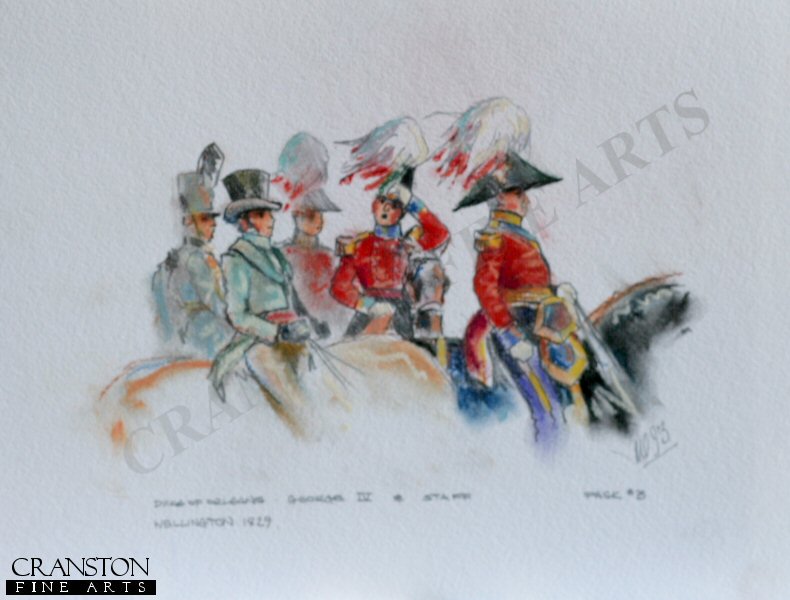
Duke of Orleans, George IV and Staff, 1829 by Mark Churms. (P) Study for the original painting March Past of the Grenadier Guards. |
Tribute to Oblt Kurt Student by Ivan Berryman. (P) Kurt Student was a pilot before the beginning of World War One and served throughout the conflict, scoring 6 aerial victories. He served with several squadrons including as commander of Jasta 9, and is shown here in his Fokker E.IV. He went on to be a high-ranking officer in the Luftwaffe during World War Two, and was instrumental in creating the German paratroop force. He was later convicted of war crimes associated with the invasion of Crete by his paratroops - he died in 1978. |
Into the Storm by Ivan Berryman. (P) Typical of the many hundreds of craft that took part in the 6th June 1944 landings at Normandy at the opening of Operation Overlord, these unarmed Royal Navy Landing Craft (LCAs) bravely transported many thousands of British and Canadian infantry to the beaches under the most intense fire. |
Albert Ball VC by Darren Baker. (P) Albert Ball was the first Royal Flying Corps pilot to score a hat-trick (3 kills on a single mission) and, in the course of his career, scored another two on his way to his outstanding 44 victories. |
K.M.S. Gneisenau - Stand by The Bowlines by Randall Wilson (P) Gneisenau returns to Kiel harbour after participating in Operation Nord Mark. With number one bowline secured crew crew prepares to bring the ship alongside. |
Action at Arras, France, 21st May 1940 by David Pentland. (P) 88mm AA guns of the 23rd Flak Regiment, used as anti-tank guns by orders of Rommel himself, are shown firing on British Matilda tanks of 4th/7th Royal Tank Regiment. |
|
Contact Details |
Sign Up To Our Newsletter!
This website is owned by Cranston Fine Arts. Torwood House, Torwoodhill Road, Rhu, Helensburgh, Scotland, G848LE Contact: Tel: (+44) (0) 1436 820269. Email: cranstonorders -at- outlook.com
|