|
|
|
|
|
|
|
|
|
Cranston Fine Arts  Original Artwork Original Artwork |
| More Pages : Original Pencil Drawings |
| Navigation | |
| Page 6 of 55 | Previous .. Page 6 .. Next |
|
|
|
|
|
|
|
|
|
|
|
|
|
|
|
|
|
|
|
|
|
| Navigation | |
| Page 6 of 55 | Previous .. Page 6 .. Next |
| Text for the above items : |
MTB107 by Ivan Berryman. (P) Commanded by Lord John Cameron, MTB107 took part in Operation Dynamo - the evacuation of Dunkirk in the first week of June 1940. Working with the destroyer HMS Vivacious, the Vosper Thornycroft experimental Motor Torpedo Boat delivered blockships overnight into June 3rd, partially blocking the channel of the port of Dunkirk. The next night, MTB107 worked with HMS Shikari to deliver two more blockships to complete the blocking of the channel. A third blockship was sunk in collision en-route, MTB107 picking up seven of the crew. |
U-453 by Ivan Berryman. (P) The Type VIIC U-Boat U-453 began service in June 1941 under the command of Knight's Cross winner Egon-Reiner von Schlippenbach and claimed 10 vessels sunk including the Royal Navy minesweeper HMS Hebe. U-453 was sunk on 21st May 1944 by the destroyers HMS Tenacious, HMS Termagant and HMS Liddesdale off the coast of Italy. She is shown here on one of 17 patrols defending herself from air attack by a Catalina from RAF Coastal Command. |
Good Morning, Spartan by Robert Barbour (P) Nimrod MR2P from 201 squadron based at RAF Kinloss, climbs away under full power during NATO exercises off the west coast of Scotland. The Nimrod has just completed simulated depth charge attacks on the fleet submarine HMS Spartan and is returning to Kinloss for breakfast. Spartan turns and heads for the Clyde Submarine Base at Faslane on the Gareloch. |
Bristol Britannia by Ivan Berryman. (P) Often referred to as the 'Whispering Giant', Bristol's sleek Type 175 Britannia represented a milestone in turboprop airliner design, although it was already something of an anachronism by the time it entered service, as the jet age was just getting underway. Nevertheless, 85 Britannias were built before production ceased in 1960, many serving with BOAC, as exemplified by G-ANBG, seen here before being re-registered because superstitious pilots disliked the letters 'NBG', believing them to be an acronym of 'No Bloody Good!'. |
Tribute to Ltn d R 'Willi' Nebgen by Ivan Berryman. (P) Flying with Jasta 7, Willi Nebgen scored four confirmed victories but sources suggest he shared in at least two others, meaning he most likely attained the magic number of 5 victories to make him an Ace. Shown here in his Fokker D.VII in the summer of 1918, it was painted all black except for the green and white diagonal flash on the fuselage. He was killed in action on 22nd October 1918 and is buried in West Flanders, Belgium. |
Hunter's Dusk by Ivan Berryman. (P) In January 1941, the young Mario Arillo was appointed the rank of Lieutenant Commander, placed in charge of the Regia Marina's submarine Ambra and was dispatched to the Mediterranean to help disrupt supplies to the Allied forces. In May of that same year, Arillo attacked the British Dido Class Cruiser HMS Bonaventure, and Destroyers HMS Hereward and HMS Stuart, south of Crete, en route from Alexandria, the cruiser Bonaventure being sunk with great loss of life. The Ambra is depicted here in a calmer moment, two of her crew scanning the horizon for 'business'. |
Pinned Like Rats in a Hole by Mark Churms (P) The original oil study for the larger painting of Pinned Like Rats in a Hole, part of the Rorkes Drift series by Mark Churms. |
Tribute to Oscar Boesch by Ivan Berryman. (P) Oscar Boesch joined the Luftwaffe in 1942 and flew his first combat mission in April 1944, crash-landing and flipping his Fw190. However, as part of a unit specialising in attacking American daylight bombing raids, he scored 18 victories in 120 missions before the end of the war. He is depicted here making a head-on attack in his Fw190A-8/R8 against American B-24 Liberators. |
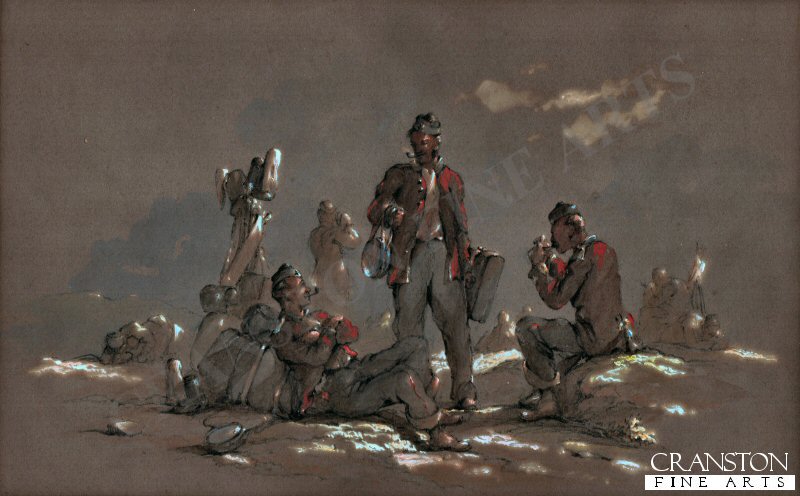
Halt of the Fusiliers by Major T S Seccombe. Fusiliers at rest, about mid-nineteenth century, around the time of the Crimean War. |
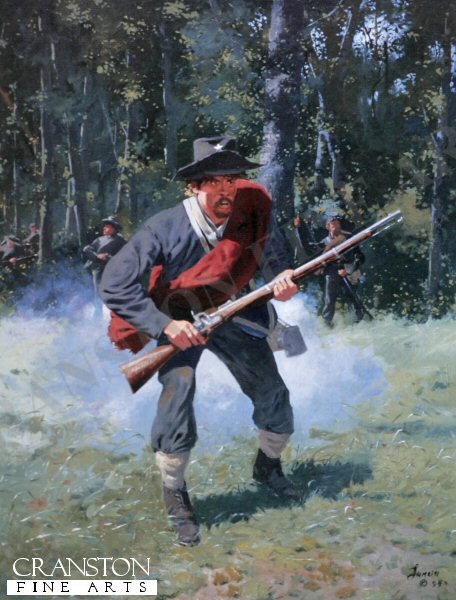
1st Texas Infantry by Jim Lancia (P) No text for this item |
HMS Benbow at the Battle of Jutland by Anthony Saunders. (P) HMS Benbow was completed in 1914, built by Beardmore (launched 12th November 1913). On the 10th of December she joined the Grand Fleet serving with the 4th Battle squadron. She was the flagship to Admiral Douglas Gamble until he was replaced in February 1915 by Sir Doveton Sturdee. During the Battle of Jutland. she suffered no damage. After the war she served from 1919 in the Mediterranean providing Gun fire support to the white Russians in the Black Sea until 1920. She remained in the Mediterranean until 1926 joining the Atlantic fleet for the next three years until 1929 when she was paid off and scrapped in March 1931. |
Falling Angels by Tim Fisher. (P) Ju 52s deploy German Paratroopers during the assault on Crete (operation Mercure) 1942. |
Captain Arthur Henry Cobby by Ivan Berryman. (P) Arriving in France in 1917 with little or no air gunnery training behind him, Captain Arthur Harry Cobby went on to become the Australian Flying Corps highest scoring ace with 29 victories to his credit, five of them observation balloons. He is shown here in Sopwith Camel E1416 of 4 Sqn AFC (formerly 71 Sqn AFC) having downed one of his final victims, a Fokker D.VII on 4th September 1918. Cobby survived the Great War and served in the RAAF during the inter war period and World War Two, eventually leaving the service as Air Commodore CBE. He died in 1955. |
USS Kitty Hawk by Ivan Berryman (P) USS Kitty Hawk (CV-63) refuels an Adams class Destroyer during a dusk operation off the Vietnam coast as a pair of E8 Crusaders are readied for launch on the forward catapults. |
HMS Anson at Sydney Harbour, July 1945 by Ivan Berryman (P) The King George V class battleship HMS Anson is pictured in Sydney Harbour where she joined the Pacific Fleet in July 1945, viewed across the flight deck of HMS Vengeance, where ten of her Vought F4.U Corsairs are ranged in front of a single folded Fairey Barracuda. |
Some Little Birds Fly at Night by David Pentland. (P) 160th SOAR, 'Nightstalkers', MH-6J 'Little Bird' and a small squad of Special Forces D-Boys fly low en route to their target in Afghanistan. |
2nd Battle Squadron at the Battle of Jutland by Randall Wilson. (P) HMS Orion leading HMS Conqueror, HMS Monarch, HMS Thunderer, the 2nd Battle Squadron. |
King Edward II's Retreat from Bannockburn by Jason Askew. (P) Knowing that the battle of Bannockburn was lost, the Earl of Pembroke and Sir Giles d'Argentan led King Edward the 2nd from the field in much haste. King Edward and his bodyguard had to fight their way through the Scots, who barred their escape. King Edward had one horse killed under him, and only the heroic resistance of the earl of Pembroke's bodyguard prevented the Scots from capturing the English King. |
HMS Blake by Ivan Berryman. (P) The newly converted Command Helicopter Cruiser HMS Blake leaves Grand Harbour Malta at the end of the 1960s. In the background, the old Submarine Depot ship HMS Forth lies at anchor at the very end of her long career. |
Brule Sioux Warrior by Alan Herriot (P) No text for this item |
New Frontiers - Enola Gay by Ivan Berryman. (P) Assigned to the 393rd Bombardment Squadron, USAAF, Enola Gay was one of 15 Boeing B-29s with the 'Silverplate' modifications necessary to deliver the new atomic weapons. She is depicted here in company with The Great Artiste, one of the other two B-29s that took part in the first nuclear bombing mission against the Japanese city of Hiroshima on 6th August 1945. The three ship mission consisted of Enola Gay (victor number 82), piloted by Colonel Paul W Tibbets, The Great Artiste (89), piloted by Major Charles W Sweeney and number 91, later named Necessary Evil, piloted by Captain George W Marquardt. Tibbets' aircraft was assigned for weapons delivery, whilst Sweeney's carried blast measurement instrumentation and Marquardt's was the camera ship. This mission and that against the city of Nagasaki a short time later changed the course of history forever and remain to this day the only time that nuclear bombs have been used in anger. |
|
Contact Details |
Sign Up To Our Newsletter!
This website is owned by Cranston Fine Arts. Torwood House, Torwoodhill Road, Rhu, Helensburgh, Scotland, G848LE Contact: Tel: (+44) (0) 1436 820269. Email: cranstonorders -at- outlook.com
|