|
|
|
|
|
|
|
|
|
Cranston Fine Arts  Original Artwork Original Artwork |
| More Pages : Original Pencil Drawings |
| Navigation | |
| Page 4 of 55 | Previous .. Page 4 .. Next |
|
|
|
|
|
|
|
|
|
|
|
|
|
|
|
|
|
|
|
|
|
| Navigation | |
| Page 4 of 55 | Previous .. Page 4 .. Next |
| Text for the above items : |
Majestic Malta by Randall Wilson (P) With the British Mediterranean Fleet riding at anchor in Grand Harbour Malta, HMS Majestic is shown preparing to leave harbour as local fisherman look on. |
Boarding the San Nicolas by Chris Collingwood. (P) Nelson's sailors and marines board the San Nicolas and during heavy hand to hand fighting capture the ship. Nelson drives HMS Captain onto the Spanish vessel in order that she can be boarded and taken as a prize, the British marines and men scrambling up the Captain's bowsprit to use it as a bridge. The San Nicolas then fouled the Spanish three-decker San Joseph, allowing Nelson and his men to take both ships as prizes in a single manoeuvre. |
No Escape by David Pentland. (P) Bf109 G2 of Major Gunther Rall pursues and downs an unidentified Soviet aircraft over the Caucasus, Russia, early Autumn 1943. Rall went on to become the third highest scoring ace of all time, with 275 victories in only 621 missions. |
Charge of the 2nd Royal North British Dragoons (Scots Greys) at Waterloo by Brian Palmer. (P) After the 2nd Royal North British Dragoons had charged the French artillery, they themselves were charged by the 3rd French Chasseur Chevals and the deadly 4th Regiment of Lancers. The scene depicted shows the French cavalry engaging the Scots Greys. |
Aces All - Tribute to the Pilots and Crews of 23 Sqn, Malta, 1943 by Ivan Berryman. (P) Arriving on the island of Malta in the final days of 1942, the De Havilland Mosquitoes of 23 Sqn were soon in action defending the skies around this strategically crucial island and carrying out intruder missions against ground targets as far away as southern Italy. Three of 23 Sqn's FB.VIs are depicted here: HJ675 (V), piloted by Fl Lt P W Rabone (9 victories), DD687 (E), flown by Sqn Ldr N J 'Jackie' Starr (5 victories) and DZ230 (A), the aircraft of Wing Commander Peter Wykeham-Barnes (14 + 3 shared). |
HMS Poseidon by Ivan Berryman. (P) Launched in Barrow in Furness on 22nd August 1929, the Parthian Class submarine HMS Poseidon (P99) was destined to meet a tragic fate on 9th June 1931 when she was inexplicably involved in a collision with a Chinese freighter in the Bohai Sea during exercises in clear visibility. 31 of her crew managed to get into the water before the submarine sank, whilst a further eight escaped from the submerged vessel. Two of these didn't make it to the surface and one died later in hospital, making a tragic total of 21 deaths in this extraordinary tragedy. HMS Poseidon is depicted here in happier times, moving off from her depot ship as the night sky closes in. |
Riding the Ninth Wave by Ivan Berryman. (P) Sailors on a clipper during a storm. |
Fields of Fire by David Pentland. (P) Normandy, France, 1944. British M5 Halftracks and Grenadier guards of the 1st Motor Battalion, Guards Armoured Division engage targets from a Normandy field. |
French Attack on Hougoumont Farm at the Battle of Waterloo by Jason Askew. (P) The fierce attack by the French infantry on Hougoumont Farm during the battle of Waterloo. |
Fire for Effect by David Pentland. (P) Bastogne, Ardennes, Belgium, 20th December 1944. Newly arrived 81mm Mortars of 2nd Battalion, 506th PIR, 101st Airborne Division, fire in support of U.S. Paratroopers defending against German probes to the north of Bastogne. |
HMS Eurydice at Anchor off Cowes by Ivan Berryman. (P) After being re-commissioned under the command of Captain Marcus Augustus Stanley Hare, Eurydice sailed from Portsmouth on a three-month tour of the West Indies and Bermuda on 13th November 1877. On 6th March 1878, she began her return voyage from Bermuda for Portsmouth. After a very fast passage across the Atlantic, on 24 March 1878, Eurydice was caught in a heavy snow storm in Sandown Bay, within sight of the Isle of Wight, capsized and sank. Only two of the ship's 319 crew and trainees survived. Most of those who were not carried down with the ship died of exposure in the freezing waters. One of the witnesses to the disaster was a young Winston Churchill, who was staying at Ventnor with his family at the time. The wreck was re-floated later that same year but had been so badly damaged during her submersion that she was then subsequently broken up. Her ship's bell is preserved in St. Paul's Church, Gatten, Shanklin. There is a memorial in the churchyard at Christ Church, The Broadway, Sandown and the ship's anchor is set into a memorial at Clayhall Cemetery, Gosport. |
First Response by Brian Bateman. (P) 7th December 1941, Pearl Harbor. Ken Taylor and George Welch took off in their P-40 Warhawks from the isolated Haleiwa airfield in western Oahu in an attempt to intercept Japanese aircraft. In the first US action of the war (excluding American Volunteer Group pilots), Ken Taylor is seen diving on to a group of Aichi D3A 'Val' dive bombers making their way to the already battered US fleet at Pearl Harbor. Ken was slightly wounded during the action, and without George covering his tail, he would likely have been shot down. Both George and Ken claimed to have shot down three enemy aircraft. |
Point of the Pincer by David Pentland. (P) Kiev, Ukraine, 7th August - 26th September 1941. Panzer IIF light tanks of the 11th Panzer Division, 'Ghost', 1st Panzergruppe, Army Group South, advance during the battle of Kiev. This was to be the largest encirclement in history and a crushing defeat for the Soviet Southwestern Front. |
Sabre's Edge - Tribute to Edwin L 'Ed' Heller by Ivan Berryman. (P) Already an ace in WWII, Ed Heller was again to find himself involved in aerial combat during the conflict in Korea, now flying the mighty F-86 Sabre with the 25th FIS, 51st FIW against the potent MiG15. Moving to 16th FIS as Squadron Commander, he was to claim 3.5 victories over MiGs before being shot down himself in January 1953. His release from captivity by the Chinese did not occur until two years after the war ended but, upon repatriation, he returned to the air flying F-100s during the Cuban Missile Crisis, finally retiring in 1967. He is depicted here in Hell-er Bust X, claiming a MiG 15. |
HMS Hood at Malta 1896 By Randall Wilson (P) HMS Hood makes a turn to port, while in line and astern is HMS Collingwood. Valetta can be seen in the distance. |
A Chance Encounter by Robert Barbour (P) On 17th June 1944, 780 miles west of Saipan in Mid Pacific, the Gato class submarine USS Cavalla dives after a lucky sighting of a Japanese Naval Task Force, which included the aircraft carriers Taiho, Shokaku and Zuikaku. The Cavalla then trailed the Japanese, attacking and sinking the Shokaku on the 19th. |
A Saint goes to War - The Second Marne Offensive, France 18th July 1918 by David Pentland. (P) St. Charmond Assault tanks of the French 10th Heavy Tank battalion move through Villers-Cotterets forest in preparation for the 10th Army counterattack on the German Soissons-Rheims salient. |
HMS Fearless by Ivan Berryman (P) Ships of the South Atlantic Task Force gather in San Carlos water during the Falklands Campaign of 1982. LCMs from HMS Fearless (L10) manoeuvre around their mother ship, with the logistic Ship RFA Sir Galahad (L3005) and the frigate HMS Argonaut (F56) in close attendance. |
USS Tang, The Life Guard of Truk Atoll by Robert Barbour (P) On 29th and 30th April 1944, while surfaced close to jagged reefs, and Japanese shore guns, the USS Tang rescued 22 downed flyers from Task Force 58s strikes against enemy positions on the islands - This was the largest rescue of airmen by a submarine in the war. USS Tang (SS-306) would later be sunk by its own torpedo off Formosa, on the 24th of October 1944. |
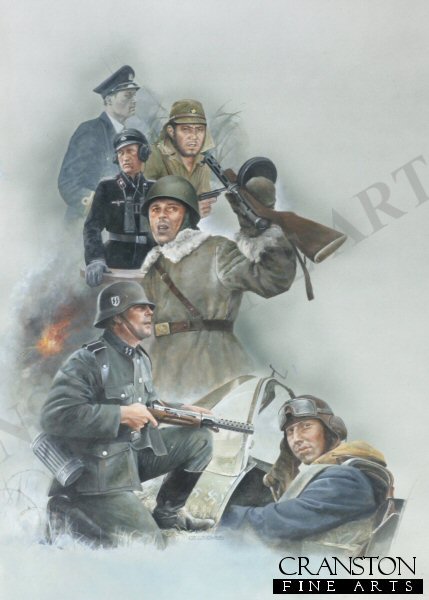
Original art work for the book A Time of War Vol II, Come Evil Days by Chris Collingwood. No text for this item |
Major Albert Carter by Ivan Berryman. (P) The Sopwith Dolphin was a radical departure from previous Sopwith design philosophies, embodying a reverse-stagger on the wings, a water-cooled Hispano-Suiza engine and an unusual, but highly popular positioning of the cockpit which gave the pilot unprecedented views. One exponent of this purposeful looking machine was Canadian Major A D Carter who claimed many of his 31 victories flying the Dolphin. He is shown here sending an Albatross to the ground on 8th May 1918 whilst flying C4017. Carter was himself shot down soon after became a prisoner of war. He was killed in 1919 whilst test flying a Fokker D.VII at Shoreham, Sussex. |
|
Contact Details |
Sign Up To Our Newsletter!
This website is owned by Cranston Fine Arts. Torwood House, Torwoodhill Road, Rhu, Helensburgh, Scotland, G848LE Contact: Tel: (+44) (0) 1436 820269. Email: cranstonorders -at- outlook.com
|