|
|
|
|
|
|
|
|
|
Cranston Fine Arts  Original Artwork Original Artwork |
| More Pages : Original Pencil Drawings |
| Navigation | |
| Page 2 of 55 | Previous .. Page 2 .. Next |
|
|
|
|
|
|
|
|
|
|
|
|
|
|
|
|
|
|
|
|
|
| Navigation | |
| Page 2 of 55 | Previous .. Page 2 .. Next |
| Text for the above items : |
The Hunted and the Hunter by Ivan Berryman. (P) The attack by Leutnant Walter Briegleb and his crew on Lancaster Mk.III ND960 DX-I of No.57 Sqn early on 22nd May 1944. Flying Me110 with codes D5+BV with his crew of Feldwebel Walter Bräunlich and Bordfunker Feldwebel Brandt, Briegleb flew undetected beneath the bomber and used the deadly 'Schräge Musik' - upward firing cannon - to hit the fuel tanks in the port wing between the fuselage and inner engine. Pulling away, he watched the aircraft burn and could see both gunners in their turrets but no return fire came. He wondered why none of the crew escaped by parachute with the bomber doomed - it disintegrated in the air over the coast of the island of Fyn, Denmark, impacting near Emtekær at 00:44hrs. Flight Lieutenant Arthur Richards (Pilot) Flying Officer William Woodall (Navigator) Pilot Officer Athur Bugden (Flight Engineer) Sergeant Thomas Edwards (Wireless Operator) Flying Officer George Ferguson (Air Bomber) Sergeant Harold Griffiths (Air Gunner) Sergeant Cyril Woodmass (Air Gunner) |
Guardian Angel by Anthony Saunders. (P) Depicting Mustang aircraft escorting Flying Fortresses on a bombing raid over Germany. |
Gold Beach, Normandy, 6th June 1944 by David Pentland. (P) Royal Engineers Churchill AVREs of 6th Assault Regiment, 81st Squadron and DD Shermans of the 4/7th Dragoon Guards. Both units were part of perhaps the most important formation involved in the British and Canadian landings, the 79th Armoured Division or Funnies. Composed of a variety of armoured vehicles, designed to support the beach assault troops, they included mine flails, bunker busters, carpet layers, and amphibious tanks. |
Tribute to Helmut Lent by Ivan Berryman. (P) Joining the Luftwaffe in 1936, Helmut Lent flew Me110s with ZG76, claiming victories in the invasion of Poland. It was as a night-fighter pilot that he excelled - the second highest scoring night Ace in history - scoring more than 100 victories for which he was awarded the Knight's Cross with Oak Leaves, Swords and Diamonds. He scored victories from 1941 to 1944 with NJG1, NJG2 and NJG3 before he was fatally wounded in an accident when the Ju88 he was transporting struck overhead wires on a hastily prepared makeshift runway as he came in to land. He is depicted here in his Me110 G4 approaching a Lancaster over France in 1943. |
Vickers Gunbus FB5 by Tim Fisher. (P) This aircraft entered service with the RFC in February 1915. Nicknamed the gunbus, it was the first British aircraft to be designed as a fighting machine from the start. The plane was armed with a single .303 inch Lewis machine gun, fired by the observer. It was only a short period of time before it was outclassed by German aircraft carrying synchronised forward firing machine guns. |
Apsaroke Crow by Alan Herriot. (P) No text for this item |
Surgeons of Camp Bastion by Graeme Lothian. (P) No text for this item |
The 9th Regiment, at the Battle of Freeman's Farm, September 19th 1777 by Brian Palmer (P) Taking over command of the British Northern Army in 1777, Lt Gen Burgoyne began a march to Albany to join forces with Lt Gen Sir William Howe. After taking Fort Ticonderoga on route he learned that Howe was leaving for Pennsylvania. Becoming desperately short on supplies he decided to press on the Albany regardless but found the road blocked by a Continental army under Maj Gen Horatio Gates. Burgoyne decided not to engage the enemys position frontally but to turn their left at Freeman's Farm. After a day of fierce fighting the British held the field but at a heavy price in casualties. On the 7th October the Colonial army, after receiving continual reinforcements attacked Howes position (the battle became known as Bemis Heights) and he was forced to retire to Saratoga. |
Opening Gambit, Poland, 2nd September 1939 by David Pentland. (P) Porucznik Stanislaw Skalski of 142nd Eskrada, flying a Polish airforce PZL P-11c, downs a Messerschmitt 110 during the first days of WWII. Although officially credited as a Dornier bomber, it is now believed that the aircraft was an Me110 from 1/ZG1. The discrepancy is attributed to the fact that the reported aircraft used nose mounted cannons unlike the Dornier, and up until then the 110 was a well kept secret. |
C-CAST Afghanistan to Medical Repatriation by Graeme Lothian. (P) Critical Care Air Support Team move casualties from the Ambulance at Camp Bastion onto the C-17A Globemaster of the Royal Air Force, returning the casualties back to the United Kingdom. (Only the title appears on print - no caption text) |
Helmand Faces by Graeme Lothian. (P) Three Afghan locals who were at two 'Shuras' (meetings). I initially sketched them as they sat on the floor talking to the soldiers from ISAF. Afterwards I asked them to pose for me as I took their photos. They are all from around the Lashkar Gah region. Artist Graeme Lothian appeared with this original painting on the BBC's The One Show on Wednesday 18th July 2012, in a piece on British War Artists. |
MERT, Sangin Valley, Helmand Province, Afghanistan by Graeme Lothian. (P) A Chinook performs an MERT pick up with the force protection of two Army Air Corps Apache helicopters. |
NTG03 - Task Force to Iraq by Ivan Berryman (P) Key ships of the British task Force sail in close formation in the Mediterranean Sea during the build-up to the coalition liberation of Iraq in march 2003. Ships pictured left to right, include ATS Argus (A135), a Type 42 destroyer in the extreme distance, the flagship HMS ark Royal (RO7), RFA Orangeleaf (A110), LSL Sir Percival (L3036), the Commando and helicopter carrier HMS ocean (L12) and the Type 42 destroyer HMS Liverpool (D92) |
Phantoms F-4 by R E Pierce. (P) No text for this item |
Tribute to Georges Lachmann by Ivan Berryman. (P) Georges Lachmann was a French Ace pilot credited with a total of 9 victories during World War One. He is shown here in his Spad S.VII armed with Le Prieur rockets lining up to claim one of four balloon victories, this being one of the three balloons he claimed in Russia in late 1917. Notable for becoming an Ace while surviving as a serving pilot from the beginning to the end of the war, he lived into his 70s and died in 1961. |
Scouting Ahead by David Pentland. (P) Kursk, Central Russia, 1st July 1943. Sdkfz 232 heavy armoured car and Sdkfz 247 light armoured car of the Reconnaissance battalion, 11th Panzer Division, scouting enemy dispositions prior to the Kursk offensive. |
Tribute to Heinrich Gontermann by Ivan Berryman. (P) Originally in Germany's military, Heinrich Gontermann did not become an aviator until early 1916, and was not a fighter pilot until November of that year. Despite this, he is credited with 39 victories including 18 observation balloons. Scoring his first victory in November 1916, he did not score again until the next March - he is shown here in his Albatros D.III of Jasta 5 in April 1917 during which he claimed 12 victories - 5 balloons and 7 aircraft. Highly decorated with awards including the Knight's Cross and Blue Max, he was killed in a crash in the last days of October 1917 while performing aerobatics in his new Fokker Dr.I. |
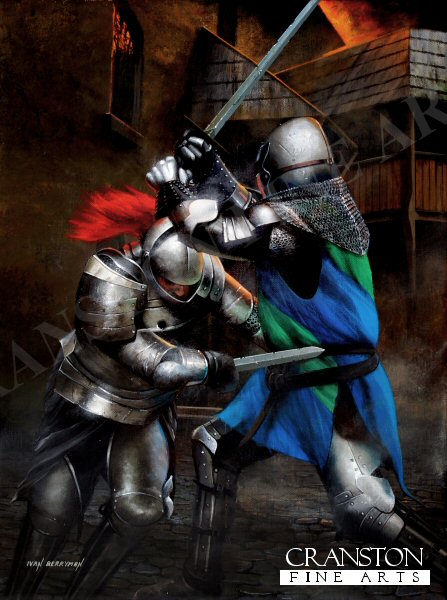
To the Death by Ivan Berryman. (P) No text for this item |
The Siege of Harfleur, 1415 by Brian Palmer. (P) King Henry V of England leads his army at the siege of Harfleur in 1415. |
Atlantic Rendezvous by Robert Barbour (P) A U-boat wallows on the surface in typical Atlantic winter weather in February, 1944. approaching at low level is a Luftwaffe FW 200 C-8 Condor of 111KG 40 from the base at Bordeaux-Marignac in S.W. France. |
Anzio, Italy, February 1944 by David Pentland. (P) Replacements from 1st Battalion Irish Guards and Sherman tanks of the 46th Royal Tank Regiment move through the debris of Anzio town towards their jump-off positions for the Battle of Campoleone Station. |
|
Contact Details |
Sign Up To Our Newsletter!
This website is owned by Cranston Fine Arts. Torwood House, Torwoodhill Road, Rhu, Helensburgh, Scotland, G848LE Contact: Tel: (+44) (0) 1436 820269. Email: cranstonorders -at- outlook.com
|