|
|
|
|
|
|
|
|
|
Cranston Fine Arts  Naval Art and Artists Naval Artists Ivan Berryman Naval Art and Artists Naval Artists Ivan Berryman  Original Paintings Original Paintings |
[UP] - Royal Navy - US Navy - German Navy - French Navy - Italian Navy - Spanish Navy - Maritime Art - Trafalgar - The Nile - Copenhagen - Cape St Vincent - Original Paintings - Original Acrylic Paintings - Postcards |
| Navigation | |
| Page 7 of 7 | Previous .. Page 7 |
|
|
|
|
|
|
|
|
|
|
|
|
|
|
| Navigation | |
| Page 7 of 7 | Previous .. Page 7 |
| Text for the above items : |
Becalmed - HMS Victory in the Doldrums by Ivan Berryman. (P) Two of Admiral Horatio Nelson's ships lie becalmed together, bathed in the soft glow of the setting sun. The 74-gun HMS Captain basks ahead of the mighty HMS Victory, the ship that would ultimately lead the British fleet into battle against the combined might of the Spanish and French fleets at Trafalgar in 1805. |
HMS Temeraire Departing Plymouth by Ivan Berryman. (P) One of the most iconic ships ever to serve in the Royal Navy, The three-decked second rate HMS Temeraire was built at Chatham in 1798 and spent many years blockading the French port of Brest before her finest hour at Trafalgar on 21st October 1805 when she came to the rescue of HMS Victory before capturing two prizes, the Redoutable and Fougueux, spending much of the battle with her captives lashed to her sides. After spending her final years first as a prison hulk, then as a guard ship in the Medway, she was finally sold for scrap in 1838, her last journey being the subject of JMW Turner's most famous painting. In this view, Temeraire is shown leaving Plymouth in her pre-Trafalgar state before receiving her 'crowned head' figurehead. |
HMS Victory Departing Portsmouth by Ivan Berryman. (P) Nelson's flagship at the Battle of Trafalgar is depicted here passing the iconic Round Tower at the entrance to Portsmouth Harbour before dropping anchor at Spithead in readiness for her next voyage. With her is the sloop HMS Pickle, also a veteran of Trafalgar, who carried Admiral Collingwood's victory despatch to the Admiralty after the great battle had been won. |
HMS Euryalus - Shadowing the Fleet by Ivan Berryman. (P) Launched at Bucklers Hard in Hampshire in 1803, the frigate HMS Euryalus is probably best known for the small part she played at Trafalgar. She was one of four British frigates sent to observe the combined French and Spanish fleets as they left Cadiz for what would become the Battle of Trafalgar. Having shadowed the enemy through the night, Euryalus sped ahead to warn the British fleet, commanded by Admiral Lord Nelson. Too small to play a significant part in the battle itself, Euryalus stood off until the afternoon when she took the badly damaged Royal Sovereign in tow, Admiral Cuthbert Collingwood transferring his flag to the little frigate following the death of Nelson. By 1825, her career as a fighting ship was over and she was decommissioned to become a prison ship until the mid 1840s when she became a coal hulk. She soldiered on in number of other menial roles until 1860 when she was finally broken up. |
HMS Victory by Ivan Berryman. (P) Arguably the best known warship in the world, and one of only a few survivors of her era, HMS Victory was the flagship of Admiral Lord Horatio Nelson at Trafalgar in 1805, leading the victorious British fleet into battle against the combined French and Spanish navies. Severely damaged during the battle, she remained afloat at Portsmouth into the 20th century and is now preserved there in dry dock for future generations to visit. Extraordinarily, HMS Victory is still a commissioned ship in the Royal Navy and is frequently used for ceremonial duties. |
Farewell, Old Portsmouth by Ivan Berryman. (P) One of the most iconic ships of all time and now beautifully restored to her 1805 condition at Portsmouth, Nelson's flagship at the Battle of Trafalgar, HMS Victory, is seen here departing Portsmouth Harbour with the frigate Euryalus. |
On the Step by Ivan Berryman. (P) The mainstay of the Royal Navy's Coastal Forces fleet from 1941, the 72-foot Vosper MTBs were among the fastest and most successful ever built. With their three Packard 1400hp engines and bigger fuel tanks, these boats could reach speeds of up to 39 knots with a maximum range of 400 miles. Armament varied from boat to boat, but those depicted are fitted with the standard 21-inch torpedo tubes and a twin .5 inch MkV Vickers machine gun mounting. Crew was typically two officers and eleven ratings. |
HMS Victory - Home Before the Squall by Ivan Berryman. (P) Against the darkening skies of an impending storm, HMS Victory is depicted entering Portsmouth Harbour. This iconic ship, launched in Chatham in 1765, is now preserved in Portsmouth's Historic Dockyard on public display and is still a commissioned warship in the Royal Navy. Weighing 2,162 tons, Victory was crewed by 850 men and carried 104 guns on three decks. |
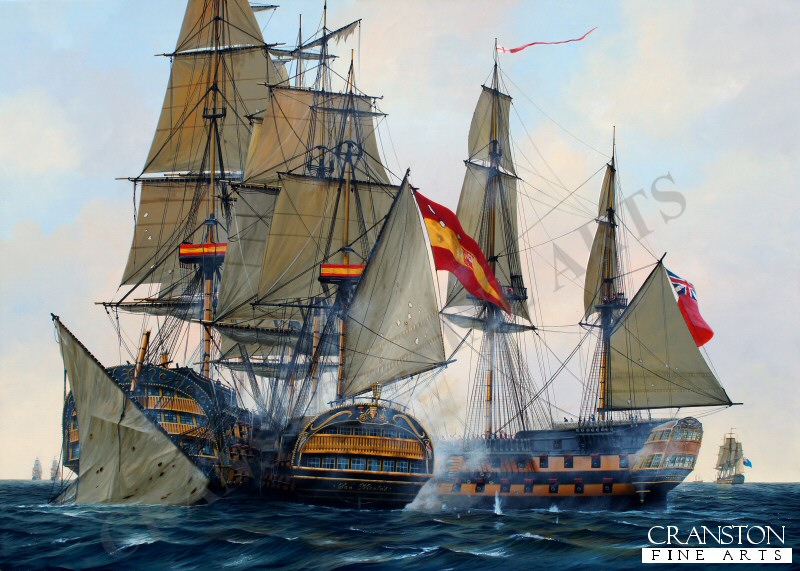
The Battle of Cape St Vincent - Nelsons Patent Bridge by Ivan Berryman (P) As the early morning fog and mist began to clear on 14th February 1797, the British squadron commanded by Admiral Jervis spotted two columns of Spanish ships and immediately set off in pursuit. Horatio Nelson was stationed at the very rear of the British squadron in HMS Captain and, from this vantage point Nelson suspected that the Spanish would form into a single fighting unit and he feared that they would attempt to encircle the British ships and attack them in the round. Against orders to the contrary, Nelson broke away and sailed directly at the Spanish line to intercept them. A fierce artillery battle ensued with the San Josef losing her mizzen mast and HMS Captain having her fore top shot away. Damage to the San Nicolas was such that she became uncontrollable and crashed heavily into the San Josef, at which point Nelson drove his ship into the pair of them, personally leading the boarding party to take both ships as prizes. This daring manoeuvre became known as Nelsons Patent Bridge for Boarding First Rates and alerted the Admiralty to young Nelsons bravado and courage. |
Nerves of Steel by Ivan Berryman (P) Just moments from her devastating opening broadside, HMS Victory prepares to pass the stern of the French flagship Bucentaure, to break through the line of the combined French and Spanish fleets as the Battle of Trafalgar begins on 21st October 1805. Victorys guns had remained silent until this moment, Lord Nelsons flagship having already suffered severe damage during the approach, but now the gun crews awaited the moment when her double-shotted cannon, her mighty 68-pounder carronade and a shower of musket balls would smash through the French vessel, rendering it at once a useless hulk. |
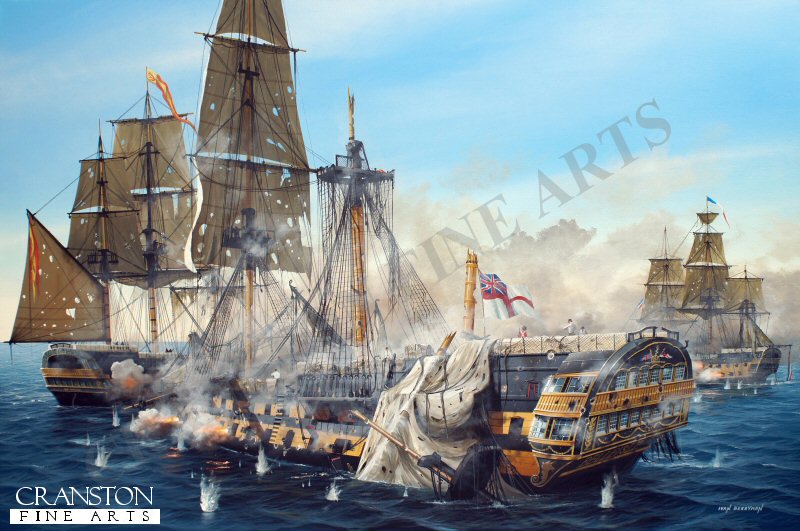
The Tenacious Belleisle by Ivan Berryman (P) Few ships fought more bravely than HMS Belleisle at the Battle of Trafalgar. Having been second in the line of Collingwoods leeward division, the 74-gun Belleisle took on a number of opponents including the Monarca, Santa Ana and Indomitable, but soon found herself surrounded by enemy ships that poured weighty broadsides into her. By 2.30 in the afternoon, Belleisle was little more than a floating wreck, having lost all her masts and bowsprit, yet still she fought bravely on, her colours flying defiantly from the stump of her mizzen mast. Belleisle survived her ordeal and was towed to Gibraltar after the battle where temporary repairs were made, arriving in Plymouth for a refit on 5th December 1805. |
Mid Atlantic Dawn by Ivan Berryman. (P) Upon hearing the news that Admiral Villeneuve and his squadron had headed across the Atlantic to the West Indies, Nelson, in HMS Victory, set off in pursuit early in June, 1805, in the hope of engaging the French there, thus preventing them from combining with the Spanish fleet that were blockaded in Cadiz. Nelsons squadron comprised the 74-gun Amazon, Swiftsure, Belleisle, Canopus, Conqueror, Donegal, Leviathan, Superb, Spencer and Tigre, plus the smaller Amphion (32) and Decade (36). The chase to Barbados and back was HMS Victorys only crossing of the Atlantic and proved fruitless, as Villeneuve had already escaped, but this action laid the ground for the Battle of Trafalgar in October of the same year. |
U-269 by Ivan Berryman (P) This limited edition print depicts the Type VIIC U-Boat U269 during an engagement in the English Channel with a B24 Liberator from 224 Squadron based at St Eval in Cornwall. |
P&O Ocean Liner SS Canberra by Ivan Berryman. (P) The P&O Liner SS Canberra during her ocean cruising heyday of the 1980s. SS Canberra is pictured off the Canary Islands. |
|
Contact Details |
Sign Up To Our Newsletter!
This website is owned by Cranston Fine Arts. Torwood House, Torwoodhill Road, Rhu, Helensburgh, Scotland, G848LE Contact: Tel: (+44) (0) 1436 820269. Email: cranstonorders -at- outlook.com
|