|
|
|
|
|
|
|
|
|
Cranston Fine Arts  Naval Art and Artists Naval Artists Ivan Berryman Naval Art and Artists Naval Artists Ivan Berryman  Original Paintings Original Paintings |
[UP] - Royal Navy - US Navy - German Navy - French Navy - Italian Navy - Spanish Navy - Maritime Art - Trafalgar - The Nile - Copenhagen - Cape St Vincent - Original Paintings - Original Acrylic Paintings - Postcards |
| Navigation | |
| Page 4 of 7 | Previous .. Page 4 .. Next |
|
|
|
|
|
|
|
|
|
|
|
|
|
|
|
|
|
|
|
|
|
| Navigation | |
| Page 4 of 7 | Previous .. Page 4 .. Next |
| Text for the above items : |
HMS Frobisher and HMS Roberts at Normandy by Ivan Berryman (P) The cruiser HMS Frobisher dominates this scene off Houlgate at the Normandy landings of 1944. The monitor HMS Roberts lies beyond Frobisher with a Large Infantry Landing Ship or LSI (L) unshipping its LCAs on the extreme right of the picture. In the foreground, a motor launch attends a group of LCP (L)s as they head for the French beaches. Two Spitfire Mk.IXs conduct sweeps overhead as Operation Neptune gathers momentum. |
USS Hornet. Doolittles Raiders by Ivan Berryman (P) In a 40 knot gale, Lt Col. Doolittles B25 hauls itself into the air. The first of a 16 strong strike force en route to Tokyo. |
HMS Emerald and HMS Enterprise by Ivan Berryman. (P) Of the three E-Class cruisers proposed at the end of World War 1, only two were ever completed, Euphrates being cancelled when the war with Germany ended in 1918. The two sisters, Emerald and Enterprise, enjoyed long and varied careers, the former remaining largely unchanged from her original appearance, the latter being much modified. The two ships are shown together at anchor off Trincomalie between the wars. |
HMS Torbay - Opration Flipper by Ivan Berryman. (P) In foul weather off the coast of North Africa on the night of 14th November 1941, HMS Torbay deploys men of 11 (Scottish) Commando for an audacious attempt to assassinate German General Erwin Rommel. Named Operation Flipper, the attempt saw 26 men from HMS Torbay join just 8 more from HMS Talisman - the rest trapped aboard by the weather - land 250 miles behind enemy lines in Libya, and march to the headquarters for the attack late on 18th November. While the Commandos made it to the target building, their leader, Lt Col Geoffrey Keyes was killed and they discovered Rommel was not there. Retreating to the landing beach to be picked up by HMS Talisman, they were intercepted by Italian forces and captured facing impossible odds, although a few managed to scatter into the desert and escape. Keyes was posthumously awarded the Victoria Cross, HMS Torbay survived the war and was scrapped soon afterwards. |
Tribute to Midget Submarine HMS XE-3 by Ivan Berryman. (P) The midget submarine HMS XE-3 made a successful attack on the Japanese cruiser Takao in Johore Strait, Singapore on 31st July 1943. Having evaded anti-submarine defences to reach their target, the Commander Ian Fraser and his diver James Magennis are shown preparing to attach limpet mines to the cruiser. Fraser then managed with great skill to position the main explosives directly under the ship before retreating back through the defended waters to safety. Both were awarded the Victoria Cross for their actions that day. |
HMS Sickle by Ivan Berryman. (P) An S-Class submarine of the Royal Navy, HMS Sickle took part in operations in the Mediterranean in the Second World War after an uneventful first patrol off Norway. On the morning of 23rd of April 1943, five days into her second war patrol, HMS Sickle intercepted the Italian merchant Mauro Croce as it left Spanish waters from Valencia. Two torpedoes were fired but passed under the target. Immediately the submarine surfaced and, as seen in this painting, opened fire with the 76mm deck gun, scoring 15 hits from 19 rounds fired before the weapon jammed. HMS Sickle dived and broke off the action, but Italians later claimed three killed and four wounded in their complaint that the attack happened in Spanish territory. That May, HMS Sickle went on to attack German U-Boat U-755 unsuccessfully, but next day torpedoed and sank U-303. On her 11th war patrol in June 1944, HMS Sickle disappeared and is thought to have been lost to mines while returning to Malta. |
USS Coral Sea by Ivan Berryman (P) USS Coral Sea (CV-43 being replenished by fast combat support ship USS Seattle (DE-3) as two of the carriers compliment of F.4s of VF-111 The Sundowners makes a low pass. |
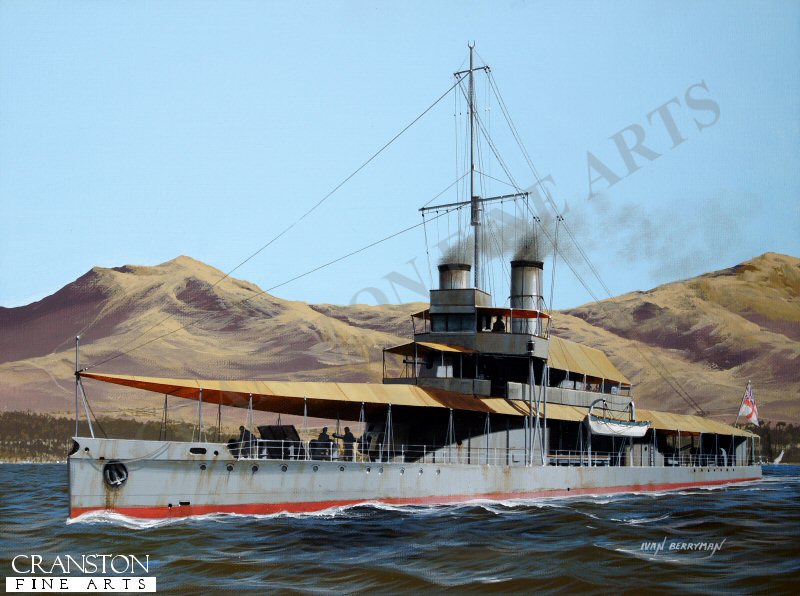
HMS Mantis by Ivan Berryman. (P) An Insect class river gunboat, HMS Mantis took part in operations on the River Tigris in modern-day Iraq in World War One. A British Army advance up the Tigris in 1915 took the town of Kut-al-Amara, but this army of more than 10,000 men were besieged by the Turks here, eventually surrendering in April 1916. With other river gunboats, HMS Mantis had attempted to help break the siege from early March 1916, and remained on the River Tigris until again called upon to assist an expedition in early 1917. As part of a fleet of nearly 20 river gunboats, HMS Mantis helped the forces of Sir Stanley Maude recapture Kut-al-Amara on 24th February 1917. The ship had a long career, briefly serving in north Russia during their civil war in 1919 before serving in China during the 1920s. Still operational at the beginning of World War Two, HMS Mantis was eventually scrapped in 1940. |
HMS Valiant and HMS Phoebe at Alexandria, 1941 by Ivan Berryman (P) A pair of 272 Squadron Bristol Beaufighters roar over the extensively rebuilt battleship HMS Valiant as she lies at anchor at Alexandria late in 1941, accompanied by the cruiser HMS Phoebe and Valiants sister ship HMS Queen Elizabeth (in the extreme distance) |
Tribute to the Crew of HMS Truant by Ivan Berryman. (P) Commissioned in October 1939, HMS Truant served in the North Sea for almost a year, notably damaging the German cruiser Karlsruhe in one action. Sent to the Mediterranean, Truant sunk several Axis merchant ships here, including the Italian tanker Bonzo depicted in this painting. Tracked off the east coast of Italy in the dark of 15th - 16th December 1940, Bonzo fell prey to one of three torpedoes, and was finished off from close range, sinking rapidly. HMS Truant continued successful patrols in the Med until May 1941, completing an Atlantic crossing for refit in the United States before returning in October that year. Sent to the Far East in 1942, the submarine returned to the UK around the Cape of Good Hope for another refit. Returning to service in UK waters in mid-1943, Truant was again sent to the Far East, making it as far as Malta before turning back with mechanical issues, spending the rest of the war as a trials ship in the United Kingdom. |
HMS Captain at the Battle of Cape St Vincent by Ivan Berryman (P) Viewed across the damaged stern of the 80-gun San Nicolas, Nelson drives HMS Captain onto the Spanish vessel in order that she can be boarded and taken as a prize, the British marines and men scrambling up the Captains bowsprit to use it as a bridge. The San Nicholas then fouled the Spanish three decker San Joseph (112), allowing Nelson and his men to take both ships as prizes in a single manoeuvre. A British frigate is moving into a supporting position in the middle distance. |
HMS Glorious by Ivan Berryman (P) HMS Glorious flying off a Fairey Swordfish at sunset with HMS Ardent off to Starboard. |
HMS Lion at the Battle of Jutland by Ivan Berryman. (P) HMS Lion with her sister ship HMS Princess Royal are shown firing on the German High Seas Fleet which can be seen in the distance during the Battle of Jutland. |
HMS Barham with HMS Eagle in Valetta Harbour in Malta during the 1930s by Ivan Berryman. (P) The Battle ship HMS Barham in company with the aircraft carrier HMS Eagle between the two World Wars. Both fell victim to German U-Boats during World War Two. |
Atlantic Comrades by Ivan Berryman (P) The Scharnhorst is pictured in 1939 when she and her sister ship Gneisenau menacingly prowled the North Atlantic. She is shown at dawn as two type VII U-Boats glide towards her for a friendly rendezvous and to take on much needed supplies, as well as a few of the luxuries that the tiny u-boats were simply too small to carry. |
HMS Nelson by Ivan Berryman (P) Over 150 years of the Royal Navy are encapsulated in this view of the mighty HMS Nelson, moored at Portsmouth in 1945. Beyond the 16in guns of A turret, the masts of Admiral Nelsons flagship at Trafalgar, HMS Victory rise into the skyline whilst in the foreground MTB 507 cruises past on its way to the Solent. |
USS Forrestal by Ivan Berryman (P) SOLD |
HMS Ark Royal and HMS Sheffield off the Mole, Gibraltar by Ivan Berryman (P) Having played a vital part in the battle for the Mediterranean for over two years, HMS Ark Royal finally succumbed to a U-Boats torpedo in November 1941. She is shown here with a pair of Swordfish Mk1s of 821 Sqn ranged on the deck, passing the cruiser HMS Sheffield off the Mole, Gibraltar, earlier that same year. |
The Raid on Pearl Harbor, 7th December 1941 by Ivan Berryman (P) The view across Battleship Row, viewed from above Ford Island as the USS Nevada gallantly makes her break for the open sea, coming under heavy attack from Japanese A6M2s from the carrier Hiryu. The Nevada was eventually too badly damaged to continue and was beached to avoid blocking the harbour entrance. In the immediate foreground, the lightly damaged USS Tennessee is trapped inboard of USS West Virginia which has sunk at her moorings, leaking burning oil and hampering the daring operations to pluck trapped crew members from her decks, while just visible to the right is the stern of the USS Maryland and the capsized Oklahoma. |
The Battle of Trafalgar, 21st October 1805 by Ivan Berryman. (P) One of the most decisive battles in the history of the Royal Navy, Nelsons defeat of the French fleet took place on 21st October 1805 off Cape Trafalgar and was conducted with not a single British ship lost, although few ships escaped severe punishment and loss of life on both sides was tragically high. |
The attack on the Admiral Hipper by HMS Glowworm by Ivan Berryman (P) HMS Glowworm, burning severely after receiving hits from the mighty Admiral Hipper, is depicted turning to begin her heroic sacrifice off the Norwegian coast on 8th April 1940. Hugely out-gunned and already crippled, Glowworms captain, Lieutenant-Commander Roope rammed his destroyer into the side of the Admiral Hipper, inflicting a 40 metre rip in its armour belt before drifting away and exploding. 38 British sailors were rescued from the sea and Roope was awarded a posthumous VC for his bravery, the first earned by the Royal Navy in WWII. |
|
Contact Details |
Sign Up To Our Newsletter!
This website is owned by Cranston Fine Arts. Torwood House, Torwoodhill Road, Rhu, Helensburgh, Scotland, G848LE Contact: Tel: (+44) (0) 1436 820269. Email: cranstonorders -at- outlook.com
|