|
|
|
|
|
|
|
|
|
Cranston Fine Arts  Military Art and Artists Military Art and Artists  Original Military Artwork Original Military Artwork |
| More Pages : Original Military Drawings |
| Navigation | |
| Page 1 of 21 | Page 1 .. Next |
|
|
|
|
|
|
|
|
|
|
|
|
|
|
|
|
|
|
|
|
|
| Navigation | |
| Page 1 of 21 | Page 1 .. Next |
| Text for the above items : |
German Assault on the Nimy Bridge, Mons, 23rd August 1914 by Jason Askew. (P) German forces begin their assault on the Nimy Bridge, 23rd August 1914. The bridge was defended by the 4th Battalion The Royal Fusiliers. |
Digging In by David Pentland. (P) Hill 112, Normandy, 28th June 1944. Infantry of the 11th Armoured Division digging in during the battle for the strategically important Hill 112. The division comprised of the 8th Motor Battalion Rifle Brigade, 4th King's Shropshire Light Infantry, 3rd Monmouthshires,1st Herefords, 3rd Royal Tank Regiment, 2nd Fife & Forfarshire, Yeomanry and 23rd Hussars. |
The War Winner by David Pentland. (P) Memel Pocket, Lithuania, 5th - 16th October 1944. T-34's of the 5th Guards Tank Army, 1st Baltic Front, during the Soviet Memel Offensive, which aimed to drive a wedge between the German Army Group North and Centre. The ubiquitous T-34 was always in the vanguard of the fighting and regarded even by the likes of Von Kleist and Guderian as the best tank of the war. With various upgrades such as those shown in the painting, (a T-34/76 and the revised turret carrying an 85mm gun) the design served from beginning to the wars end, and beyond. |
Battle of the Little Big Horn by Brian Palmer (General Custer) (P) Last stand of General Custer at the Battle of Little Big Horn. General George Armstrong Custer and the 7th cavalrys last stand at the battle of Little Big Horn. |
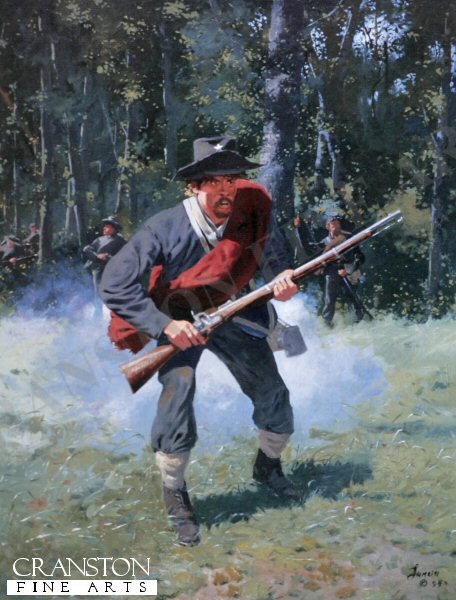
1st Texas Infantry by Jim Lancia (P) No text for this item |
Anzio Annie, Italy, 29th January 1944 by David Pentland. (P) Sturmgeschutz IIIg and Paratroops of the 4th Fallschirmjager Division, driving to the front line, pass one of the two giant 28cm K5 (Eisenbaum) railway guns responsible for the shelling the Allied beacheads at Anzio and Nettuno. |
Raising the Standard at Glenfinnan, by Mark Churms. (P) Supported by the Highland Chiefs with twelve hundred highlanders present. Prince Charles Edward Stuart raised his standard at Glenfinnan on the 19th August 1745. This was the start of the Forty Five which would end with the defeat of the Jacobite Army on Drumossie Moor at the battle of Culloden 16th April 1746. |
Battle on the Volga, Stalingrad, Southern Russia, 30th September 1942 by David Pentland. (P) Germany Infantry assault troops and PzIV tank of the 24th Panzer Division are counterattacked by Soviet riflemen of General Chuikovs 62nd Army as they push towards the Red October factory works. |
Defenders of the Reichswald by David Pentland. (P) Goch-Gennep, Germany, 9th February 1945. The Sturmgeschutz III of Leutnant Heinz Deutsch, Stug-Brigade XII, and paratroops of 7th Fallschirmjager Division counterattacking the Allied advance into the Reichswald forest in the final months of the war. The small Stug brigade numbering at its peak only 30 assault guns was responsible for the destruction of 250 allied tanks, Deutsch's gun claiming 44 of that total. |
The Machine Guns - Battle of Amiens, France, 8th August 1918 by David Pentland. (P) A German machine gun team defend against the British 3rd Corps attack on the high ground north of the Somme. This was to be the start of the final Allied offensive of the war. |
Wounded by Mark Churms. (P) Corporal Allen and Corporal Lyons, B. Company 2nd Battalion 24th Foot Rorkes Drift Back Wall, 6pm January 22nd 1879. After the initial Zulu assault on the back wall of the post failed at about 4.30pm, a fire-fight broke out between Zulu snipers posted on the terraces of the Shiyane (Oskarsberg) Hill and the defenders posted behind the barricade of wagons and mealie-bags. This section of the wall as commanded by Sergeant Henry Gallagher, of B Company. At about 6 pm, Corporal Lyons was leaning over the barricade to aim when he was hit in the neck by a bullet which paralysed him, as his friend, Corporal Allen, bent to help him, Allen too was shot through the arm. In the foreground Corporal Attwood of the Army Service Corps distributes ammunition. The wall was abandoned shortly after and the British retired to the small are in front of the storehouse. Allen was later awarded the VC, and Attwood the DCM. He was born at Churcham, Gloucestershire, and served for five years in the Monmouthshire Militia before joining the 24th Regiment. He served through the Kaffir War 1877-8 before his bravery at Rorkes Drift for which he was presented with the Victoria Cross by Lord Wolseley on August 3rd 1879. He later served in the 1st Volunteers Battalion Royal Fusiliers. |
Richard the Lionheart by Ivan Berryman. (P) No text for this item |
The Taking of Stirling Bridge by Mike Shaw (P) The taking of Stirling Bridge over the Forth by the Scots marks the point where the first great battle of the Scottish wars of independence was won. The heavily equipped English army, now divided into two, struggle to fight in the heavy ground of the river plain. In the centre the Scots Captain Wallace can be seen slaying treasurer Cressingham, while to the right lies a fatally wounded Sir Andrew de Moray. A very large and impressive painting. |
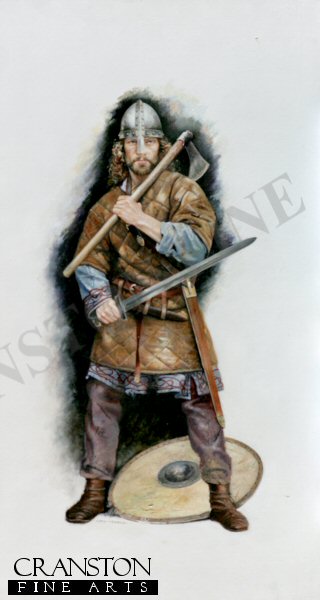
The Viking Hersir by Chris Collingwood. No text for this item |
Original Oil Study of the Marshal Ney at the Battle of Waterloo painting by Mark Churms. (P) No text for this item |
Polish Winged Lancers - Battle of Vienna, September 12th 1683 by Brian Palmer. (P) In an attempt to expand into Europe, Ottoman Turks under the command of Grand Vizier Kara Mustafa laid siege to Vienna for two months. A coalition of Polish, German and Austrians led by John III Sobieski, the King of Poland, arrived before Vienna to raise the siege. Sobieski led a charge of 20,000 cavalry, including the fearsome Winged Hussars into the Ottoman camp and completely routed their army. The battle was over in three hours, the Turks fled the field leaving behind tents, weapons, battle standards and provisions. The threat to Europe had been reversed, and this battle signaled the beginning of the end for the Ottoman Empire. |
Mr Churchill's Tank by David Pentland. (P) Normandy, France, 1944. British Churchill Mk VII tanks of 147 Regiment, 34th Tank Brigade, Royal Armoured Corps, move through a deserted Normandy farmyard in the dense Normandy Bocage. |
The Last Battle, Berlin, 30th April 1945 by David Pentland. (P) Unterscharfurher Karl-Heinz Turk of the Schwere SS Panzerabteilung 503, in one of the units few remaining Kingtigers, defends the Potsdammer Platz along with elements of the Munchberg Division against the rapidly encroaching Soviet forces. |
Piper Bill, Pegasus Bridge, Normandy, 13.00hrs, 6th June 1944 by David Pentland. (P) Commandos of 1st Special Service Brigade, led by Lord Lovat, are piped past the defenders of the Caen canal (Pegasus) bridge by piper Bill Millin. The bridge was originally taken in a coup de main attack by the gliders of 6th Airborne Divisions D Company, 2nd battalion Oxfordshire and Buckinghamshire Light Infantry, led by Major John Howard earlier that morning. Shortly afterwards the glider troops were reinforced by 7 Parachute Battalion, and together they held the area against German attacks until the main British forces landing at Sword beach could fight through to join them. |
Well Earned Rest by Jason Askew. (P) After taking the town of Sainte-Marie-du-Mont, US infantry take time out for coffee and cigarettes while keeping a look out from the rooftop of the building they have captured. |
Colour Party, 1829 by Mark Churms. (P) Study for the original painting March Past of the Grenadier Guards. |
|
Contact Details |
Sign Up To Our Newsletter!
This website is owned by Cranston Fine Arts. Torwood House, Torwoodhill Road, Rhu, Helensburgh, Scotland, G848LE Contact: Tel: (+44) (0) 1436 820269. Email: cranstonorders -at- outlook.com
|