|
|
|
|
|
|
|
|
|
Cranston Fine Arts  Military Art and Artists World War Two Campaigns Military Art and Artists World War Two Campaigns  Normandy Normandy |
[UP] - D-Day - Dunkirk - Eastern Front - Italy - North Africa - Normandy - Ardennes - Burma - Manchuria - Pacific |
| Navigation | |
| Page 2 of 3 | Previous .. Page 2 .. Next |
|
|
|
|
|
|
|
|
|
|
|
|
|
|
|
|
|
|
|
|
|
| Navigation | |
| Page 2 of 3 | Previous .. Page 2 .. Next |
| Text for the above items : |
Hell's Corner, 7th June 1944 by David Pentland. The men of the US 501st Parachute Infantry Regiment ambushed the German 1st Battalion, 6th Fallschrimjager Regiment making their way to Carentan, the Battle of Hell's Corner ensued. |
Mr Churchill's Tank by David Pentland. Normandy, France, 1944. British Churchill Mk VII tanks of 147 Regiment, 34th Tank Brigade, Royal Armoured Corps, move through a deserted Normandy farmyard in the dense Normandy Bocage. |
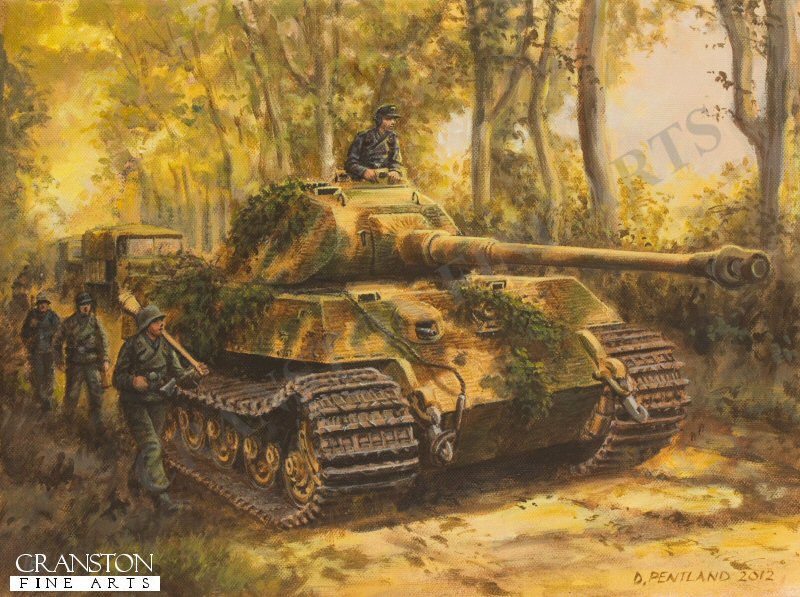
The Shepherd by David Pentland. Orville, Normandy, 20th August 1944. Within days of the death of his friend and commander Obfw. Fendesack, Feldwebel Kurt Knipsel climbed into the last remaining Tiger II of 1st Company 503rd Heavy Tank Battalion as a tank commander. While leading the unit's retreat to the Seine he more than once saved it by knocking out allied tanks at extreme visual range. On the 28th the column reached Pontiose, and safety. |
Enemy in Sight by David Pentland. Cheux, Normandy, 25th June 1944. Royal Armoured Corps Recce troops of the 15th (Scottish) Infantry Division set up a temporary observation post to locate 12th SS Panzer Division positions, prior to Operation Epsom. The 15th Division comprised of 9th Cameronians, 2nd Glasgow Highlanders, 7th Seaforth Highlanders, 8th Royal Scots, 6th Royal Scots Fusiliers, 6th King's Own Scottish Borderers, 10th Highland Light Infantry, 2nd Gordon Highlanders and the 2nd Argyll and Sutherland Highlanders. |
Arromanches by David Pentland. Normandy, Mid-June 1944. A REME Leyland Retriever mobile workshop truck and M7 Priest SP gun of 33rd Field Regiment, Royal Artillery, 3rd Infantry Division, disembark from an LST at one of the Whale floating roadways that made up the British Mulberry B harbour at Arromanches. |
Lying in Wait by David Pentland. Rauray, Normandy, 1st July 1944. A 6pdr anti tank gun team of the 49th (West Riding) Infantry Division, The Polar Bears, in action against the attacking tanks and infantry of 9th SS and 2nd SS Panzer Divisions. The 49th Division comprised of 1st Tyneside Scottish, 10th & 11th Durham Light Infantry, 4th Lincolnshire, 1/4th King's Own Yorkshire Light Infantry, the Hallamshire Battalion, 6th & 7th Duke of Wellingtons, and 11th Royal Scots Fusiliers. |
Sanctuary by David Pentland. Abbey DArdenne, Normandy, 8th July 1944. Commander of 3rd Company, SS-Panzer Regiment 12, Obersturmfuhrer Rudolf von Ribbentrop, shelters within the walls of the Abbey DArdenne. After a full day of battle against the Canadians, the remaining Panthers of the unit along with Panzer Grenadiers of 25th Reminet managed to halt their advance just in front of the divisional headquarters at the abbey. |
Taming the Tiger by Geoff Lea. It is August 1944, barely two months since the Allies landed their first troops on the beaches of Normandy. After the failed Operation Luttich (codename given to a German counterattack during the Battle of Normandy, which took place around the American positions near Mortain from 7 August to 13 August, 1944 ) The German Panzer Divisions were in full retreat, The British and American Generals believed it to be critical to halt them before they cauld regroup. Caught in the Gap at Falaise, the battle was to be decisive. Flying throughout a continuous onslaught, rocket-firing Typhoons kept up their attacks on the trapped armoured divisions from dawn to dusk. The effect was devastating: at the end of the ten day battle the 100,000 strong German force was decimated. The battle of the Falaise Pocket marked the closing phase of the Battle of Normandy with a decisive German defeat. It is believed that between 80,000 to 100,000 German troops were caught in the encirclement of which 10,000 to 15,000 were killed, 45,000 to 50,000 taken prisoner, and around 20,000 escaped . Shown here are German Tiger I tanks under continues attack by Royal Aoir Force Typhoons. |
Tiger! Tiger! by Nicolas Trudgian. The infamous Tiger Tank, one of the the deadliest fighting machines ever built and the most successful tank ace of WWII, Michael Wittmann. Wittmanns Tiger advances towards Beauvais in June 1944 to intercept the advancing British 7th Armoured Division - the famous Desert Rats - during the Allied Invasion of Normandy. Awarded the Knights Cross with Swords and Oak Leaves, Michael Wittman was the most decorated tank commander of WWII but, together with his entire crew, lost his life on August 8 in the battle for Cintheaux when his Tiger received a direct hit from a rocket fired by an RAF Typhoon ground attack fighter. |
We Treated Them All The Same by Simon Smith. IN HONOUR AND IN RECOGNITION OF ROBERT E.WRIGHT, KENNETH J. MOORE, MEDICS 2nd Bn 501 PIR, 101st AIRBORNE DIVISION FOR HUMANE AND LIFE-SAVING CARE RENDERED TO 80 COMBATANTS AND A CHILD IN THIS CHURCH IN JUNE 1944. These simple words, carved into a stone memorial outside the ancient church at Angouville-au-Plain, a small hamlet six miles south-west of Utah Beach in Normandy, recall the heroic actions that took place. In the early hours of 6 June 1944 two medics from the 101st Airborne - Kenneth Moore and Robert Wright - arrived to find themselves in the middle of a confused and savage firefight. Undeterred by the fighting around them the two men immediately set up a field dressing-station in the little village church to treat the growing numbers of wounded. In an act of true humanity within the brutality of war, the two medics insisted on treating every wounded soldier brought here equally, regardless of the uniform they wore. There was, however, one simple rule. No guns were to be brought inside the church. When two German paratroopers burst through the doors, machine-guns raised, the medics simply stared them straight in the eye and nodded down to the young German soldier they were treating. The two enemy paratroopers immediately understood. Both saluted and withdrew. By the time the fighting was over, all but three of the 80 wounded had survived. |
Closing the Door by David Pentland. Norrey en Bessin, Normandy, 11th July 1944. A counter attack by the Panthers of Obersturmfuhrer Hans Siegels 8th Company, SS-Panzer Regiment 12, along with Panzer Grenadiers of the 26th Regiment, virtually destroyed a breakthrough by the Canadian 1st Hussars and Queens Own Rifles of Canada. |
Scots Guards Fighting Through the Bocage by Terence Cuneo. Action of the right flank, 3rd Battalion Scots Guards during the advance from Caumont to Les Loges, Normandy, 30th July 1944. Commanding the Churchill tank, Lochinvar is Lt Robert Runcie later to become Archbishop of Canterbury. |
The Greys by David Pentland. Normandy, Odon, France, 1944. M4 Sherman II's of the Royal Scots Greys, 4th Armoured Brigade, during Operation Epsom. |
Counter Attack at Villers Bocage by David Pentland. A handful of Tigers from 2nd Kompanie SS Schwere Panzer Abteilung 101 halted the advance of the British 7th Armoured Division, The Desert Rats, outside the little Norman village of Villers Bocage. Prowling through the streets of the village, the solitary tank of Hauptsturmfuhrer Michael Wittmann knocked out most of the 4th County of London Yeomanry's regimental HQ Stuart and Cromwell tanks, before falling victim to a 6pdr anti-tank gun. Wittmann survived the battle but was killed a month later on August 8th 1944. |
Holding the Line by Richard Taylor. Skillfully led by their mercurial commander, SS-Hauptsturmfuhrer Michael Wittmann, the Tiger Tanks of s.SS-Pz. Abt. 101 blaze through a shattered French village in the days following D-Day, June, 1944. Their destination - Normandy! |
First Response by David Pentland. Caen, Normandy, 7th June 1944. Panzer IVGs of 7th Company, 2nd Panzer Battalion, 12th SS Division, supporting Panzer Grenadiers fron the 2nd Battalion, 25th Panzer Grenadier Regiment, in their attack on St Contest and Gamanche. Both objectives were successfully taken, and along with other simultaneous attacks the Canadian advance was stalled in front of Caen. |
Wittmann at Villers Bocage, Normandy, 0900 hrs, June 13th 1944 by David Pentland. While other Tigers of his command struck northwest and decimated the tanks and half tracks of the Sharpshooters and Rifle Brigade parked along the road towards point 213 and Caen, Haupsturmfuhrer Michel Wittmann attacked on his own to the south east. Driving his panzer into the village of Villers Bocage. he proceeded to destroy the Stuart and Cromwell tanks of Viscount Arthur Cranleys 4th County of London Yeomanry the Sharpshooters RHQ. Although subsequently immobilized in the village center, the battle between the British 7th Armoured Division Desert Rats and Wittmanns 101st Heavy Tank Battalion continued for a full day, and blunted the British threat to the German line. |
Panthers in the Fog by David Pentland. Mortain, France, 7th August 1944. Panther tanks of 1st SS Panzer Division 'Leibstandarde' attack units of US 30th Infantry Division in Mortain under cover of heavy fog. Following the successful American breakthrough at St. Lo, and the virtual collapse of the western half of the German line, Hitler ordered an immediate counterattack between Mortain and Avranches to halt the US forces. 'Operation Luttich' was the code name given to this last major German counterattack in Normandy. Initially successful the operation was doomed to failure once the weather cleared and the US air support was brought to bear. |
Heavy Artillery by David Pentland. Falaise, 12th - 21st August 1944. British 5.5 inch guns of the Royal Artillery in action during the final Normandy battles to close the Falaise Pocket. |
David and Goliath by David Pentland. Vernon, France, 27th August 1944. Leading 30th Corps assault across the Seine at Vernon, 43rd Wessex Division gained an initial foothold on the east bank. Heroic efforts however by the Royal Engineers of 71st, 72nd and 73rd Field Companies, succeeded in constructing a Class 9 Bailey bridge (David, shown left) and a Second Class 40 bridge (Goliath, shown right) Despite constant enemy fire this amazing feat was achieved in only 2 days, and allowed 15/19th Hussars Cromwells and 4.7th Dragoons Guards Shermans to cross just in time to repulse a serious German counter attack by Tiger IIs of SS Panzer Abteilung 101. |
82nd Airborne by Chris Collingwood. Superb figure study of the 82nd Airborne in 1944. |
|
Contact Details |
Sign Up To Our Newsletter!
This website is owned by Cranston Fine Arts. Torwood House, Torwoodhill Road, Rhu, Helensburgh, Scotland, G848LE Contact: Tel: (+44) (0) 1436 820269. Email: cranstonorders -at- outlook.com
|