|
|
|
|
|
|
|
|
|
Cranston Fine Arts  Military Art and Artists More Military Artists B  Berryman, Ivan |
[UP] - Bacon, John Henry Frederick - Bagdatopulos, B S - Baines, Thomas - Baker, Bernad Granville - Balling - Barker, J. - Barrett, Jerry - Beavis, R - Becker, Carl - Begg, S - Bellange, H - Bendixon, Siegfried Detler - Benigni - Benvenuti - Berkeley, Stanley - Berne-Bellecour, E - Berryman, Ivan - Bourgain, Gustave - Bradshaw, Bud - Brooke, Richard - Brown, Stuart - Brueghel, J - Buckley, J E - Bunnet, H - Burchett, Richard |
| More Pages : Original Paintings |
| Ivan Berryman |
Over the last 30 years, Ivan Berryman has become a leading aviation, motor racing and naval artist. In this time, the subjects of his paintings have been wide and varied as he has deliberately strived to include some of the lesser know aircraft, ships and events in his portfolio, which includes aircraft like the Defiant, TSR2, Beaufort, ships including MTBs and corvettes, and around 100 different aircraft of the first world war. In addition to this he has taken new approaches to the classic subjects of his field, including the Dambuster Lancasters, Battle of Britain Spitfires, Bf109s and Hurricanes, HMS Hood, Bismarck and the best known naval ships, as well as some iconic sporting moments. In his own words : Art and aviation have been like a brother and sister to me. We have grown up together, learned together and made our adult lives together. But you do not have to have an appreciation of aircraft to admire the graceful lines of a Spitfire or the functional simplicity of a Focke-Wulf 190. They are themselves a work of art and they cry out to be painted - not as machines of war and destruction, but as objects of beauty, born of necessity and function, yet given a life and iconic classicism beyond their original calling. My interest and love of art and aircraft was gifted to me by my father, a designer and aeronautical engineer of considerable repute. Denis Berryman C.Eng. FRAeS. He gave me his eyes, his passion, his dedication and his unwavering professionalism. I owe him everything. And I miss him terribly. A love of art and of beautiful and interesting things takes you on a journey. You discover new interests, new fascinations, and you want to paint them. You want to paint them in their environment, in their element. Whether it is an aeroplane, a warship, a racing car or a beautiful woman, their gift to an artist is the same: Their lines, their texture and the way that light and shadows give them form. These are the food and oxygen of an artist. Not the paint and the canvas. These are mere tools. The secret is in the passion and the perception... |
|
|
|
|
|
|
|
|
|
|
|
|
|
|
|
|
|
|
|
|
|
| Text for the above items : |
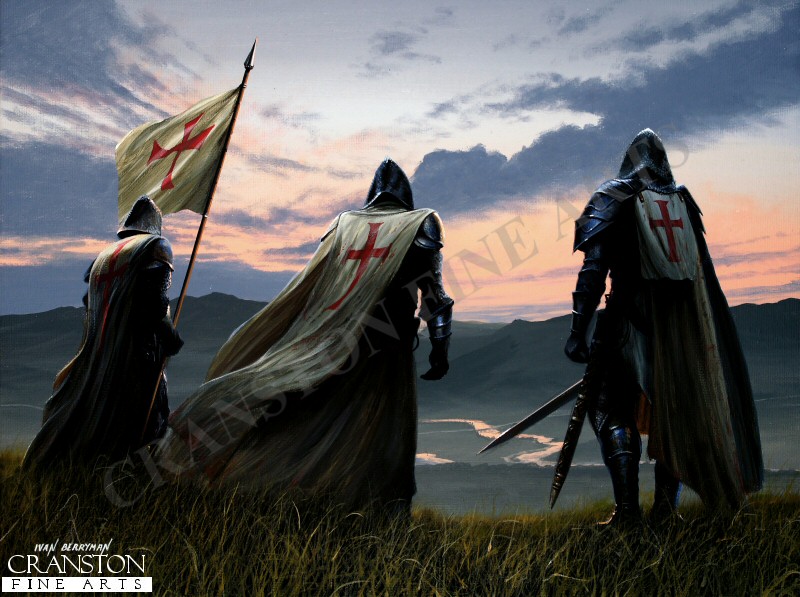
Unholy Land by Ivan Berryman. The Knights Templar, clad in distinctive white mantles adorned with red crosses. These skilled warriors protected Christian pilgrims across the Holy Land and were one of the most powerful military assets during the crusades. |
The Shield Wall by Ivan Berryman The Roman shield wall tactic involved soldiers forming a tight, protective barrier with their large shields, creating an effective defensive formation that allowed them to withstand enemy attacks while simultaneously presenting a solid front for offensive manoeuvres. |
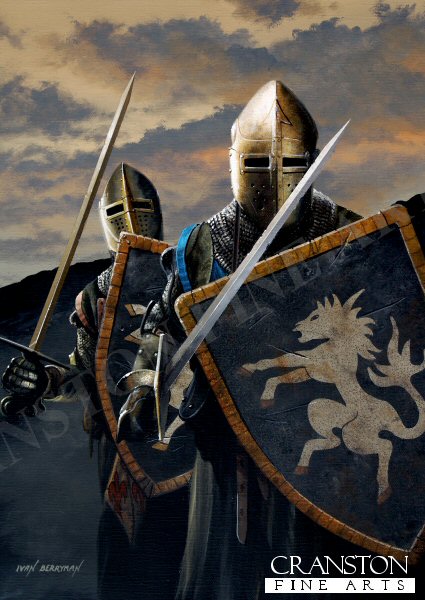
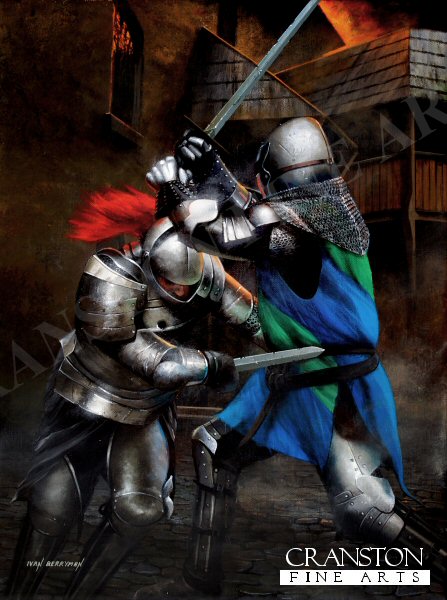
Wouldst Though Challenge Me? by Ivan Berryman. A knight fought with measured precision, the shield always close, turning aside blows and driving the enemy off balance. The sword worked in tight, efficient motions-quick cuts and thrusts aimed at the gaps in armour. Every move was a rhythm of defence and attack, shield creating the opening, sword striking in the moment that followed. |
The Last Knight by Ivan Berryman. No text for this item |
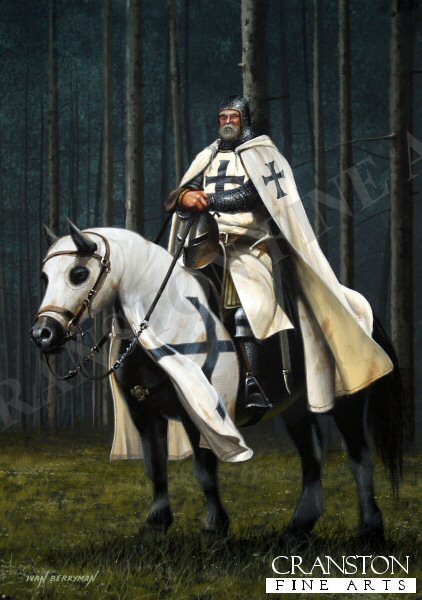
The Old Soldier by Ivan Berryman An Old Knight of the Teutonic Order after many years of service, having fought the crusades in the Holy Land and returned to Europe to continue the battle against pagans in the Baltic states, he is shown wearing the distinctive black cross on his white cloak. |
First Dawn in Britain by Ivan Berryman The Roman conquest of Britain was the Roman Empire s conquest of most of the island, which was inhabited by the Celtic Britons. It began in earnest in AD 43 under Emperor Claudius, and was largely completed in the southern half of Britain (most of England and Wales) by AD 87. |
The Wrath by Ivan Berryman. Spartan warriors were known for their long hair and red cloaks. Their constant military drilling and discipline honed their skills in the ancient Greek style of combat, particularly in the phalanx formation. |
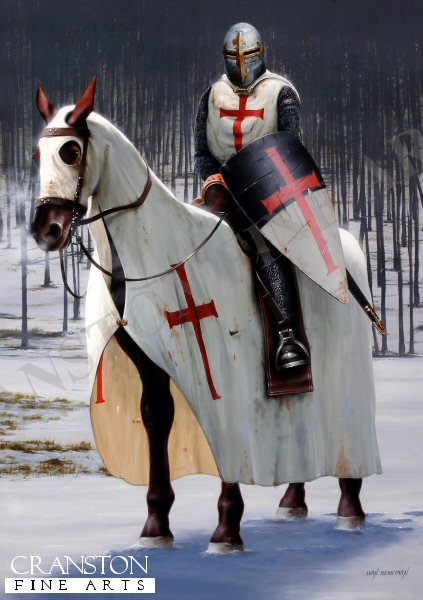
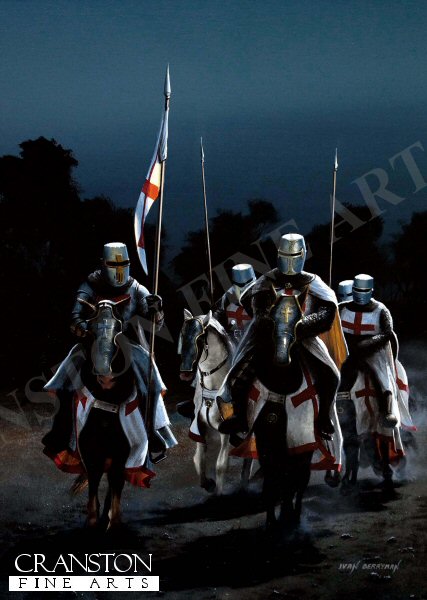
Non Nobis Domine by Ivan Berryman A Knight Templar on horseback, his horse draped in the iconic heraldry of the order. Perhaps one of the most recognisable heraldic symbols of the time, the cross represented martyrdom and courage and was displayed proudly by all members of the Knights Templar. |
The Brave 91 by Ivan Berryman. Lt JG Arend Vyn Jr USCGR guides LCI 91 through a hail of fire toward Omaha Beach on 6th June 1944 carrying 201 men from Headquarters 116th Infantry, 147th Engineers Battalion, 121st Engineers Battalion and 7th Beach Battalion. After a troubled approach to Dog White Beach, a successful disembarkation was accomplished, but US91 was damaged by a mined stake and was eventually lost to enemy artillery as she began her withdrawal, the vessel being abandoned on the sands of Omaha Beach. The command ship USS Ancon (AGC-4) can be seen in the background. |
The Knight's Wrath by Ivan Berryman. A Templar Knight of the medieval order best known today as the Knights Templar. Existing from the early 12th century for nearly two hundred years when they were disbanded by the Pope after members in France were arrested, tortured and murdered under the orders of King Philip IV, the order are closely linked to The Crusades and faded as an organistaion after the Holy Land was lost. King Philip IV was in deep financial debt to the order who had grown rapidly in wealth and made innovations in early banking and he used the end of the Crusades to successfully push for the disbandment of the order. |
Through Hell to Omaha by Ivan Berryman. Troops of the 5th Ranger Battalion forge ahead through a hail of plummeting shells and crossfire as their British landing craft from HMS Prince Baudouin make their perilous way to Omaha Beach on D-Day, 6th June 1944. |
Julius Caesar by Ivan Berryman. Julius Caesar was a Roman general renowned for his military prowess. He achieved notable victories in the Gallic Wars (58-50 BC), expanding Roman territory to include present-day France and Belgium. Caesars conquest of Gaul culminated in the decisive Battle of Alesia. His subsequent Civil War against Pompey (49-45 BC) saw him triumph in battles like Pharsalus and Munda, ultimately leading to his dictatorship over Rome. His military successes laid the groundwork for the transition from the Roman Republic to the Roman Empire. |
The Blood Red Cross by Ivan Berryman. No text for this item |
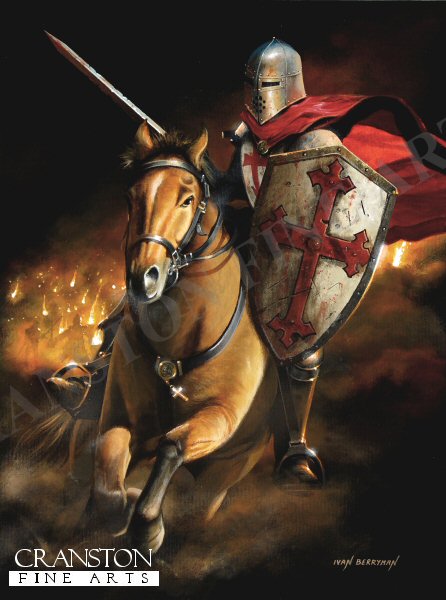
God's Work by Ivan Berryman. A key stratagem of the Knights Templar was the Squadron Charge in which a group of knights and their armoured warhorses would charge towards enemy lines at full speed. This displayed their ferocity and sheer determination and would often break a hole in enemy lines, allowing the tides of battle to change in favour of the Knights Templar forces. |
Man Down by Ivan Berryman. Archers posed a unique challenge to Spartan warriors, who were primarily trained for close combat in phalanx formations. While the heavily armoured Spartans could withstand a significant amount of missile fire due to their large shields and protective armour, sustained volleys of arrows could disrupt their formations and cause casualties. |
The Five by Ivan Berryman. No text for this item |
The Last Stand by Ivan Berryman. The Romans used war elephants mainly after encountering them in battles against Pyrrhus of Epirus and Carthage. Initially, they struggled but adapted their tactics over time. Elephants were used in various campaigns, notably in Greece and during the Punie Wars. By the time of Emperor Claudius, their use declined serving more for psychological impact and ceremonial purposes. The last significant use of war elephants by the Romans was at the Battle of Thapsus in 46 BC. |
Leonidas by Ivan Berryman. Leonidas, the Spartan king, etched his name into history through unwavering courage. As the epitome of braverym he stood against the invading Persian army at the pass of Thermopylae in central Greece. Leading a small band of Greek allies, Leonidas valiantly defended the narrow passage, where Xerxes' massive army sought to invade Greece. |
The Power of the Sword by Ivan Berryman. A knight's one-handed sword was a study in balance-blade long enough for reach, yet light enough for quick recovery behind a shield. Its double edge tapered to a precise point, suited for both cutting through mail and thrusting into the joints of plate. The crossguard flared straight and simple, protecting the hand without burdening it, and the pommel served to counterbalance the blade's weight. |
A Fear of the Knight by Ivan Berryman. No text for this item |
To the Death by Ivan Berryman. No text for this item |
|
Contact Details |
Sign Up To Our Newsletter!
This website is owned by Cranston Fine Arts. Torwood House, Torwoodhill Road, Rhu, Helensburgh, Scotland, G848LE Contact: Tel: (+44) (0) 1436 820269. Email: cranstonorders -at- outlook.com
|