|
|
|
|
|
|
|
|
|
Cranston Fine Arts  Military Art and Artists Featured Current Military Artists Military Art and Artists Featured Current Military Artists  Chris Collingwood Chris Collingwood |
[UP] - Chris Collingwood - David Pentland - Mark Churms - Brian Palmer - Graeme Lothian - Jason Askew - Terence Cuneo - David Rowlands |
| More Pages : Ancient History - Medieval History - Napoleonic Art - Crimean War - American Civil War - Colonial India - Zulu Wars - World War Two - Historical Portraits - Original Paintings - Original Drawings - Postcards |
| Chris Collingwood |
Chris has produced a wealth of impressive paintings from the Napoleonic War, American Civil War, English Civil War, and a variety of Portraits of Great Military Leaders, He also has produced superb paintings of Pirates, a particular favourite of his. Chris studied at Berkshire College of Art 1966 - 1970 and then worked for Halas and Batchelor as a background artist. In the golden age of book cover illustration Chris made the Gunslinger, Crow and Herne series his own. To this day the shelves of high street booksellers are full of his work. Perhaps his best known popular pieces are in the now famous Jorvik Centres paintings which form the focus of the exhibitions promotion and won a travel industry award. In recent years his best work has been paintings, such as SPQR, Anne Bonny, Mary Reid and Calico Jack Rakam and Blackbeard in Damnation Seize My Soul. His super realistic style, using oils, brilliantly reflects the techniques, passion and depth of the old masters. He has a particular love of portraiture, which his portraits of Wellington and William of Orange certainly reflect, along with others from the English Civil War, his love of the subject. He is also fascinated by the awful romance of weaponry and war. Chris uses traditional Dutch paints made today, as in 1664, and is meticulous in his research and attention to detail, so scarce in our modern throw away society. Sir Anthony Van Dyke, William Dobson, Sir Peter Lely and Fortunio Matania played a vital part in his formative years. He also is much influenced by Meissonier and De Neuville. |
| Navigation | |
| Page 6 of 8 | Previous .. Page 6 .. Next |
|
|
|
|
|
|
|
|
|
|
|
|
|
|
|
|
|
|
|
|
|
| Navigation | |
| Page 6 of 8 | Previous .. Page 6 .. Next |
| Text for the above items : |
US 8th Cavalryman by Chris Collingwood. (P) No text for this item |
Confederate Infantryman by Chris Collingwood. No text for this item |
Tending the Wounded at Rorkes Drift by Chris Collingwood. (P) No text for this item |
Parliamentarian Harquebusier Trooper by Chris Collingwood. Part of a series of seven English Civil War uniform stuies. |
The Burning Moment - 1916- The Somme by Chris Collingwood. The 1st Battalion Lancashire Fusiliers going over the top on July 1st 1916, Battle of the Somme. |
Heer Grenadiers - Operation Citadel, July 1943 by Chris Collingwood. (AP) In July 1943 during the eastern campaign, 15 divisions of the German field army (feldheer) were needed for Operation Citadel. The losses suffered were so heavy that there were no longer enough recruits available to replace the fallen. Back in Germany, young men of 18 and 19 were being incorporated into Ersatz-Battalione to fill the depleted ranks. Through the gloom and smoke of battle, two such Grenadiers sight the enemy. The ever present tension and fear of mortal combat takes hold - only their courage and training may save them. |
Primus Pilus by Chris Collingwood. In his 50s with 30 years experience, who has now attained High Centurian rank and commands the entire 1st Cohort. |
15th Hussars 1809 by Chris Collingwood. No text for this item |
Rorkes Drift by Chris Collingwood. Pencil detail of men of the 24th of Foot, or 2nd Warwickshire regiment (later in 1881 to become the South Wales Borderers) standing in preparation to repel the massed Zulus attempting to smash through the mealie bag entrenchment. At the conclusion of the battle, hundreds of Zulus lay dead. According to official figures the British lost 25 men, 11 Victoria crosses were awarded. |
Alfred The Great by Chris Collingwood. Alfred was born in 849 at Wantage, Oxfordshire He was the youngest son of King Ethelwulf of Wessex, he became King of the Anglo Saxon Kingdom of Wessex from 871 to 899. Alfred is known for his great defence of the Kingdoms of southern England against the Vikings. Eventually in 871 he made peace with the Vikings who agreed to a withdrawal out of his kingdom. It is likely a large payment of gold was made. Alfred was awarded the epithet The Great, and was the only king to be awarded this title. Alfred the Great was a learned man and improved the education and legal and military systems and structure. Alfred died on the 26th October 899 |
Stonewall Jackson by Chris Collingwood. No text for this item |
William III by Chris Collingwood. Showing William III in full Black Armour at the time of the Battle of Boyne. |
Soldier, 24th of Foot at Rorkes Drift by Chris Collingwood. (P) No text for this item |
Opposing Generals of Horse - Battle of Marston Moor by Chris Collingwood. Portraits of Sir Thomas Fairfax and Prince Rupert of the Rhine. Sir Thomas Fairfax (1612-71) Captain general of the Parliamentary New Model Army and his opponent Prince Rupert of the Rhine (1619-82) nephew of King Charles 1st and general of Royalist Horse. Centre section of the painting depicts cavalry engagement during the battle of Marston Moor. |
British Lancer c.1914 by Chris Collingwood. No text for this item |
Tribute to the 95th Rifles by Chris Collingwood. In August 1808 the 2nd battalion of the 95th Rifles were part of the expedition commanded by Sir Arthur Wellesley to Portugal and covered the landings at Mondego Bay. On 15th August during a skirmish at Obidos, they had the distinction of firing the first shots of the Peninsular War against the French. The Rifles were trained to think quickly and by themselves in dangerous situations, they were also taught to work and fight together in pairs while firing harassing and well aimed shots at the enemy. The Baker rifle which the 95th used was an accurate weapon for its day, with reported kills being taken up to 270 metres away. During the Peninsular War, Rifleman Thomas Plunkett of the 1st Battalion, 95th Rifles, shot the French General Auguste-Marie-Francois Colbert at a range that may have been even greater. Rifleman Thomas Plunkett then shot a second French officer who rode to the general's aid. |
Sun in Splendour by Chris Collingwood. Soldiers of the Yorkist cause c.1461. Crossbowman, Man at arms and knight with the standard of the Sun in Splendour. |
Parliamentarian Cornet by Chris Collingwood. Parliamentarian Cornet Standard Bearer of Sir John Fiennes Regiment. Colonel John Fiennes's Regiment of Horse was part of the Right Wing under the comannd of Lieutenant General Oliver Cromwell during the Battle of Naseby during the First English Civil War. Part of a series of seven English Civil War uniform stuies. |
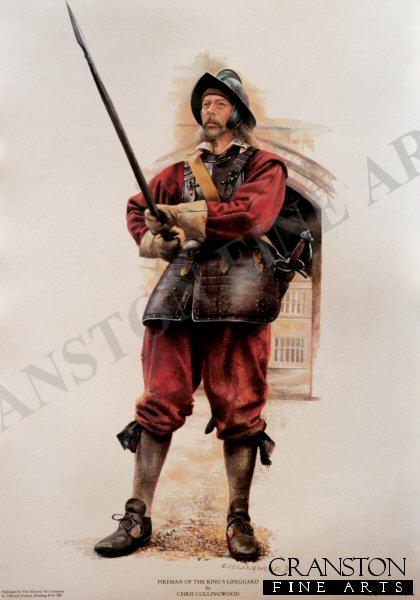
Pikeman of the Kings Life Guard by Chris Collingwood. Part of a series of seven English Civil War uniform stuies. |
SS Panzer Grenadiers by Chris Collingwood. The term Panzergrenadier was applied equally to both the infantry section of the German Panzer Divisons and was also used for the new Panzergrenadier Divisions. The German army Panzergrenadier Divisions initially came from existing infantry divisions but were the first Divisons to be motorised. These included the 3rd, 10th, 14th, 15th, 16th, 18th, 20th, 25th, and 29th divisions. During the war special elite regiments such as the Grosdeutchland Division were created. The Waffen SS also produced a number of panzergrenadier regiments. Many army and Waffen SS regiments were upgraded to Panzer divisions during the later stages of the war. The Panzergrenadier division usually consisted of six battalions of truck-mounted infantry organized into either two or three regiments, also a battalion of tanks and artillery were included along with sections of anti-tank, anti-aircraft and combat engineers. Panzer grenadier divisions were often equipped with assault guns - Stugs. Panzergrenadier divisions had one tank battalion less than a Panzer division but strengthened with two more infantry battalions. Of 226 panzergrenadier battalions in the whole of the German Army, Waffen SS (and some in the Luftwaffe ) in September 1943, only 26 were equipped with armoured half tracks, the remaining Panzergrenadier divisions were equipped with trucks. |
1461, Gunpowder by Chris Collingwood (P) No text for this item |
|
Contact Details |
Sign Up To Our Newsletter!
This website is owned by Cranston Fine Arts. Torwood House, Torwoodhill Road, Rhu, Helensburgh, Scotland, G848LE Contact: Tel: (+44) (0) 1436 820269. Email: cranstonorders -at- outlook.com
|