|
|
|
|
|
|
|
|
|
Cranston Fine Arts  Military Art and Artists Featured Current Military Artists Chris Collingwood Military Art and Artists Featured Current Military Artists Chris Collingwood  World War Two World War Two |
[UP] - Ancient History - Medieval History - Napoleonic Art - Crimean War - American Civil War - Colonial India - Zulu Wars - World War Two - Historical Portraits - Original Paintings - Original Drawings - Postcards |
| More Pages : 82nd Airborne |
|
|
|
|
|
|
|
|
|
|
|
|
|
|
| Text for the above items : |
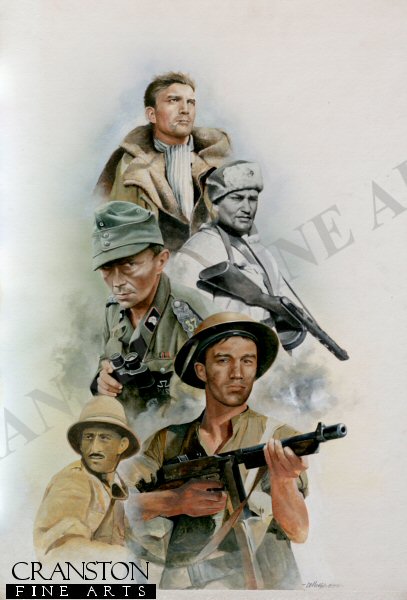
General Erwin Rommel with the Africa Korps before the Battle for Tobruk by Chris Collingwood. No text for this item |
Original art for the poster of the film The Big Red One starring Lee Marvin by Chris Collingwood. No text for this item |
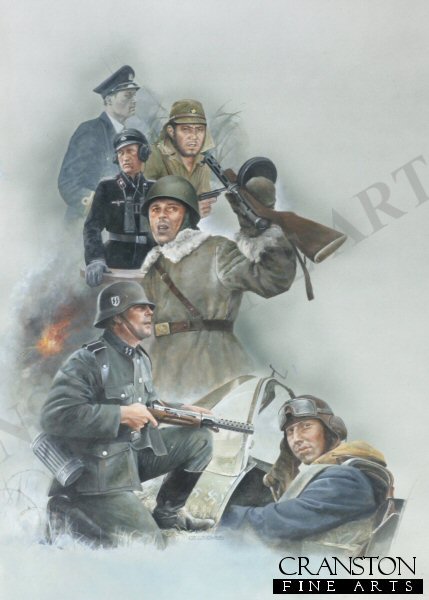
Original art work for the book A Time of War Vol I, The Transgressors by Chris Collingwood. No text for this item |
82nd Airborne by Chris Collingwood. Superb figure study of the 82nd Airborne in 1944. |
101st Airborne by Chris Collingwood. No text for this item |
SS Panzer Grenadiers by Chris Collingwood. The term Panzergrenadier was applied equally to both the infantry section of the German Panzer Divisons and was also used for the new Panzergrenadier Divisions. The German army Panzergrenadier Divisions initially came from existing infantry divisions but were the first Divisons to be motorised. These included the 3rd, 10th, 14th, 15th, 16th, 18th, 20th, 25th, and 29th divisions. During the war special elite regiments such as the Grosdeutchland Division were created. The Waffen SS also produced a number of panzergrenadier regiments. Many army and Waffen SS regiments were upgraded to Panzer divisions during the later stages of the war. The Panzergrenadier division usually consisted of six battalions of truck-mounted infantry organized into either two or three regiments, also a battalion of tanks and artillery were included along with sections of anti-tank, anti-aircraft and combat engineers. Panzer grenadier divisions were often equipped with assault guns - Stugs. Panzergrenadier divisions had one tank battalion less than a Panzer division but strengthened with two more infantry battalions. Of 226 panzergrenadier battalions in the whole of the German Army, Waffen SS (and some in the Luftwaffe ) in September 1943, only 26 were equipped with armoured half tracks, the remaining Panzergrenadier divisions were equipped with trucks. |
Heer Grenadiers - Operation Citadel, July 1943 by Chris Collingwood. (AP) In July 1943 during the eastern campaign, 15 divisions of the German field army (feldheer) were needed for Operation Citadel. The losses suffered were so heavy that there were no longer enough recruits available to replace the fallen. Back in Germany, young men of 18 and 19 were being incorporated into Ersatz-Battalione to fill the depleted ranks. Through the gloom and smoke of battle, two such Grenadiers sight the enemy. The ever present tension and fear of mortal combat takes hold - only their courage and training may save them. |
Fighting for a Foothold, 82nd Airborne at St Mere Eglise, 1944 by Chris Collingwood. During the morning of June 7th the 82nd Airborne were attacked by a mixed German battle group. Supported by 4th Division armour the Paratroopers and Glider troops repelled the attack which lasted most of the day. |
D-Day by Chris Collingwood. June 6th 1944 allied troops land in Normandy, here assault troops of the South Lancashire Regiment of the British 3rd Infantry Division storm ashore at sword beach. |
Original art work for the book A Time of War Vol II, Come Evil Days by Chris Collingwood. No text for this item |
British Paratroopers 1943 by Chris Collingwood. No text for this item |
US Bombadier by Chris Collingwood. A Bombadier from a B17 Flying Fortress. A tribute to all Bombadier from all Bomber Aircraft. |
Easy Company - The Taking of Carentan by Chris Collingwood. You have a rendezvous with destiny! - promised Major Gen William Lee to his men as the 101st Airborne Division was activated at Camp Claiborne, Louisiana, 15 August 1942. And the first place they kept that rendezvous was Normandy. At precisely 23.00 hours on the night of 5th June 1944, aircraft containing the men of Easy Company, 506th Parachute Regiment, 101st Airborne Division, thundered down the runway at Upottery Airfield. Lifting off into the night, the hazardous mission given to the paratroopers of the 101st was to speaerhead the Allied invasion of Hitler occupied Europe - a rendezvous with destiny if ever there was one. Crossing the French coast two hours later, the vast air armada was met by heavy German AA fire and hampered by heavy banks of cloud, scattering the Division over a wide area. Few units landed in their designated drop zones and by dawn on the morning of 6th June, Easy Company comprised just nine rifle men, two officers, a couple of machine guns, and a mortar. The task of these eleven men - to annihilate a German battery targetting the landings on Utah Beach! Undaunted, this tiny group of young paratroopers ferociously assaulted and captured the battery, their action saving the lives of hundreds of their comrades coming ashore on the beach head below. In the gruelling days that followed, the men of Easy Company fought their way through dense hedgerows, across fields and orchards, through farms and villages towards their next objective - the strategic town of Carentan. Heavily defended by German forces, its seizure was vital to the Allied advance. Portrays the men of Easy Company as they fight their way through the bullet-swept streets of Carentan. Facing the enemy in close combat house-to-house street fighting, the paratroopers relentlessly pounded the enemy until the last vestiges of German resistance were overwhelmed and the objective taken. But for the men of Easy Company and the 101st Airborne, this action is just the beginning of their distinguished but savage war. Others will follow: the liberation of the first Dutch city, Eindhoven; the siege of Bastogne during the Battle of the Bulge; and ultimately, the capture of Hitlers Eagles Nest at Berchtesgaden. |
Easy Company - Moving On by Chris Collingwood. Major Dick Winters and the men of Easy Company, 101st Airborne Division, as they take up a holding position in the Normandy town of Carentan on 14 June 1944, eight days after their dramatic parachute drop into Normandy on D-Day. |
|
Contact Details |
Sign Up To Our Newsletter!
This website is owned by Cranston Fine Arts. Torwood House, Torwoodhill Road, Rhu, Helensburgh, Scotland, G848LE Contact: Tel: (+44) (0) 1436 820269. Email: cranstonorders -at- outlook.com
|