|
|
|
|
|
|
|
|
|
Cranston Fine Arts  Aviation Art and Artists World War Two Aircraft Aviation Art and Artists World War Two Aircraft  Spitfire Spitfire |
[UP] - Beaufighter - Flying Fortress - Fw190 - Halifax - He111 - Hurricane - Lancaster - Liberator - P-38 Lightning - Me109 - Me262 - Mosquito - Mustang - Spitfire - Thunderbolt - More Aircraft |
| Navigation | |
| Page 1 of 15 | Page 1 .. Next |
| Spitfire Aviation Prints |
|
|
|
|
|
|
|
|
|
|
|
|
|
|
|
|
|
|
|
|
|
| Navigation | |
| Page 1 of 15 | Page 1 .. Next |
| Text for the above items : |
Angels Three Zero by Robert Taylor Bobby Oxspring in his 66 Squadron Spitfire destroys an ME109 of JF/53 Ace of Spades Group, in a high level attack at 30,000 feet above Dover, 18th September 1940. |
Spitfires Over Kent by Graeme Lothian. (GL) Spitfires of No.92 Sqn in action over Kent during the Battle of Britain. |
Hammer Blow by David Pritchard Having expended all his ammunition, Sgt Pilot Ronnie Fokes of 92 Squadron shadows the stricken Yellow 7 and its pilot Uffz R Hammer moments before their participation in the Battle of Britain was to end. Having sustained major damage to it's cooling system, Yellow 7 crash-landed on 30th September 1940, at Pelsham House, Peasmarsh Sussex. |
Land, Sea and Air by Ivan Berryman. Spitfire of 761 Training Squadron (attached to the Royal Navy) flies over the Forth Railway Bridge on the eve of World War Two, also shown is HMS Royal Oak departing Rosyth for the open sea. |
Southern Patrol by Philip West. During the battle of Britain, 609 Squadron (PR) and 152 Squadron (UM) were pitting themselves against the Luftwaffe. 609 based at Middle Wallop near Andover and 152 operating from Warmwell were tasked with protecting part of 10 Groups Southern Sector. |
Lone Warrior by Ivan Berryman. A classic beauty in its element, a 19 Squadron Spitfire on a routine patrol in the skies above southern England. |
Battle of Britain, Manston, 12th August 1940 by Gerald Coulson. A surprise dive bombing attack at 12.45pm as Spitfires of 65 squadron were taking off. 148 bombs were dropped on the airfield and hangars. The entire squadron got airborne with one exception, its engine was stopped by the blast from one of the bombs. |
Spitfire Over Buckingham Palace by John Young. (AP) Spitfire from No. 71 (eagle) squadron flys over Buckingham Palace. |
Final Encore by Roy Garner. Spitfire Mk.IX of No.350 Sqn. |
Spitfire Dawn by Keith Woodcock. No text for this item |
First Light - Battle of Britain, July 1940 by Philip West. Another busy start to the day at Biggin Hill in the summer of 1940. The Battle of Britain is at its height and 92 Squadron Spitfires with Geoffrey Wellum in G for George, depart under early morning sunlight to engage a mass of incoming enemy aircraft over the southeast coast. By the end of 1940 the Squadron was credited with having destroyed 127 German aircraft. |
Freedom Fighters by Simon Smith. A pair of Royal Air Force Spitfires fly over the hay fields of southern England as the farmers toil. A tranquil scene which will soon be spoilt with the German Luftwaffe aircraft as the Battle of Britain begins. |
92 Squadron Intercept by Jason Askew. (P) Spitfire QJ-K of No.92 Squadron intercepts a marauding pair of Ju88s over southern England. |
Spitfire F Mk21 by Ivan Berryman. Pushing the concept of the Spitfire almost to the limit, the sleek F Mk212 represented the ultimate in fighter design at the end of the Second World War. Powered by the mighty Griffon 61 engine driving a five blade propeller, its armament consisted of four 20mm British Hispano Cannon, two in each wing. This example is LA200 (DL-E) of 91 Sqn in 1945. |
September Victory by Nicolas Trudgian. (B) Spitfires pass above a downed Me110 as they return to base at Biggin Hill in September 1940, the most intense and crucial phase of the Battle of Britain. |
Spitfire Duo by Barry Price. No text for this item |
In the Sunlit Silence by Gerald Coulson. Spitfire Mk1As of 92 Squadron. |
Evening Patrol by Gerald Coulson. During the early part of World War II the coastline of Britain was constantly under threat, particularly the busy shipping lanes of the North Sea. As well as carrying out bombing raids on strategic coastal targets and ports such as Luftflotte 5s attack on the north-east in August 1940, allied shipping was regularly attacked at sea as the Luftwaffe tried to disrupt supplies. The RAF played a vital part in protecting these supplies, escorting fishing fleets and shipping convoys, as well as long range patrols over the sea, seeking enemy activity and intercepting high altitude reconnaissance aircraft. These patrols were often long and arduous with pilots running the gauntlet of, if shot down, ditching into the sea. Often pilots would survive being hit and baling out, only to succumb to the freezing and hostile waters of the North Sea. Often fighter squadrons being rested during the Battle of Britain, would be moved to northern locations such as Acklington and Leconfield, and carry out coastal and sea patrols before returning to the more intense fighting in the south. Flying over the Humber Estuary as the sun is setting, pilots of 610 Sqn return their MKII Spitfires to Leconfield after a convoy patrol late in 1940. |
First Flap of the Day by Nicolas Trudgian. HM Stephen - one of the Battle of Britains top scoring fighter pilots, brings down two Me109s in quick succession over the White Cliffs of Dover, early on August 11, 1940. Flying a Spitfire with 74 Squadron, HM shot down five German aircraft on this day, and damaged a further three. The note in his log book starts First flap of the day at 0600 hrs ... Published 2000. Sadly, all of the pilots who signed this edition have since passed away. |
Lone Patrol by Ivan Berryman (PC) No 611 Squadron was one of the earliest to receive the Spitfire Mk IX, the first aircraft in the RAFs inventory that could take on Germanys mighty Focke-Wulf 190 on equal terms. OC of 611 Sqn in February 1942 was Sqn Ldr Hugo Armstrong, shown here flying BS435, FY-F. |
Heroes Return by Nicolas Trudgian. In a classic image of wartime England, Mk V Spitfires, symbol of the RAF, defiant against the threat of the Luftwaffe return to their base in the heart of the beautiful rolling English countryside. |
| Spitfire Pilot and aircrew signature details |
 Captain Luke Allen Our estimated value of this signature : £30 | Captain Luke Allen Volunteering for the RAF just as the Battle of Britain was reaching its climax, Luke joined 71 Eagle Squadron, flying his first combat operation in April 1941 on Hurricanes. Converting to Spitfires the squadron had a busy period of patrols, sweeps and escorts before transferring to the USAAF as the 334th Fighter Squadron. Luke flew over 60 combat missions in Europe. |
Flight Lieutenant Peter Allen Our estimated value of this signature : £30 | Flight Lieutenant Peter Allen Completing his pilot training at No.1 OTU in Canada, he was assigned to 54 Sqn on Spitfires which had been relocated from Britain to Darwin, Northern Australia in 1943. The squadron carried out Air Defence patrols against Japanese aircraft and high-level reconnaissance flights. |
Captain Murray Anderson DFC* Our estimated value of this signature : £20 Died : 2016 | Captain Murray Anderson DFC* Commissioned in the Royal Tank Regiment from RMA Woolwich in 1939, Murray Anderson was seconded to the Royal Air Force in 1940. He flew Spitfires with No.1 Photo Reconnaissance Unit at RAF Benson until 1943. He then joined 161 (Special Duties) Squadron flying Lysanders, and was the most successful pick up pilot for the whole of that year even though in May 1944 he was posted to 65 Squadron 2nd Tactical Air Force, flying Mustangs. After a rest period he was posted to 52 Sqn at Dum Dum in May 1945. Murray Anderson died in April 2016. |
  Flight Lieutenant Alexander N R L Appleford Our estimated value of this signature : £40 Died : 2012 | Flight Lieutenant Alexander N R L Appleford Born in September 1921, Robin Appleford was one of the youngest pilots to take part in the Battle of Britain. He joined 66 Squadron at Duxford on 13th May 1940, flying Spitfires. He was shot down over the Thames Estuary during a dogfight on 4th September 1940, but baled out slightly wounded. After a spell as an instructor, in 1943 he flew another combat tour, this time with 274 Squadron, flying Hurricanes on coastal defence in North Africa. After a spell with the Aircraft Delivery Unit, he went to South Africa as a flying instructor. Sadly, we have learned that Alexander Appleford passed away on 17th April 2012. |
Flight Lieutenant Peter Arkell Our estimated value of this signature : £45 Died : 2010 | Flight Lieutenant Peter Arkell For his first tour Peter flew Mustangs and Spitfires with 26 Squadron on intruder and low lever photographic sorties over France, before joining 161 Squadron as Tempsford in 1944, flying Lysanders into occupied Europe. He then accompanied the Lysanders to Burma where he flew 35 successful but hazardous missions supplying Force 136 behind the Japanese lines. He was awarded the OBE in the Queen's Birthday Honours in 1997 for his work as chairman of the Anglo-American community relations committee at RAF Fairford. Peter Arkell passed away on 27th August 2010. |
Flight Lieutenant William Tex Ash Our estimated value of this signature : £15 | Flight Lieutenant William Tex Ash Volunteer American pilot Bill Ash joined the RCAF and flew Spitfires with 411 Squadron gaining 3 confirmed victories. Shot down in 1942 he became a POW and was sent to Stalag Luft III where he took part in 'The Great Escape', and later was involved in more than a dozen escape attempts from POW camps in Poland, Germany and Lithuania. A constant trouble maker to his captors, Bill Ash became a real life 'Cooler King' after many hours spent in solitary captivity. |
Flight Lieutenant Sir John Atkinson KCB DFC Our estimated value of this signature : £45 | Flight Lieutenant Sir John Atkinson KCB DFC John Atkinson joined the RAF from Oxford University in 1938 and completed his pilot training in England. His first operational posting was in 1940 to 234 Squadron at St Eval, Cornwall, flying Spitfires, before moving on to 609 Squadron at Warwell, Dorchester. In 1942 he converted to Typhoons with 609 Squadron at Duxford, and from there to Biggin Hill and Manston, launching fighter operations over France. When his tour of operations ended in 1943 he was awarded the DFC and went on to become a Flying Instructor until the war was over. Released from the RAF in 1945, he went on to have a successful career in the civil service, and was knighted in 1979. |
  Wing Commander Peter V Ayerst DFC Our estimated value of this signature : £45 Died : 2014 | Wing Commander Peter V Ayerst DFC Peter Ayerst joined the RAF in 1938, and was posted to 73 Squadron in August 1939, flying Hurricanes. He went to France with the squadron, scoring his first victory in April 1940. After a spell instructing, when he shared in the destruction of a He111 with two other instructors, he had postings with both 145 and 243 Squadrons. In July 1942 he went to 33 Squadron, before promotion to flight commander with 238 Squadron, both postings with further combat success. After a period in South Africa, he returned to the UK, joining 124 Squadron flying Spitfire MkVIIs in defence of the invasion ports, where he scored his final victory; then flew Spitfire MkIXs on bomber escorts to Germany. He later became a Spitfire test pilot at Castle Bromwich. Peter finished the war not only a brilliant fighter Ace, but also one of the most highly regarded wartime instructors in the RAF. His final victory tally stood at 5 destroyed, 1 probable, 3 damaged and 2 further destroyed on the ground. Peter Ayerst died on 15th May 2014. A Clipped Signature is Available |
  Group Captain Sir Douglas Bader CBE, DSO*, DFC* Our estimated value of this signature : £150 Died : 1982 | Group Captain Sir Douglas Bader CBE, DSO*, DFC* One of the most famous fighter aces of World War Two, Douglas Bader joined the RAF in 1928. A fearless aerobatic flyer, his luck ran out when his aircraft crashed attempting a slow roll. He lost both legs, and his career in the RAF was, for the time being, over. At the outbreak of World War Two however, his persistence persuaded the RAF to let him fly again, this time with artificial legs. Joining 19 Squadron in February 1940, he soon scored his first victory. A brilliant fighter leader, he was given command of 242 Squadron - and led them throughout the Battle of Britain. Posted to Tangmere in 1941 Bader was one of the first Wing Leaders. Baders luck again ran out on August 9th 1941, when he was brought down over St Omer, France. Bader was taken prisoner, ending up in Colditz for the rest of the war. He scored 20 and shared 4 victories. A Clipped Signature is Available |
  Sqdn Ldr H C Baker Our estimated value of this signature : £20 | Sqdn Ldr H C Baker Just one month before the Battle began, Henry 'Butch' Baker had already seen fierce fighting over Dunkirk where he shot down one German aircraft and damaged another. After surviving a car accident, he joined 41 Squadron on September 15, viewed by many as Battle of Britain Day, when 17 squadrons fought off a major attack. Flew Spitfires and helped destroy seven Messerschmitts in the Battle. |
  Air Marshall Sir Alfred (Freddy) Ball, KCB DSO DFC Our estimated value of this signature : £20 | Air Marshall Sir Alfred (Freddy) Ball, KCB DSO DFC Air Marshall Sir Alfred (Freddy) Ball, KCB DSO DFC attended RAF College, Cranwell in 1939 and joined 13 Squadron in France in March 1940 on Lysanders (Army Co-operation). He joined No 1 PRU Benson early in 1941 on Spitfires. He commanded 4 PRU (later 682 Sqdn) as Squadron Leader in October 1942 and flew out to North Africa for Operation Torch, the Allied landings, flying Spitfires. He was posted to the UK as CF1, 8PR, OTU Dyce, Aberdeen in September 1943 and took over 542 Sqdn Benson in March 1944 (PR Spitfire Mk XIs and Mk XIXs). In September he was promoted to Wing Commander and given command of No 540 Squadron flying Mosquito 16s and 32s. The Squadron moved to France early in 1945 to support the Allied armies. In December, Freddy was posted to Egypt to take command of No 680 PR Sqdn (later to become 13 Sqdn), flying Mosquitoes and Spitfires. He was posted to Staff AHQ East Africa in 1946 and retired from the RAF in April 1979. |
  Squadron Leader Cyril Bam Bamberger Our estimated value of this signature : £50 Died : 2008 | Squadron Leader Cyril Bam Bamberger Born in Port Sunlight on May 4th 1919, Cyril Bamberger won an electrical engineering apprenticeship at Lever Brothers in 1934. He joined 610 Squadron AuxAF, in 1936 on the ground staff. Accepted for pilot training with the RAF VR in late 1938, he soloed in mid 1939. Bamberger was called up at the outbreak of war and on the 23rd October 1939 was posted to No 8 EFTS, Woodley and later went to 9 FTS, Hullavington to complete his training. He rejoined 610 (F) Squadron at Biggin Hill on July 27th but with no experience on Spitfires, he was sent to Hawarden for three weeks. Back with 610 (F) Squadron, Bamberger claimed a probable Bf109 on August 28th 1940. He was posted to 41 (F) Squadron at Hornchurch, Essex, September 17th and on October 5th he claimed a Bf109 destroyed. After volunteering for Malta, Bamberger left 41 (F) Squadron in mid-October 1940. He sailed from Glasgow on the Aircraft Carrier HMS Argus. Luckily for him, he did not fly off for Malta with the twelve Hurricanes ad two navigating Skuas which did. Only five of the fourteen aircraft reached their destination. Bamberger eventually reached Malta on November 28th on the destroyer HMS Hotspur, and on arrival he joined 261 Squadron. On January 18th 1941 he destroyed a Junkers JU87 Stuka and another the following day. 261 Squadron was dispended on May 21st 1941. Bamberger moved on the 12th to the newly formed 185 (F) Squadron at Hal Far. He was posted back to England on June 12th and was sent to Central Gunnery School at Sutton Bridge. Commissioned in February 1942, he was posted to Northern Ireland as a Gunnery Officer with the Americans who were converting to Spitfires. In March 1943 Bamberger volunteered for North Africa where he joined 93 Squadron at Hal Far, Malta in May. On July 13th operating over Sicily, he shot down a Junkers JU87 Stuka. In August Bamberger joined 243 Squadron in Sicily as a Flight Commander. He was awarded the DFC (28.09.43). On October 16th Bamberger damaged a Bf109, his first success after 243 crossed into Italy. On May 25th 1944 he claimed a Bf109 destroyed and on June 15th a Macci 202 damaged. Bamberger came off operations in July for medical reasons returning to the UK. He was sent on an instructors course and in early 1945 was posted to the Gunnery School at Catfoss. Awarded a bar to his DFC (14.11.44). Bamberger received it from the King at Buckingham Palace on July 3rd 1945. Released in 1946, Bamberger returned to Lever Brothers and rejoined 610 Squadron at Hooten Park, becoming its CO in 1950. When the Korean crisis came, he was recalled to the RAF. In February 1951 he was granted a permanent commission and in May 1952 moved to an Intelligence Unit, assessing strike capabilities of the Chinese and Koreans. Bamberger retired on January 29th 1959 as a Squadron Leader, and became managing director of a small packaging materials company – he started in 1954. On retirement he had an antique shop in Hampshire. Sadly, Cyril Bamberger passed away on 3rd February 2008. A Clipped Signature is Available |
  Wing Commander Paddy Barthropp DFC AFC Our estimated value of this signature : £60 Died : 2008 | Wing Commander Paddy Barthropp DFC AFC At the outbreak of war Paddy flew obsolete Hinds, Hectors and Lysanders in combat, but converted to Spitfires and joined 602 Squadron at Tangmere. During the Battle of Britain he flew with some of the great aces - Douglas Bader, Sailor Malan, and Bob Stanford Tuck. In 1941 he was a Flight Commander with 610 Squadron. Continuing to fly Spitfires, now with 122 Squadron based at Hornchurch, he flew fighter sweeps and escort missions. On 17th May 1942 he was shot down over St Omer. He baled out but was captured, spending the next three years as a POW. One of the RAFs best known and best loved characters, though the bane of certain senior officers, Paddy Barthropps RAF service spanned the period from bi-planes to supersonic jets. Joining the RAF in 1938, his first squadron was 613 flying Hinds, Hectors and Lysanders. In 1940 he was released to fly Spitfires with 602 Squadron where he shared in the destruction of two aircraft. He was posted to 610 Squadron, and then to 91 Squadron, shooting down two Bf 109s during summer 1941 and receiving the DFC. In August 1941 he returned to 610 Squadron as a flight commander. He was shot down three times, the third time being taken prisoner ofwar. He had by then brought his total to 9. Scraps in the air were accompanied by scrapes on the ground, and appearances in Magistrates Courts for disorderly conduct. Addicted to fast cars and lively ladies - and the sworn enemy of stuffed shirts everywhere - he was the irrepressible life and soul of any party, and a persistant thorn in the side of overweening authority as the Germans were to discover. The war over, he was posted to the Empire Test Pilots School where he flew over a hundred different types of plane in ten months. Soon, he was out in the Sudan and in serious trouble again - under arrest after taking a hippo to an upper-crust party. As a boy, he had been taught to ride by champion jockey Steve Donaghue and now, posted to Hong Kong, he rode winners on the track at Happy Valley, and seriously thought of turning professional. Then it was back to the U.K. to take up an appointment as a Fighter Station Commander, and to lead the Coronation fly-past over Buckingham Palace. He left the RAF to set up his own luxury car-hire firm. He died on 16th April 2008. A Clipped Signature is Available |
  Raymond Baxter Our estimated value of this signature : £50 Died : 2006 | Raymond Baxter Spitfire pilot, and the voice of British aviation broadcasting. Raymond Baxter was born on January 25, 1922 in Ilford, Essex. In 1940 at the age of 18, Baxter joined the Royal Air Force and became a Spitfire pilot with the celebrated 602 (City of Glasgow) Squadron, rising to the rank of Flight Lieutenant and being mentioned in despatches for his part in Operation Big Ben, when six of 602s Spitfires, converted to carry small bombs, attacked the Bataafsche petrol company in Holland to try to wipe out the headquarters of the German V2 rocket forces, which were the plague of London at the time. Baxter was also twice mentioned in despatches. In 1945 Baxter joined Forces Broadcasting in Cairo. After the war he was deputy director of the British Forces Network in Hamburg and went on to the BBC. Raymond Baxter is probabaly best known for being in the Tomorrows World TV series which he was involved with since the beginning in 1965. Raymond Baxter stayed with Tomorrows World for 12 years. A regular participant in the Monte Carlo Rally - he competed in no fewer than 14 of them - he showed his professionalism in the 1954 event when the car in which he was travelling skidded into a ditch in central France. Although shaken by the incident and sustaining a cut over his eye, Baxter immediately recorded a description of what had happened. On three occasions he was a member of a winning rally team. He was also an accomplished Formula 1 commentator. Baxter would also commentate at many major historical moments, the funerals of Sir Winston Churchill and Lord Mountbatten of Burma, the 1953 Coronation and the the annual Festival of Remembrance. He also commentated at many aviation events and also is know for his commentary for Concorde's first flight. A favourite recreation was boating. He served on the management committee of the Royal National Lifeboat Institution and was vice-president from 1987 to 1997. As honorary admiral of the Association of Dunkirk Little Ships he took a prominent part in events to mark the 60th anniversary of the Dunkirk evacuation in June 2000. Baxter was appointed OBE in 2003. Sadly Raymond Baxter died on September 15, 2006, aged 84. A Clipped Signature is Available |
 Squadron Leader Percival H. Beake DFC Our estimated value of this signature : £50 Died : 2016 | Squadron Leader Percival H. Beake DFC Joining the RAFVR in April 1939, Percival Beake was mobilised at the outbreak of war. Posted to 64 Squadron on Spitfires in the summer of 1940 at the height of the Battle of Britain, he flew with them until June 1941 when he was posted first to 92 Squadron at Biggin Hill, and then 601 Squadron at Duxford. After a spell instructing he returned for his second tour in December 1942, joining 193 Squadron as a Flight Commander. In May 1944 he took command of 164 Squadron at Thorney Island flying Typhoons, moving to France shortly after the Normandy Invasion. With two victories to his credit he was awarded the DFC in September 1944. Starting with 6th August 1944 my log book records that a successful attack was carried out on an enemy strong point in a quarry and that on the following morning I flew home on a very rare 48 hour leave. For a few days after my return we had only one specific target - an enemy dump which we effectively bombarded with rockets on 11th August - so we were deployed on armed reconnaissances. After landing from one of these on 13th August my Wing Commander, Walter Dring, called me to his caravan and said - Beaky, you have just done your last op. You are not to fly again and that is an order, until returning to the UK. I am arranging for your relief as soon as possible. - I was absolutely stunned and my lasting memory of that period is not of carnage but of acute embarrassment at having been grounded. I just hated sending the squadron up without myself leading and remember making frequent calls to the met office hoping to get forecasts of filthy weather that would make operational flying impossible. In the event, my relief, Squadron Leader Ian Waddy, was shot down by flak within two or three days of taking over command, so maybe Wally Dring had some sort of premonition that prompted my grounding. Percival Beake died on 25th June 2016. |
  Squadron Leader Robert Beardsley DFC Our estimated value of this signature : £60 Died : 2003 | Squadron Leader Robert Beardsley DFC An RAFVR pilot, joining 610 Squadron at Biggin Hill at the peak of the Battle of Britain, in August 1940, Beardsley had three confirmed victories before the end of the Battle. Posted to 41 Squadron, Beardsley spent months with the Tangmere Wing in 1941, remembering Bader for his determination to operate the wing on every possible occasion and his calmness of the radio which compared favourably with some other Wing Leaders. Commissioned in June 1941, Beardsley remained with 41 Squadron until November. After a period instructing, he went to North Africa with 93 Squadron, covering the Allied invasion. After D-Day he went to France with 222 Squadron on Spitfires. Beardsley left the RAF in 1945 but rejoined in 1949, flying Meteors with 74 Squadron. He died on 17th October 2003. A Clipped Signature is Available |
  Squadron Leader Ben Bennions DFC Our estimated value of this signature : £70 Died : 2004 | Squadron Leader Ben Bennions DFC Ben Bennions joined the RAF in 1929 and after pilot training he was posted to 41 Squadron. He was already a seasoned Spitfire pilot by the outbreak of World War Two. During the Battle of Britain he destroyed 12 enemy aircraft and 5 probables before being shot down on October 1st 1940. Ben baled out, and badly wounded with one eye destroyed and serious head injuries underwent plastic surgery by Archie McIndoe. He is the sole surviving Battle of Britain Spitfire pilot who is both a member of the Caterpillar Club (using silk parachutes) and a founder member of the Guinea Pig Club (those who underwent plastic surgery) Ben Bennions died 30th January 2004. |
Flight Lieutenant Jack Biggs Our estimated value of this signature : £25 | Flight Lieutenant Jack Biggs Serving with 17 Sqn on Hurricanes he then transferred to Spitfires flying on the Burma front from March 1944 until the end of September 1945 as air cover for the planned invasion on Malaya which, as a result of the Nuclear attacks on the Japanese Empire, never happened. |
  Group Captain John Bisdee OBE DFC Our estimated value of this signature : £60 Died : 2000 | Group Captain John Bisdee OBE DFC John Derek Bisdee was born on November 20th 1915 at Weston-Super-Mare, and educated at Marlborough. He joined the RAF Voluntary Reserve, and began the war as a sergeant pilot. His combat career started while with 609 (West Riding) squadron RAAF, flying Spitfires when the squadron was moved from Edinburgh to Drem in December 1939. They participated in the air cover of the evacuation of the BEF form Dunkirk. John Bisdee destroyed six aircraft between July 1940 and July 1941, including an Me110 during an eventful day n August 1940 when they attacked a strong Luftwaffe force of 45 JU88s escorted by many Me109s and Me110s. In July 1941 he became instructor at No 61 Operational training unit. While here he had a small speaking roll in the classic wartime film The First of the Few. John Bisdee became commander of 601 (County of London) auxiliary Spitfire squadron and embarked (along with 603 (Edinburgh) Squadron) for Malta on board the US carrier Wasp. While off Algiers 47 Spitfires took of for Malta. and almost immedniatly upon arriving took part in combat. John Bisdee shot down JU88. He himself had to bail out. with a damaged parachute dangling by one leg, he had to disentangle himself as he fell, managing just in time and landing in the sea, paddling his way 6 miles in his dinghy to Malta. in June 1942 the squadron went to Egypt. In August John Bisdee became flight training officer at the Middle East Headquarters, Cairo, moving in 1943 as Wing Commander for day fighters in Tunisia. In July 1943, after the capture of the island of Lampedusa, halfway between Malta and Sicily, Bisdee was appointed its governor - the first governor in liberated Europe, as he liked to claim. Returning to North Africa, Bisdee trained Free French pilots at Bone. Later, after a brief spell in Corsica, he commanded No 322 Wing at Bone. In 322 Wing wre three Spitfire squadrons, a Beaufighter Squadron a Wellington Squadon used in anti shipping role and an Air Sea Rescue unit. Group Captain John Bisdee left the Royal Air Force in 1945 with his offcial score of 8 but it is likely there were a few others. Sadly John Bidee died at the age of 84 on the 21st October 2000. Group Captain John Bisdee was awarded the DFC in 1941 and appointed OBE in 1943. A Clipped Signature is Available |
  Flying Officer Arthur Bishop RCAF Our estimated value of this signature : £50 Died : 2013 | Flying Officer Arthur Bishop RCAF Arthur Bishop is the son of Billy Bishop VC, perhaps the most famous of all the First World War Canadian Aces. Arthur joined the Royal Canadian Air Force in 1941. Arriving in England he joined 401 Squadron RCAF flying Spitfires as part of 83 Group in the then recently formed 2nd TAF. After D-Day the Squadron was based in France, where he continued intensive flying. After the war he became a distinguished Canadian author, whose books include The Splendid Hundred - the story of Canadians who flew in the Battle of Britain. Arthur Bishop died 14th February 2013 aged 89. A Clipped Signature is Available |
 Flight Lieutenant John Bisley Our estimated value of this signature : £50 | Flight Lieutenant John Bisley Fl Lt John Bisley DFC Royal Australian Air Force, fighter pilot joined the RAAF in 1940 and was posted to England where he joined 122 Sqn RAF. On 29 March 1942 he flew a Spitfire off HMS Eagle and landed at Malta as part of operation Picket II. On 5 April 1942 Plt Off John Bisley was flying one of three Mk VB Spitfires of 126 Sqn RAF who intercepted 100 German aircraft attacking Malta. He was then attacked by 12 Me109s from JG-53 who took it in turns to attack two at a time to try and shoot him down and he was hit by 55 cannon shells. Fl Lt John Bisley DFC said I would flick the aircraft over, standing it on its wingtip just 5 or 10 feet above the water and pulll into a tight turn go part way then flick back the other way. He then made a wheels up landing at Ta Kali and watched from a slit trench as two of the 109s then strafed what was left of his Spitfire. This was the intense aerial air battles over Valetta in April 1942. Between the summer of 1940 and the end of 1942, Malta became one of the most bombed places on earth. The RAFs desperate fight to retain control of the diminutive Mediterranean island, and the defiant courage of the people of Malta, is one of the epic stories of World War Two. Bisley was awareded the DFC on the 7th July 1942. From April to early July, Bisley shot down a Junkers Ju88, a Ju87, two Me109s a Macchi MC202 and a half share in a Savoia-Marchetti SM.84. He returned back the England and then to Australia in August 1942 joinming 452 Sqn in Darwin flying Spitfire MKVs. On 20 June 1943, Flight Lieutenant John Henry Eric Bisley (402720) shot down a Nakajima KI-49 (Helen) (Squadron Leader R. S. MacDonald, and Flight Lieutenant D. Evans also each shot down a Japanese Helen or Sally.) John Bisley became a test and ferry pilot from 1944 and then a instructor at the Central Flying School. He left the Ryal Australian Air Force in August 1945 and after the war established an import export business. |
  Squadron Leader Ian Blair DFM Our estimated value of this signature : £55 Died : 2016 | Squadron Leader Ian Blair DFM Ian Blair joined 113 Squadron in 1938 as a AC1/Armourer AG. on Hawker Hind and later Blenheim Mk 1s. He took part in the heavy fighting of the first Lybian campaign. He was forced to take control and fly the Blenheim airceaft after his pilot was killed following an attack by an Italian Fiat CR 42. Remarkably he managed not only to evade the enemy aircraft, but fly to fly the Blenheim 350 miles back to his base where he made a succesful textbook landing. This extraordinary action earned him the award of an immediate DFM. Ian Blair said about the event : The day before, we had been sent out to bomb an enemy airfield at Derna, about 400 miles west of Alexandria. We were in a Blenheim bomber, and I was the observer. That's the guy in the front who does the navigation and drops the bombs. But as soon as I had released the bombs, a fighter-plane attacked us. Glasgow-born Sqn Ldr Blair still has the blood-stained flight log he made that day. The pencil entries end suddenly. He said : There was an almighty bang. When I looked round, the pilot - a chap called Reynolds - was slumped forward on the controls. I think it was the very last round that killed him. It was really unfortunate. His luck had run out. Then the aircraft went into a steep dive. Despite having never flown an aircraft in his life before that moment, the young airman - paid one shilling and sixpence per day extra to fill in as part-time air crew - took charge. He said : From that moment the only thing going through my mind was survival. Everything happened so quickly, and we had to get the heck out of there. I managed to pull the pilot's body off his seat and get the aircraft under control. But we still had to get home and land the thing. My gunner, Hank, sent a message back to base saying: 'We're in dire trouble here, the observer is flying the aircraft.' Lo and behold, when we got back to base there was whole gallery of people, cars, ambulances and fire tenders all lined up waiting for the ultimate - but it didn't happen. I had spent a long time watching pilots, and made a textbook landing. We came down in a shower of dust. Perhaps I was a bit over-confident. The air officer commanding the base apparently said: 'If that guy can fly an aircraft without a pilot's course, let's send him on a pilot's course.' He was presented with his DFM by George VI. The experience led him to train as a pilot at No 4 SFTS RAF Habbaniya, where the No 6 War Course were heavily engaged in operations to raize the siege of the base from the Iraqi Army. He was finally awarded his wings in May 1941. On return to the UK he served with 501 Squadron on combat duties on Spitfire Mk V's until injured as a result of enemy action. On return to flying duties he was posted to 602 Squadron flying MkV's and MkIX's until June 1944. In February 1944, he claimed a high altitude victory by destroying a Me.109 F at an altitude of 35,000 feet, flying a Spitfire Mk.VII H.F. |
  Colonel Don Blakeslee Our estimated value of this signature : £55 Died : 2008 | Colonel Don Blakeslee Joining the RAF in 1940 Don Blakeslee flew Spitfires with 401 Squadron. When the Eagle Squadron were formed he transferred as an experienced flight commander with several victories to his credit. An aggressive and fearless fighter pilot, Blakeslee was promoted to lead 133 Squadron, and was described as the best fighter leader the war produced. Already an Ace, he transferred to the USAAF 4th Fighter Group. By the war end he had over four years of continuous combat flying, and 14.5 air victories to his credit. Colonel Don Blakeslee sadly passed away on 3rd September 2008. A Clipped Signature is Available |
Squadron Leader Peter Booth-Jones DFC Our estimated value of this signature : £25 | Squadron Leader Peter Booth-Jones DFC Joined the RAAF in January 1941. After initial training in Australia, gained his wings and graduated as a Pilot Officer in Canada. Peter was posted to 58 OTU in the UK and converted to Spitfires, then posted to 118 Sqn at Ibsley until March 1942. He then returned to Australia and joined 75 Sqn in Juner 1942. Flying Kittyhawks Peter took part in the Battle of Milne Bay and on 27th August, he and Flt Lt Bruce Watson attacked 3 Val Dive Bombers over the Bay. They were credited with sharing 1 destroyed, 1 probable and 1 damaged. On 27th November he flew S A29-133 on a scramble from Cairns and again on 1st December. He was posted as an instructor to 2 OTU Mildura until September 1944. Sqn Ldr Jones was posted as CO to 76 Sqn based at Noemfoor, then Morotai, Sanga Sanga and Labuan until the end of the war. |
Flying Officer Arthur H Brace Our estimated value of this signature : £20 | Flying Officer Arthur H Brace Flying Officer Arthur H Brace joined the RAF in 1941. After pre-elementary training he went to Canada for flying training, in Neepawa and Moosejaw, gaining his wings in Oct 1942. Arthur then went on to General Reconnaissance School on Prince Edward Island. On return to the UK he completed an Operational Training course at Dyce, Scotland, and was posted to Benson in Sept 1943, where, whilst awaiting posting to a PR squadron, he joined No 309 FT & ADU which was concerned with supplying the latest marks of PR Spitfires to our overseas Squadrons; during this time Arthur ferried aircraft to Italy and India. He joined No 542 PR Squadron in August 1944 and remained with it until August 1945. He then spent a short time with Meteological Squadron no 519 before being posted to No 16 Squadron, BAFO, stationed at Celle, Germany where injuries incurred in a road accident in March 1946 put paid to any further flying. he left the RAF in August 1946. |
 Lieutenant John Bradshaw Our estimated value of this signature : £30 | Lieutenant John Bradshaw Volunteering to fly with the RAF, John Bradshaw flew Spitfires with 41 Squadron. An experienced pilot, he transferred to the USAAF in 1943 and was immediately posted to the 56th Fighter Group, flying with the 63rd Fighter Squadron. He flew a total of 126 combat missions, flew on D-Dat, belly-landed twice in Holland, and downed 1.5 enemy aircraft. |
 Captain Richard Braley Our estimated value of this signature : £50 Died : 2006 | Captain Richard Braley Richard Braley joined the Royal Air Force as a volunteer in March, 1942. He flew Spitfires with 64 Squadron before being personally recruited by by General McColpin to join 133 Squadron - the third 'Eagle' squadron to be formed by the RAF. On September 12, 1942, the Eagle Squadrons were transferred to the USAAF and activated as the 4th Figher Group. Richard Braley was one of the squadron P-51 strafing experts - attacking and destroying numerous trains, a bridge and an electrical plant. He flew over 210 combat missions, first in Spitfires, then in P-47s and P-51s - including 3 missions as Flight Commander of 336 Squadron on D-Day. He died on 24th January 2006. |
Flt. Lt. Peter G Brearley DFC Our estimated value of this signature : £25 | Flt. Lt. Peter G Brearley DFC Flt. Lt. Peter G Brearley DFC joined the RAF in 1941 from Cambridge University Air Sqn. He obtained his Wings in 1942, and then completed a navigation course at 3 School of General Reconnaissance and after OTU in Novembe 1942 Peter G Brearley was posted to 140 Squadron, Army Co-op Command, later Fighter Command, then Tactical Air Force. At first equipped with P.R Spitfires then P.R Mosquitoes. A Photographic Reconnaissance unit dedicated to the Army Intelligence, making a revising maps for the coming invasion, beach gradients for troop landings and photo targets relevant to that operation. Also coverage of flying bomb sites to enable No. 2 Group (Boston & Mitchell medium bombers), stationed on the same airfield to carry out bombing raids to minimise the V1 threat. V2s were launched from mobile lorries so we attacked when seen by fighter-bombers. At first Peter flew Spitfires and later Mosquitoes with F/O Leslie W Preston GM as navigator Flt. Lt Peter G Brearley was awarded the D.F.C in August 1944, presented by H.M. George VI at Holyroodhouse, Edinburgh: - Citation - This Officer has shown great keenness and ability and can always be relied upon to complete his allocated task. He has made a great number of high level photographic sorties, often through most adverse weather, but his results have always been of the highest order. His Squadron started at Mount Farm, near Benson, Oxon, then moved to Hartford Bridge, Hants, re-named Blackbushe, and finally to Northolt after which he left in May 1944. Flt. Lt. Peter G Brearley DFC finished his RAF service as a flying instructor on Mosquitoes when he was sent as a flying instructor to 132 O.T.U, RAF East Fortune, East Lothian. They were the vanguard in converting the Beaufighter squadrons operating from RAF Banff on the Mosquito. As Beaufighters were phased out the O.T.U used Mosquitos entirely. The unit moved to RAF Brawdy for three months in 1945 during which time VE-Day came. Flt. Lt. Peter G Brearley DFC unit then moved back to RAF East Fortune awaiting demob. He had a short spell March to April 1946 at RAF Tain with Coastal Command Instructors School until it closed, after which he was sent back to East Fortune. Flt. Lt. Peter G Brearley DFC was demobbed in August 1946. |
  Captain Jim Brooks Our estimated value of this signature : £55 | Captain Jim Brooks Jim Brooks joined the 31st Fighter Group in Italy in early 1944, flying the P51 against Me109s, Fw190s, and the Italian Macchi Mc202. He scored his first victory on a mission to Ploesti. Later, leading the 307th Fighter Squadron on a Russian shuttle mission, they engaged a large formation of Ju87 Stukas, shooting down 27 enemy aircraft, Jim Brooks accounting for three of them. He ended his tour with 280 combat hours, and 13 confirmed victories. A Clipped Signature is Available |
  Air Commodore Peter Brothers CBE, DSO, DFC* Our estimated value of this signature : £65 Died : 2008 | Air Commodore Peter Brothers CBE, DSO, DFC* Learnt to fly at the age of 16 and joined the RAF two years later in 1936. He first saw action in 1940 when as a Flight Commander in 32 Squadron, based at Biggin Hill, he flew his Hurricane against the fighters and bombers of the Luftwaffe. He recalls this as an intensely busy period, during which he shot down an Me109 - his first enemy aircraft; by the end of August that same year his tally of enemy aircraft shot down increased to eight. Awarded the DFC, he was transferred to 257 Squadron where he joined Bob-Stanford Tuck as a Flight Commander. Promoted in 1941 to Squadron Leader, Pete Brothers then took command of 457 Squadron RAAF, equipped with Spitfires. A year later when 457 Squadron returned to Australia, Pete took command of 602 Squadron. In the early autumn of 1942 he went on to become Wing Leader of the Tangmere Wing, succeeding his old friend, Douglas Bader. By the end of the war Pete Brothers had amassed 875 operational hours over a 44-month period. He was credited with having personally shot down 16 enemy aircraft and damaged many more. He later went on to command 57 Squadron during the Malaya campaign. Upon return to the UK Pete Brothers joined the V-Force, flying Valiant-4 jet bombers. He retired in 1973. Sadly, Pete Brothers died 18th December 2008. A Clipped Signature is Available |
 Flight Lieutenant Bernard W Brown Our estimated value of this signature : £40 Died : 2017 | Flight Lieutenant Bernard W Brown Flight Lieutenant Bernard Walter Brown was accepted for a short service commission in 1938, and after being accepted arrived in England in September, training at 5 E&RFTS, Hanworth and in late January 1939 he was posted to 5FTS, Sealand. He then went to No 1 School of Army Co-Operation at Old Sarum for a course on Lysanders in August 1939, and soon after joined 613 Squadron. Bernard Walker Brown was flying one of six Hectors detailed to dive-bomb gun emplacements near Calais. On the way to the target, he test-fired his forward gun but a fault caused the muzzle attachment to fly off, penetrate the fuselage and hole the main fuel tank. He jettisoned his bombs and turned back and make a forced-landing. In August 1940 he volunteered for Fighter Command, converting to Spitfires. He joined 610 Squadron at Biggin Hill. In late September he went to 72 Squadron, but on the 23rd was shot down by a Bf 109. He bailed out of the aircraft, badly wounded. Returning to active duty in November 1940, he was posted to 8FTS, Montrose for an instructor's course, after which he went to Rhodesia, subsequently instructing at Cumalo. In 1943, he trained with Transport Command, becoming a ferry pilot. He flew between the United Kingdom and the Middle East. He transferred to the RNZAF in January 1944 and by the end of the year was flying Halifaxes. He was released in 1945 to fly Dakotas with BOAC and later joined BEA, flying with the airline until his retirement in 1972. He died on 23rd January 2017. |
  Squadron Leader Maurice Peter Brown Our estimated value of this signature : £60 Died : 2011 | Squadron Leader Maurice Peter Brown Maurice Peter Brown (known as Peter) was born in London on 17th June 1919. On leaving school he qualified for entry in the civil service with an appointment in the Air Ministry. But in April 1938 he left to join the Royal Air Force with a short service commission. In September 1939 he was posted to 611 West Lancashire Squadron with Spitfires in 12 Group, initially at Duxford and then Digby. His initiation into battle was over Dunkirk. He was at readiness throughout the Battle of Britain, including with the controversial Ducford Big Wing on 15th September, when the Luftwaffe's morale was broken, and then in late September with 41 Squadron at Hornchurch where the fiercest fighting with highest casualties had taken place. It was a quantum leap. In June 1941, after serving as a flight commander in the squadron, Peter was posted as an instructor to 61 Operational Training Unit at Heston and other OTUs and then at AFUs as a Squadron Leader Flying. He left the RAF with the rank of Squadron Leader and was awarded the Air Force Cross. In his flying career, Maurice Peter Brown flew Spitfire Mk.I, Mk.II and Mk.V. We have learned the sad news that Maurice Peter Brown passed away on 20th January 2011. A Clipped Signature is Available |
 Pilot Officer Norman Brown Our estimated value of this signature : £45 Died : 2013 | Pilot Officer Norman Brown Norman McHardy Brown was born in Edinburgh on 27 July, 1919, and went to South Morningside Primary before George Heriot's School. He volunteered for the Royal Air Force Voluntary Reserve (RAFVR) as an airman u/t pilot (under training) a few days after his 20th birthday and was called up on 1st September, 1939 as war loomed. He was posted to 3 ITW (Initial Training Wings) in Hastings, moving in April 1940 to EFTS (Elementary Flying Training School) at RAF Burnaston near Derby. He was commissioned as Pilot Officer on 7 September, 1940 - with the service number 84958 - trained in Spitfires at 7 OTU (Operational Training Unit), RAF Hawarden, Chester, and was posted to 611 Squadron at RAF Digby, Lincolnshire, immediately engaging in the Battle of Britain. Norman Brown was one of 'The Few', those who took part in the Battle of Britain in the autumn of 1940 in the skies above England and the Channel. He was never shot down. On 12 October, 1940, Brown - nicknamed Sneezy by his comrades - was transferred to No.41 Squadron at Hornchurch and continued to hunt down German fighter planes. As the RAF gained the upper hand in the Battle of Britain, Brown's Spitfire was returning to Hornchurch on 1 November, 1940 when, in poor visibility, it overshot the RAF base and strayed into London's Barrage Balloon defence area. He struck a cable.The weather was still quite thick … my starboard wing struck a cable - not a pleasant discovery, he wrote many years later in a an article for the Scottish Saltire Branch of the Aircrew Association (ACA). My first instinct was to bale out, but I couldn't for two reasons; I was fully occupied holding the Spitfire straight as it tried to spin round the cable and secondly I could see I was over houses. If I had tried, I would almost certainly have killed myself. As it was I struggled hard with the controls and literally flew down the cable with the airspeed falling dramatically. Finally, the aircraft stalled and did what I can only describe as a violent flick roll. At this point the cable, I think, broke and tore away part of the wing, and I went into a steep dive. On trying to pull out, the Spit turned over on it's back at about 1,000ft and I thought all was over and I momentarily experienced the most unusual sense of complete tranquillity…He went on to describe how he spotted a small housing development site just beyond a railway line and decided to try and land there. He aimed to hit the fence to reduce the plane's speed, as the site was not very big and there were houses at the far end. I don't recall much about the impact except that it was very much more violent than a normal 'wheels up' forced landing, which I had previously experienced. I was very confused and found myself in almost complete darkness and realised that the Spit was upside down and there was only a little light through the windscreen as it was buried in soil through into which it had ploughed. He recalled the stench of petrol and thought he was about to be barbecued. The canopy had slammed shut but two men who had been working nearby came to his rescue. A hob-nailed boot smashed the canopy. I was never so pleased to see a hob-nailed boot and I was pulled out after I released my straps.Brown was believed to be the last survivor of No.41 Squadron, based at RAF Hornchurch, Essex, which lost 16 pilots in action during the three-month Battle of Britain but claimed more than 100 'kills' of enemy planes. In a separate article for the Scottish Saltire branch of the ACA, Brown wrote: The autumn of 1940, what memories! So very hectic, exhausting and frightening. The dangers, fears, excitement, the sadness and the fun, shared with some of the best people one could ever hope to meet. Waiting! Time is passed dozing, reading, listening to music or playing cards. The telephone rings: '41 Squadron scramble!' A dash for the dispersed Spits. Climbing at maximum rate, oxygen on at about 13,000ft, getting colder - probably about minus 30 degrees Centigrade … a gaggle of Messerschmitt Me109s dive on us out of the sun, their trails concealed by a drift of high cloud … gun button on to 'fire' … violent turns to meet the attack head on …chin pressed down on to chest and vision …darkening as G force increases … orange streaks of cannon fire pass too close … aircraft everywhere … a glimpse of an enemy fighter … a quick burst … more tight turns … a Spitfire dives past on fire and below, an Me109 with a Spitfire on its tail disintegrates … more evasive action, dive and tight turns and then level off. Back on base, we thankfully retire to the local hostelry for the odd pint … there is no mention of absentees. So ends another day. Having left the RAF in 1941, Brown returned to Scotland and forestry. As a result, he volunteered after the war to assist RAF 317 Squadron, on the ground in the western-controlled zone of Germany, in Operation Woodpecker, a reparations scheme to get badly-needed timber to the UK where wood had been rationed for civilians during the war in favour of the military effort. In 1947, the operation also provided timber and peat for heating to Germans civilians, who had survived the war only to face displacement and freezing temperatures. Norman Brown died in the Borders General Hospital in Melrose on the 17th December 2013 aged 94. |
Flying Officer John Byrne Our estimated value of this signature : £40 | Flying Officer John Byrne With the RAF since 1938, Byrne flew Hurricanes, Spitfires, P-47s, Tempests and Typhoons during WWII. Upon joining 197 Sqn in March 1944 he flew Typhoons during one the squadrons most hectic periods in the run up to D-Day and throughout the subsequent Allied invasion, mostly on low-level bombing missions. In total Byrne completed over 150 combat operations and finally left the RAF in 1946. |
 Flight Lieutenant John Cambell Our estimated value of this signature : £25 | Flight Lieutenant John Cambell John Cambell flew Spitfires with 234 Squadron, before joining 121 Eagle Squadron. After the transfer of the Eagles to the USAAF, John chose to remain with the RAF and was posted to 258 Squadron for the final defence of Singapore, and then to 605 Squadron defending Java. With four victories in the Far East to his credit, in March 1942 the squadron was over-run by the Japanese, and John became a POW in a harsh prison camp in Java for the next 3 and a half years. |
Hoagy Carmichael Our estimated value of this signature : £50 Died : 1997 | Hoagy Carmichael Commander Peter (Hoagy )Carmichael was born on the 11th of August 1923. In 1942 Peter Carmichael joined the Royal Navy and began pilot training in the US and South Africa, and went on to fly the Spitfire and F4U Corsairs during the final days of the Second World War. After the war, Carmichael flew the Blackburn Firebrand. In June 1948 Carmichael converted to fly the Hawker Sea Fury. In 1952 Hoagy Carmichael, was deployed to Korea with 802 Squadron. The squadron was on board HMS Theseus and travelled to Malta. This was followed by a two month break for an intensive work-up at RNAS Hal Far on Malta, before the squadron sailed to Korea aboard HMS Ocean in April, with a four day stop over in Hong Kong where addtional aircraft arrived. On 9th August 1952 Carmichael, flying his regular Sea Fury (WJ232), was leading a four aircraft formation to attack railway facilities in North Korea between Manchon and Pyongyang. While flying over Chinnampo they came under attack from MiG 15's diving down on them. Hoagy Carmichael later stated: Eight MiGs came at us out of the sun. I did not see them at first, and my No. 4, 'Smoo' Ellis, gave a break when he noticed tracer streaming past his fuselage. We all turned towards the MiGs and commenced a 'scissors'. It soon became apparent that four MiGs were after each section of two Furies, but by continuing our break turns, we presented impossible targets. They made no attempt to bracket us. One MiG came at me head on. I saw his heavy tracer shells. I fired a burst, then he flashed past me. I believe Carl got some hits on him too. This aircraft then broke away, and went head on to my Nos 3 and 4, Lieutenant Pete Davies and 'Smoo' Ellis. They were seen to get good hits on one who broke away with smoke coming from him. Hoagy Carmichael in his Sea Fury became one of the few prop-driven aircraft to down a jet fighter and was the only British Pilot in a British aircraft to do so. For this action he was awarded the DSC. Commander Peter (Hoagy )Carmichael was CO of 806 Naval Air Squadron at Lossiemouth, the last Royal Navy unit flying Sea Hawks. Carmichael later went on to serve as Commanding Officer of T.S. Prince of Wales, Holyhead Sea Cadets until his retired in 1984. Sadly, Hoagy Carmichael died on the 25th of July 1997 |
Flt. Lt. John (Chips) Carpenter DFC Our estimated value of this signature : £25 Died : 2005 | Flt. Lt. John (Chips) Carpenter DFC Flt. Lt. John Chips Carpenter DFC was born on 9 April 1921. He began elementary flying instruction at Redhill and later on Harvards at Turnhill with the RAF in February 1939 and on completion of his training he joined 263 Squadron at Filton in November. On 21 April 1940 the squadron embarked on HMS Glorious for Norway, flying off three days later to land on a frozen lake. By the 26th all the Gladiators were either destroyed or unserviceable, so 263 Squadron re-embarked for the UK. In May another attempt was made. From the 21st until it re-embarked on HMS Glorious on 6 June the squadron gave a good account of itself, covering the evacuation of the Army and flying offensive patrols. The carrier was sunk by enemy action soon after sailing and nearly all 263's pilots were lost. Carpenter had not flown on to the carrier and returned to the UK by another ship. He joined 222 Squadron on Spitfires at Hornchurch in late June 1940 in time for the evacuation of Dunkirk. On 31 August he claimed a probable Bf109, on 1 September he destroyed another Bf109, on the 3rd a Bf110 and on the 4th a further Bf109. Soon afterwards he was shot down and wounded and returned to the squadron in October. Carpenter stayed with 222 Sqn. until April 1941, when he was posted to 46 Squadron, just as it prepared to go to the Middle East. The squadron embarked on HMS Argus, before transferring to the Ark Royal, from which they flew off to Hal Far, Malta on 6 June. 46 Squadron was kept in Malta and re-numbered 126 Squadron. On 30 June Carpenter shot down a Mc200, on 4 September he claimed another, on 8 November a Mc202, on the 12th another Mc202 and on 27 December he shot a Ju88 down into the sea. Carpenter, who had been a Flight Commander since early October, was awarded the DFC (2.1.42) and posted to 92 Squadron in the Western Desert. In May 1942 he covered the invasion of Sicily and Italy and was given command of 72 Squadron at Anzio. After a rest Carpenter was given command of 72 Squadron at Lago, Italy in January 1944. On 11 April he was posted away, received a Bar to the DFC (7.7.44) and returned to the UK. He went to Hawker's as a production test pilot. Carpenter was granted a Permanent Commission in September 1945 and he retired on 31 December 1959, as a Flight Lieutenant, retaining the rank of Squadron Leader. Post war he served as CO in Kai Tek, Hong Kong. He died 11th February 2005. |
Squadron Leader A M Charlesworth DFC Our estimated value of this signature : £25 | Squadron Leader A M Charlesworth DFC Joined the RAF straight from school just before his 18th birthday in the summer of 1940 with the sole purpose of becoming a fighter pilot. After training, at age just 18, he was posted to RAF Ibsley, Hampshire, to 118 Sqdn, flying Spitfire 2Bs. Here he took part in his first scramble. After a month he was posted where the action was thickest, to a 11 Group Station, RAF Kenley, where he joined 602 Sqdn. His Squadron Commander was Al Deere, by this time a highly decorated ace; Al was 23 then and had already been shot down nine times. 602 Squadron was equipped with the more advanced Spitfire VBs which had two 20mm cannons, firing at 1200 rounds a minute, plus four very useful Browning 50mm machine guns firing at an even higher rate per minute. Al Deere was eventually posted to another squadron and Paddy Finucane took over - 'possibly the finest fighter pilot I came across', Max. Charlesworth continues, 'I remember him trying to get his 21st victory before his birthday and I often flew No. 2 to him. These were twitchy and tiring days when three sweeps a over occupied France day were the norm, to be met each time by several hundred Me 109s and Focke Wolf 190s, at our maximum range, where hectic dog fights ensued. We were normally outnumbered and a day could last from an early morning call at 3.30am to the last landing at 10.30pm in the semi-dark of the long summer of 1941. The average age of the approximately 30 pilots on the squadron was always about 19.' During this period they were scrambled to search for and attack the German battleships Scharnhorst and Gneisenau (although they did not know it at the time) which, with escorting vessels had slipped up the Channel from Brest. The weather was awful and Max flew straight across the German battle cruiser Hipper thinking it was a Royal Navy cruiser. The Hipper opened up at Max with guns blazing but he was fortunate to escape with just a hole in one wing. In April 1942 Max was posted to a secret unit called MSFU (Merchant Service Fighter Unit) where he flew Hurricanes from catapults on merchant ships attached to convoys of anything up to fifty merchant men a time. The ships were mainly bringing supplies from America and taking them to Murmansk and Archangel, the hard-pressed Soviets and Gibraltar. Max recalls this as a highly physical and uncomfortable task, apart from also being very scary. The ships were constantly attacked by U Boat packs and aircraft. When they were in range of the latter, if they launched the Hurricane they knew they would ultimately have to bail out and hope to be picked up by either a friendly escort vessel or a sunken ships lifeboat. 'The North Atlantic route to Canada, north of Iceland and down the Greenland coast at an average sped of six knots in appalling seas was not our idea of a holiday cruise', Max vividly recalls. Having survived this posting Max was then moved to 124 Sq. at West Malting, Near Maidstone, Kent. The squadron was equipped with the much more powerful Spitfire IXs. Their task here was mainly escorting USAF and RAF bombing raids into Europe. With longrange tanks fitted they were able to reach Hamburg and Ludwigshafen; later on they were able to refuel from liberated bases in France. These ops. required them to fly as Top Cover at over 30,000 feet for up to three hours, where it was so cold the pilots returned to base hardly able to climb out of their cockpits. On February 9th 1945 Max was the Senior Flight Commander on 124 Squadron during their move to Cottishall. Here they adapted the Spitfire Ks to dive-bombing. The Spitfires carried either a 500lb. bomb under the fuselage and two 250lbs. under each wing or, a 90-gallon fuel tank under the fuselage and a 250lb. bomb under each wing. Their mission was to destroy V2 sites in Holland - mainly situated in small parks near the centre of the Hague. These V2 sites were launching rockets on London in ever increasing numbers. As well as attacking the V2 sites they were to destroy railway lines used by the Germans to transport V2s into the area. These were dangerous times as the V2s sites were heavily defended by 88mm guns down to 20mm. 'The flak was horrendous and we lost many' recalls Max. As Senior Flight Commander, Max often led the squadron, though identifying targets from 12,000 feet was difficult. After the war Max was one of the first pilots to convert to the Meteor twin-engined jet, later to move on to Vampires and Canberras. His flying career was completed in June 1961 when he was posted to Warsaw, Poland as the Assistant Air Attache. He finally retired from the RAF in 1966. |
 Colonel Hubert M. Childress Our estimated value of this signature : £45 | Colonel Hubert M. Childress Hubert Childress was posted to England, joining the 27th Photo Recon Squadron, 7th Photographic Group flying the F5 - a specially adapted photo-recon version of the P38 with cameras and no guns. Hubert flew his first combat mission on New Year's Eve 1943, and was heavily involved in many reconnaissance missions prior to D-Day. He also flew the Spitfire MkIXs on several operations. He flew 58 combat missions and later commanded the 7th Photographic Group (R) |
  Squadron Leader Douglas G Clift Our estimated value of this signature : £50 Died : 2008 | Squadron Leader Douglas G Clift Squadron Leader Douglas G Clift was born in 1919 and joined the RAF in January 1939. Douglas Clift arrived at 11 Group Pool, St Athan on 24 October 1939 and after converting to Hurricanes, he joined 79 Squadron at Biggin Hill on November 17. On 15 August 1940 Clift claimed a Bf 110 destroyed and on 30 August he shared in the destruction of a He 111. In July 1941 he was posted to the Central Flying School at Upavon for an instructor's course. Clift later volunteered for the Merchant Ship Fighter Unit (MSFU) and served with it until October 1942. He remained on flying duties for the rest of the war, finishing up in South-East Asia with the Royal Indian Air Force (RIAF). After the war Clift served with 34 Squadron flying photo-reconnaissance Spitfires until its disbandment in August 1947. later he became a radar specialist, sadly Squadron Leader Douglas G Clift passed away on the 31st December 2008 aged 89. |
  Colonel Pierre Clostermann CDLL MM CdeG DFC* Our estimated value of this signature : £55 Died : 2006 | Colonel Pierre Clostermann CDLL MM CdeG DFC* One of the RAFs best known fighter pilots, with more than 20 victories, Clostermann was a Free French officer and later the author of a classic book about World War Two flying, The Big Show. Clostermann came to Britain via the United States and was first in action with 341 (Alsace) Squadron on Spitfires in 1943. By D-Day he was with 602 Squadron, also on Spitfires, and flew a patrol over the beaches late in the afternoon of June 6th. On June 14th he became the first French pilot to land in liberated France. Rested in July 1944, Clostermann returned to action in January 1945 and from 4th March was flying Tempests with 274 Squadron. His first Tempest score was a Bf 109 on his second day during a cannon test. In the middle of March 1945 he was posted as a Flight commander to No 56 Squadron. With this unit he destroyed a Bf109 in the air. On 8th April he was transferred to No 3 Squadron as A Flight commander where he on 20th April scored two Fw190D-9s. Clostermanns final score in Tempest is at least 12 destroyed, 6 shared and 2 probables. He was awarded the DSO and DFC and Bar in addition to French, Belgian and American decorations. Post war he achieved world-wide fame with The Big Show, and other books, and enjoyed a substantial career in politics and the aviation industry. Pierre Clostermann passed away on 22nd March 2006. |
Flying Officer Ken Cockram Our estimated value of this signature : £25 Died : 2013 | Flying Officer Ken Cockram After training in Rhodesia and a spell with 73 OTU in Egypt, Ken Cockram flew Hurricanes and Spitfires in late 1944 and early 1945 with 26 AA Cooperation Unit based in Egypt. He also flew Curtiss Kittyhawks with 112 Squadron on anti-shipping and fighter patrols, once crashing his aircraft on take-off during a dust storm. He completed a total of 198 operations. He died on 7th June 2013. |
 Colonel Oscar Coen Our estimated value of this signature : £65 Died : 2004 | Colonel Oscar Coen Oscar Coen was born at Hannaford, N.D., on May 11, 1917, to Archie and Mary Coen. He grew up in Pound, Wis., and received his bachelor of science degree at the University of Wisconsin, Madison. Enlisting in 1940 into the RCAF, Oscar Coen transferred to the RAF in 1941, joining 71 Squadron RAF. In a daring raid over France he destroyed a complete ammunition train with a pass so low that exploding debris hit his Spitfire. Managing to bail out safely he was smuggled to Spain by the French Resistance, and eventually back to England. With several victories and a DFC to his credit he transferred to the USAAF in 1942 as a Squadron Commander, completing the war as an Ace with 5 victories and flying over 250 combat missions. Oscar Hoffman Coen, 87, of Baker City, died June 23, 2004, at the Idaho State Veterans Home in Boise. |
Flight Lieutenant Stan Colley Our estimated value of this signature : £10 | Flight Lieutenant Stan Colley Joining the RAF in 1941, Stan undertook his flight training in Canada in Tiger moths. He returned to the UK in 1944 training Glider pilots prior to D-Day. He learnt to fly Spitfires with 73 OTU prior to working in Egypt towards the end of the War. |
 J Collinsworth Our estimated value of this signature : £50 | J Collinsworth RAF fighter ace with 6 victories. Born in Dublin, Texas, he is one of the few Americans to become an ace flying the Supermarine Spitfire. March 1942 saw him in England flying in the 31st. F.G., 307th Squadron. This was the first Yank fighter unit in the country since WWI. On August 19, 1942, he received his baptism of fire above the ill-fated commando raid on the coast of France. Later, Collinsworth helped spearhead Operation Torch landings in Oran, Algeria, still flying Spitfires. He covered the landings at southern Sicily, flying from Maltas sister island Gozo. In 125 combat sorties, he shot down 6 Axis aircraft, 1 probable and 1 damaged. He finished his military career as a Colonel. His Spitfire is seen low left in Defiance at Dieppe. Awards include D.F.C. with 1 O.L.C., Air Medal with 17 O.L.C.s, the Purple Heart and Army Commendation Medal. |
Flight Lieutenant Bryan Colston Our estimated value of this signature : £10 | Flight Lieutenant Bryan Colston Bryan Colston was born in Buckinghamshire on 27 May 1921 and was educated at St Pauls School. He joined the RAFVR in 1940, training on Tiger Moths, Oxfords and Lysanders, becoming a fighter reconnaissance pilot with 225 Squadron in 1941. He served with 225 Sqn until July 1943 and became a Flight Commander in 1942. He flew Lysanders, Tomahawks, Hurricanes, Mustangs and Spitfires serving throughout the Tunisian campaign and flying over a hundred operational sorties. He contracted typhoid fever at the end of the campaign and was invalided back to the UK, where, after periods of instructing at 61 OTU and some staff appointments, he commanded 695 Squadron flying Spitfire XVIs. |
 Flight Lieutenant William J. Corbin DFC Our estimated value of this signature : £50 Died : 2012 | Flight Lieutenant William J. Corbin DFC Already a member of the RAFVR, William Corbin was called up for active duty in September 1939. Following training and conversion to Spitfires, in September 1940 he was posted as a Sergeant Pilot to join 66 Squadron at Coltishall. With the exception of a few weeks spent with 610 Squadron he remained with 66 Squadron until September 1941. Commissioned in June 1942, he returned to combat flying in September, joining 72 Squadron with whom he went to North Africa. Here he shared in a probable Me109 and damaged another, and in August 1943 was awarded the DFC. Sadly he passed away on 8th December 2012. |
Wing Commander Hank Costain MBE Our estimated value of this signature : £10 | Wing Commander Hank Costain MBE Hank Costain was born in Horton on the Gower Coast and was educated at Christ College Brecon. He joined the RAFVR for pilot training in September 1940. He trained in the USA in Arizona at Thunderbird Field and Falcon Field, returning to the UK in 1941 to complete operational training at 53 OTU on Spitfire Mk1s. He flew with No 154 Squadron (Motor Industries Squadron) Spitfire Vbs in the Hornchurch Wing. The Squadron was withdrawn from 11 Group to prepare for the invasion of North Africa, operation Torch. He flew with the Squadron throughout the North African campaign and moved with the Squadron to Malta to prepare for the invasion of Sicily, operation Husky. After moving to Lentini East in Sicily his tour was completed and he was posted back to The Canal Zone 73 OTU Abu Sueir as an instructor. Having completed his instructors tour the Far East were calling for experienced Spitfire pilots and he found himself en route to No 615 Squadron (County of Surrey) R.Aux.A.F. in Burma. He baled out of a Spitfire MkVIII while operating with 615 Squadron and spent several months in hospital in Calcutta before being invalided home. Fit again he became an instructor at 61 OTU Keevil on Spitfires and Mustangs. The next tour was with 245 Squadron at Horsham St Faith flying Meteor 3s. This tour was cut short, as there was a call for the two Spitfire Squadrons in Japan to be reinforced. At the end of 1946 he found himself on No 11 Squadron at Miho in Japan as part of the BCAIR element of BCOF (British Commonwealth Occupation Force). Returning from Japan in 1948 he spent a period ferrying with No 20 Maintenance Unit followed be an appointment as Unit Test Pilot at No9 MU. He completed the CFS Course in 1952 and became Training Officer of No602 (City of Glasgow) Squadron R.Aux.A.F. Promoted to Squadron Leader in 1953, a tour as Chief Ground Instructor and OC Gunnery Squadron at 226 OCU was completed. When 226 OCU was disbanded he took command of No608 (NR) Squadron R.Aux.A.F. at Thornaby on Tees, flying Vampires. He completed his RAF career in Guided Weapons. A tour of Woomera evaluating the Bloodhound Mk2 SAM missile. Then CO of No 33 (SAM) Squadron at Butterworth in Malaysia followed by appointment as CO of No 25 (SAM) Squadron at North Coates and RAF Germany. |
Flight Lieutenant Raife J Cowan Our estimated value of this signature : £20 | Flight Lieutenant Raife J Cowan Joined the RAAF in May 1940 and attended EFTS in Australia and gained his wings in Canada. Early in 1941, Raife sailed to the UK and converted to Spitfires at 57 OTU Hawarden. In April 1942 he joined 452 Sqn RAAF being formed at Kirton in Lindsay, Lincolnshire. On 16th June 1941 he was hospitalised after a night flying prang until re-joining the squadron at Kenley during September. Raife flew operations with 452 Sqn until the squadron was posted to Australia for the defence of Darwin. On 24th June he joined 75 Sqn which was re-forming at Kingaroy after their epic forty four day Battle at Port Moresby. Cowan flew to New Guinea in July and participated in the Battle of Milne Bay during August and September, then withdrew to Australia with the squadron. In February 1943 Raife was posted to 2 OTU Mildura as an instructor on Spitfires, Kittyhawks and Wirraways. On 3rd August 1945 Raife Cowan was posted as CO to 78 Sqn at Tarakan until the end of the war. |
  Wing Commander David Cox DFC Our estimated value of this signature : £50 Died : 2004 | Wing Commander David Cox DFC Ending the war with seven confirmed victories and as Wing Leader of 909 Spitfire Wing in Burma, Cox remembers an acerbic encounter with Bader as a young Sergeant Pilot. Bader made it very clear that the battle damage to his Spitfire was not excused by his having shot down the Bf 109 that caused it! Above all, however, he remembers Baders calmness on the radio when leading the Wing - it calmed evervone else. Cox, from Cambridge, an RAFVR pilot, originally failed the RAF medical, working for some months in Billingsgate market to build up his strength. He joined 19 Squadron at Duxford in 1940. He scored several victories during the Battle of Britain, but was shot down on September 27 1940 and wounded. Cox took part in many fighter sweeps with 19 Squadron in 1941 and was commissioned in July. After a spell instructing, Cox joined 72 Squadron in May 1942, accompanying it to North Affica where lie increased his score to a total of seven confirmed victories. On April 5 1945 he was posted to Burma. David Cox died 20th January 2004. A Clipped Signature is Available |
 Lieutenant Steve Crowe Our estimated value of this signature : £20 | Lieutenant Steve Crowe Steve Crowe flew Hurricanes with 257 Squadron RAF. and undertook his first combat operation in November 1941. Along with other Americans he was then posted to join 133 Eagle Squadron, flying Spitfires, transferring to the USAAF in September 1942 as the 336th Fighter Squadron. He flew over 70 combat missions in both the European and Mediterranean theatres of operations. |
Flight Lieutenant W R Cundy DFC DFM MID Our estimated value of this signature : £40 | Flight Lieutenant W R Cundy DFC DFM MID Ron Cundy commenced flying with 135 Sqn before being posted to the Middle East with 260 Sqn flying Hurricanes and later Kittyhawks. Returning back to Australia he flew Spitfires in defence of Darwin with 452 Sqn RAAF. In North Africa he survived an encounter with Marseille, and ended the war with 5 confirmed victories. |
  Group Captain John Cunningham CBE DSO DFC AE DL FRAeS Our estimated value of this signature : £70 Died : 2002 | Group Captain John Cunningham CBE DSO DFC AE DL FRAeS John Cunningham joined the RAF in 1935 with 604 Squadron. At the outbreak of World War Two he was based at North Weald flying Blenheims on day escort and night fighter operations. In September 1940 he converted onto Beaufighters equipped with radar, the first aircraft that made night fighting really possible. In November he had the Squadrons first successful night combat. He took command of 604 Squadron in August 1941. After a period at HQ81 Group, he was posted on his second tour to command 85 Squadron equipped with Mosquitoes. In March 1944 with 19 night and 1 day victory he was posted to HQ11 Group to look after night operations. The most famous Allied night fighter Ace of WWII - 20 victories. He died 21st July 2002. Born in 1917, Group Captain John Cunningham was the top-scoring night fighter ace of the Royal Air Force. Cunningham joined the RAF in 1935 as a Pilot Officer. He learned to fly in the Avro 504N and was awarded his wings in 1936. While assigned to the Middlesex Squadron Auxiliary based at Hendon, Cunningham received instruction in the Hawker Hart prior to moving on the Hawker Demon. The Demon was a two-seat day and night fighter. Cunningharns squadron was mobilized in 1938 following the Czechoslovak crisis. His No. 604 unit was moved to North Weald. Later in 1938 his unit returned to Hendon and was reequipped with the more modern Blenheim 1 fighter. In August of 1939 the unit was again mobilized and returned to North Weald. The Squadron was primarily utilized to provide daylight air cover for convoys. Lacking radar the Blenheim was relatively useless as a night fighter. In September of 1940 the unit was moved to Middle Wallop and the first Bristol Beaufighters arrived. The Beatifighter had a modestly effective, although often unreliable radar. It was an excellent aircraft with reliable air-cooled engines and four 20mm cannons. Cunningham attained the units first night victory in the Beaufighter, and his tally rose steadily. He was promoted to Wing Commander of 604 Squadron in August of 1941. Cunningham completed his first combat tour of duty in mid-1942 with a total of 15 victories. He was then posted to H.Q. 81 Group, which was an operational training group under the Fighter Command. In January of 1943 Cunningham was transferred to command of No. 85 Squadron which was equipped with the Mosquito. With the higher speed of the Mosquito, Cunningham was successful at downing Fw-190s, something impossible in the slower Beaufighter. Cunningham completed his second tour in 1944 with a total of nineteen victories at night and one by day. He was promoted to Group Captain at that time, and was assigned to H.Q. 11 Group. Cunninghams radar operator Sqd. Ldr. Jimmy Rawnsley participated in most of Cunninghams victories. The 604 Squadron was disbanded in 1945, but in 1946 Cunningham was given the honor of reforming the Squadron at Hendon - flying the Spitfire. Cunningham left the RAF in 1946 and joined the De Havilland Aircraft Co. at Hatfield as its Chief Test Pilot. Cunningham had a long and distinguished career in the British aviation industry, retiring from British Aerospace in 1980. Cunningham was appointed OBE in 1951 and CBE in 1963. He was awarded the DSO in 1941 and Bars in 1942 and 1944; the DFC and Bar in 1941, also the Air Efficiency Award (AE). He also held the Soviet Order of Patriotic War 1st Class and the US Silver Star. Group Capt John Cunningham died at the age of 84 on the 21st July 2002. A Clipped Signature is Available |
Peter Cunningham Our estimated value of this signature : £45 Died : 2007 | Peter Cunningham Battle of Britain Spitfire Pilot. Passed away 2007. Like so many pilots, Peter began his flying career in the USA on Stearmans, staying as an instructor after qualifying. The death of a close friend in action prompted him to request posting to an active fighter squadron and after a short conversion spell on Hurricanes in England, Peter found himself flying Spitfire Mk.IXs over Italy in 1943. One incident he recalled was the occasion when he was obliged to put his Spitfire, which had been damaged by ground fire, into the sea off the coast of Anzio and the resulting difficulty he had in extricating himself from the rapidly sinking fighter! Following his tour of operations Peter was sent to the Middle?East as a test pilot and it was here that he met Vera, the WAAF who would become his wife. With flying now truly engrained in his blood, Peter went on after the war to become one of the worlds most respected civil airline pilots, flying the classic aircraft of the day and witnessing amazing sights as his adventure?filled career took him across Europe, Asia, Africa and the Middle?East. |
  Flight Lieutenant Wallace Cunningham DFC Our estimated value of this signature : £45 Died : 2011 | Flight Lieutenant Wallace Cunningham DFC Wallace Cunningham, known as Jock during his time in the RAF, was born in Glasgow on December 4th 1916. He studied Engineering part-time at the Royal Technical College (later to become the University of Strathclyde) and joined the RAFVR in 1938, learning to fly at Prestwick. When war was declared he was commissioned. He did his flying training at 11 FTS, Shawbury. After converting to Spitfires at 5 OTU, Aston Down, he was posted to 19 Squadron in July 1940. Flew Spitfire Mk.I P8439. On 16th August 1940 he destroyed a Bf110. On September 7th the Duxford Wing of three squadrons flew its first offensive patrol under the leadership of Douglas Bader. The controversial Big Wing took off in the late afternoon to head towards London. A large force of enemy bombers, with their fighter escort, was intercepted and Cunningham shot down a Heinkel 111 bomber over Ramsgate and damaged a second. His next success came two days later when the Big Wing scrambled in the afternoon. After attacking a bomber force, Cunningham found a stray Messerschmitt Bf109, which he shot down. September 15th saw the most intensive fighting and the turning point of the Battle, with all fighter squadrons in the south of England scrambled. Cunningham shared in the destruction of a Bf110 and destroyed a second fighter over the Thames Estuary. Before the battle was over at the end of October, he shared in the destruction of two more enemy aircraft. In October he was awarded the DFC for great personal gallantry and splendid skill in action. After the Battle of Britain, Flight Lieutenant Cunningham remained with No.19 Sqn as a flight commander. In July 1941 he damaged a Bf109 but on August 28th, while escorting a force of Blenheim bombers, he was shot down by flak near Rotterdam and taken prisoner. Flight Lieutenant Cunningham was initially sent to Oflag XC at Lubeck before joining a large RAF contingent at Oflag VIB at Warburg. He was soon involved in escape activities. The tunnelling fraternity he joined was almost ready to break out when its efforts were discovered. Within weeks he was on the digging team of another tunnel and was one of 35 PoWs selected for the escape. But when the tunnel broke the surface on April 18 1942 it was well short of the intended spot. Only five prisoners were able to escape before the tunnel was discovered next morning. Later in the year Cunningham was transferred to Stalag Luft III. At the end of January 1945, the camp was evacuated and the PoWs were forced to march westwards in atrocious winter weather. In late April, British forces liberated the prisoners and Cunningham was flown back to England. He was released from the RAF in 1946. Sadly Wallace Cunningham passed away on October 4th 2011. |
  Lt Col Bob Curtis Our estimated value of this signature : £45 Died : 2021 | Lt Col Bob Curtis Bob Curtis arrived in North Africa in 1943, moving to Sicily soon after, flying Spitfires with the 52nd Fighter Group. He scored his first air victory over an Me109 flying his Spitfire, and later survived a bail out when his fighter was badly damaged after a building he strafed exploded beneath him. Moving across to the 15th Air Force, the 52nd Fighter Group re-equipped with the P-51 and Bob Curtis became a Squadron Commander. He added 13 more to his score flying the P-51, ending his war with 14 victories. He died on 31st March 2021. A Clipped Signature is Available |
Miss Lettice Curtis Our estimated value of this signature : £20 | Miss Lettice Curtis Joined the Air Transport Auxiliary (ATA) in July 1940 having been taken on to ferry Tiger Moths. Although we were later allowed to ferry other training types such as Oxfords and Masters, it was not until the autumn of 1941 that women were allowed to fly operational aircraft types. I flew my first Hurricane in August 1941 and my first Spitfire a couple of weeks later. After a brief course on a Blenheim I was cleared to fly without any further training, twin-engine bombers up to the Wellington. In November 1943 I was sent on a Halifax course, which due to unserviceability and bad weather closed, restarting in February 1943 at Pocklington where I was cleared for ferrying Halifaxes. After that without further training, I ferried Lancasters and over 100 Stirlings. In November 1945 I ferried 14 Liberators. |
Flight Lieutenant Roy Daines DFM Our estimated value of this signature : £50 | Flight Lieutenant Roy Daines DFM Roy Daines joined the RAF as soon as he was able, and after completing his hurried training as a pilot, was posted to join 247 Squadron in the autumn of 1940. Here he flew Gladiators and Hurricanes on coastal patrols, 247 being the only squadron to fly Gladiators during the Battle of Britain, before converting to nightfighting Hurricanes. Later, in 1943, he flew Typhoons with 247 before being posted to join 65 Squadron flying Spitfires and Mustangs. |
Flight Lieutenant Alan Davies Our estimated value of this signature : £45 | Flight Lieutenant Alan Davies Joining the RAF in 1943, Alan Davies did his pilot training in America. Returning to the UK he flew Spitfire MkXIVs with an OTU, before joining 225 Tactical Reconnaissance Squadron flying Spitfire Mk IXs. At the end of the war, he remained with the squadron, first at Klagenfurt in Austria, then Udine in Italy, and served briefly with 253 Squadron. |
 Air Commodore Alan Deere DSO DFC* Our estimated value of this signature : £80 Died : 1995 | Air Commodore Alan Deere DSO DFC* Top scoring New Zealand Ace with 22 victories, Deere was born in Auckland on December 12th 1917. Alan Deere would become one of the RAFs finest pilots. Joining the RAF in 1937, in September 1938 Al Deere was posted to No.54 Sqn at the time flying Gloster Gladiators, then in early 1940 the Squadron converted to Spitfires. His first brush with death happened when his oxygen failed while at altitude and ke blacked out, coming to only in time to pull his aircraft out of a dive and certain death. At the beginning of May 1940 Deere took part in the intensive air war over Dunkirk and on 23rd May 1940 Deere took part in a daring rescue operation. He and Pilot Officer Allen escorted their flight commander, James Leathart, to France where he was to land a Miles Master trainer and pick up the CO of 74 Squadron who had made a forced landing on the airfield at Calais-Marck. While the pick up was made, Alan Deere was at low level with Pilot Officer Allen at 8000 feet. As Flight Commander James Leathart prepared for take off in the Master, Pilot Offcier Allen spotted a flight o Bf109s coming their way. Deere scored his first victory, as a strafing Bf109 pulled out of its dive, presenting a perfect target. Deere fired a short burst and the aircraft stalled and then crashed into the sea. Deere, climbing to help Allen, crossed the path of two 109s, one of which turned towards him. Deere also turned, firing at the second one, which rolled over and dived away. Pursuing the first one, he caught up at treetop height and pursued him, firing off his remaining ammunition before the German headed for home. During the whole event Deere and Allen accoutned for three Bf109s shot down and three damaged. All three aircraft returned to their base at RAF Hornchurch. During four days - 23rd to 29th May - Deere shot down three Bf109s and three Bf110s but his luck ran out and he was shot down over Dunkirk while attacking a Dornier Do17 and luckily managed a forced landing in Belgium where he optained a bicycle and cycled to Dunkirk where he managed to get on a destroyer and returned to Hornchurch within 30 hours of taking off. In June he was decorated with the DFC by the King at a special ceremony at Hornchurch. Alan Deere destroyed seven more enemy fighters and one bomber during the Battle of Britian and was awarded a Bar to the DFC. In January 1941 became an Operations Room Controller. He returned to operations on 7th May 1941, joining 602 Squadron in Scotland as a Flight Commander. On August 1st 1941 Alan Deere took command of 602 Squadron and on that day destroyed a Bf109. When his second operational tour ended in January 1942 Deere went to the USA to lecture on fighter tactics. In May 1942, he took command of 403 Squadron, commanding the squadron until August before being posted to staff duties. During a temporary attachment to 611 Squadron in February 1943 Deere destroyed an Fw190. Some days later he was appointed Wing Leader at Biggin Hill. He flew 121 sorties during his six months leadership and by this time his tally was twenty-two confirmed victories, ten probables and eighteen damaged. He was also awarded the DSO and a bar to his DFC. Alan Deere was also awarded the Croix de Guerre and the DFC (USA) and in May 1945 He was awarded an OBE. In December 1977 Air Commodore Deere retired form the Royal Air Force. Iin 1959 Air Commodore Alan Deere wrote of his experiences in his book, 'Nine Lives'. Sadly, he passed away on 21st September 1995. A Clipped Signature is Available |
  Jimmy Dell OBE Our estimated value of this signature : £50 Died : 2008 | Jimmy Dell OBE Jimmy Dell joined the RAF in 1942 and after the war flew F-86Es and the first radar equipped F-86D with the USAF. He was the first RAF Lightning Project Test Pilot and later became Chief Test Pilot at English Electric/BAC test flying Lightning, TSR 2 and Jaguar. One of a unique breed of aviators who have achieved great career success as a fast jet test pilot within both military and commercial environments. Probably best known for his work on the English Electric Lightning, Jimmy Dell has used his skill, courage and intimate knowledge of aerodynamics to reach the very top of a highly demanding profession. Joining the RAF in 1942, Jimmy Dell did his initial pilot training in Southern Rhodesia. By 1944 he had already become a Flying Instructor for advanced trainers. After the war Jimmy performed various training and test flying roles on aircraft such as Spitfires, Meteors, Venoms and Hunters. He also led test flight teams to the USA and France to work on aircraft such as the F-100, F-104, F-105, F-106, Mystere 4 and Mirage 3. In 1960 he joined English Electric on the Lightning development programme and was Chief Test Pilot from 1961 to 1970. Jimmy also worked on the TSR2 programme and flew 12 of the aircraft's 24 test flights, before its untimely cancellation in 1965. He worked on the French / UK Jaguar programme, and finally became Director, Flight Operations with responsibility for all Tornado test flight activities across the three participating countries. Jimmy Dell retired in 1989. Amongst his awards was the OBE for services to test flying. Sadly, Jimmy Dell died on 25th March 2008. A Clipped Signature is Available |
 Warrant Officer David Denchfield Our estimated value of this signature : £35 Died : 2012 | Warrant Officer David Denchfield Called up in 1939 he converted to Spitfires and joined 610 Squadron at Acklington in the Battle of Britain. On a Blenheim escort to St Omer in February 1941 his aircraft was hit and, having baled out at 5,000 feet, he was captured by the Germans. He spent time in several POW camps, including Stalg Luft III, and at the end of the war in May 1945 flew back to the UK in a Lancaster of 617 Squadron. Sadly he passed away on 5th December 2012. |
 Flight Lieutenant Nigel Drever Our estimated value of this signature : £20 | Flight Lieutenant Nigel Drever Joining the RAF on a short service commission in May 1939, he was sent to 98 Sqn upon completion of his training. At the height of the Battle of Britain in September 1940 he then joined 610 Sqn on Spitfires before later being shot down over France in 1942 and spending time as a PoW in several camps including Stalag Luft III. |
  Wing Commander Bob Doe, DSO, DFC* Our estimated value of this signature : £60 Died : 2010 | Wing Commander Bob Doe, DSO, DFC* In 1939 he joined the R.A.F. and upon completion of his training was posted to 234 squadron. During the Battle of Britain he achieved great success. He was one of the very few pilots to successfully fly both Hurricanes and Spitfires and was one of the top scorers of the Battle with 14 and two shared victories. He was awarded the DFC in October and a BAR in November. He joined 66 squadron as a Flight Commander then moving to 130 squadron in August 1943 saw him in 613 squadron flying Mustangs. October 1943 he was posted out to the Far-East, forming 10 squadron, Indian Air Force, which he led on the Burma front. Awarded the DSO in 1945. He stayed on in the R.A.F. after the war, retirement in 1966 was followed by opening a Garage business which proved successful. Sadly, we have learned of the passing of Bob Doe on 21st February 2010. |
  Colonel Archie G Donahue USMC Our estimated value of this signature : £60 Died : 2007 | Colonel Archie G Donahue USMC Archie Donahue was born in Casper, Wyoming in 1917. He attended schools in Wyoming until 1934 when his family moved to Texas. He had his first airplane ride at the age of eight and the flying bug bit him. Archie completed three years of engineering studies at the University of Texas before joining the Navy as an Aviation Cadet. During his training Archie was stationed at Kansas City, Jacksonville, and finally Corpus Christi. He requested a transfer to the Marine Corps, and upon his graduation he was commissioned as a Second Lieutenant in February of 1942. After a short posting to Norfolk, Archie was assigned to VMF-112, which was nicknamed the 'Wolfpack.' The squadron was sent to Guadacanal in September where they commenced combat missions flying the Grumman F4F Wildcat. Archie would soon transition to the state-of-the-art F4U-1 Corsair. Between September 1942 and June of 1943 Archie was credited with nine aerial victories. One of these was achieved in the Wildcat with the balance attained while piloting the Corsair. On May 13, 1943 Archic would down five A6M3 Zeros during a single mission. In June of 1943 VMF-112 returned to the States, and the squadron was disbanded. Serving as a flight officer at El Toro Air Station in California, Archie was given the assignment of carrier qualifying VMF-451. In February of 1945 VMF-451 began combat operations flying from the deck of the USS Bunker Hill. For the next three months Donahue and his squdroninates flew numerous missions in support of the landings at lwo Jima and Okinawa, as well as strikes at the Japanese mainland, and in the process earning the nickname 'Angels of Okinawa.' On April 12, 1945 Donahue was once again credited with five victories during a fierce aerial battle over Okinawa. On May 11 th Archie's flight of 16 Corsairs had just returned to the carrier, and as the pilots completed their debriefing the Bunker Hill was hit by two Kamikaze aircraft, setting off a huge fire and killing 346. The Bunker Hill had to be withdrawn from action. Donahue returned to the States where he was made Commander of a squadron at El Toro. He was later transferred to Quantico, a large Marine base near Washington, DC. Archie flew a total of 215 combat missions during WWII including 56 from the deck of the Bunker Hill. He was credited with a total of 14 confirmed aerial victories. He had more than 4000 flying hours in military aircraft and 110 successful carrier landings. Although he never crashed an airplane, Archie was reported killed during aerial gunnery training when a student made a beautiful run and cut the tail off Archie's plane about five feet behind his head. Archie is a recipient of the Navy Cross, three Distinguished Flying Crosses, and five Air Medals. Archie has also been an active participant in the Confederate Air Force, and in 1990 he piloted an SBD with an unusual pilot, Saburo Sakai, the high scoring Japanese ace who was shot down in WWII by the rear gunner of a SBD. Following his retirement from military service in 1958 Archie began a long and successful career in real estate development. Archie lives in Texas with his wife Mary. They have five children and many grandchildren and great grandchildren. Sadly, he passed away on 30th July 2007. A Clipped Signature is Available |
  Lieutenant General Avi Baron Mike Donnet CVO DFC FRAeS Our estimated value of this signature : £45 Died : 2013 | Lieutenant General Avi Baron Mike Donnet CVO DFC FRAeS One of Belgiums most distinguished fighter pilots, Mike Donnet led 350 (Belgian) Squadron Spitfires over the D-Day beaches just before dawn, as the invasion was going in. He returned to the beachhead during the day and then finally at sunset. In all he flew 30 sorties over the beaches during the Normandy campaign. Originally a member of the Belgian Air Force, Donnet was captured by the Germans in May 1940 but subsequently made a daring escape to England by air in July 1941. Flying with 69 Squadron he scored three victories before taking command of 350 Squadron. After Normandy Donnet was in action against the V1s and the retreating German ground forces, as well as providing air cover for the Arnhem operation. In October 1944 he took command of the Hawkinge Wing of Spitfires. He rose to high command in the postwar Belgian Air Force. Mike Donnett died on 31st July 2013. A Clipped Signature is Available |
  Group Captain Byron Duckenfield AFC Our estimated value of this signature : £50 Died : 2010 | Group Captain Byron Duckenfield AFC Byron Duckenfield started at Flying Training School on 25th November 1935 in a Blackburn B2 at Brough. As a Sergeant, he joined No.32 Sqn at Biggin Hill on 8th August 1936 and flew Gauntlets and Hurricanes. He joined 74 Squadron at Hornchurch on 11th April 1940, flying Spitfires, and on 5th May was posted to 501 Squadron flying Hurricanes at Tangmere. On the 11th of May at Betheniville, he survived a crash in a passenger transport Bombay aircraft in an aircraft in which he was a passenger, While comin ginto land the aircraft at 200 feet the aircraft stalled and the aircrfat fell backwards just levelly out as it histhe ground. 5 of th epassengers were killed when the centre section collapsed and crushed them. Duckenfield was fortunate as he had moved position during the flight. as the two passengers sitting each side of where he was sitting had died in the crash. (it was found later that the Bombay had beeb loaded with to much weight in the aft sectiion. ) recovering in hospital in Roehampton. On 23rd July 1940, he rejoined No.501 Sqn at Middle Wallop, then moved to to Gravesend two days later, scoring his first victory, a Ju87, on the 29th of July 1940. During August and September he scored three more victories. After a spell as a test pilot from 14th September 1940, he was posted to command 66 Squadron on 20th December 1941, flying Spitfires. On 26th February 1942 he took command of 615 Squadron flying Hurricanes from Fairwood Common, taking the squadron to the Far East. In late December 1942 he was shot down in Burma and captured by the Japanese. He remained a POW until release in May 1945. After a refresher course at the Flying Training School in November 1949, he took command of No.19 Squadron flying Hornets and Meteors from Chruch Fenton. After a series of staff positions, he retired from the RAF as a Group Captain on 28th May 1969. Duckenfield would write later his details : Burma At first light, 12 Hurricanes IIC aircraft of 615 Squadron, myself in the lead, took off from Chittagong for central Burma to attack the Japanese air base at Magwe, 300 miles away on the banks of the River Irrawaddy. Arriving at Yenangyaung, we turned downstream at minimum height for Magwe, 30 miles to the South and jettisoned drop tanks. Just before sighting the enemy base, the squadron climbed to 1200 feet and positioned to attack from up sun. On the ramp at the base, in front of the hangers, were 10 or 12 Nakajima KI - 43 Oscars in a rough line up (not dispersed) perhaps readying for take. These aircraft and the hangars behind them were attacked in a single pass, before withdrawing westward at low level and maximum speed. A few minutes later perhaps 20 miles away form Magwe, I was following the line of a cheung (small creek), height about 250 feet, speed aboput 280 mph, when the aircraft gave a violent shudder, accompanied by a very lound, unusual noise. The cause was instantly apparent: the airscrew has disappeared completely, leaving only the spinning hub. My immediate reaction was to throttle back fully and switch off to stop the violently overspeeding engine. Further action was obvious: I was committed to staying with the aircraft because, with a high initial speed, not enough height to eject could be gained without the help of an airscrew. So I jettisoned the canopy and acknowledged gratefully the fact that I was following a creek; the banks of either side were hillocky ground, hostile to a forced landing aircraft. Flying the course of the creek, I soon found the aircraft to be near the stall (luckily, a lower than normal figure without an airscrew) extended the flaps and touched down wheels-up with minimum impact ( I have done worse landings on a smooth runway!) My luck was holding, if one can talk of luck in such a situation. December is the height of the dry season in that area and the creek had little water, it was shallow and narrow at the point where I came down: shallow enough to support the fusalage and narrow enough to support wing tips. So I released the harness, pushed the IFF Destruct switch, climed out and walked the wing ashore, dryshod. The question may occur -Why did not others in the squadron see their leader go down? - the answer is simple, the usual tatctic of withdrawal from an enemy target was to fly single at high speed and low level on parallel courses until a safe distance from target was attained. Then, the formation would climb to re-assemble. Having left the aircraft, I now faced a formidable escape problem? I was 300 miles from friendly territory: my desired route would be westward but 80% of that 300 miles was covered by steep north-south ridges impenetrably clothed in virgin jungle; these were natural impediments, there was also the enemy to consider. Having thought over my predicament, I decided the best I could do - having heard reports of mean herted plainspeope - was to get as far into the hills as possible and then find a (hopefully sympathetic) village. I suppose I may have covered about 15 miles by nightfall when I came upon this small hill village and walked into the village square. Nobody seemed surprised to see me (I suspect I had been followed for some time) I wa given a quiet welcome, seated at a table in the open and given food. Then exhaustion took over, I fell asleep in the chair and woke later to find myself tied up in it. Next day I was handed over to a Japanese sergeant and escort who took me back to Magwe and, soon after that, 2.5 years captivity in Rangoon jail. Sadly we have learned that Byron Duckenfield passed away on 19th November 2010. |
  Squadron Leader Neville Duke, DSO, OBE, DFC*, AFC, CzMC Our estimated value of this signature : £75 Died : 2007 | Squadron Leader Neville Duke, DSO, OBE, DFC*, AFC, CzMC Neville Duke flew Spitfires as wingman to Sailor Malan in 92 Squadron. In November 1941 he was posted to 112 Squadron in the Middle East. After a second tour in the Desert, he flew a third tour, with 145 Squadron in Italy. He was the top scoring Allied Ace in the Mediterranean with 28 victories. After the war, in 1953, he captured the World Air Speed record. He died 7th April 2007. A Clipped Signature is Available |
  Group Captain Sir Hugh Dundas CBE DSO DFC DI Our estimated value of this signature : £65 Died : 1995 | Group Captain Sir Hugh Dundas CBE DSO DFC DI Hugh Dundas was born on the 2nd of July 1920 in Doncaster. Hugh Dundas, like his elder brother John, became fascinated by the idea of flying from childhood, and straight after leaving Stowe School in 1938 joined the Auxiliary Air Force. As a pre-war member of the Royal Auxiliary Air Force, Hugh Dundas was called up early in the war, serving with 616 Squadron. After a promising start as a fighter pilot, Dundas was shot down on 22nd August and wounded during the Battle of Britian, but returned to his squadron in September 1940. His brother John, a 12 victory ace with No.609 Squadron, was killed in action in November 1940 after shooting down the top-scoring German Luftwaffe ace at the time, Helmut Wick. In early 1941 he was at Tangmere and came under the command of Wing Commander Douglas Bader. Dundas became one of the leading members of that Wing and frequently flew with Bader, gradually building his reputation as a fighter pilot and tactician. After receiving the DFC, Dundas became Flight Commander in 610 Squadron. December 1941 brought another promotion as commanding officer of 56 Squadron, the first in the RAF to be converted to Typhoons. Posted to the Mediterranean in 1943, he led 244 Spitfire Wing from Malta and later Italy. In 1944, Dundas was awarded the DSO and became one of the youngest Group Captains in the RAF. For some years after the war, Dundas served once more with the RAuxAF during which time he became CO of 601 Squadron. His war time score was 4 destroyed, 6 shared destroyed, 2 shared probables, and 2 and 1 shared damaged. After the war had ended Dundas served with the RAuxAF as CO of No.601 Squadron and was the air correspondent for the Daily Express newspaper. In 1961 he joined Rediffusion ltd becoming a Director in 1966, and Chairman of Thames Television unitl 1987, when he was knighted. In 1989 he served as High Sheriff of Surrey. Sir Hugh Dundas died on 10th July 1995 at the age of 74. |
 Colonel Bill Edwards Our estimated value of this signature : £25 Died : 2009 | Colonel Bill Edwards Bill Edwards applied to the USAAF but was turned down because of two missing molars. He volunteered for the RAF in 1940, and was readily accepted and was shipped to Tulsa's Spartan School for RAF training. Upon graduation, he was sent to an OTU in England flying Hurricanes and Spitfires. He was assigned to the 133 Squadron, last of the famed 'Eagle Squadrons.' He flew convoy escort duty out of Northern Ireland and delivered all types of British aircraft to and from operational units. By September 1942, Lt. Edwards joined the USAAF along with most other Eagle Squadron pilots who wore the wings of both the RAF and USAAF. Assigned to the 8th Air Force Fighter Command, Bill's job was to ensure that newly arriving fighter units received first hand information on British navigating systems, aircraft, maps etc. As a Major, Bill commanded the first P-51 / P-38 OTU in England providing intensive flying in all combat and weather conditions. In June, 1944, Major Edwards was assigned with his Eagle Squadron friends to the Fourth Fighter Group flying P-51Ds escorting bombers on deep missions into Germany. During one escort mission to Munich, which bill was leading, Bill's Mustang was hit by German '88 flack' and downed near the French and German border. Bill spent the remainder of the war as a POW at Stalag Luft I, Barth, Germany until liberated in June 1945. Bill Edwards flew a total of 37 combat operations with 133 Squadron, the third Eagle Squadron to be formed. He retired from the USAF in 1968. Sadly Colonel Bill Edwards died on the 7th of August 2009. |
 Wing Commander J F Stocky Edwards DFC* DFM Our estimated value of this signature : £45 Died : 2022 | Wing Commander J F Stocky Edwards DFC* DFM Stocky Edwards became a P40 Ace with 260 Sqn. 94 Sqn RAF, Flight Commander 260 Sqn RAF, 417 Sqn RCAF, Flight Commander 92 Sqn RAF, Squadron Commander 274 Sqn RAF, Wing Leader 127 Wing RCAF. His victory total was 15 with 3 shared. He died on 14th May 2022. |
Wing Commander Mac England DFC Our estimated value of this signature : £55 | Wing Commander Mac England DFC 'Mac' England joined the RAF in 1938 and after qualifying, posted as a pilot into Lancasters. In 1941 he was transferred from Bomber command to fighter Command-flying Spitfires on coastal sweeps. After a short period of time on Spitfires he was transferred back again to bomber Command, and in 1943 completed 30 Operations on Lancasters. When he retired in 1974 he had flown a total of 36 different aircraft including Hunters and Canberras. |
Flight Lieutenant Ken Evans DFC Our estimated value of this signature : £45 | Flight Lieutenant Ken Evans DFC Joining the RAF in 1939, Ken Evans was posted to 600 Squadron, where he flew night operations. In September 1941 he was posted to 130 Squadron to fly Spitfires, and in early 1942 was ordered to Malta. Arriving in Gibraltar he joined the carrier HMS Eagle. On 18 May he flew his Spitfire to Malta from the Eagle, to join 126 Squadron. Seeing much action over the island in June and July, in August he returned to Gibraltar to lead a new flight back to Malta, this time embarking on the carrier HMS Furious. One of 126 Squadrons most successful pilots on Malta, Ken was awarded the DFC on 1st December 1942, and credited with 5 destroyed, 3 probables and 3 damaged. Commissioned on Malta, he returned to the UK, and in September 1943 was posted to 165 Squadron as a flight commander. |
Wing Commander Edward (Tim) Fairhurst DFC Our estimated value of this signature : £15 Died : 2009 | Wing Commander Edward (Tim) Fairhurst DFC Wing Commander Edward (Tim) Fairhurst DFC was born on April 14th 1918 at Mirfield in Yorkshire and educated at Shrewsbury School. He joined the Territorial Army in 1936 and was commissioned into the 7th West Yorkshire Regiment. With little activity after the outbreak of war, he responded to a request for Army officers to transfer to the RAF to train as pilots. He completed his flying training in November 1940 when he was posted to No 4 Squadron, flying the Lysander. In October 1941 he was posted to D Flight No1 PRU (Spitfires), which later became No 541 Squadron. In September 1942 he flew to Russia as OC PRU detachment and operated there with red star markings in place of RAF roundels. He was promoted to Sqd Ldr, converted to Mosquitoes and posted across the airfield as OC A Flight 544 Sqdn. Fairhurst went to America to brief the USAAF on photographic operations before returning to the UK. In September 1944 he was posted back to 541 Sqn (Spitfires) as CO and remained there until the end of the war. By the end of the war he had flown 88 long-range photographic sorties. He was twice mentioned in despatches, was awarded the Belgian Croix de Guerre avec Palme and received the Territorial Decoration. After two years as a civilian, Wing Commander Edward (Tim) Fairhurst rejoined the RAF in May 1947 and flew Spitfires in Malaya before going to Hong Kong. Following a period selecting men for officer and aircrew training, he spent the final two years of his service as the permanent president of a court martial standing board. He retired in 1965, when he became a civil servant and worked for the MoD as a positive vetting officer. In old age he was invited to the Russian embassy to be presented with the Arctic Star. Tim Fairhurst died on April 25th 2009 aged 91. |
  Wing Commander Paul Farnes DFM Our estimated value of this signature : £55 Died : 2020 | Wing Commander Paul Farnes DFM Paul Farnes was born in Boscombe, Hampshire, July 16, 1918. He joined the RAFVR in April 1938 and is mobilized in July 1939 before being posted to 501 Squadron, 14 September 1939. He accompanied the Squadron when it was sent to France in May 1940, winning his first victories in the campaign of France and during the Battle of Britain. In October, he was awarded the DFM after eight victories and was promoted to officer the following month. In February 1941 he was transferred to 57 OTU as an instructor and then to 73 OTU in November, in Aden. In late February 1942, he was posted to 229 Squadron in North Africa as Flight Commander. On March 27, 1942, he flew to Malta with the rest of the Squadron aboard the Hurricane IIc BN122. After a period of intense and difficult battles in which defenders of the island will lose many fighters, during which he took command of the Squadron, he returned to Egypt with the survivors of his unit May 27, 1942. He then transferred to Iraq where he joined the Headquarters and remained there until March 1945. He then returned to Great Britain and three weeks after upgrading to the UTO 53, he took command of 124 Squadron, a position he held until the end of the war. He joined the Tangmere before making command of 611 Squadron equipped Mustang IV July 7, 1945. In August, the Squadron was disbanded and it supports the 164 Squadron with Spitfire IX. 63 Squadron was designated in August 1946. In January 1947, he became an officer of Liaison with training centres with the Air Ministry until October 1948. He then became an instructor in various centres. He continued his career in the RAF until 1958 and left active service with the rank of Wing Commander. He returned to his civilian career in the industry. He died on 28h January 2020. A Clipped Signature is Available |
 Squadron Leader Hartland Finlay DFC Our estimated value of this signature : £40 Died : 2009 | Squadron Leader Hartland Finlay DFC Born in Montreal, 1920 and educated at McGill University. Former COTC and RCA. Hartland Finlay enlisted for the RAF in Montreal, on the 14th of September 1940 and trained at No.1 ITS, graduating on 21st December 1940. He then went to No.4 EFTS followed by further training at No.9 SFTS graduating on the 28th of May 1941. Commissioned from Warrant Officer to Pilot Officer in 1942 and Flight Officer in January 1943, he went to Britian in 1943. Posted to 1 Sqn in June 1943, he moved to 416 later in the month. On August 12th Flt Off. Hartland Finlay bailed out of a malfunctioning Spitfire and was rescued from the English Channel. Transferred to 443 Sqn in September 1944 and promoted to F/L in March 1944. Attended Fighter Leaders course in May-June 1944 and posted to 53 OTU in July as an instructor. In March 1945 he rejoined 403 Sqn and in April was posted to 443 Sq. Successfully bailed out at 200 ft when his Spitfire was set on fire by return fire from a Ju88 he was attacking. Returned to unit 3 days later and was awarded DFC on 24th July and promoted to S/L later that month. Joined RCAF HQ in September 1945 and returned to Canada in November1945. Squadron Leader Hartland Finlay DFC after leaving the air force flew for KLM from 1946 to 1948. Served with the Canadian Department of Transport. Sadly, Squadron Leader Hartland Finlay DFC passed away on January 22nd 2009. |
Charles Fischette Our estimated value of this signature : £30 | Charles Fischette RAF fighter ace with 5 victories. On April 5th Charles Fischette while Escorting A-20s downed a FW190 and on May 6th while participating in a sweep to Tunis, Fischette destroyed another German fighter. On June 10th while escorting bombers to the Italian island stronghold of Pantelleria. was engaged by 30 enemy fighters over the harbour. Fischette destroyed one ME-109 and shared a probable with Lt. Wooten. On the 11th Pantelleria fell but the 307th engaged a formation of bombers and fighters attacking the invasion fleet. Lt Fischette downed 2 enemy aircraft and making him a ace. (and his five victories were part of the the 307th total of 33 enemy aircraft downed at that point). Charles Fischette woulod gonto command the 494th fighter SQD on the 19th July 1944 |
  Wing Commander Bob Foster DFC Our estimated value of this signature : £55 Died : 2014 | Wing Commander Bob Foster DFC Wing Commander Bob Foster, who has died aged 94, flew Hurricane fighters during the Battle of Britain, when he was credited with destroying and damaging a number of enemy aircraft; later in the war he destroyed at least five Japanese aircraft while flying from airfields in northern Australia. For much of the Battle of Britain, Foster was serving with No 605 Squadron in Scotland; but in September, 605 moved to Croydon to join the main action over the south-east of England. It was soon heavily engaged, but it was not until September 27 that Foster achieved his first success, when he damaged a Messerschmitt Bf 110 fighter over Surrey. During this encounter his Hurricane was hit by return fire, and he was forced to make an emergency landing on Gatwick airfield. On October 7 he shot down a Messerschmitt Bf 109 near Lingfield racecourse, and on the following day he shared in the destruction of a Junkers 88 bomber. By the end of the month he is thought to have destroyed another Bf 109 and damaged a third. In 1941 No 605 moved to Suffolk, from where on one occasion Foster chased a lone German Heinkel bomber well out to sea. His gunfire knocked pieces off the enemy aircraft, but it escaped into cloud before Foster could follow up with a second attack. In September 1941 he was transferred to a fighter training unit as an instructor. Robert William Foster was born on May 14 1920 at Battersea, south-west London. After leaving school he worked for the joint petroleum marketing venture Shell-Mex and BP, and in March 1939 - six months before the outbreak of war - he joined the RAF Volunteer Reserve to train as a pilot. He was called up in August to complete his training before joining No 605. Foster's spell as an instructor lasted six months, and in April 1942 he was posted as a flight commander to No 54 Squadron. Within weeks of his joining, it was sent to Australia to join two other Spitfire squadrons to form No 1 Fighter Wing of the Royal Australian Air Force. The Wing was ready for action by the beginning of 1943, and moved to airfields in the Darwin area to counter Japanese bombing raids mounted from captured airfields in the Dutch East Indies and Timor. On February 26 Foster intercepted a Mitsubishi Dinah reconnaissance aircraft (all Japanese wartime aircraft types were given British names) and shot it down. It was the squadron's first success in Australia, and the first time a Spitfire had shot down a Japanese aircraft. Enemy bombing raids against Darwin continued, and on March 15 Foster was engaged in a fierce fight during which he downed a Mitsubishi Betty bomber and damaged a second. The three squadrons of No 1 Wing were in constant action throughout the spring of 1943, but Foster had to wait until June 20 for his next success. This came when he was leading No 54 Squadron as his formation intercepted a raid by 18 Betty bombers which were accompanied by a fighter escort. Foster attacked the leading bomber and sent it crashing into the sea. A Japanese Zero fighter broke towards him, and in the ensuing encounter Foster damaged the enemy aircraft. In June, the raids on Darwin became even more intense, and on June 30 Foster claimed another Betty destroyed as well as a probable. A week later he achieved his final successes when 30 bombers were reported to be heading for the city from the west. Foster led his formation to intercept the force, and he shot down a Betty and damaged a second near Peron Island, west of Darwin. He was the third pilot to claim five successes over Australia (earning him the title of ace) and a few weeks later he was awarded a DFC. After returning to Britain in early 1944, Foster joined the Air Information Unit with the role of escorting war correspondents. He arrived in Normandy soon after the Allied landings, and was one of the first RAF officers to enter Paris, joining General de Gaulle's triumphant procession down the Champs-Elysées. Foster spent the final months of the war at HQ Fighter Command and as the adjutant of a fighter base in Suffolk. In 1946 he left the RAF, but joined the Auxiliary Air Force on its re-formation in late 1947. He served with No 3613 Fighter Control Unit until its disbandment in March 1957, by which time he was a wing commander commanding the unit. He received the Air Efficiency Award. After the war Foster had rejoined Shell-Mex and BP, where he worked as a marketing executive until his retirement in 1975. In 2004 he was reunited with the Hurricane he had flown during the Battle of Britain. The aircraft, R 4118, had been rescued as a wreck in India by the printer and publisher of academic journals Peter Vacher, who brought it back to Britain in 2002 and had it restored to full flying condition. The aircraft now flies regularly as the only surviving Battle of Britain Hurricane and is the subject of a book by Vacher, Hurricane R 4118. Foster was a keen supporter of the Battle of Britain Fighter Association, becoming its chairman in 2009. He was a life vice-president of the Battle of Britain Memorial Trust, and a dedicated supporter of its initiative to erect The Wing, a new building at the National Memorial to The Few at Capel-le-Ferne, on the Kent coast. Designed in the shape of a Spitfire wing, the museum and educational facility will tell the story of what the Battle of Britain pilots achieved in the summer of 1940. Foster took the controls of the mechanical digger to turn the first turf and start the work. In recent years he had accompanied some of the tours, organised by the Trust, of Battle of Britain sites in east Kent. Wing Commander Bob Foster, born May 14 1920, died July 30 2014. |
Sqn. Ldr. Frank (Jerry) Fray DFC Our estimated value of this signature : £15 Died : 2003 | Sqn. Ldr. Frank (Jerry) Fray DFC Sqn. Ldr. Frank (Jerry) Fray DFC volunteered to join the RAF in 1940 and commenced his flying training in the summer of 1941 at Hullavington, Wiltshire. Following training on Spitfires he volunteered to join the Photo-Reconnaissance Unit (PRU) and was posted to RAF Benson, Oxfordshire in 1942. His first op was to Den Helder in July 1942. On 15th May 1943 (his 36th op) he flew to take photographs of the dams from 30,000 feet. He returned to the Mohne, Eder and Sorpe dams on 17th May to photograph the damage inflicted by 617 Squadron. He died on 26th June 2003. |
  Wing Commander John Freeborn DFC* Our estimated value of this signature : £70 Died : 2010 | Wing Commander John Freeborn DFC* Wing Commnader John. C. Freeborn was born on the 1st of December 1919 in Middleton, Yorkshire. John left grammar school at 16 and joined the RAF in 1938, where he made 14 shillings a week and shot pheasant in his spare time. He later visited his classmates after flight school by landing his plane on a nearby cricket pitch. In March 1938 John Freeborn was commissioned in the RAFO, and on the 9th of April 1938 went to Montrose and joined 8 FTS, where he completed his training before going to 74 'Tiger' Squadron at Hornchurch on 29th October. He relinquished his RAFO commission on being granted a short service one in the RAF in January 1939. Johnie Freeborn flew Spitfires with 74 Squadron over Dunkirk, and claimed a probable Ju 88 on May 21st 1940. On the 22nd of May 1940 he destroyed a Junkers 88, and a probable Bf 109 on the 24th of May followed soon after on the 27th by a Bf 109 destroyed and another probably destroyed. On one occasion his Spitfire was badly damaged over Dunkirk and he crash-landed on the beach near Calais but managed to get a lift home in a returning aircraft. His squadron flew relentlessly during the Battle of Britain. In one eight-hour period, its pilots flew into combat four times, destroying 23 enemy aircraft (three by John Freeborn) and damaging 14 more. Five kills denoted an Ace and by the end of the Battle of Britain, John had seven to his credit and won the DFC. John claimed a Bf 109 destroyed on 10th July, shared a probable Dornier 17 on the 24th, shot down a Bf 109 on the 28th, destroyed two Bf 110s, a Bf 109 and probably another on 11th August, destroyed a Do 17 on the 13th, destroyed another on 11th September and damaged an He 111 on the 14th. Freeborn was made a Flight Commander on 28th August. He shared a Bf 109 on 17th November, shot down two Bf 109s, shared another and damaged a fourth on 5th December, and damaged a Dornier 17 on 5th February and 4th March 1941. John Freeborn had been with his squadron longer, and flown more hours, than any other Battle of Britain pilot and on the 25th of February 1941 John freeborn was awarded a Bar to the DFC. In January, 1942 John Freeborn was posted to Army Air Force Base in Selma, Alababma which was home to the South East Training Command in America. After two months as RAF liaison officer he went to Eglin Field, Florida where he helped in testing various aircraft, including the new fighters the Thunderbolt and P-51 Mustang. He returned to the UK in December 1942 and went to Harrowbear, Exeter, and then to Bolt Head as Station Commander. John Freeborn joined 602 Squadron in 1942, and commanded 118 Squadron in June 1943 at Coltishall, leading it until January 1944. In June 1944 he was promoted Wing Commander (the youngest Wing Commander in the RAF) of 286 Wing in Italy. John Freeborn scored 17 victories and left the Royal Air Force in 1946. Sadly, we have learned that John Freeborn passed away on 28th August 2010. John Freeborn was truly one of the great Fighter Pilots of world war two and his autograph is certainly a major additon to any signature collection, as he did not sign a great deal of art pieces. |
  Colonel Gabby Gabreski Our estimated value of this signature : £95 Died : 2002 | Colonel Gabby Gabreski Gabby Gabreski was the top scoring 8th Air Force fighter Ace in Europe with 28.5 victories in World War II, plus further 6.5 in Korea. Flying P47s with the 56th Fighter Group, his illustrious career in Europe came to a spectacular end, when, strafing an airfield his aircraft touched the ground. He crash landed and was taken prisoner. The story of this American hero from Oil City, Pennsylvania begins in 1942. Gabreski dropped out of his pre-med studies at the University of Notre Dame to become a flyer. Anxious to get into action quickly Francis Gabreski got himself assigned to the 3-1-5 Polish fighter squadron of the RAF in 1942. Although Gabreski flew many combat missions with the Polish fighter squadron he attained no victories. In February of 1943 he was reassigned to the U.S. Army's Eighth Air Force. On August 24, 1943 he got his first victory (a Focke-Wulf 190) over France. Flying the P-47 Thunderbolt or 'Jug', Gabreski continued to achieve victory after victory. He was officially credited with 28 confirmed aerial victories, and that excludes the scores of aircraft, tanks, and other vehicles destroyed by Gabreski during ground attack missions. For many weeks leading up to and following D-Day in June of 1944 Gabby had been on numerous missions involving the dive bombing and strafing of German trains, bridges, armored convoys, and gun emplacements. On July 20,1944 Gabby was scheduled to depart for a much-deserved leave, during which he planned to marry his girl, Kay Lochran. Shortly before his scheduled departure Gabreski was given the opportunity of leading the 61st Squadron of the 56th Fighter Group on an important mission. This was a challenge this ace could not resist. Near Cologne, Gabby spotted an airdrome and began a high-speed low-level attack. Defying his own axiom to 'hit them hard, hit them fast, hit them low, but never come around for a second pass,' Gabby made an ill-fated second pass over the field. On this second pass his propeller hit the tarmac, and Gabreski was forced to make a crash landing in a wheat field adjacent to the German airfield. For five days he was able to elude the German army, but he was finally captured and sent to Stalag Luft 1 in Barth Germany. In 1945 with the end of the War Gabby was released and he married Kay Cochran on June 11. Not long after the Korean War broke out, Gabby found himself in command of the 51st Fighter Wing, where he flew the F-86 Sabre jet. In Korea Gabreski attained 6.5 more confirmed aerial victories in engagements with Migs, earning the unique distinction of ace status in two different wars. Following his retirement from military service in 1967, Gabby worked for several years for Grumman Aircraft on Long Island. Later he was to become the President and General Manager of the Long Island Railroad. Two of his nine children are Air Force Academy graduates and pilots with the U.S. Air Force. At the time of his retirement from military service in 1967 Gabby is believed to have flown more combat missions than any other American fighter pilot. Gabreski lived in Long Island New York where the American flag proudly flew each day atop the Gabreski family flagpole. Colonel Francis 'Gabby' Gabreski passed away on 31st January 2002. A Clipped Signature is Available |
 Bobby Gibbes Our estimated value of this signature : £40 Died : 2007 | Bobby Gibbes Born 6th May 1916. Bobby Gibbes began pilot training in 1940, and by June 1941 was flying Tomahawks with No3 RAAF Sqn. By February 1942, he was commanding the squadron. Upgrading to the Kittyhawk, he had more aerial victories, before being forced to bale out on May 26th 1942. On December 21st 1942, during an action in the Western Desert, an aircraft from the squadron was forced to crash land a few miles from the target. Gibbes landed his aircraft in the rocky desert, aiming to pick up the downed pilot. He ditched his own parachute, sitting on the pilots lap in the cockpit. On take-off, one wheel fell off the aircraft after colliding with an object on the groud, but he managed to land the aircraft on the one remaining wheel, avoiding a damaging belly landing. He was then shot down behind enemy lines, evading capture for three days before being rescued. He returned to Australia, and was injured during a training flight crash. He died 11th April 2007. |
Group Captain Peter Gilpin CBE DFC Our estimated value of this signature : £25 | Group Captain Peter Gilpin CBE DFC Peter originally joined 253 Sqn flying Hurricanes, converting to Spitfire Mark 5s he took part in the invasions of North Africa and Sicily, providing fighter cover. Later based in Italy he was on a low level fighter sweep over Yugoslavia on the 2nd June 1944 when he was hit by ground fire and had to bale out. Captured by the Germans he was initially a PoW in Yugoslavia, before being transferred to Stalag Luft 7a, Moosberg, Germany. |
 Major Michael B Gladych Our estimated value of this signature : £25 | Major Michael B Gladych After flying with the Polish Air Force, Michael Gladych eventually escaped to England after the final fall of France, joining 303 Squadron RAF on Spitfires. With 17 victories to his credit, he rammed his eighteenth and final victory in June 1941 and was in hospital for several months afterwards. In 1943 he was posted to 302 Squadron, but then loaned himself to serve with Gabreski and the 56th Fighter Group. |
  Colonel Bob Goebel Our estimated value of this signature : £55 Died : 2011 | Colonel Bob Goebel December 1943 found Bob Goebel in North Africa flying Spitfires in preparation for joining the 31st Fighter Group. As soon as they arrived they re-equipped with P51 Mustangs and flew to Italy, where Bob flew a total of 62 combat missions, including 16 hazardous trips to the Romanian oilfields. During his combat operations he led his squadron into action seven times, and his entire Group twice, whilst still only aged 21. He ended the war with 11 air victories. Sadly, Bob Goebel passed away on 20th February 2011. A Clipped Signature is Available |
Flight Lieutenant John Golley Our estimated value of this signature : £55 Died : 2000 | Flight Lieutenant John Golley John Golley flew Hurricanes, Spitfires and Typhoons during World War II, commencing his combat flying with fighter sweeps and ground attacks over Northern Europe. During the run up to D-Day his No. 245 Squadron Typhoons were equipped with rockets, specializing in tank-busting in the Normandy Campaign. He has written several best-selling military books including The Day of the Typhoon. He died in December 2000. A Clipped Signature is Available |
  Lieutenant Colonel Jim Goodson Our estimated value of this signature : £60 Died : 2014 | Lieutenant Colonel Jim Goodson Jim Goodson joined the RAF in 1940. Posted to re-form 133 Eagle Squadron RAF flying Spitfires, he transferred to the USAAF 4th fighter Group in September 1942, commanding 336 Squadron. Flying P47s and then P51s, Jim Goodson flew continuously until he was shot down ten months before the end of the war. He was one of the most highly decorated Aces in the USAAF, with 32 enemy aircraft to his credit. He died on 1st May 2014. A Clipped Signature is Available |
Flight Lieutenant A J Nat Gould Our estimated value of this signature : £25 | Flight Lieutenant A J Nat Gould Joined the RAAF in April 1940 and trained in Australia. Nat sailed to the UK in December 1940 and attended 56 OTU at Sutton Bridge. In April 1941 he joined 17 Sqn RAF and in September joined 134 Sqn equipped with Hurricanes and sailed aboard HMS Argus for Murmansk, USSR. After some ops, Nat returned to the UK in December and converted to Spitfires. He then sailed for Australia in March 1942 and joined 75 Sqn RAAF equipped with Kittyhawks. He flew to New Guinea in July and participated in the Battle of Milne Bay and on 28th August twice flew S A29-133 on ops and remained with 75 Sqn until December. After instructing at 2 OTU, Nat was posted in October 1943 to 457 Sqn equipped with Spitfires at Darwin. After 12 months of operations he returned to 2 OTU. In June 1945, Gould transferred to RANVR for service with the RN. Nat Gould commanded 816 Firefly and 806 Sea Fury Sqns during Korea. |
 Flight Lieutenant James Gray Our estimated value of this signature : £30 Died : 2009 | Flight Lieutenant James Gray James Gray was in college and taking a civilian pilot training course when the European war began. 'I tried for the U.S. Army Air Corps and couldn't pass the physical,' he says. 'I heard that the British were recruiting pilots for the Royal Air Force. I wanted to fly a fast fighter.' Like many prospective Eagle Squadron pilots, Gray went to a special school in the United States and learned flying from former U.S. Army Air Corps pilots before shipping off to England. James Gray joined the RAF as an American volunteer in September 1941, and was posted to 71 Eagle Squadron flying Spitfire Vbs. Gray's first missions in the Spitfire were mostly convoy patrols over the English Channel. By September of 1941, the faster Spitfire Mk.V had replaced No.71 Squadron's Mk. IIs, and along with the aircraft change came Eagle missions of a little more range - sweeps across the Channel into France. These missions were dubbed Rhubarbs, Circuses and Rodeos, depending on the number of aircraft used, their tactics and varied methods of enticing the Luftwaffe to fight. Gray says he shot down his first enemy plane in the spring of 1942. The day before, some RAF bombers had been badly shot up on a major operation. Rescue boats went out looking for aircrew that might still be floating in dinghies, and Spitfires were sent to provide air cover for the operation. While on this patrol they were attacked by a number of Fw190's. Gray attacked one of the Fw190s which was pursuing Wing Leader Bob Sprague's Spitfire, Gray opened fire with his cannons and sent the Fw190 plunging into the sea. Staying in the RAF throughout the war, he flew Spitfires in North Africa and the Mediterranean, first with 93 Squadron, and later 111 Squadron. His luck eventually ran out in Italy when he was shot down early in 1945 whilst serving with 72 Squadron. Flight Lieutenant James Gray was shot down on January 4th, 1945, his 26th birthday. Gray's Squadron's Spitfire IXs were carrying 500-pound bombs in ground attacks against German troops in northern Italy. He was taken POW for four months in Stalag-Luft I, north of Berlin. Among Flight Lieutenant James Gray's awards and decorations is the prestigious British Distinguished Flying Cross (DFC). After the war Flight Lieutenant James Gray became a pilot for United Airlines, started flying the DC-3, then flew the Convair 340 and, after a long successful career, retired as a Captain in DC-8 jets. He was also the historian for the Eagle Squadrons. James Gray at the age of 90 passed away on the 25th of November 2009. |
 Flight Lieutenant Trevor Gray Our estimated value of this signature : £55 Died : 2012 | Flight Lieutenant Trevor Gray Trevor Gray joined the RAFVR in 1939 and was called for service on the outbreak of war. As he was only partially trained, he completed his flying training and after being awarded his wings was posted to 7 OTU at Hawarden After training Trevor Gray was commissioned as a Pilot Officer in August 1940. Converted onto Spitfires, and with the Battle of Britain at its Climax, he was urgently posted to join 64 Squadron at Leconfield, arriving on 16th September 1940. The Squadron had re-equipped from Blenheims to Spitfires earlier that year as it fought in the great air battles over Dunkirk, before seeing hectic action in the Battle of Britain. he damaged a Bf 110 in December 1940. He left the Squadron on April 3 1941 having completed his tour and was posted to 58 OTU at Grangemouth as an instructor from there he was posted to Castletown, the most northerly station on the mainland, to join 124 Squadron which was then being formed. Trevor Gray was then given a post as a research engineer officer at RAE Farnborough and finally left the RAF in 1946 as a flight Lieutenant. He died on 21st January 2012. |
  Flight Lieutenant Bill Green Our estimated value of this signature : £40 Died : 2014 | Flight Lieutenant Bill Green In December 1936, Bill Green joined the Auxiliary Air Force as an aero engine fitter with 501 Squadron at Filton, near Bristol. Shortly before the start of the Second World War, he was given a rare chance for an engine fitter. In 1938 he joined a scheme to recruit NCO pilots, qualifying as a Flight Sergeant and re-joined 501 at Bristol in July 1940. Sgt Bill Green had completed just 10 hours of dual flying - with an instructor. In October, he was sent for further flying instruction and on October 30th he had his first solo flight in a Magister aircraft. After more training - and getting married on June 3rd - he flew a Hurricane for the first time on August 8th 1940, when the Battle of Britain had been raging for a month. He flew from Kenley throughout the Battle of Britain until November, surviving being shot down twice, before being posted to 504 Squadron. After a spell instructing on Spitfires and Tomahawks, he converted to Typhoons, and from November 1944 served with 56 Squadron on Tempests. He flew more than 50 missions in Tempest fighter aircraft with 56 Squadron. He was shot down over Germany on February 22nd 1945 and spent the last three months of the war as a prisoner of war. After the war, Green enjoyed a hugely successful business career, ending up as the managing director and chairman of Crown Paints, before retiring on his 60th birthday. Flight Lieutenant Bill Green, who has died aged 97, was twice shot down flying a Hurricane during the Battle of Britain; five years later he was taken prisoner after again being shot down, this time over Germany. Green had less than 200 hours' flying time, and just seven hours in the Hurricane, when he joined No 501 Squadron and was pitched into the fighting at the height of the Battle of Britain in August 1940. On August 24, flying from Hawkinge in Kent, his squadron was scrambled to intercept a raid against the nearby airfield at Manston. Green closed in to attack an enemy dive-bomber when his aircraft was hit by the airfield's anti-aircraft fire. His Hurricane was badly damaged and the engine stopped - but he managed to glide to Hawkinge, where he discovered half the undercarriage had been shot away. He crash-landed and scrambled from the wrecked aircraft. Five days later his squadron was orbiting over Deal at 20,000ft when a large force of Messerschmitt Bf 109 fighters attacked the formation. The windscreen of Green's aircraft was shattered and the engine damaged. With no control, he was forced to bail out. His parachute failed to stream correctly and the main canopy became entangled around his legs. He fought to release it and fell thousands of feet before it finally opened fully. Within seconds he hit the ground. He had been wounded in the leg and his days in the Battle were over. The son of a regular soldier, William James Green was born in Bristol on April 23 1917 and attended St Gabriel School. He left at 14 to work in a cardboard box factory specialising in packages for shoes and small goods, there he met the girl who would become his wife. Green was an enterprising boy and he designed a new, larger box. Receiving no encouragement from his manager, he took it to Mardon, Son & Hall, where he was offered a job. The company encouraged workmen to join auxiliary military units, and Green joined No 501 Squadron of the Auxiliary Air Force, stationed at nearby Filton. He trained as an aero-engine fitter and two years later volunteered to be a pilot. He was mobilised at the beginning of the war and completed his training before returning to No 501. After recovering from his wounds, he was posted to No 504 Squadron, based at Filton. One night he was cycling home when German bombers attacked Bristol in force and the city suffered heavy damage. Over the next few days Green flew standing patrols over the city and on a number of occasions chased enemy bombers away. He spent three years as a flying instructor before, in late 1944, joining No 56 Squadron, flying the RAF's most powerful piston-engine fighter, the Tempest. The squadron was based at Volkel in the Netherlands and he flew low-level strafing attacks against trains, motor transport and supply columns. On February 22 1945 he came under fire from two friendly fighters but evaded them, only to be shot down near Osnabruck by intense anti-aircraft fire. I should have zigged when I zagged he said later. Green bailed out and was captured. His prison camp near Nuremberg was soon evacuated and the PoWs marched south to Stalag 7A, a large camp at Moosburg near Munich. On April 29 the US Seventh Army liberated that camp, and within two weeks Green was back in England. He was released from the RAF in December and received the Air Efficiency Award. Green returned to the cardboard box industry, then, in 1960, joined Reed International, rising to be chairman. Green admired the work of the Salvation Army and achieved great contentment in religious activities. In June 2012, aged 95, he flew in a two-seat Spitfire from Goodwood airfield. Bill Green married, in 1940, Bertha Biggs; she died in 2008, and he is survived by their son and daughter. Flight Lieutenant Bill Green, born April 23 1917, died on November 7 2014. |
Flying Officer T W Terry Green Our estimated value of this signature : £20 | Flying Officer T W Terry Green Trained by the United States Army in Georgia and Alabama. He was awarded his wings in March 1942 and joined 501 Sqdn at Middle Wallop later that year. He was posted overseas when 501 were rested in Northern Ireland. He joined 232 Sqdn in North Africa in March 1943 and stayed with them through Tunisia on to Malta to cover the invasion of Sicily and then on to Sicily to cover the invasion of Italy at Salerno. The Squadron then flew their Spitfires some 2,500 miles to the north of Syria on the Turkish border to cover what Churchill called the invasion of the soft underbelly of Europe. Since this was aborted they moved back to Corsica to cover the invasion of the south of France at Frejus. They stayed in France until September 1944 where the Squadron was disbanded after handing over their Spitfires to the Free French Air Force. Finally, Terry was posted to 1675 Heavy Conversion Unit at Abu Sueir, Egypt for fighter affiliation duties with aircrews converting from twins to B24 Liberators. He was demobilised in June 1945 and carried on as a weekend flyer in the RAF Volunteer Reserve at Woodley and Fairoaks until 1952. |
Flight Lieutenant Ted Hall Our estimated value of this signature : £35 | Flight Lieutenant Ted Hall Flight Commander, 452 Squadron. Ted Hall joined the RAAF in 1940 and went to England where he was posted to 129 Squadron at Tangmere flying Spitfires. As Flight Commander he claimed his first victory on 24th July 1942. In the next month he destroyed two more and one shared. He returned to Australia, joining 452 Squadron in Darwin again as Flight Commander. In March 1943 he claimed two Japanese aircraft damaged and on 30th Jun destroyed a Zeke. |
Squadron Leader Norman Hancock DFC Our estimated value of this signature : £50 Died : 2010 | Squadron Leader Norman Hancock DFC Sqn Ldr Norman Hancock - Battle of Britian pilot who flew Spitfires with 65 and 152 Squadrons. He recieved the DFC on the 23rd of June 1944. Sadly, Norman Hancock passed away on the 8th of December 2010. |
Flying Officer Tom Hannam Our estimated value of this signature : £20 | Flying Officer Tom Hannam Flying Officer Tom Hannam qualified as a pilot in October 1942 having been trained by the US Army Air Forces in Georgia, Alabama and Florida. Returning to the UK and after Operational Training Unit he joined 222 (Natal) Squadron, which was equipped with Spitfires Mark Vs in January/February 1943 aged 21. Most operational sorties were on sweeps, high cover for bombers and ships convey patrols. At the end of September he was shot down over Normandy and spent the next three months avoiding capture by the Germans. Eventually arriving in Gibraltar he was flown home on 23 December 1943. After a brief period he rejoined 222 Squadron to take part in the invasion of Europe and went through Northern France, Belgium and Holland. In December 1944, with the war in Europe no more than 5 months from its end, the Squadron converted onto Tempests Mark Vs and returned to Europe supporting the crossing of the Rhine near Nijmegen and then into Germany. Operational flying covered attacks on airfields, trains, road transport, tanks and rocket sites. When the war in Europe ended he became a flying instructor on Tiger Moths for a short period. Tom returned to civilian life a little older but very much wiser. |
  P/O Peter Harding Our estimated value of this signature : £20 Died : 2006 | P/O Peter Harding P/O Peter Harding joined the University of London Air Squadron in 1937, Flying Tutors, Harts and Hinds. He received a VR commission in June 1939 and was prohibited from joining up. In his reserved occupation as metallurgical student at the Royal School of Mines he failed his exam in 1940 and then wrote to the Air Ministry saying 'failed exam - call me up'. By return post he was told 'get medical, get uniform'. He was put through his training period and passed out in Lysander in 227 Squadron. He was converted to Spitfires by Wg Cdr Tuttle and then to 3 PRU Oakington and later to Benson. During his 23rd op his enginestopped over Wilhelmhaven and he had to bail out. He was a PoW from August 1941 to May 1945. After his discharge VJ + 1, he returned to his studies. We have learned that Peter Harding passed away on 24th January 2006, aged 86. |
 Sergeant Leopold Heimes Our estimated value of this signature : £50 Died : 2009 | Sergeant Leopold Heimes Already in the Belgian Air Force, he moved to 235 Sqn Coastal Command as an Air Gunner on Blenheims during the Battle of Britain before becoming a pilot, flying Spitfires and Catalinas with 350 Sqn before converting to 76 Sqn on Dakotas in India. Heimes stayed in the RAF until September 1951 having been gazetted as a Master Pilot. Sadly, Leopold Heimes died in 2009. |
Squadron Leader Gordon Henderson DFC Our estimated value of this signature : £50 | Squadron Leader Gordon Henderson DFC Gordon Henderson joined the RAF in 1941, at Lords Cricket Ground, and after training in America returned home in 1943. He was then posted to 225 Squadron in North Africa, flying Spitfire Mk IXs in Tactical and Photographic Support to the First Army, completing a total of 105 sorties. For his second tour he rejoined 225 Squadron, becoming its Commanding Officer. |
  Chief Test Pilot Alex Henshaw Our estimated value of this signature : £70 Died : 2007 | Chief Test Pilot Alex Henshaw Alex Henshaw perhaps understands the Spitfire better than any other pilot - for he was Vickers Chief Test Pilot on Spitfires at the new Spitfire factory at Castle Bromwich during World War II. By the end of the war he had personally test flown a total of 2360 different Spitfires and Seafires - more than ten per cent of the entire production. It is often stated that those lucky enough to have seen Alex handle the Spitfire in flight, that it is an experience that can never be forgotten, he was acknowledged as a virtuoso in aerobatics. Alex Henshaw died 24th February 2007. |
Flight Lieutenant Tony Holland DFC AE DFC Our estimated value of this signature : £55 Died : 2006 | Flight Lieutenant Tony Holland DFC AE DFC Tony Holland flew the first spitfire to Malta from USS Wasp with 603 Squadron in April 1942. He shared in the destruction of 6 enemy aircraft. Sadly Tony passed away on the 28th of March 2006 at 85. |
Group Captain Albert Houle DFC Our estimated value of this signature : £25 Died : 2008 | Group Captain Albert Houle DFC Flying Officer and Group Captain Albert 'Shorty' Ulrich Houle Jr. Born in Massey on March 24, 1914, Albert Houle went to the University of Toronto with a Bsc (science) in 1936. In 1936 he won the Canadian intercollegiate wrestling championship . After the outbreak of World War Two Albert Houle in September 1940 enlisted in the Royal Canadian Air Force at North Bay and received his flying wings is Saskatchewan. Along with other Canadian Pilots he joined 213 Squadron at Nicosia, Cyprus in September 1941 and remained with 213 Squadron until 1942. It was during this period that Flying Officer Albert Houle destroyed three enemy aircraft, damaged three others, and also had one probable and one shared. He was awarded the DFC on November 27, 1942. Not only did Group Captain Albert Houle fly with 213 Squadron but also 145 and 417 Squadrons, and his score of enemy aircraft was 11 destroyed, one probable and seven others damaged. Houle and his Spitfire became a legend during and after the war. He was the most successful of the many Canadian pilots who flew with the squadron during the war. His citation for his DFC reads : One evening in October, 1942, Flying Officer Houle was flying with his squadron on patrol over El Alamein when a formation of enemy dive-bombers was sighted. The enemy aircraft jettisoned their bombs and flew west in an attempt to avoid the combat. With great tenacity and determination Flying Officer Houle pursued them far over the enemies lines and in the rapidly failing light engaged and destroyed at least two of the hostile bombers, Group Captain Albert Shorty Ulrich Houle died June 1st 2008 and is buried in Ottawa Canada. |
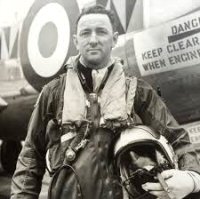  Air Vice-Marshal John Howe CB CBE AFC Our estimated value of this signature : £10 Died : 2016 | Air Vice-Marshal John Howe CB CBE AFC John Howe flew Spitfires, Mustangs and Vampires With the South African Air Force and F-5lD Mustang fighter bombers in the Korean War before joining the RAF 'to fly Hunters'. He commanded the first RAF Lightning squadron when No.74 Sqn converted from Hunters to Lightnings in 1960, and led the famous No.74 Sqn 'Tigers' nine-ship Lightning aerobatic team. He has flown all the legendary USAF 'century series' fighters, and later commanded the F-4 Phantom OCU and RAF Gutersloh. John Frederick George Howe was born in East London, South Africa, on March 26th 1930 and educated at St Andrew's College, Grahamstown. As soon as he left school, he joined the South African Air Force and trained as a pilot. In early 1951 he joined No 2 Squadron, known as the Flying Cheetahs, which was based in South Korea as part of the United Nations forces. The squadron, equipped with the piston-engine Mustang, was heavily engaged in the ground attack role in support of the Army. On June 24th, Howe took off with three others. They responded to an emergency call for air support by a surrounded ground force. In the face of intense anti-aircraft fire, the four Mustangs attacked gun emplacements a number of times. Howe did not expect to survive, but the four aircraft returned to base. All four pilots received US gallantry awards. A month later, Howe was forced to crash land and was rescued by a helicopter. In September, as a 21-year-old second lieutenant, he was the leader of four aircraft instructed to attack enemy troops that were threatening friendly forces. Fierce enemy fire damaged Howe's aircraft but he continued to lead his formation against the target. The US authorities awarded him an immediate DFC, the citation recording: He displayed a standard of leadership above and beyond that normally expected. After completing his flying tour, Howe remained in Korea as a forward air controller before returning to South Africa. At the end of 1954 he travelled to Britain to join the RAF. In April 1956 he joined No 222 (Natal) Squadron flying the Hunter. When a volunteer was required for forward air controller duties with No 3 Commando Brigade in late 1956, Howe's experience in Korea helped to land him the job. He sailed with the Brigade for the ill-fated Suez campaign and, at dawn on November 6th, landed on the beaches at Port Said with No 40 Commando, to direct aircraft on to targets in the area. In the event, the campaign was short-lived. Howe returned to his squadron before joining No 43 Squadron as a flight commander, still flying the Hunter. He was awarded a Queen's Commendation for Valuable Service in the Air, receiving a second two years later. In June 1959 he started training to take command of his Lightning squadron. Howe remained in the fighter business, including a tour of duty with the USAF which gave him an opportunity to fly the latest American fighters, including the Phantom. He has flown all the legendary USAF 'century series' fighters. In 1968 he was appointed to command the RAF's operational conversion unit that saw the introduction of the Phantom into RAF service, his unit being responsible for the conversion of the first squadron crews. After a staff tour he became the station commander of RAF Gutersloh, the home of two Lightning squadrons and a support helicopter squadron. His fighter squadrons, based a few minutes' flying time from the border with Warsaw Pact forces, mounted a continuous quick-reaction capability. He rarely missed an opportunity to maintain his fighter pilot proficiency. After attending the Royal College of Defence Studies he served at HQ 11 (Fighter) Group, and on promotion to air commodore was appointed the commandant of the Royal Observer Corps (ROC). The organisation had a fine record, but Howe justifiably believed that it was in need of modernisation and a more robust attitude. With his usual, not always popular, vigour, he set about applying the same exacting standards to the ROC that he did to his flying. By the time he left in 1980, the efficiency of the Corps had risen sharply. In May 1980 he was appointed the air officer commanding the Southern Maritime Region, a departure from his previous fighter experience and where his usual forceful approach was much in evidence. His final appointment in the RAF was the dual role of Commandant General RAF Regiment and Provost Marshal of the RAF. He retired in November 1985. He was appointed CB (1985) and CBE (1978). Air Vice-Marshal John Howe died January 27th 2016. |
  Squadron Leader Iain Hutchinson Our estimated value of this signature : £50 Died : 2007 | Squadron Leader Iain Hutchinson Squadron Leader Iain Hutchinson was born in Charminster. Posted to join 222 Squadron at Hornchurch, Iain Hutchinson flew with them from June 1940 throughout the Battle of Britain. He said of his experience; 'On our first sortie we lost half the squadron. I myself was shot down the next day. I was flying again the next day but I was shot down five times during the next month, though I didn't end up in hospital until the last time.' That happened when he was shot down in flames over south west London, miraculously managing to bale out, although he was badly burned. Hutchinson was treated for burns at RAF hospital Uxbridge where he was one of the last to receive a tannic acid treatment then used for burns. He said: 'The acid produced great scabs that covered my face and legs while the whites of my eyes turned bright red.' As the fighting grew towards its crescendo, on 30th August his Spitfire was damaged in fighting and he force landed unhurt in Essex. Returning to the fray he downed an Me109 on 6th September, another the following day, and a third a week later. On 18th September, after combat over Kent, he was forced to bale out near Canterbury, and then on 30th September following action over London he was wounded and made a forced landing at Denham. His Battle of Britain totals were three Me109 German fighters as confirmed kills, one Heinkel bomber, an Me109 and one Me110 twin-engined heavy fighter as probably destroyed and one Me109 damaged. It was Hutchinson who shot down the German Ace Oberleutenant Eckhardt Priebe, who was taken prisoner and sent to Canada Squadron leader Hutchinson conitnued his service flying reconnaissance un armed spitfires. He was on a long range mission in a specially adapted Mosquito when he was shot donw by a Me109 over Norway. He landed despite the tail being shot off and his navigator fired a Verey pistol into a pool of petrol, blowing up the Mosquito. Hutchinson spent the rest of the war in Stalag Luft 3 the prisoner of war camp of Wooden Horse and Great Escape fame. After the war he returned and stayed with the RAF flying the Vampire jet aircraft and helped pioneer innovations in aircraft safety, finally retiring form the Royal Air Force in 1957. Sadly he died on April 27th 2007 in Dorchester aged 88. A Clipped Signature is Available |
Flight Lieutenant Alec A Ince Our estimated value of this signature : £25 | Flight Lieutenant Alec A Ince Joined the Royal Canadian Air Force in January 1941 and by midsummer he had travelled to Quebec, then to North Sidney, Nova Scotia, followed by Victoriaville, Quebec for air crew training in Oshawa, Ontario flying Tiger Moths and next to Montreal, Quebec for advanced training on Harvards. By January 1942 he arrived in Shropshire, England at an advanced flying school at RAF base Fern Hill, followed by operational training on Spitfires, marks one and two at RAF station Aston Down, near Stroud. By midsummer 1942, the training there was complete and Alec was posted to 402 Sqdn at RAF Kenley where they were occupied with escorting American bombers to Northern France on bombing expeditions, which lasted until the American Mustang and Thunderbolt fighters arrived to take over from the RAF fighter squadrons. Their duties then changed to Hit and Run raids along the south and south-east coast of England where many dog fights took place over coastal towns. The policy of the Canadian Government was to repatriate aircrews back to Canada after four years on active service and Alec was returned to the University to complete his education. |
  Squadron Leader Tony Iveson DFC Our estimated value of this signature : £45 Died : 2013 | Squadron Leader Tony Iveson DFC Tony Iveson fought in the Battle of Britain with RAF Fighter Command, as a Sergeant pilot, joining 616 Squadron at Kenley flying Spitfires on 2 September 1940. On the 16th of September, he was forced to ditch into the sea after running out of fuel following a pursuit of a Ju88 bomber. His Spitfire L1036 ditched 20 miles off Cromer in Norfolk, and he was picked up by an MTB. He joined No.92 Sqn the following month. Commissioned in 1942, Tony undertook his second tour transferring to RAF Bomber Command, where he was selected to join the famous 617 Squadron, flying Lancasters. He took part in most of 617 Squadrons high precision operations, including all three sorties against the German battleship Tirpitz, and went on to become one of the most respected pilots in the squadron. He died on 5th November 2013. A Clipped Signature is Available |
Air Commodore Ken James Our estimated value of this signature : £40 | Air Commodore Ken James A native of Victoria, Squadron Leader Ken James first served in the UK before going back to Australia in August 1944. He became CO of No.85 Squadron RAAF from September 1944 to March 1945, then No.790 Squadron RAAF in May 1945. Squadron Leader Ken James made the first Spitfire flight in Australia just before midday on the 25th August. He demonstrated the aircraft to an audience of assembled VIPs and film-camera men. After assembly the six aircraft were ferried up to RAAF Richmond, near Sydney, NSW. Leader Ken 'Skeeter' James later took charge of 457 squadron and ended the war with 2.5 victories. |
  Air Vice Marshal Johnnie Johnson CB, CBE, DSO**, DFC* Our estimated value of this signature : £70 Died : 2001 | Air Vice Marshal Johnnie Johnson CB, CBE, DSO**, DFC* James Edgar Johnson was born in Barrow on Soar near Loughborough on 9th March 1915. He lived in Melton, the first house on the left of Welby Lane as you leave Nottingham Road, with his parents - his father being a local Police Inspector. Johnnie qualified as a Civil Engineer at Nottingham University in 1937. He joined the RAFVR and did his flying training at 21 E&RFTS, Stapleford before enlisting for full-time service in the RAF at the beginning of WWII. He first went to ITW at Jesus College, Cambridge, completed his ab initio flying at 22 EFTS, Cambridge and his intermediate and advanced flying at 5 FTS, Sealand. Johnnie Johnson joined 92 Spitfire squadron in August 1940, but it was with 616 squadron that he scored his first victory on June 26th 1941 while flying with Douglas Baders Tangmere Wing. He was squadron leader of 610 squadron in July 1942, but it was as Wing Commander of the Kenley Wing in 1943 that his scores really started to mount. He was W/C of 144 wing during D-Day and led 127 and 125 wings until the end of the war when we has the topscoring allied fighter pilot with 38 air victories. Inspired by the great British WW 1 aces like Bishop and Ball, Johnnie Johnson dreamed often as a child of becoming an R.A.F. pilot. The young Johnson enthusiastically joined the Volunteer Reserve at the first opportunity. After completing his initial flight training Johnson was posted to 616 Squadron at Kenley. However, this Squadron had been hit hard with the loss of six pilots and five wounded, and the unit was withdrawn to Coltishall prior to Johnson encountering combat. With only 12 hours of flight time in a Spitfire this was no doubt advantageous. In February 1941 Billy Burton moved the Squadron to Tangmere. Douglas Bader then arrived to take over the Tangmere Wing, and fly with the 616 Squadron. Johnnie, Alan Smith and Cocky Dundas were chosen to fly with Bader. During the summer of 1940 the Battle of Britain was at its peak. Bader took the time to instruct Johnson carefully in both the art of flying and the skills necessary to attain success in aerial combat. Baders idea of an afternoon off duty, according to Johnson, was to take his section over the Channel in hopes of running into Adolph Galland and his Abbeyville Boys. On August 19, 1941 Bader failed to return from a mission when 616 Squadron was hit hard by a group of Messerschmitt 109s. Johnson flew on in Baders absence, and in the summer of 1942 he was promoted to command of the 610 Squadron. In 1943 he was promoted again to Wing Commander of the Canadian Spitfire Wing in Kenley. By that time Johnson had attained eight confirmed victories. During the spring and summer of 1943 Johnnie led the Canadian unit on more than 140 missions over Northwest Europe. Johnsons squadron attained more than 100 victories during this period, and Johnnies own personal score rose to 25. After a short leave, Johnson was posted to lead the 144 Canadian Spitfire Wing. On D-Day Johnson led his Wing on four missions in support of the Allied invasion. On June 8, Johnsons Wing was the first Spitfire group to land in newly liberated France. Johnson continued fighting in France through September 1944 when he achieved his 38th and final victory. Patrolling the Rhine Johnsons unit jumped nine 109s which were flying beneath them in the opposite direction. Five of the 109s were downed. Early in 1945 Johnson was promoted to Group Captain and put in command of the 125 Wing, which was equipped with the Spitfire XIV. Flying from former Luftwaffe airfields the 125 Wing assisted in the final Allied push to Berlin. Johnson attributed much of his aerial combat success to his ability to make tight turning maneuvers. Johnsons tightest call came on August 19, 1942 when he was unable to dislodge an Me-109 from his tail during the raid on Diepppe. Johnson raced his Spitfire flat out at a group of Royal Navy ships. The usual barrage of flak and tracer fire came right at him, and fortunately for the ace, missed his Spitfire but effectively eliminated the brave pilot on his tail. During the Korean War Johnson flew fighter-bombers with the USAF. Following his retirement from the R.A.F. in 1966 Johnson founded the Johnnie Johnson Housing Trust that has provided homes for more than 4000 disabled and elderly persons, and his sixth book Winged Victory was published in 1995. Johnson flew many of the Spitfire models. His favorite was the beautiful Mark IX, the best of them all. Johnnie passed away in 2001 at the age of 85, in Derbyshire, England. A Clipped Signature is Available |
 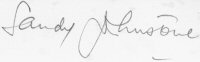 Air Vice Marshal Sandy Johnstone CB DFC AE DL Our estimated value of this signature : £60 Died : 2000 | Air Vice Marshal Sandy Johnstone CB DFC AE DL Early in 1938, Alexander Vallance Riddell Johnstone, known as Sandy, was a civilian navigation instructor at Scottish Aviation, moving later to the Civil Air Navigation School at Prestwick. In August 1939 he was called to full-time service with 602 Squadron. After some Spitfire engagements off the Scottish coast, he received command of 602 - he was still only 24 - and led it south to the tiny airfield at West Hampnett, in West Sussex, where it was stationed throughout the Battle of Britain. Sandy was in command of no. 602 squadron during the critical days of the Battle of Britain, flying with the squadron before the war though to 1941, when he was posted to the Middle east, he also served with 229 and 249 squadrons in Malta during the Islands most fateful days of the war. Sandy became a successful author and resided near Ipswich in Suffolk. Sandy Johnstone died 13th December 2000, aged 84. A Clipped Signature is Available |
  Flight Lieutenant Richard L Jones Our estimated value of this signature : £45 Died : 2012 | Flight Lieutenant Richard L Jones Richard Jones was born in 1918 and in July 1940 Richard Jones was posted to 64 Squadron at Kenley, flying Spitfires. He was involved in heavy fighting over the Channel during the Battle of Britain, with the squadron suffering many losses during July and August. Towards the end of the Battle of Britain, in October, he moved to 19 Squadron flying Spitfires from Fowlmere, and was heavily involved in the fighter sweeps taking place at that time. Near the end of the Battle of Britain, Pilot Officer Richard Jones was shot down during a dogfight over Kent with Me 109s. Jones crash landed his Spitfire in a field, colliding with a flock of sheep - he would go on to write in his log book 'Crashed into a load of sheep. What a bloody mess!' After the Battle of Britain, Richard Jones became a test pilot for De Havilland at Witney in Oxfordshire, and test flew thousands of Hawker Hurricanes and other types, including civil types. After the war Richard Jones joined the RAFVR and started a long career in the motor industry. Sadly Richard Jones passed away on 7th March 2012. A Clipped Signature is Available |
  Wing Commander Terence Kane Our estimated value of this signature : £40 Died : 2016 | Wing Commander Terence Kane Terence Michael Kane was born in London on September 9th 1920 and educated at Varndean School in Brighton. He joined the RAF on a short service commission on July 25th 1938, During his flying training he was injured in an Audax crash and admitted to hospital, however he was able to complete his training and was posted to CFS, Upavon, for an instructor's course, after which he joined the staff at 14 FTS, Kinloss and later Cranfield. He went to 7 OTU, Hawarden in July 1940, converted to Spitfires and joined No.234 Squadron on September 14th. On September 22nd 1940 he had shared in the destruction of a Junkers Ju88 bomber. The following day, only nine days after joining No.234 Squadron, Kane took off on a routine patrol when Messerschmitt Bf109s attacked his section. Kane shot one of them down but, during the combat, the engine of his Spitfire was damaged and he was forced to bale out at 6,000 feet. He had difficulty escaping from the fighter's cockpit but eventually managed to roll the aircraft over and fall clear. His parachute opened at 500 feet and seconds later he landed in the sea off the French coast. Floating in his life jacket, he was fortunate to be plucked from the sea within two hours by the German Navy. After being rescued, Kane was well treated before being taken to his first PoW camp. After initial interrogation he was sent to Oflag IXA/H, a converted medieval castle at Spangenberg, 15 miles south of Kassel. With his fellow RAF PoWs, Kane was moved between camps a number of times and on October 2nd 1941 he was in a large party that arrived at Oflag VIB near Warburg. A week later another group of RAF prisoners arrived, among whom Kane recognised his elder brother, Squadron Leader Mike Kane MBE, whose Whitley bomber had been shot down two months earlier. The younger Kane was unaware that his brother had been posted as missing, or that he had already made a daring escape bid – only to be recaptured when he was discovered in the hold of a Swedish ship in the docks at Lübeck. The two brothers were moved in May 1942 to the new Luftwaffe camp, Stalag Luft III at Sagan. They were sent to the East Compound, next to the one where the Great Escape took place in March 1944. On the night of January 27th 1945 the prisoners were given a few hours' notice to gather their belongings and prepare to leave. The Soviet Army was approaching from the east and the Germans had decided to evacuate the camp and march the prisoners westwards. During one of the coldest winters of the century, the men suffered great privation and numerous casualties on what became known as 'The Long March'. Eventually, Kane and his colleagues reached Lübeck where they were liberated by a scout car of the British 11th Armoured Division. Kane was flown back to England on May 8th after four-and-a half years as a PoW. Kane remained in the RAF, mainly on intelligence duties including two years in the Middle East. He left the service in 1950 but could not settle to civilian life and re-joined in February 1954. He specialised as a fighter controller, serving in Germany and in the United Kingdom. After a period as the defence adviser in Libya he became the project officer in the MoD for the 'Linesman' system, a network of radars and a centralised control system for the air defence of the UK. He finally he retired in 1974. He died on 5th August 2016. |
  Wing Commander Joseph Robert Kayll DFC DSO Our estimated value of this signature : £50 Died : 2000 | Wing Commander Joseph Robert Kayll DFC DSO Joe Kayll joined the Auxiliary Air Force in 1934, serving with No. 607 (County of Durham) Squadron rising to become a flight lieutenant. Following the outbreak of the war he volunteered for full-time service and fought in France in early 1940 before taking part in the Battle of Britain, commanding No. 615 (County of Surrey) Squadron as an acting squadron leader. During the Battle of Britain Kayll was credited with shooting down seven German aircraft with one shared and six unconfirmed destroyed, along with six damaged. For these efforts he was awarded the Distinguished Service Order and Distinguished Flying Cross personally by King George VI. In 1941, he was promoted to wing commander and given command of The Hornchurch wing of three Spitfire squadrons. In 1941 he was mentioned in despatches before being shot down over France in July. He was subsequently captured by the Germans and became a prisoner of war. He became Senior British officer at Oflag IX until moved to Oflag VI-B Warburg in October 1941. In September 1942 Wing Commander Kayll escaped in a mass break out and with a companion travelled by foot 90 Kilometres before being recaptured south of Fulda. He was transferred to Stalag Luft III at Sagan in May 1943, and was in charge of the Escape Committee for the East Compound. He remained in captivity for the remainder of the war, co-ordinating numerous escape attempts, for which he was later appointed an Officer of the Order of the British Empire in 1946. After the war he continued to serve, rejoining the Royal Auxiliary Air Force, and commanding No. 607 (County of Durham) Squadron. Born in Sunderland and educated at Aysgarth and Stowe, he entered the family timber business but, inspired by flying, he joined the Royal Auxiliary Air Force in 1934. Commissioned, he learned to fly with 607 County of Durham Squadron, using Wapiti and Hart biplanes. By early 1939, Kayll was a Flight-Commander in 607 Squadron, which now flew Gladiator biplane fighters. In November 1939, Kayll's squadron was posted to France. The following March, he became commander of 615 County of Surrey Squadron flying obsolete Gladiators. On May 10, the German offensive against the low countries and France began, and 615 Squadron, caught re-equipping with Hurricane 1 fighters, was involved in the intensive air fighting. Kayll nourished 615's fighting spirit by flying up to seven sorties a day from improvised airfields with a mixture of Hurricanes and Gladiators. The squadron inflicted heavy losses on the Luftwaffe while the German army continually overran the squadron's forward airfields. On May 15th, Kayll, flying a Hurricane, shot down two Messerschmitt Bf 110 twin-engined fighters, and on May 20th destroyed a Heinkel 111 bomber. The next day, 615's surviving pilots flew back to Kenley, south of London. By mid-June, 615 had regrouped, and it resumed operations against Luftwaffe-occupied airfields in France. Kayll was awarded the DSO and DFC, and during the Battle of Britain he shot down a Messerschmidt Bf 109E fighter and Do 17 and He 111 bombers. This was in a ferocious seven-day period, which started on August 18th. In late September, the exhausted 615 Squadron was moved to Prestwick to regroup. It was credited with 97 German aircraft destroyed. Kayll's score was seven and one shared destroyed, seven unconfirmed destroyed and six damaged. In October, 615 returned to defend London against German fighter-bomber attacks. In June 1941, after six months at Fighter Command HQ, Kayll returned to operations as a wing-commander flying with the famous Hornchurch Wing, operating three Spitfire squadrons. Fighter Command was mounting numerous sweeps over France and he flew in several Circus operations, which involved a small number of bombers, heavily escorted by fighters, to draw the Luftwaffe into battle. On June 25th, Kayll, while flying with his section near St Omer, was shot down, captured and sent first to Spangenberg Castle POW camp, and later to Wartburg, from which he escaped during the great breakout of September 1942. He was recaptured and sent to Stalag Luft III at Sargan, Silesia, location of the wooden horse escape. Other short-term escapes followed until the Great Escape of March 1944. But after the Gestapo shot 50 allied airmen, all escape plans ceased. Kayll was awarded an OBE for his escape activities, and was demobilised in 1946. He rejoined the Royal Auxiliary Air Force, commanding 607 Squadron, and also re-entered the family business, which he later ran with his two sons. He died on 3rd March 2000. A Clipped Signature is Available |
 Wing Commander Don Kingaby DSO AFC DFM** DFC (USA) Our estimated value of this signature : £75 Died : 1990 | Wing Commander Don Kingaby DSO AFC DFM** DFC (USA) Born in London on 7th January 1920. Joined the RAFVR in April 1939 at the age of 20. He flew a Mk.I Spitfire with No.266 Squadron during the initial stages of the Battle of Britain, claiming as damaged two Ju88s and an Me110. He then joined No.92 Squadron in September 1940, claiming 4 aircraft (including 3 Me109s) in October, then 6 more Me109s in November 1940, including 4 in a single day on the 15th. He claimed a further 12 victories during 1941, before joining No.111 Sqn and No.64 Sqn in March and April 1942 correspondingly. He later joined No.122 Squadron, and was promoted to lead the Hornchurch wing in March 1943. On D-Day, he claimed the final addition to his total, sharing in the destruction of an Me109. He was the only RAF pilot to be awarded three DFMs, and scored a total of 23 victories and 8 probables. His Air Force Cross medal was awarded in 1952 for his work with Vampire jets. He retired in 1958. Sadly, he passed away on 31st December 1990. |
Group Captain Brian Kingcome DSO DFC Our estimated value of this signature : £65 Died : 1994 | Group Captain Brian Kingcome DSO DFC Brian Fabris Kingcome was born in Calcutta on May 31st 1917. Brian Kingcome was educated at Bedford and in 1936 entered the RAF College, Cranwell. Soon after he began his pilot course he was seriously injured in a car accident and was told by the RAF medical board that he would never fly again as he was expected to suffer permanent double vision. But after months in hospital and with Brians strength of character he proved the board wrong. In 1938 he was posted to No 65, a biplane Gladiator fighter squadron based at Hornchurch. Brian Kingcome took part in the Battles of France and Dunkirk but transferred to 92 Squadron as a flight commander and flying Spitfires in May 1940 scoring his first victories in June 1940. Brian Kingcome became acting commanding officer during the latter stages of the Battle of Britain. During this time he and his pilots achieved the highest success rate of any squadron in the entire Battle of Britain. After being shot down by Me109s and wounded, he returned to active operations. In February 1942 he was posted to command 72 Squadron, followed by promotion to Wing Leader at Kenley. In May 1943 he was posted to lead 244 Wing in the Mediterranean during the invasion of Sicily. An Ace, Brian Kingcome flew Spitfires in combat continually until the end of 1944, his tally finishing at 8 and 3 shared destroyed, plus a score of probables and damaged. One of the prewar Cranwell elite, Brian Kingcome was to become one ofthe Second World Wars great fighter leaders, alongside such immortals as Douglas Bader, Bob Stanford Tuck and Johnnie Johnson. At the outbreak of war he was serving in 65 Squadron, but in May 1940 was posted to 92 Squadron as flight commander. On 25 May he shared a Do 17 and on 2 June destroyed two He l l Is and damaged a third. He shared a Ju 88 with two others on I0 July, and again on the 24th. On 9 September he probably destroyed a Bf 110 and two days later shot down a He 111. On the 14th he damaged another. He shot down a Bf 109 on the 23rd and next day probably destroyed another and damaged a Ju 88. Three days later he shared a Ju 88 again, damaged two others, probably destroyed a Do 17, and damaged one of these also. Around this time he was awarded a DFC for six victories, and on 11 October got a Bf 109 He claimed another next day, and also damaged one. In 1941 he became commanding officer, having frequently led the squadron. It will be noted that he claimed many probables and damaged during the Battle of Britain, and this was due to his view that it was more important to hit as many as possible than to try and confirm victories. On 16 June 1941 lie probably destroyed a Bf 109, and on 24 July shot one down. He was then rested until late in the year, when he was posted to command 72 Squadron, and in February 1942 gave escort cover to the Fleet Air Arm pilot Eugene Esmonde, who won the VC trying to attack German capital ships Scharnhorst and Gneisenau and and the cruiser Prinz Eugen with Swordfish during the Channel Dash. In atrocious weather Kingcome caught a fleeting glimpse of tbe Scharnhorst - Oh what a beautiful battleboat! he exclaimed, just as a shell made a hole the size of a dustbin lid in his port wing. During 1941 he received a Bar to his DFC, having brought his score to 10. He was promoted to lead the Kenley wing, and on 15 April 1942 damaged a Fw 190. He probably destroyed a Bf 109 on 28 May, and during the year was awarded a DSO, having added another victory to his score. In 1943 he was posted to North Africa to lead 244 Wing, and lead this for 18 months, becoming a Gp. Capt. after the invasion of Italy. By the end of his stay with the wing he had brought his score to 18, and was then posted as SASO of a Liberator group, and flew an operation as a waist gunner over northern Yugoslavia after taking up this appointment. Sadly Group Captain Brian Kingcome passed away aged 76 in 1994. |
Squadron Leader Franciszek Kornicki Our estimated value of this signature : £25 | Squadron Leader Franciszek Kornicki Posted in 1939 to 3rd Fighter Wing in Lwow as part of the Polish Air Force. This area was soon overrun by Germans so he travelled to England to join 303 Polish Sqn on Spitfires and also served with 308, 315 and 317 Squadrons carrying out many fighter sweeps over France and occupied Europe. |
 Squadron Leader Ginger Lacey DFM Our estimated value of this signature : £90 Died : 1989 | Squadron Leader Ginger Lacey DFM James Harry Lacey, from Wetherby, who was destined to become the top scoring RAF fighter pilot in the Battle of Britain, joined the RAFVR. in 1937. After an instructors course in 1938 he became an instructor at the Yorkshire Aeroplane Club. Called up at the outbreak of war, he was posted to 501 Squadron, and in May 1940 was posted with the unit to France. On the 13th he set off late on an early patrol, and shot down a Bf 109 and a He 111. Later in the day he destroyed a Bf 110. On the 27th he destroyed two He 11 Is and then returned to the United Kingdom, in June, having made an emergency landing in a swamp on the 9th and overturned, nearly being drowned. On 20 July he shot down a 13f 109, and was then awarded a DFM. In the Battle of Britain, during August, he destroyed a Ju 87 and a probable on the 12th, damaged a Do 17 on the 15th, probably destroyed a Bf 109 on the 16th, and on the 24th shot down a Ju 88 and damaged a Do 17. On the 29th he destroyed a 13f 109 and next day claimed a He 111 and probablya Bf110. He shot down a Bf109 on the 31st and on 2 September got two Bf 109s and damaged a Do 17. Two days later he destroyed two more Bf 109s, and was then sent on leave for a few days. on his return, on the 13th, he took off in very bad weather to shoot down a lone He 111 which had just bombed Buckingham Palace. Having destroyed it, he found the cloud too thick to return to base and was forced to bale out. On the 15th he shot down another He 111 and two Bf 109s with a third damaged, on the 27th destroyed another Bf 109 and on the 30th damaged a Ju 88. During October he was in action frequently against Bf 109s, getting a probable on the 7th and destroying others on the 12th, 26th, and the 30th, damaging one also on this latter date. His score was now 23, and he had been shot down or forced to bale out nine times. Of his victories 18 were gained during the Battle of Britain, and this was the highest score of any pilot for this period. In December he received a Bar to his DFM and was commissioned the following month. He converted to Spitfires early in 1941, and in June became a flight commander. During July he destroyed a Bf 109 on the 10th, damaged one on the 14th, shot down a He 59 floatplane on the 17th and destroyed two more Bf 109s on the 24th, causing them to collide. He was then posted as an instructor to 57 OTU where he trained, among others, George Beurling. In March 1942 he was posted to 602 Squadron, and on 24th March damaged a Fw 190. On 25 April he damaged two more, but was then posted to HQ 81 Group as Tactics Officer, now as a Sqn. Ldr. He spent some while testing Hurricanes with rocket projectiles and 40 mm. anti-tank guns, and then became Chief Flying Instructor at Millfield. In March 1943 he was sent to India, and first was responsible for converting squadrons to Hurricanes at Madras. He then moved to Bangalore, where he converted Hurricane pilots to Thunderbolts. In September 1944 he was posted to 3 TAC at Komila as Sqn. Ldr. Tactics, and the following month attended an Air Fighting Instructors Course at Armarda Road, which was run by Wg. Cdr. F.R. Carey. In November he became temporary commanding officer of 155 Squadron, flying Spitfire 8s in Burma, but later that month took command of 17 Squadron, equipped with the same aircraft. His squadron was responsible for giving ground support to a Gurkha regiment, so he ordered his pilots to have their heads shaved in the Gurkha fashion, which proved to be a very popular move. On 19 February 1945 he shot down a Nakajima Ki 43 Oscar, his twenty-eighth and last victory. He died on 30th May 1989. |
  Flight Lieutenant R G (Bob) Large, DFC, Legion d Honneur Our estimated value of this signature : £25 Died : 2015 | Flight Lieutenant R G (Bob) Large, DFC, Legion d Honneur Learned to fly in Scotland in 1940 and in 1941 joined 616 Squadron as part of the Tangmere Wing, commanded by the famous legless pilot Wing Commander Douglas Bader. The Squadron flew Fighter and Bomber sweeps over Northern France. The remains of Bobs Spitfire lie at the bottom of the sea ten miles off Hythe (where he now lives) after being bounced by eighty plus ME 109Gs over the English Channel. Having learned of the activities of 161 SD Squadron he was interviewed by the CO, Wing Commander Lewis Hodges, and joined the Lysander Flight. He then flew many important missions into occupied France in single, double and a memorable treble pickup when his excuse for being late at the rendezvous was that he had had a haircut in the firms time because it grew in the firms time! After D-Day he returned to Fighter Command and later flew Meteors. (Bobs dog, Patrick, became the first dog in the Allied Forces to fly in a jet which took place in a Meteor 3 on 11th May 1946 and is now recorded in the Guinness Book of Records!) We have learned that Bob Large died on 29th December 2015. |
  Squadron Leader Keith Lawrence DFC Our estimated value of this signature : £55 Died : 2016 | Squadron Leader Keith Lawrence DFC Keith Lawrence was born in New Zealand at Waitara on November 25th 1919. After attending Southland Boys High School at Invercargill, Lawrence went to work in a local bank in December 1936. In November 1938 he applied to join the RAF and was accepted for pilot training in Britain and sailed in February 1939. In November 1939 Keith Lawrence completed his flying training and joined the newly-formed 234 Squadron, which flew Spitfires throughout the Battle of Britain. Whilst based at St Eval in Cornwall, Lawrence shared 234s first victory on 8th July 1940 with the destruction of a Ju88 which was attacking a convoy in the Western Approaches. 234 Squadron was posted to Middle Wallop on 15 August. On 15 September Lawrence was posted to 603 Squadron at Hornchurch, and on 8 October moved to 421 Flight at Gravesend, a unit which early the following year became 91 Squadron. During the Battle of Britain he destroyed two enemy aircraft and damaged four others. Whilst on a weather reconnaissance on 26 November 1940, Lawrences Spitfire was shot down by ME 109s, his Spitfire breaking up and throwing him clear to parachute into the sea. Lawrence was picked up by a RNLI lifeboat, and having suffered severe leg injuries and a dislocated arm, was taken to hospital. He returned to 91 Squadron on the 16th of January 1942. On the 17th of February 1942 Lawrence was posted to 185 Squadron in Malta. At this time, the island's capital Valetta and its airfields were suffering almost constant bombardment from bombers with fighter escorts which generally considerably outnumbered the defending fighters. While in Malta, Lawrence was promoted to squadron commander. The Squadron flew Hurricanes until Spitfires arrived on 9 May. Lawrence returned to the UK from Malta at the end of June 1942, and began a long period as an instructor. He served at three different Operational Training Units, and after receiving training at the Central Gunnery School at Sutton Bridge, became a gunnery instructor flying Spitfires. Lawrence returned to operations with 124 Squadron from early February until the end of April 1945. The unit had been successfully intercepting German reconnaissance aircraft at 50,000 feet plus, using Spitfire VIIs with pressurised cockpits, flying from Manston. As Lawrence arrived, it was re-equipping with Spitfire IX's to carry out dive-bombing attacks on V2 sites around The Hague from RAF Coltishall. After each aircraft had dropped its 1000 lb bomb-load, it flew on to captured airfields in Belgium, and refuelled and re-armed, before bombing targets again during the return flight to Coltishall. The unit also carried out daylight escorts for bombers raiding into Germany. From the end of August 1945 Lawrence flew Meteors with 124 Squadron until he was released from the RAF in March 1946. He returned to New Zealand and settled in Christchurch but later returned to Britain. He died on 2nd June 2016. A Clipped Signature is Available |
  Air Commodore James Leathart Our estimated value of this signature : £85 Died : 1998 | Air Commodore James Leathart After flight training, he joined No.54 Squadron flying Gauntlets. He became the commanding officer of No.54 Squadron as they re-equipped with Spitfire MkIs. In a remarkable event, he was awarded the DSO when he rescued the stranded CO of No.74 Sqn. Commandeering a Miles Master training aircraft, he flew to France escorted by other pilots from No.54 Sqn, and rescued the CO before returning across the Channel. It was for this action that he was awarded the DSO in June 1940. Died in 1998. |
  Squadron Leader Arthur Leigh DFC, DFM Our estimated value of this signature : £50 Died : 2004 | Squadron Leader Arthur Leigh DFC, DFM Another RAFVR pilot, The son of a regular soldier, Arthur Leigh was called up at the outbreak of war. After finishing his flying training he was posted to 7 OTU and then on to convert to Spitfires in August 1940. Arthur Leigh flew with 64 Squadron at Leconfield and 72 Squadron at Biggin Hill during the Battle of Britain before transferring to 611 Squadron. Awarded the DFM in September 1941, Leigh had then completed 50 sweeps, had destroyed two Bf 109s, probably destroyed another four and shared in the destruction of a Do 17. After a spell instructing and ferrying Hurricanes from Gibraltar to Cairo, he returned to operations with 56 Squadron flying Typhoons from Manston. He was shot down on his first sweep by flak, near Calais but was picked up by an ASR launch. In late 1943 Leigh was posted to 129 Squadron at Hornchurch and was awarded the DDC on completing his second tour in December 1944, spending the rest of the war as an instructor. He died on 3rd July 2004. A Clipped Signature is Available |
Warrant Officer John Abe Lincoln Our estimated value of this signature : £45 | Warrant Officer John Abe Lincoln Born in 1923, Abe Lincoln joined the RAF in August 1942, spending two years training in India and Rhodesia. After training he was posted back to the UK, flying first Spitfires and then on Typhoons with 175 Squadron. The squadron was by then heavily involved with softening up targets with rockets ahead of the armies advance and close support duties at the front as the allies advanced through France into Germany. He remained with the squadron until the end of the war. |
 Wing Commander James Lindsay DFC Our estimated value of this signature : £25 | Wing Commander James Lindsay DFC Born in September 1922, James 'Doug' Lindsay joined the RCAF in February 1941, training on Harvards. He was posted to the UK, arriving in March 1943 and joining 403 Sqn in October that year. In his first tour, he claimed 5 Me109s as well as 2 Fw190s, plus another damaged. Of the Me109s he shot down, three of these were in a single minute, earning him a DFC. For his second tour, he rejoined 403 Sqn in April 1945, claiming a probable Fw190 during his short time with this squadron before he moved to 416 squadron until the end of the war in Europe. After the war he stayed with the air force, and in 1952 served during the Korean war with the USAF. He flew F-86 Sabres with the 39th Fighter Squadron of the 51st Fighter Wing, claiming victories over two MiG-15s and damaging 3 others. In 1953, he returned to the UK with No.1 Fighter Wing leading Sabres in formation at the Queen's Coronation. He retired in 1972, having flown more than 30 different types of aircraft (excluding different Mks). These included, Harvard, Anson, Master, Spitfire, Typhoon, Tempest, Hurricane, Mustang, Beaufort, Beaufighter, Oxford, Dakota, Tiger Moth, Vampire and Sabre. |
  Flight Lieutenant Derek Lovell Our estimated value of this signature : £40 Died : 2019 | Flight Lieutenant Derek Lovell Volunteered for the RAFVR in January 1941. He trained in Canada on Tiger Moths and Oxfords. He received his wings in April 1942 and was posted to Central Flying School. Following graduation, he taught Fleet Air Arm trainees on Harvards. He returned to the UK in March 1943 and flew Masters at AFU and Hurricanes at OTU. He taught Lancaster crews fighter evasion prior to posting to 84 GSU to fly Typhoons. He joined 197 Squadron at Needs Oar Point in the New Forest in June 1944 and was involved in close support operations and tactical dive bombing and low level bombing throughout the Normandy campaign and on through to VE-Day. He completed 135 operations and in August 1945 was posted to an OTU to instruct on Typhoons and Tempest Vs. He was demobbed in June 1946 and flew weekends in the VR on Tiger Moths and later Chipmunks. He was called up on the G Reserve in July 1951 and flew Harvards, Spitfire XXIIs and then Vampire Vs. He stood down in September as the Korea situation eased. He passed away on March 1st, 2019. A Clipped Signature is Available |
  Lt Gen George Loving Our estimated value of this signature : £50 Died : 2016 | Lt Gen George Loving General George Loving was born in Roanoke, Va., in 1923, graduated from E.C. Glass High School in Lynchburg, Va., and attended Lynchburg College. He is a graduate of the University of Alabama and holds a master's degree from The George Washington University. During the academic year 1969-70, he was a research associate with the Council on Foreign Relations. He entered military service in March 1942 as an aviation cadet and graduated from flying school in 1943 with a commission as second lieutenant and his pilot wings. He flew 151 combat missions as a fighter pilot with the 31st Fighter Group during World War II, flying Spitfires and P-51 aircraft over Italy, Southern France, Germany, Czechoslovakia and the other occupied countries of Eastern Europe. He became a fighter ace during this period, shooting down five enemy aircraft and damaging two others. He returned to the United States in October 1944 and served as a P-47 fighter pilot instructor and base armament officer at Millville Army Air Field, N.J. He was next assigned as squadron commander and instructor at Shaw Field, S.C. In July 1946 he went to Itazuke Air Base, Japan, to serve in the occupation forces. Initially assigned as a personnel staff officer, he later served as commander of the 433d Fighter Squadron and as operations officer of the 475th Fighter Group. In January 1949 he became operations officer at the Air Force Reserve Training Center, Byrd Field, Richmond, Va. He was transferred to Headquarters Ninth Air Force, Langley Air Force Base, Va., in June 1949 and assigned as a staff officer in the Personnel Directorate. Shortly after the beginning of the Korean War, he volunteered for combat duty and in July 1950 went to Taegu, Korea, where he served 13 months, initially as base operations officer, and then as commander of the 9th Fighter-Bomber Squadron. He flew 113 missions against North Korean and Communist Chinese forces and participated in five major campaigns. Between September 1951 and July 1955, he was assigned to the Air Proving Ground Command at Eglin Air Force Base, Fla. As a senior project officer, he was responsible for the operational suitability testing of the F-84F, KB-29 Phase II Outing Tanker, KC-97 Drogue Tanker, and various other systems and munitions. After graduation from Air Command and Staff College in June 19569 he joined the faculty as an instructor and curriculum planner with responsibility for the college's correspondence course, which had an enrollment of more than 5,000 students. He was transferred to Taiwan in April 1960 and for two years was U.S. adviser to the Republic of China's National War College. General Loving went to Headquarters Tactical Air Command at Langley Air Force Base, Va., in July 1962 and served for two years as a staff officer with the Policy Division (Plans), during which time he was concerned with formulating tactical air doctrine. He attended the Air War College during 1964-65 and subsequently was assigned to Headquarters U.S. Air Force in the Aerospace Doctrine Division, Office of the Deputy Chief of Staff for Plans and Operations, as a staff officer and branch chief. He was responsible for the development of Air Force and Joint doctrinal publications which form the fundamental basis for war plans and for organizing, training, equipping and employing U.S. military forces. He served as commandant, Air Command and Staff College from June 1970 to January 1973. General Loving was assigned as deputy director of plans in the Office of the Deputy Chief of Staff, Plans and operations at Headquarters U.S. Air Force, in January 1973, and served as director of plans from April 1973 to January 1975. He was appointed Joint Chiefs of Staff Representative for Mutual and Balanced Force Reduction in January 1975 and served as the senior military member of the U.S. delegation to the international conference in Vienna on MBFR. During the period August 1975 to June 1977, he served as commander, Sixth Allied Tactical Air Force, with headquarters at Izmir, Turkey. He was reassigned to Japan and assumed command of U.S. Forces Japan and Fifth Air Force in June 1977. A command pilot, his military decorations and awards include the Distinguished Service Medal with oak leaf cluster, Silver Star, Legion of Merit, Distinguished Flying Cross with oak leaf cluster, Meritorious Service Medal, Air Medal with 24 oak leaf clusters, Air Force Commendation Medal with oak leaf cluster, Army Commendation Medal, Presidential Unit Citation with oak leaf cluster, and the Republic of Korea Presidential Unit Citation. He was promoted to the grade of lieutenant general Sept. 1, 1975, with date of rank Aug. 26, 1975. He died on 31st December 2016. A Clipped Signature is Available |
  Wing Commander Laddie Lucas CBE DSO DFC Our estimated value of this signature : £75 Died : 1998 | Wing Commander Laddie Lucas CBE DSO DFC Laddie (Percy Belgrave) Lucas rose in two years from Aircraftman 2nd class to Command No.249, the top scoring fighter squadron in the Battle of Malta in 1942 at the age of 26. Lucas led two Spitfire squadrons and in 1943 a wing on the Western Front. In 1944 he switched to the Mosquito of the 2nd Tactical Air Force. After the war he was a Conservative MP for ten years and was also one of Britain's best amateur golfers, captaining Cambridge University, England in the Walker Cup, Great Britain and Ireland against the United States. Laddie Lucas died on 20th March 1998. A Clipped Signature is Available |


