|
|
|
|
|
|
|
|
|
Cranston Fine Arts  Aviation Art and Artists World War Two Aircraft More Aircraft Initials A to D Aviation Art and Artists World War Two Aircraft More Aircraft Initials A to D  Catalina Catalina |
[UP] - Aichi - Airacobra - Albacore - Anson - Ar196 - Ar234 - Avenger - Barracuda - Battle - Beaufort - Betty - Bisley - Black Widow - Blenheim - Bombay - Boston - BRE693 - Buffalo - Bv222 - Bv238 - Cant Z.506B - Catalina - Corsair - D520 - Dakota - Dauntless - DB-3 - Defiant - Devastator - Do17 - Do24 - Do335 - Do435 - Do525 - Dominator - Duck |
| Catalina Aviation Prints |
|
|
|
|
|
|
|
|
|
|
|
|
| Text for the above items : |
Main Body by Stan Stokes. Jimmy Doolittles attack on Japan with B-25s launched from the USS Hornet was a blow to Japanese morale, and it gave Admiral Yamamoto the leverage he needed to push for a grandiose plan to inflict a decisive military blow to American forces in the Pacific. Yamamotos grand scheme would have several elements. A huge fleet would be sent to Midway Island to lure American carrier forces into combat. The force would include seven battleships, ten aircraft carriers, some two dozen cruisers and more than seventy destroyers. A separate strikeforce would be sent to the Aleutians under the command of Vice Admiral Hosogaya Moshiro. The plan was for the the northern force to strike first and divert American carrier forces northward away from Midways air support forces where they could be dispatched by Yamamotos overwhelming force. Fortunately for the US Navy a highly skilled group of cryptographers had broken portions of the Japanese Navys secret code. The Americans sent a bogus message to trick the Japanese into revealing the true target of their massive force. While not surprised, the American forces in the Midway area were sadly outnumbered, and good fortune would be needed to offset the Japanese advantage in numbers. The three primary US carriers in the Pacific (Enterprise, Hornet and Yorktown) were readied for the action. Shortly after 9:00 AM on the morning of June 3, 1942, Ensign Jack Reid of VP-44, piloting a PBY Catalina flying boat, spotted the main Japanese invasion force, and shadowed the fleet at low altitude for several hours. Later that day B-17s from Midway Island would attack the invasion fleet followed by a torpedo attack by other PBYs. Early in the morning of June 4 the Japanese launched their first aerial attack on Midway. As the 108 Japanese aircraft approached the island a hodgepodge of all air worthy American aircraft were launched including PBYs, B-17s, Wildcat and Buffalo fighters, Vindicator bombers, B-26 Marauders and SBD Dauntless divebombers. |
The Aircraft That Found the Bismarck by Ivan Berryman. In early May 1941, in conditions of strict secrecy because the United States was not yet at war, seventeen pilots of the US Navy had arrived in Britain and been attached to Catalina squadrons of Coastal Command. These experienced PBY pilots were there to assist the Royal Air Force to become familiar with the Catalina, and also to gain operational experience for the US Navy. On 26th May 1941 Catalina Z of No.209 Sqn, commanded by Flying Officer Dennis Briggs RAF, with Ensign Leonard B Smith USN as co-pilot, joined the search for the Bismarck. At 1015 the aircraft was being flown in poor visibility at an altitude of 500ft when Ensign Smith sighted the Bismarck at a range of eight miles. The Catalina was flown towards the contact so that a positive identification could be made and emerged from the cloud only 500 yards from the German ship. The aircraft met a hail of anti-aircraft fire but was able to make its escape. As a result of the sighting report from Catalina Z the Bismarck was again engaged by ships and aircraft of the Royal Navy and was sunk at 1040 on 27th May 1941. Leonard Smith can be considered therefore, the first American to be directly involved in action in World War Two. He was awarded the Distinguished Flying Cross (American) for his actions. |
Catalina Crescendo by Ivan Berryman. No text for this item |
Sinking of U-Boat 347 by Tim Fisher. Flt. Lt. John Alexander Cruickshank in his consolidated Catalina. Winning his Victoria Cross for sinking U-347. |
By Dawn's Light by Ivan Berryman. The Consolidated Model 28 PBY Catalina was so successful in its definitive form that it went on to become the most extensively built flying boat of all time. Here, a 210 Squadron Catalina Mk IVA from RAF Sullom Voe, Shetland, has located two weary downed aircrew, drained but grateful after a long night in the North Atlantic swell. |
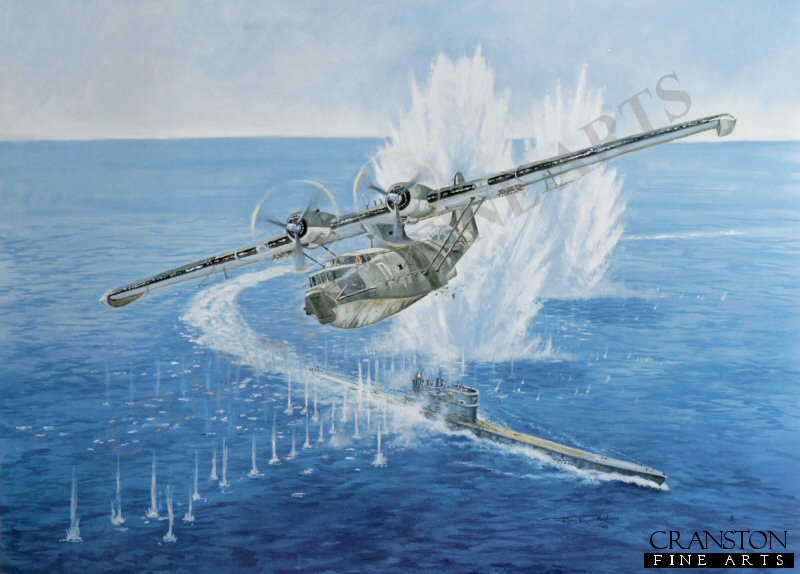
Catalina Attack by John Wynne Hopkins. D for Donald of 270 squadron, Royal Air Force, out of Freetown, West Africa operating in the Atlantic Ocean. It was during routine operation search that D for Donald surprised U515 on the surface and immediately attacked the submarine. U515 in putting up stiff resistance blew a large hole in the hull of D for Donald and the magazine of the starboard side 0.5 twin Browning was hit and the subsequent shrapnel wounded both blister gunners. U515 escaped but was sunk by an American naval hunter group a year later. D for Donald limped back to base and managed to make the beach before it would sink completely. |
Heading for the Convoys by Stephen Brown. RAF Catalinas of 210 Squadron over the West Coast of Scotland in 1944. The Consolidated Catalina PBY-5 proved invaluable to the RAF in its efforts to defend the vital convoys from the threat of enemy submarines, particularly during the Battle of the Atlantic. |
Black Cat Rescue by Nicolas Trudgian. On February 15, 1944, flying his Navy PBY Catalina on air-sea rescue duty, Lt. Nathan Gordon received an urgent call. Several 345th BG B25s were down following a major attack on Kavieng, and crews were in the water just offshore. Under intense gunfire, Gordon made no fewer than four perilous water landings to pick up survivors, returning to make an emergency landing at Cape Gloucester with 25 people aboard, an just 10 gallons of fuel in his tanks. Gordon was awarded the Medal of Honor. |
Wings Over Waikiki by Stan Stokes. The Consolidated PBY Catalina, the sea going flying workhorse of the US Navy during WW II, is with no doubt the most successful flying boat ever produced. Produced for more than ten years, it was built in greater numbers (3,300) than any other flying boat in history. In the early days of aviation flying boats made a lot of sense because of the relatively limited number of prepared airfields. Any estuary, river, or lake could become an airfield for an aircraft designed as a flying boat. Consolidated Aircraft got into the flying boat business rather late in the game. In 1928 the company won a bid to produce a prototype of a new high-wing monoplane flying boat for the Navy which would utilize aluminum in its fabrication. The XPY prototype was successfully flown in early 1929, but the Glen L. Martin Co., one of the pioneers in flying boat production, won the production contract. Not deterred by this setback, Consolidated utilized the expertise it had developed on this project to introduce a commercial 28-passenger flying boat called the Commodore. This aircraft was utilized by a number of airlines including Pan Am. Concurrent with work on the Commodore the Consolidated design team set about developing an improved version of the XPY. This design (the P2Y-1) had an enclosed cockpit, and was designed to handle either two or three engines. A total of 47 P2Ys were put in service. As production commenced on the P2Y, Consolidated began work on another improved flying boat which would be considerably larger than the P2Y. The prototype of this new aircraft (the XPY-3) utilized retractable wing floats. In 1935 Consolidated won the initial production order for the first PBY-1s in 1935. In 1936 another fifty aircraft were ordered as the PBY-2 derivative. A PBY-2 based in Hawaii is depicted in its pre-war markings over Diamond Head, in Stan Stokes painting entitled Wings Over Waikiki. This version lacked the fuselage window blisters which would be used on later variants. The PBY-2 had a wing span of 104 feet, and was nearly 64 feet in length. Powered by two 850-HP Pratt and Whitney R-1830-64s, the PBY-2 had a maximum speed of 178-MPH, and a range of more than 2,000 miles. The British ordered more than 100 PBYs in 1939. They called the aircraft Catalina. Also in 1939 a number of Catalinas were modified into amphibians by adding a retractable tricycle undercarriage. This added more than 2,000 pounds to the weight of the aircraft, but also improved its versatility. In the first few days following the Japanese attack on Pearl Harbor, many of the PBYs deployed throughout the Pacific were damaged or destroyed. The PBYs were vulnerable to enemy fighter attack when in the air. Despite these early setbacks, the Navy learned to make good use of the PBY as the war progressed. One of the most effective uses of the aircraft was in night search and attack missions, where the aircraft were generally painted all black. These Black Cats operated from island bases and seaplane tenders and effectively hampered night time movement of enemy supplies. The Catalina also flew many Dumbo missions during the war rescuing downed allied aviators. Many thousands of lives were saved during these missions. |
On the Prowl by Timothy OBrien. Royal Air Force catalina over flys a Royal Navy Cruiser of Gibraltar while on patrol. |
Black Cat, Indian Ocean, 1944 by David Pentland. A Catalina flying boat of the Royal Air Force shown at anchor in the Indian Ocean at night. |
Great Catalina Take-Off by Roy Cross. No text for this item |
| Catalina Pilot and aircrew signature details |
M Belcher Our estimated value of this signature : £20 | M Belcher Catalina pilot of No.259 Sqn based at Mombasa, carrying out patrols over the Indian Ocean |
Flt. Lt. John Bishop Our estimated value of this signature : £40 | Flt. Lt. John Bishop Joined the RAF in April 1943 from Edinburgh University Air Squadron and trained as a pilot in Rhodesia. In August 1944 he was posted to Diego Suarez to fly Catalina flying boats on anti-submarine patrols. He converted to Sunderlands at Mombassa on 209 Sqdn. and 57 MU also on Sunderlands until 1953. This included the Berlin airlift in 1948, flying from the river in Hamburg to Havel Lake, and flew in an anti-shipping role in Burma. At the end o fthe war in the Far East he flew form Hong Kong and Singapore until returning to the UK in Spetember 1946. He continued on 201 Sqd. Flying Boats until 1953. Thereafter he was mainly employed on V.I.P. duties flying from Malta, Northolt, Fontainebleau, Bovingdon and White Waltham. He flew 173 ops and 1800 hours on Sunderlands and 1800 hours on Devons out of a total of 6250 flying hours. The last fiver years of his service was as an Air Traffic Controller at R.A.F. Benson and RAF Abingdon. A Clipped Signature is Available |
Amm John Brately Our estimated value of this signature : £50 Died : 2007 | Amm John Brately John Brately was Mechanic on the Catalina PBY 'Arkansas Traveler' 08139. Sadly John Brately died in 2007. A Clipped Signature is Available |
Flying Officer George Cook Our estimated value of this signature : £15 | Flying Officer George Cook A WOP/AG on Hampdens with 49 Sqn, where he completed 33 Ops. He completed the 2 thousand bomber raids to Cologne and Essen. He then went out to SEAC with 205 Sqn where he completed a full tour of 1000 hours on Operations in a Catalina hunting Japanese submarines. |
  Flight Lieutenant John Cruickshank VC Our estimated value of this signature : £75 | Flight Lieutenant John Cruickshank VC Joined the Territorial Army in April 1939 and was mobilized for active service at the outbreak of World War II. He served mostly in south east England. In July 1941 he transferred to the RAF for aircrew duties, undergoing pilot training with the US Navy at Pensacola, Florida and gaining his pilot's wings in June 1942. Following a short period with the RAF Ferry Command in Canada and further operational training in the UK he joined 210 Sqdn based at Pembroke Dock, South Wales and later Poole Bay, Dorset. As captain of a Catalina flying boat, he carried out Anti-U-boat patrols in the Bay of Biscay and the Eastern Atlantic Ocean until December 1943. During this period, he carried out a detachment to Gibraltar for similar duties. In early 1944 elements of his Sqdn were moved to Sullom Voe in the Shetland Islands for Anti U-boat duties and General Maritime Reconnaissance in northern waters. In mid July 1944, while on an Anti U-boat patrol west of the Lofoten Islands, they sighted and attacked a surfaced German U-boat. During the attack, the aircraft received extensive damage from the U-boat's armaments also suffering crew casualties. The aircraft remained airborne and returned to base. For this action three members of the crew were decorated with the Distinguished Flying Cross, the Distinguished Flying Medal, and the Victoria Cross. Following this episode, Cruickshank became tour expired and moved to staff duties at Headquarters, Coastal Command, Northwood, near London. He was released from active service in early 1946 and returned to a civilian occupation. A Clipped Signature is Available |
  Lieutenant Commander Nathan Gordon Our estimated value of this signature : £50 Died : 2008 | Lieutenant Commander Nathan Gordon Lt. (jg) Nathan Gordon made four stall landings in his Black Cat PBY in rough waters of Kavieng Harbor to collect ditched survivors of the strike. Coming under intense enemy fire, he and his crew located and picked up 15 Army fliers shot down during the attack. His actions on this day earned him the Medal of Honor. Born in 1916, Nathan Gordon enlisted in 1941, training in Florida until February 1942, joining VP-34 flying PBY Catalinas. In June 1943 the squadron was posted to Hawaii, and subsequently flew missions over Midway and Tarawa, before moving to Australia on anti-shipping raids, then to Samarai Island, where the squadron acquired the nickname Black Cats. It was from here that Nathan Gordon completed the daring rescue mission for which he received the Medal of Honor. Sadly Nathan Gordon died on 9th September 2008. A Clipped Signature is Available |
 Flight Lieutenant William Hallisey Our estimated value of this signature : £10 | Flight Lieutenant William Hallisey With No.230 Sqn, flew Sunderlands against the Japanese. Working as a customs and excise officer at the outbreak of war he was finally allowed to enlist in January 1941, in the RAF Volunteer Reserve. After training he became a Flying Instructor spending two years in Canada, sometimes flying anti-submarine patrols. Receiving an operational posting to 202 Squadron in April 1944 and based in Gibraltar as a 2nd Pilot on Catalina PBYs, he flew during Operation Cork to protect the western flank of the D-Day landings from U-Boats. In April 1945 he was posted to the Far East where he flew Sunderlands with 230 Squadron against retreating Japanese coastal vessels, where he also gave informal night-flying training. Following the Japanese surrender he represented the squadron to fly in the formal surrender ceremonies, then helped to ferry recently liberated Allied POWs out of Singapore and back to India. |
 Sergeant Leopold Heimes Our estimated value of this signature : £50 Died : 2009 | Sergeant Leopold Heimes Already in the Belgian Air Force, he moved to 235 Sqn Coastal Command as an Air Gunner on Blenheims during the Battle of Britain before becoming a pilot, flying Spitfires and Catalinas with 350 Sqn before converting to 76 Sqn on Dakotas in India. Heimes stayed in the RAF until September 1951 having been gazetted as a Master Pilot. Sadly, Leopold Heimes died in 2009. |
Sydney Hillier Our estimated value of this signature : £40 | Sydney Hillier Sydney Hiller was a member of the crew of Catalina D for Donald of 270 Squadron. The squadron was based for most of the war at Freetown, West Africa. He was a member of the crew when his aircraft launched a surprise attack on u-boat U-515. |
Wg. Cdr. V. Hodgkinson DFC, MID, MRAeS Our estimated value of this signature : £35 | Wg. Cdr. V. Hodgkinson DFC, MID, MRAeS Joined the Royal Australian Air Force in 1937 (Service no 463). He was posted to No. 10 Sqdn. RAAF in the UK in January 1940 flying Sunderlands from Pembroke Dock and went on to serve until 1942 flying operations in the Atlantic and Mediterranean from bases in Pembroke Dock, Oban, Plymouth, Gibraltar and Alexandria (Egypt). In 1942 he was posted back to No. 20 Sqdn. in Australia flying Catalinas from Cairns on bombing raids over Japanese bases and anti-shipping patrols throughout the Solomon Islands and north of New Guinea . He went on to complete 44 operations and commanded this squadron until 1943 before becoming Chief Flying Instructor, Catalinas 3 OTU Rathmines. Vic later formed and commanded No. 40 Sqdn. RAAF Sunderlands, Port Moresby, New Guinea until 1945. He retired from the RAAF in 1946 to join BOAC, Hythe, flying their civil Sunderland conversions - Hythes, Sandringhams and Solents. Vic transferred to landplanes in 1950 flying Canadair Argonauts, Bristol Britannias, DH Comet 4s, 707-436s and 336s. Vic retired in 1971 having amassed 19,300 hours, including some 4,300 hours on Flying Boats. In his retirement Vic is currently restoring and maintaining a Sandringham Flying Boat at the Southampton Hall of Aviation. A Clipped Signature is Available |
 Oud Adjudand Onderofficier Vlieger Paul Kommer Our estimated value of this signature : £35 | Oud Adjudand Onderofficier Vlieger Paul Kommer Paul Kommer joined the R.NI.N. in August 1940 as Teerling Onderofficier Mieger. In December 1941 he was Korporaal Mieger, flying the Dornier 24 as co-pilot on the Chance Encounter operation, one of his 50 war time combat patrols. After the eventual capitulation of the Netherlands East ladies, he became a prisoner of war and was sent to work in the coal mines in Japan. When war was over he had somehow survived, but he weighed just 94lbs, nearly half of his normal body weight. After the war he flew PBYs with the R.NI.N. and later became an instructor. |
  Pilot Officer Bill Leckie, AEM, KW Our estimated value of this signature : £50 Died : 2021 | Pilot Officer Bill Leckie, AEM, KW Bill Leckie was born in Glasgow, Scotland on 23rd June 1921, joined the Royal Air Force in June 1941 and went to St Johns Wood on the 15th of September 1941. Bill Leckie started his flying training on the 4th of April 1942 at Stoke Orchard near Cheltenham in Tiger Moths. He went to Canada on the 26th of May 1942 at Monkton for further training until June before going on to Detroit and on to Pensacola, Florida on the 1st October 1942, flying Stearman and Catalina Flying boats until 31st March 1943 when Bill went to Prince Edward Island for further training. Back in the UK, Bill was expecting to join a Coastal Command squadron flying Catalinas but was transferred to Bomber Command and a conversion course on to Whitleys at Kinloss Scotland on the 22nd of February 1944, and joined 77 Squadron at Full Sutton on the 19th July 1944 on Halifaxes, flying 6 bombing missions, one being the bombing of the Flying Bomb Factory at Russesheim, before transferring to 148 Special Duties squadron on the 19th of August 1944 and going to Brindisi. Pilot Officer Bill Leckie was involved in the dropping of supplies (guns, ammunition and food) to the Polish during the Warsaw uprising. This was a costly mission and many aircraft were lost. (Bill was flying Halifax JD319 (FS - G). For his efforts in air-dropping supplies during this period, Bill Leckie was awarded the Polish Cross of Valour (KW). Pilot Officer Bill Leckie was also the Pilot for Operation Ebensburg on Sunday 8th April 1945. Halifax B.II Series 1 (Special) JP254 of 148 Special Duties Squadron carried out the misison to drop four SOE agents and their equipment near Alt Aussee salt mine in the Austrian Alps. Thier mission was to secure and protect 6,755 items of the worlds greatest works of art that had been looted and stored by the Germans as they swept across Europe. With the allied forces closing in, the Germans had planned to blow up the entire store to prevent the artworks from falling into the hands of the liberators. Once on the ground, the four agents linked up with local resistance fighters and the mine and its valuable contents were eventually secured, the explosives made safe and the entire cache taken into the safe keeping of the 80th US Infantry Division as the German occupation of Europe crumbled. Bill Leckie stayed with 148 Squadron until 18th May 1945 when he was posted to Cairo with 216 Squadron (Dakotas) of Transport Command and on 1st January 1946 to 78 Squadron flying Dakotas again until 1st June 1946 , finally leaving the RAF on the 18th September 1946. He died in October 2021. |
Wg. Cdr. A.W.L. Paddy Mahon MBE, C. Eng. MRAeS Our estimated value of this signature : £40 | Wg. Cdr. A.W.L. Paddy Mahon MBE, C. Eng. MRAeS Started his 37 year career in the Royal Air Force in 1930 when he enlisted as an Aircraft Apprentice at Halton. he served as Metal Rigger and later as an Aircraft Fitter on Fleet Air stations and ships, for a while on Queen Bee aircraft. In 1937 he finally succeeded in selection as an Airman Pilot. EFTS at Bristol, SFTS at South Cerney, Maritime Recce at Thorney Island, and finally Flying Boat School at Calshot. There he learned his craft as a 'Boat' pilot on ageing Supermarine Scapas formerly used by 202 Squadron, Malta. On completion he was posted to 228 Squadrion at Pembroke Dock which was in process of re-equipping with Stranraers. In December 1938 he was 2nd pilot on the collection from Rochester of the Squadron's first Sunderland. In June 1939 the Squadron moved to Alexandria for Naval Co-operation Exercises. In addition to these the Sunderlands were used for long range V.I.P. flights and for transport around the Med. In course of these, the crew of which Sgt Mahon was a member, visited Malta, Bizerta, Cairo, Cyprus and for the third time Athens, leaving on 2nd September 1939. The Squadron was ordered home to Pembroke Dock on September 9th and immediately started the round of convoy escorting anti-submarine sweeps and general maritime tasks covering from Norway to Malta. On 24th November Sgt Mahon was one of the crew detailed to search for the Deutschland after it had sunk the armed merchant cruiser Jervis Bay. The operation involved the crew in 15 hours of flying in the most severe weather. Detachments to the Shetlands often meant the whole crew living on the aircraft for several days at a time because the weather prevented small craft coming along side but flying by day continued. In June 1940 he was seconded to 10 RAAF Squadron at Mount Batten to increase their roll of qualified first Pilots. One of his first trips was to convey Lord Gort and Mr Duff Cooper to Rabat on an unsuccessful attempt to persuade the Sultan of Morocco to continue the war on its allies' side. That trip earned the Captain a DFC. In the months he spent with 10 Squadron several trips were made to Malta supporting the Hurricane reinforcement by aircraft carriers conveying essential ground personnel and equipment including one load of several tons of Browning gun links, none of which were held on the island. In February 1941 it was back to 'two layers of wing'. He was posted to 202 Squadron at Gibraltar, which was flying Saro Londons but expected to be re-equipped with Sunderlands. He travelled as a 'passenger' on a 10 Squadron aircraft in company with Anthony Eden and Lord Dill. That trip is recorded in several books on the Sunderland as being 'special'. It was Sgt Mahon's last ever time flying in a Sunderland as 202 Squadron were subsequently re-equipped with Catalinas. The transfer meant flying to UK with a London, a memorable trip of over 15 hours. Qualifying courses at Stranraer on the Catalina led to the ferrying flight back to Gibraltar. Unfortunately on Sgt Mahon's ferry trip the elevator controls failed en route and the attempted landing at Gibraltar using only trim tabs resulted in a serious crash ending his flying career. After a long period of hospital and subsequent rehabilitation, he reverted to his ground trade. He was commissioned into the Technical Branch in which he served until 1967 being awarded the MBE in 1963. A Clipped Signature is Available |
Alex Morrison Our estimated value of this signature : £35 | Alex Morrison Alex Morrison was a member of the crew of Catalina D for Donald of 270 Squadron. The squadron was based for most of the war at Freetown, West Africa. He was a member of the crew when his aircraft launched a surprise attack on u-boat U-515. |
 Jack Morrissey Our estimated value of this signature : £10 | Jack Morrissey Jack Morrissey enlisted in the US Navy in June 1941, quickly rising to become Aviation Machinist Mate 1st Class and was soon operating as a Naval Aviation Pilot flying the PBY Catalina. Posted to Midway Naval Air Station he fle combat operation PBY-5s throughout the Battle of Midway in June 1942, rescuing American airmn that had been shot down, and went on to fly the SBD Dauntless. During his service, he was shot down once but by the end of the war had managed to notch up over 4500 flying hours. He was awarded 3 Presidential Citations and left the service at the end of the war. |
 Flight Lieutenant Graham Stevens Our estimated value of this signature : £10 | Flight Lieutenant Graham Stevens With No.230 Sqn, flew Sunderlands against the Japanese. Called up in 1941, he completed his pilot training with the US Navy in Pensacola, Florida and was selected to fly Catalina flying boats in the maritime reconnaissance role. Inititally posted to 270 Squadron in West Africa as a 2nd Pilot, he and his crew were tasked with patrolling over the South Atlantic gathering information on enemy maritime activity. As the war in Europe drew to a close, he completed a Captains conversion course and re-trained to gly the Short Sunderland. As victory over the Japanese approached he joined 230 Squadron in Madras to begin what was the most satisfying period of his service, piloting repatriation flights for Allied POWs from Singapore to begin the first leg of their journey home. |
Flt. Lt. John Tattersall Our estimated value of this signature : £40 Died : 2006 | Flt. Lt. John Tattersall Made his first attempt at becoming a pilot by joining the waiting list for Pilots of Manchester Auxiliary Squadron. He joined the RAF as a clerk in 1940 and remustered Aircrew in May 1941 and by June was on his way to the US Naval Air Service Station, Pensacola, Florida as a member of the first group of students under the TOWER scheme. On his first day solo in October 1941 he crashed and woke up in hospital with a headache and scratched eyebrows. Eleven days later he was flying again and finally gained his wings in May 1942 on Catalinas. Returning to the UK he spent some time flying 'Oxfords' before being posted to 131 OTU, Loch erne, N. Ireland. In January 1943 he passed out as an aircraft Commander and joined 210 Sqdn at Pembroke Dock in February. He spent the next ten months (some 700 flying hours) flying over the Bay of Biscay on Anti-Sub operations including Leigh Leight operations, some convoy and naval co-operation. In January 1944, 210 Sqd. disbanded and he returned for a short spell to 131 OTU before being seconded to BOAC in April 1944. With BOAC he flew on the civil version of the Sunderland and 'c' class flying boats thence landplanes - Arginaut, Comet, Britannias (102 and 312) and VC10s retiring in 1973 to a ground job as Flight Crew Executive until May 1976. He died on 10th November 2006. A Clipped Signature is Available |
Flt. Lt. Ron Vaughan, DFC Our estimated value of this signature : £45 | Flt. Lt. Ron Vaughan, DFC Joined the RAFVR in December 1940 and trained as a pilot-cadet with the US Navy at Pensacola, Florida. After further Coastal Command training in the UK, he joined 10 OTU (detachment) at St Eval, Cornwall. The tour was completed, as a Whitley co-pilot, on U-boat patrols over the Bay of Biscay, between December 1942 and March 1943. After training for command on the Catalina, he joined 210 Sqdn at Sullom Voe, Shetland from June 1943 to October 1944. In October 1943, with all landing areas closed with fog, his Catalina, out of fuel, ditched in the Atlantic, west of the Shetlands. It had remained airborne for 22 hours and then survived, on the water, for a further 18 hours before the crew were rescued. The pigeon which had carried the SOS message to base, later received the 'Dicken Medal' (Animal VC) for flying over 60 miles, in fog, in nine hours! In May 1944, U-boat 394 was attacked in northern waters, without success. On 18th July 1944, U-boat 742 was sunk 180 miles west of the Lofoten Islands, off Norway. The Catalina was badly holed but managed to return to base, 500 miles in six and a quarter hours, on the port engine. F/Lt John Cruickshank had sunk U-361 on the previous day, from the same Arctic U-boat Flotilla. F/Lt Vaughan instructed on Catalinas in Northern Ireland and was then posted to India, yo join Catalina 240 Sqdn in Madras, and then until VJ Day with Liberator Sqdn 357 in Ceylon. He left the RAF in 1946 having flown Halifax 7, at Linton and Cranwell. He joined BOAC and captained many types of aircraft for 29 years before retiring in 1975. A Clipped Signature is Available |
Cdr Cole Windham USN Our estimated value of this signature : £40 | Cdr Cole Windham USN Cole Windham was born in West Columbia, South Carolina on April 29, 1912. At the age of six Cole remembers standing on a brick wall in front of his home and watching a platoon of WW1 soldiers marching toward him. As they came abreast he saluted, and the platoon leader returned the salute. It was a vivid memory that lasted a life time. His family moved to Gastonia, North Carolina in the early 1920s. Cole finished high school there, and was awarded a full academic scholarship to attend Davidson College. Following his graduation in 1936, Cole joined the Navy as an aviation cadet. After earning his wings, Cole's first assignment was with VP-19 flying P2Y-3s out of Seattle, Washington and Sitka, Alaska. In 1939 he was reassigned to VP-33 flying PBYs out of Panama. When war broke out in Europe in 1939, President Rooselvelt, fearing for the safety of American shipping in neutral waters, organized 'The Neutrality Patrol'. Cole was sent with a detachment of aircraft to Key West, Florida. There he remained busy, flying every day, and reporting the positions and information on all shipping in the area. In 1940 he was transferred to VP-71 flying the PBY-5. This squadron operated from British Guyana to Iceland. Cole flew a number of antisubmarine patrols around lend lease convoys carrying supplies to England and Russia. He also flew survey flights out of Guyana to recommend a location for a search and rescue seaplane base. In May of 1941 eleven aircraft in Cole's squadron were enlisted in the search for the German Battleship Bismarck. In an unsuccessful flight of more than seventeen hours in duration, Cole experienced some very difficult weather conditions which required constant instrument flying. The aircraft were only able to return safely by radioing their ship for a bearing. Under the conditions, it was remarkable that all eleven aircraft and crews made it back safely. With America's entry into the War in December of 1941, Cole was assigned to Kaneohe Bay in Hawaii. There he would fly long 700 mile patrols to protect the islands from any additional attacks. He was then transferred to the Coral Sea to fly patrols for the U.S fleet prior to the Battle of the Coral Sea. Upon return to Hawaii in 1942, Cole was transferred back to the States and given Staff Duty with the Amphibious Forces. At war's end in 1946, he returned to civilian life, and joined Pan American Airways as a pilot. Following a successful career in commercial aviation, Cole has settled down in Asheville, North Carolina with his bride of fifty years. He enjoys telling his treasured 'sea stories' to his two daughters, three grandchildren and great grandson. A Clipped Signature is Available |
| Catalina Squadron details |
No.190 Sqn RAF Country : UK Disbanded 21st January 1946 Known Codes : , G5, L9, 6S, | No.190 Sqn RAF Ex tenebris - Through darkness |
No.191 Sqn RAF Country : UK Disbanded 15th June 1945 | No.191 Sqn RAF Vidi vici - I saw, I conquered |
No.202 Sqn RAF Country : UK Known Codes : , Y3, AX, JU, TJ, TQ, | No.202 Sqn RAF Semper vigilate - Be always vigilant |
No.205 Sqn RAF Country : UK Disbanded 31st October 1971 Known Codes : , FV, KM, | No.205 Sqn RAF Pertama di Malaya - First in Malaya |
No.209 Sqn RAF Country : UK Disbanded 31st December 1968 Known Codes : , FK, WQ, | No.209 Sqn RAF City of Hong Kong Might and main |
No.210 Sqn RAF Country : UK Disbanded 15th November 1971 Known Codes : , DA, VG, | No.210 Sqn RAF Yn y nwyfre yn hedfan - Hovering in the heavens |
No.240 Sqn RAF Country : UK Disbanded 8th January 1963 Known Codes : , BN, SH, | No.240 Sqn RAF Sjo-Vordur Lopt-Vordur - Guardian of the sea, guardian of the sky |
No.259 Sqn RAF Country : UK Disbanded 30th April 1945 | No.259 Sqn RAF Haya ingia napigane - Get in a fight |
No.265 Sqn RAF Country : UK Disbanded 30th April 1945 Known Codes : , TR, | No.265 Sqn RAF |
No.270 Sqn RAF Country : UK Disbanded 30th June 1945 | No.270 Sqn RAF |
No.321 Sqn RAF Country : UK Disbanded 8th December 1945 Known Codes : , HH, QQ, UU, | No.321 Sqn RAF Dutch |
No.330 Sqn RAF Country : UK Disbanded 21st November 1945 Known Codes : , GS, WH, | No.330 Sqn RAF Norwegian Trygg havet - Guarding the seas |
No.333 Sqn RAF Country : UK Disbanded 21st November 1945 Known Codes : , KK, | No.333 Sqn RAF Norwegian For Konge, Fedreland og flaggets heder - For King, country and the honour of the flag |
No.350 Sqn RAF Country : UK Disbanded 24th October 1946 Known Codes : , MN, | No.350 Sqn RAF Belgian Belgae gallorum fortissimi - The Belgae, bravest of the Gauls |
No.413 Sqn RCAF Country : Canada Disbanded 23rd February 1945 Known Codes : , QL, | No.413 Sqn RCAF Tusker Ad vigilamus undis - We watch the waves |
|
Contact Details |
Sign Up To Our Newsletter!
This website is owned by Cranston Fine Arts. Torwood House, Torwoodhill Road, Rhu, Helensburgh, Scotland, G848LE Contact: Tel: (+44) (0) 1436 820269. Email: cranstonorders -at- outlook.com
|