|
|
|
|
|
|
|
|
|
Cranston Fine Arts  Aviation Art and Artists World War Two Aviation Art and Artists World War Two  Postcards Postcards |
[UP] - Aircraft - Countries - Squadrons - Veteran Signatures - Postcards - Print List - Articles and Collections |
| Navigation | |
| Page 5 of 19 | Previous .. Page 5 .. Next |
|
|
|
|
|
|
|
|
|
|
|
|
|
|
|
|
|
|
|
|
|
| Navigation | |
| Page 5 of 19 | Previous .. Page 5 .. Next |
| Text for the above items : |
Red Tails by Ivan Berryman. (PC) Often described as the most effective fighter escorts in the US Army Air Force, the famous red-tailed Tuskegee airmen could proudly boast that they never lost a single bomber to enemy fighters in all the missions flown. Nearest aircraft here is the P51C of Lt. Lee A Archer Jr, who finished the war with four confirmed victories and one shared. His personal aircraft was named Ina the Macon Belle after his wife. |
A Battle Lost by Ivan Berryman. (PC) Although vulnerable and out-moded, the Fairey Battle nonetheless played a vital role in the early years of WWII, especially during the Battle of France. This aircraft, K9176 (MQ-G), a Fairey Battle Mk1 of 226 Sqn was lost on the night of 21st / 22nd May, 1940, crashing near Montcornet. |
Tribute to Johannes Steinhoff by Graeme Lothian. (PC) No text for this item |
A Spot of Gardening by Ivan Berryman. (PC) Wellington Mk.III X3671 of 156 Sqn piloted by P/O Fox is depicted laying mines in the Estuary of the Loire on the night of 16th April 1942 in the Bay of Biscay. Just three days later, P/O Fox failed to return from a similar 'Gardening' sortie whilst flying Wellington X3485. |
Focke-Wulf Fw190A-5/U8 by Ivan Berryman. (PC) Focke-Wulf FW.190A-5/U8 of 1 Gruppe, Schnellkampfgeschwader 10 in 1943. All national markings were painted out, except for the call sign C on the fuselage and repeated, crudely sprayed, on the engine cowling. |
Wimpey Wonderland by Keith Aspinall. (PC) Returning from a night mission, two Wellington bombers return over the snow covered fields of England. A fitting tribute to the air crews of the Wellington squadrons of World War Two. |
Duel by Ivan Berryman. (PC) With the Battle of Britain at its height and the RAF stretched to breaking point, September of 1940 was a desperate time for the young pilots who fought gallantly to defend the UK against an imminent invasion. Among those brave few was the eighteen year old Geoffrey Wellum, shown here destroying a Heinkel He.111 on 11th September in Spitfire 1a K9998. The Heinkel fought back, peppering Wellum's Spitfire with holes, but the German bomber was mortally wounded and was seen to go down in flames. |
Dora-Nine by Ivan Berryman. (PC) Without doubt one of the finest fighter aircraft of WW2, the Focke-Wulf FW.190 was steadily developed from the BMW-powered 'A' series through to the Jumo-Powered 'D', the latter of which proved superior to its predecessors in almost every respect. Here, a pair of D-9s of IV./JG3 based at Prenzlau in Eastern Germany, roll through a glorious late afternoon sky in March 1945. |
Job Well Done by Ivan Berryman. (PC) A Photo Reconnaissance Spitfire returning from a mission over occupied France. |
A De Havilland Beauty by Ivan Berryman. (PC) A Mosquito Mk.BIX above the clouds in late 1943. Mosquito B.IX LR503 holds the record for the most combat missions flown by a single Allied bomber in the Second World War, serving 213 sorties. |
Drop Zone Ahead by Ivan Berryman. (PC) Douglas C-47s of the 439th Troop Carrier Group, 94th Troop Carrier Squadron, approach the Drop Zone above Normandy on the night of 5th / 6th June 1944 at the start of Operation Overlord. |
Tribute to Sqn Ldr Eugeniusz Horbaczewski by Ivan Berryman. (PC) On 16 February 1944 Horbaczewski took command of the Polish No. 315 Squadron, flying the new P-51 Mustang Mk. III. On 12 June 1944 he shot down a FW 190, and on 30 July one Bf 109 individually and one with his wingman (counted as a 0.5 'share'). |
Dogfight over Asch, Belgium, 09.20 a.m., New Years Day, 1st January 1945 by David Pentland. (PC) As the four P51D Mustangs of Major William T Haltons Yellow Flight, 487th Fighter Squadron took off from Asch, they found themselves in the middle of a massive German attack. That New Years Day the Luftwaffe had launched hundreds of aircraft in low level raids against the allied airfields across Northern France and Belgium. The unexpected take-off by the 487th however, ended Jagdgeswader 11s chances of success, with Yellow Flight alone claiming 9 enemy aircraft destroyed. |
Tribute to the Crews of the Stirling by Graeme Lothian. (PC) Outward bound, Stirling III of 199 Squadron based at Lakenheath, Suffolk, heads out on another night of operations in August 1943. EE953, Sqd letters EX - E of 100 group is piloted by F/L Tom Austin DFC who finished his tour by the end of October 1944, winning the DFC with his bomb aimer F/O Jack Lawrence. Nicknamed the Queen of the Skies, the Stirling was the 1st four engined bomber to enter service with the RAF in 1941. The cockpit stood a massive 22.5 feet from the ground and had an operational ceiling of only 12,000 feet, well within the range of the enemy AA guns. By September 1944 other bombers were taking the brunt of the attack to the Germans and the Stirlings were used mainly for glider towing especially for D-day and Arnhem. |
Tribute to Capitano Ugo Drago by Ivan Berryman. (PC) Having converted to the Messerschmitt Bf.109G with 150° Gruppo in 1943, Ugo Drago opted to ally himself with the Repubblica Sociale Italiana when the armistice was announced, taking command of 1a Squadriglia which also re-equipped with the Bf.109G. Drago scored eleven personal victories in the following nine months from June 1944, many of them flying 'Black 7', as depicted here, claiming a P.47 off the coast of Pantelleria. |
Messerschmitt Me262B-1a/U1 by Ivan Berryman. (PC) Messerschmitt Me262B-1a/U1 of 10 Staffel, Natchjagdgeschwader 11. |
The Last of the Many by Keith Woodcock. (PC) Hurricane PZ865 of the Battle of Britain Memorial Flight. |
The Longest July by Ivan Berryman. (PC) Posted to 64 Squadron on 1st July 1940, the tragically short relationship of Sub Lt F Dawson Paul with the Spitfire was crammed with victories. He immediately shared a Dornier Do17 off Beachy Head and, just four days later claimed a Messerschmitt Bf.109. Further kills were confirmed over the next two weeks, among them five Bf.110s and another Do.17. His final victory was a Bf.109 on 25th, but on this day he fell to the guns of the German ace Adolf Galland. Dawson Paul was rescued from the English Channel by a German E-boat, but died of his wounds five days later as a prisoner of war. |
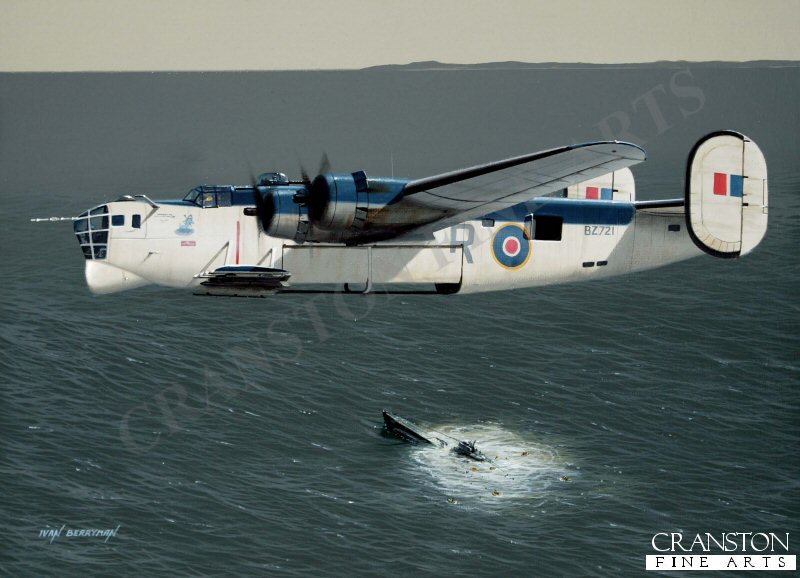
Tribute to Terry Bulloch by Ivan Berryman. (PC) A prominent aviator in the Battle of the Atlantic, Terry Bulloch flew B-24 Liberators with No.120 Sqn in an anti-submarine role. Already awarded the Distinguished Flying Cross for shooting down two German aircraft in a No.206 Sqn Lockheed Hudson over Dunkirk, he was awarded a Bar to this when he sunk U-boat U-597 in October 1942. After another attack, this time sinking U-132 and damaging U-89, he was awarded the Distinguished Service Order, and gained a Bar to this on leaving No.120 Sqn at the end of 1942. Bulloch is seen here on 8th July 1943 in Liberator GR Mk.V BZ721 of No.224 Sqn having completed his hat-trick of U-boat kills, this time sinking U-514 in the Bay of Biscay. This type had been modified by RAF Coastal Command to carry rockets, which Bulloch had used to attack the submarine, finishing it off with depth charges. After the war, Bulloch became an airline pilot, crossing the Atlantic on more than 1,000 occasions. He died in 2014. |
Tribute to Peter Wykeham-Barnes by Ivan Berryman. (PC) Lattely known as Air Marshal Sir Peter Guy Wykeham, KCB, DSO and Bar, OBE, DFC and Bar, AFC - he is shown here baling out of his stricken Gloster Gladiator of No.80 Sqn over North Africa on 4th August 1940. At the time he would have been known as Peter Wykeham-Barnes - a flying Ace who would go on to score 14 victories plus 3 shared in a wartime career which also saw him fly with No.274 Sqn and command No.73 Sqn, No.257 Sqn and No.23 Sqn. Remaining with the Royal Air Force after the war, he became a test pilot and served with the US Air Force in the Korean War before taking serveral roles in the RAF, culminating in Deputy Chief of Air Staff from 1967 until retirement in 1969. He died in 1995. |
Spitfires of No.611 West Lancashire Squadron by Ivan Berryman. (PC) Spitfire Mk.IXs of No.611 Sqn including aircraft FY-F belonging to the Commanding Officer of 611 Squadron, Sqn Ldr Hugo Armstrong, on patrol late in 1942. Armstrong scored a victory in this aircraft on 2nd November 1942, bringing down an Fw190 for his only victory with this squadron. With a total of nine victories, he was awarded the DFC in May 1942, and the Bar to the DFC in January 1943, before being shot down and killed over the English Channel in February 1943. |
|
Contact Details |
Sign Up To Our Newsletter!
This website is owned by Cranston Fine Arts. Torwood House, Torwoodhill Road, Rhu, Helensburgh, Scotland, G848LE Contact: Tel: (+44) (0) 1436 820269. Email: cranstonorders -at- outlook.com
|