|
|
|
|
|
|
|
|
|
Cranston Fine Arts  Military Art and Artists World War One Military Art and Artists World War One  WW1 Military Postcards WW1 Military Postcards |
[UP] - Battles - Tanks - WW1 Book Plates - WW1 Medals - WW1 Military Postcards - WW1 Military Print List - World War One Regiments |
| Navigation | |
| Page 1 of 3 | Page 1 .. Next |
|
|
|
|
|
|
|
|
|
|
|
|
|
|
|
|
|
|
|
|
|
| Navigation | |
| Page 1 of 3 | Page 1 .. Next |
| Text for the above items : |
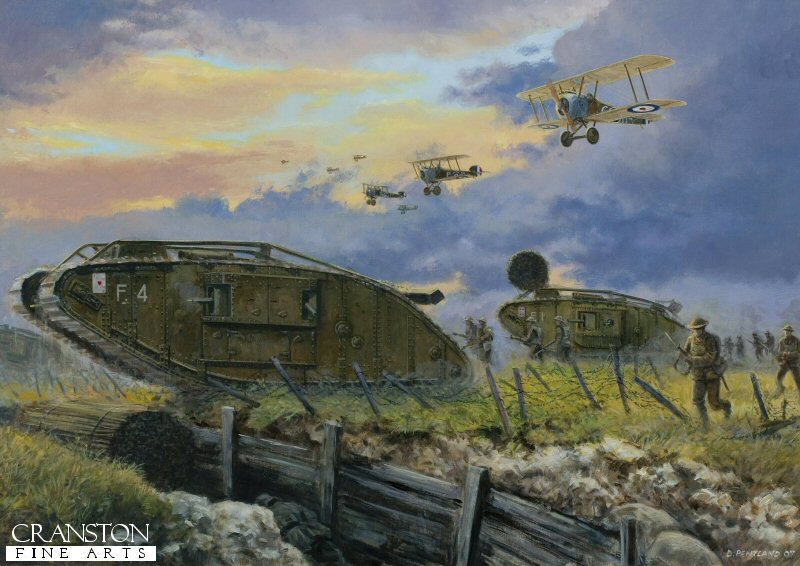
Battle of Cambrai, France, 20th November 1917 by David Pentland. (PC) At 0620 hours covered by a brief barrage from 1000 guns, the tanks of C and F Battalions in MkIV tanks advanced alongside the men of the British 12th Division against the impregnable German Hindenburg line at Cambrai. Supported in the air by 4 RFC squadron flying ground attack missions, the general offensive had broken through 3 trench lines and penetrated 5 miles on a 6 mile front by lunchtime. Although these gains were not exploited and later retaken by a German counter offensive, Cambrai showed the full potential of the tank on the battlefield. |
The Coldstream Guards at Landrecies, August, 1914 by William Barnes Wollen. (PC) During the great retreat from Mons the sorely-tried Second Division of the British Army, after fighting for several consecutive days, halted for the night exhausted. They were then suddenly attacked by fresh German hordes, but our brave fellows - Grenadiers, Coldstrea, and Irish Guards - were still able to turn and with the bayonet drive the enemy through the shell-torn streets of the little town. The action has been described as one of the greatest soldiers' battles in history. |
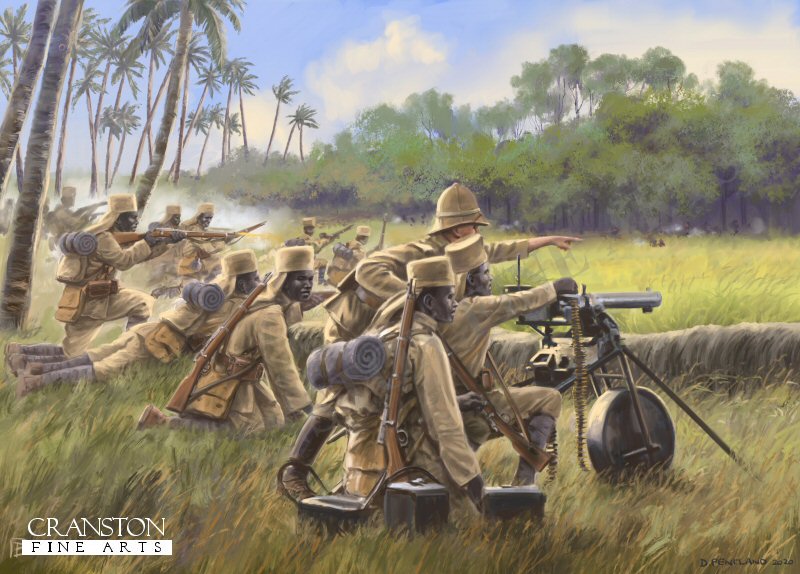
Battle of Tanga by David Pentland (PC) Schulztruppen and Askaris, Tanga, Tanzania 3rd-5th November 1914. Also known as the "Battle of the Bees", this was the first major engagement of the East African campaign. The British Indian Expeditonary Force's invasion of the port of Tanga failed, defeated by the smaller German force of Paul von Lettow-Vorbeck. |
Holding the Railway - Infantry on Manoeuvres by William Barnes Wollen (PC) British soldiers conducting training somewhere in the British countryside, seen with their iconic WW1 era Brodie Helmets and Lee Enfield rifles. |
Bayonet Charge of the London Scottish at Messines, Halloween 1914 by Allan Stewart (PC) At the Battle of Messines during October 1914, the London Scottish a part of the British Expeditionary Force, participated in the defence of the Ypres Salient. The London Scottish were positioned in key defensive locations to hold the line against the advancing enemy. Despite suffering heavy casualties, they displayed ferocious resistance at one point conducting a bayonet charge counter-attack against an overwhelming German advance. |
The Great Folly of 1916 by Jason Askew. (PC) Assault in the vicinity of Thiepval by the Ulster division-1st July 1916. The 11th Royal Irish Rifles, moving forward from the A line of trenches, and moving forward to attack the B line of trenches, the attacking infantry are preceded by Bombers - seen carryng grenades in green canvas buckets - who are engaged in throwing grenades in anticipation of the rifle company assault on the enemy trenches; an activity barely changed since the days of Marlborough. The rifle companies are armed with the Lee Enfield SMLE - a superb rifle, though expensive to make. The advance is made with bayonets fixed, as trench clearing involved numerous hand to hand confrontations and bayonet fights. The rifle companies are supported by two Lewis gun teams per company. Note that visible in the painting is a man carrying an orange painted steel marker, painted on one side only. The markers are to to indicate to British artillery observers as to the most forward positions taken by the British advance. Naturally, one does not present the orange side to the enemy! |
Passchendaele by Jason Askew. (PC) The German attack on the British trenches at Passchendaele in the rain. |
Charge of the 21st Lancers at Givenchy by John Charlton. (PC) No text for this item |
The Battle of the Somme - At the German Trenches by Jason Askew. (PC0 Very few of the British soldiers made it through the barbed wire defences, and even fewer to the German trenches. By the end of the first day the British losses were 60,000 men. |
The Firing Line by David Pentland (PC) 1st Battle of the Marne, France, 5th September 1914. Also known as the "Miracle of the Marne", where the allied armies halted a headlong retreat from the German army, and then counterattacked forcing a German retreat all along the entire Western Front. |
The Kaisers Battle, Operation Michael, France, 21st March 1918 by David Pentland. (PC) German Stosstruppen of the 18th Army, having broken through the British lines near St Quentin, engage secondary trench lines occupied by men of the 9th Battalion Royal Inniskilling Fusiliers (36th Ulster Division) . Similar attacks occurred right across the BEFs front, where the new tactics of short bombardments, infiltration, close air support, and non persistent gas had ripped open the British lines. |
A Saint goes to War - The Second Marne Offensive, France 18th July 1918 by David Pentland. (PC) St. Charmond Assault tanks of the French 10th Heavy Tank battalion move through Villers-Cotterets forest in preparation for the 10th Army counterattack on the German Soissons-Rheims salient. |
To the Green Fields Beyond, Cambrai, France, 20th November 1917 by David Pentland. (PC) At 0620 hours covered by a brief barrage from 1000 guns, Brigadier General Elles in a MkIV called Hilda led his 476 tanks against the impregnable German Hindenburg line at Cambrai. Supported by 6 infantry divisions and 4 Royal Flying Corps squadrons flying ground attack missions, the attack had broken through 3 trench lines and penetrated 5 miles on a 6 mile front by lunchtime. Although these gains were not exploited and later retaken by a German counter offensive, Cambrai showed the full potential of the tank on the battlefield. |
Tanks on the Marne - France, 18th July 1918 by David Pentland. (PC) Schneider CA1 Tanks of the French tenth army spearhead the successful counter offensive against the German army on the river Marne. Overhead a tenacious Junkers JI artillery spotter dogs their tracks. The Second Battle of the Marne, though not an overwhelming victory, spelt the end of German successes on the Western front, and a turning point for the allies. |
They Bombed and Bayoneted Their Way up the Enemy Trench by Cyrus Cuneo. (PC) No text for this item |
Baptism of Fire - St Mihiel Salient, 12th - 15th September 1918 by David Pentland. (PC) Renault FT 17 baby tanks of the recently formed US 304th tank brigade commanded by the young Lt. Col George S. Patton Jnr. are employed for the first time during the allied assault on the St Mihiel Salient. Leading the 344th battalion in person Patton and his tanks help the infantry divisions push the enemy back to the Hindenberg line in only 4 days. |
The Grenadier Guards Saluting The Colour by Douglas Macpherson (PC) Prior to going on guard for the day an assembly of grenadier guards salute the colour. |
Australian Imperial Force at Gallipoli by Cyrus Cuneo. (PC) 'Midst Shot and Shell we made the narrow beach, landing at Gallipoli.' 15th Battalion, Australian Imperial Force. |
Battle of the Somme, the Attack of the Ulster Division by J P Beadle. (PC) A classic art print of the Ulster Division advancing into the German trenches during the Battle of the Somme. The officer shown leading the unit is Lt Francis Bodenham Thornley. During the Battle of the Somme he was wounded while serving with B company Royal Irish Rifles and while recuperating he was given the job to advise J P Beadle on the painting. In the painting the troops are shown with the SMLE Rifle which is fitted with the No. 1 Mk 1 pattern Sword bayonet. Also shown in the painting is a soldier carrying a Battalion marker, which is used to show the Battalions progress. The troops shown are of the 5th battalion Royal Irish Rifles (North Belfast Volunteers) a supporting unit to the 108th Infantry Brigade. |
The Machine Guns - Battle of Amiens, France, 8th August 1918 by David Pentland. (PC) A German machine gun team defend against the British 3rd Corps attack on the high ground north of the Somme. This was to be the start of the final Allied offensive of the war. |
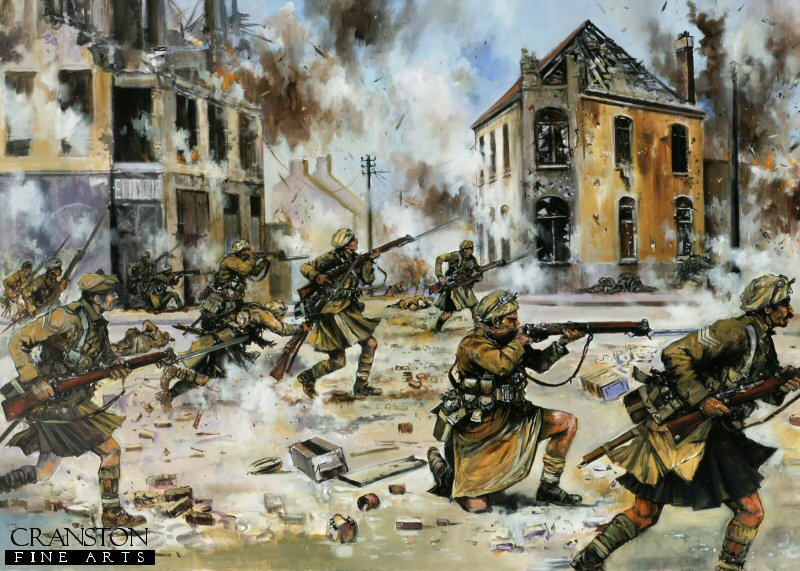
Faster Boys - Give Them Hell! Loos, September 25th 1915 by Jason Askew. (PC) Dawn. British artillery thundered, and the territorial soldiers 15th Scottish division stormed towards the German trenches defending the coal mining village of Loos. The gas cloud that preceded the Highland advance was pendulous and largely stationary due to a distinct lack of wind, and ,upon emerging from the smudgy gas, the highlanders were pelted with machine gun fire and shrapnel from the defending German batteries. Not to be denied, the Scots gritted their teeth, and with an officer shouting faster boys! give them hell! the highlanders charged straight at the defenses. The Germans, unnerved by the stubborn courage of their kilted opponents, began to fall back through the village of Loos. The Camerons and the Black Watch, shouting their battle cry and charging down the main road of the village, then engaged the defending Germans in a series of savage battles for each and every house - hob-nailed boots, rifle butts, and bayonets being wielded with great enthusiasm by the vengeful Scots. By 8.00am the village was in Scottish hands. |
|
Contact Details |
Sign Up To Our Newsletter!
This website is owned by Cranston Fine Arts. Torwood House, Torwoodhill Road, Rhu, Helensburgh, Scotland, G848LE Contact: Tel: (+44) (0) 1436 820269. Email: cranstonorders -at- outlook.com
|