|
|
|
|
|
|
|
|
|
Cranston Fine Arts  Naval Art and Artists World War Two Naval Art and Artists World War Two  Print List Print List |
[UP] - Ships - Countries - D-Day (Operation Neptune) - Postcards - Print List |
| Navigation | |
| Page 7 of 16 | Previous .. Page 7 .. Next |
|
|
|
|
|
|
|
|
|
|
|
|
|
|
|
|
|
|
|
|
|
| Navigation | |
| Page 7 of 16 | Previous .. Page 7 .. Next |
| Text for the above items : |
IJMS Yamato by Randall Wilson. No text for this item |
Tribute to the Crew of HMS Truant by Ivan Berryman. Commissioned in October 1939, HMS Truant served in the North Sea for almost a year, notably damaging the German cruiser Karlsruhe in one action. Sent to the Mediterranean, Truant sunk several Axis merchant ships here, including the Italian tanker Bonzo depicted in this painting. Tracked off the east coast of Italy in the dark of 15th - 16th December 1940, Bonzo fell prey to one of three torpedoes, and was finished off from close range, sinking rapidly. HMS Truant continued successful patrols in the Med until May 1941, completing an Atlantic crossing for refit in the United States before returning in October that year. Sent to the Far East in 1942, the submarine returned to the UK around the Cape of Good Hope for another refit. Returning to service in UK waters in mid-1943, Truant was again sent to the Far East, making it as far as Malta before turning back with mechanical issues, spending the rest of the war as a trials ship in the United Kingdom. |
D-Day Normandy Landings by Robert Taylor. On June 6, 1944, no fewer than 4000 ships landed 133,000 assault troops on the beaches of Normandy. A further 23,000 parachuted in, whilst Allied aircraft flew 14,000 sorties on that historic day. By the end of August 200,000 seamen had transported two million troops across to France. It was the greatest and most successful military invasion in history, which led to the downfall of Hitlers Germany, and the end of the war in Europe. Robert Taylors painting captures the very essence of that herculean battle. The painting is dominated by one of the many large transport ships, lowering her landing craft under bombardment from shore batteries. Barrage balloons flying, this massive fleet sailed into the teeth of the German defences, to land its invasion forces against all odds. |
U-552 by Ivan Berryman. Erich Topps notorious Red Devil Boat, U-552, slips quietly away from the scene of another victory in the North Atlantic in 1941. |
Destination Tokyo by Stan Stokes. On April 18, 1942, Lt. Col. James H. Doolittle led a group of 16 B-25 bombers on a carrier-launched raid on industrial and military targets in Japan. The raid was one of the most daring missions of WW II. Planning for this secret mission began several months earlier, and Jimmy Doolittle, one of the most outstanding pilots and leaders in the United States Army Air Corps was chosen to plan, organize and lead the raid. The plan was to get within 300 or 400 miles of Japan, attack military and industrial targets in Tokyo, Osaka, and Kobe shortly after nightfall, and then fly on to a dawn landing at secret airfields on the coast of China. The twin engine B-25 Mitchell bomber was selected by Doolittle for the mission and practice indicated that it should be possible to launch these aircraft from a carrier deck with less than 500 feet of runway. On April 2, 1942 the USS Hornet and a number of escorts set sail from Alameda, California with the 16 B-25s strapped to its deck. This task force rendezvoused with another including the USS Enterprise, and proceeded for the Japanese mainland. An element of surprise was important for this mission to succeed. When the task force was spotted by a Japanese picket boat, Admiral Halsey made the decision to launch the attack earlier than was planned. This meant that the raiders would have to fly more than 600 miles to Japan, and would arrive over their targets in daylight. It also meant that it would be unlikely that each aircraft would have sufficient fuel to reach useable airfields in China. Doolittle had 50 gallons of additional fuel stowed on each aircraft as well as a dinghy and survival supplies for the likely ditchings at sea which would now take place. At approximately 8:00 AM the Hornets loudspeaker blared, Now hear this: Army pilots, man your planes! Doolittle and his co-pilot R.E. Cole piloted the first B-25 off the Hornets deck at about 8:20 AM. With full flaps, and full throttle the Mitchell roared towards the Hornets bow, just barely missing the ships island superstructure. The B-25 lifted off, Doolittle leveled out, and made a single low altitude pass down the painted center line on the Hornets deck to align his compass. The remaining aircraft lifted off at approximately five minute intervals. The mission was planned to include five three-plane sections directed at various targets. However, Doolittle had made it clear that each aircraft was on its own. He insisted, however, that civilian targets be avoided, and under no circumstances was the Imperial Palace in Tokyo to be bombed. About 30 minutes after taking off Doolittles B-25 was joined by another piloted by Lt. Travis Hoover. These two aircraft approached Tokyo from the north. They encountered a number of Japanese fighter or trainer aircraft, but they remained generally undetected at their low altitude. At 1:30 PM the Japanese homeland came under attack for the first time in the War. From low altitudes the raiders put their cargoes of four 500 pounders into a number of key targets. Despite antiaircraft fire, all the attacking aircraft were unscathed. The mission had been a surprise, but the most hazardous portion of the mission lay ahead. The Chinese were not prepared for the raiders arrival. Many of the aircraft were ditched along the coast, and the crews of other aircraft, including Doolittles were forced to bail out in darkness. There were a number of casualties, and several of the raiders were caught by Japanese troops in China, and some were eventually executed. This painting is dedicated to the memories of those airmen who made the ultimate sacrifice for their country and the thousands of innocent Chinese citizens which were brutally slaughtered as a reprisal for their assistance in rescuing the downed crews. |
Glosters Return by David Griffin The allied invasion of Normandy Operation Overlord was the greatest sea-bourne military operation in history. Key to its success and at the heart of the invasion were the Landings of the British 50th division on Gold beach and the Canadian 3rd Division on Juno beach. They provided a vital link between the landings of the British 3rd Division on Sword beach and the Americans on Omaha and Utah beaches. They were also crucial in securing the beachhead and the drive inland to Bayeux and Caen. |
Tokyo Bound by Nicolas Trudgian. On April 18, 1942, under the leadership of Lieutenant Colonel Jimmy Doolittle, a small force of B-25 Mitchell light bombers set forth on one of the most audacious air raids of World War II. Launching in a rough sea from the heaving deck of the carrier USS Hornet, the crews knew that even if they achieved success, they were not to return. Their mission to bomb Tokyo and other industrial targets some 800 miles distant would leave them barely enough fuel to fly on to crash-land in China. Nine aircraft were attacked by enemy fighters, every one made it to the target, all but one aircraft were lost. But the raid was a triumph. The Japanese High Command were so alarmed by the Americans ability to strike at their homeland they attempted to expand the perimeter of activity in the central and southern Pacific - with disastrous results. Lt. Col. Doolittle was awarded the Congressional Medal of Honor in recognition of the extraordinary feat he and his gallant crews performed. Miraculously most survived to fly and fight again later in the war, Jimmy Doolittle going on to command the Eighth Air Force in Europe at the time of the Normandy invasion. |
Deutschland Passing Through the Kiel Canal by Ivan Berryman. No text for this item |
The Pursuit of the Graf Spee by Ivan Berryman. No text for this item |
Last Man Away by Ivan Berryman. The remarkable Fairey Swordfish served with distinction throughout WWII, despite being nothing short of an anachronism. Its dated appearance belied a solid, workmanlike airframe that provided a stable platform from which to launch torpedoes against enemy shipping, the venerable 'Stringbag' sending a greater tonnage of Axis shipping to the bottom than any other allied aircraft in the Second World War. A Mk.II is shown taking off from HMS Ark Royal early in 1941. |
HMS King George V by Ivan Berryman. No text for this item |
Bismarck - Pride of the Kriegsmarine by Ivan Berryman. Together with her sister, Tirpitz, the Bismarck was Germany's most modern and formidable warship of WWII. Equipped with the very latest in rangefinder technology and festooned with defensive firepower, perhaps her most daunting weapons were the eight 15 inch guns, arranged in four turrets, that were to prove so effective against almost every other ship that she encountered, the most famous of these arguably being the Royal Navy's HMS Hood, sunk with huge loss of life in the Battle of the Denmark Strait in May 1941. Bismarck is depicted here in company with Prinz Eugen. |
Into the Storm by Ivan Berryman. Typical of the many hundreds of craft that took part in the 6th June 1944 landings at Normandy at the opening of Operation Overlord, these unarmed Royal Navy Landing Craft (LCAs) bravely transported many thousands of British and Canadian infantry to the beaches under the most intense fire. |
HMS Courageous by Randall Wilson. Two Stringbags (Fairey Swordfish) pass across the bow of HMS Courageous as she staggers from torpedo strikes launched from a German U-Boat in the Irish Sea. On 17th September 1939 HMS Courageous was struck by two torpedoes from the German submarine U-29 about 190 nautical miles south-west of Dursey Head, Ireland. HMS Courageous sank in less than 16 minutes with the loss of 519 lives, including her commander Captain W T Makeig-Jones. Her total complement was 1,260 officers and ratings and two squadrons of Fairey Swordfish aircraft (48 planes). The sinking of the HMS Courageous was the first U-boat offensive against the Royal Navy, and more importantly, Schuhart's victory prompted the Admiralty to withdraw all three remaining carriers from the Western Approaches. |
Last Voyage of the Yamato by Stan Stokes. The 74,000 ton Yamato and the Musashi were the two largest battleships ever built, and typified the Imperial Japanese Navys attitude that their ships should be superior to anything the United States had. As a comparison the German Battleship Deutschland displaced a mere 15,500 tons. Each of these ships carried nine 18.1 inch guns, the most powerful armament available on any ship at that point in time. The Yamato participated in the attack on Midway, serving as Admiral Yamamotos flag ship, and many of the other significant sea battles in the Pacific. By the time the Allies were preparing to invade Okinawa, the Japanese had been forced to utilize Kikusui tactics which would involve mass suicide attacks and individual suicide missions. The army had made numerous sacrifices, and senior Japanese naval officers realized that the Yamato would need to be sacrificed in the defense of Okinawa, as a matter of pride. The Yamatos 350-mile trip to Okinawa without any meaningful air cover would be a suicide mission, and the ship and its escort vessels were equipped with only enough fuel for a one-way trip. On April 6, 1945 the huge vessel departed and was immediately sighted by two American submarines, the USS Threadfin and the USS Hackleback. The information was passed on to the USN task force, and on April 7 an F6F from the USS Essex spotted the Yamato and relayed its position back to the USS Indianapolis, the flag ship of Admiral Spruance. An initial attack force of 280 USN aircraft were launched from nine American carriers, followed by a second wave of aircraft from four other carriers. Knowing that the Japanese had no air cover, the F6F Hellcats carried 500 pound bombs, and were joined by Avenger torpedo bombers and Curtis SB2C dive bombers. The Americans had learned from their earlier attack on the Musashi to concentrate torpedo attacks on one side of the giant ship. The Yamato was hit with numerous torpedoes and bombs. By 13:00 the giant battleship was listing 20 degrees to port and her antiaircraft guns were inoperative. At 14:10 another torpedo hit jammed the ships rudder, and the Yamato began to circle at about 8 knots. At 14:23 the Yamato rolled over and exploded in a giant mushroom cloud and sank with the loss of nearly 2,500 men. The Grumman TBF Avenger was the first torpedo bomber produced by that company. It bore a resemblance to the F4F Wildcat, and incorporated a unique internal bomb bay capable of carrying a 2,000 lb torpedo or four 500 lb bombs. The TBF was a big aircraft with a wingspan of 54 feet, and an empty weight of 10,080 lbs. It was capable of 271-MPH with a range of 1,215 miles. The Avenger incorporated a light weight electrically driven rear ball turret. The Avenger was so successful that General Motors was also pressed into service producing the aircraft with their version designated as a TBM. |
USS Ohio BB 68 by Randall Wilson USS Ohio as she would have looked if built, firing her Aft turrets. Cranston Fine Arts have arranged with the artist Randall Wilson to produce a low cost limited edition of 100 prints only. Numbered only, not signed. A canvas edition also available. |
The Narvik Squadron by Anthony Saunders. The Last of the heavy Cruisers built by Germany (5 in total) The picture shows Admiral Hipper making her first sortie on the 18th February 1940, accompanied by the Scharnhorst and the Gneisenau on Operation Nordmark. (Search for allied convoys on the route between Britain and Norway) |
USS Oakland Escorting the Damaged USS Lexington by Ivan Berryman No text for this item |
U-203 Under Cover of Darkness by Anthony Saunders. October 1941, U203 approaches her mooring on the western bank at the French port of Brest. Her fate would be sealed by depth charges from the destroyer HMS Pathfinder and aircraft from the escort carrier HMS Biter while attacking the convoy ONS 4 south of Greenland on April 25th 1943. |
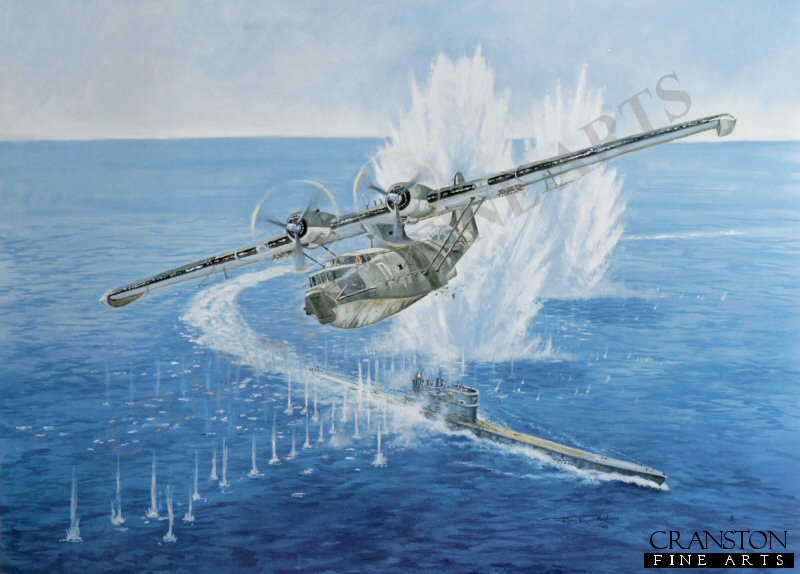
Catalina Attack by John Wynne Hopkins. D for Donald of 270 squadron, Royal Air Force, out of Freetown, West Africa operating in the Atlantic Ocean. It was during routine operation search that D for Donald surprised U515 on the surface and immediately attacked the submarine. U515 in putting up stiff resistance blew a large hole in the hull of D for Donald and the magazine of the starboard side 0.5 twin Browning was hit and the subsequent shrapnel wounded both blister gunners. U515 escaped but was sunk by an American naval hunter group a year later. D for Donald limped back to base and managed to make the beach before it would sink completely. |
USS Tennessee During the Landings at Iwo Jima by Anthony Saunders. In February 1945, 850 square miles of volcanic rock became the most strategically important island in the South Pacific. From Iwo Jima heavy bombers would be able to raid Japanese cities almost at will. Even with its overwhelming military might, the Americans would have to pay a heavy price for such a seemingly small island. |
|
Contact Details |
Sign Up To Our Newsletter!
This website is owned by Cranston Fine Arts. Torwood House, Torwoodhill Road, Rhu, Helensburgh, Scotland, G848LE Contact: Tel: (+44) (0) 1436 820269. Email: cranstonorders -at- outlook.com
|