|
|
|
|
|
|
|
|
|
Cranston Fine Arts  Naval Art and Artists World War Two Naval Art and Artists World War Two  Print List Print List |
[UP] - Ships - Countries - D-Day (Operation Neptune) - Postcards - Print List |
| Navigation | |
| Page 5 of 16 | Previous .. Page 5 .. Next |
|
|
|
|
|
|
|
|
|
|
|
|
|
|
|
|
|
|
|
|
| Navigation | |
| Page 5 of 16 | Previous .. Page 5 .. Next |
| Text for the above items : |
HMS Victorious by Ivan Berryman. Completed in May 1941, HMS Victorious had been in commission just nine days when her pilots encountered and attacked the Bismarck. She is seen here in August 1942 with HMS Eagle astern of her. |
Hook Down and Homeward Bound by Stan Stokes. The Chance-Vought F4U Corsair was arguably the finest naval aviation fighter of its era. Work on this design dates to 1938 and was headed-up by Voughts Chief Engineer, Rex Biesel. The initial prototype was powered by an 1800-HP Pratt & Whitney double Wasp radial engine. This was the third Vought aircraft to carry the Corsair name. The graceful and highly recognizable gull-wing design of the F4U permitted the aircraft to utilize a 13-foot, three-blade, Hamilton Standard propeller, while not having to lengthen the landing gear. Because of the rigors of carrier landings, this was a very important design consideration. Folding wings were also required for carrier operations. The F4U was thirty feet long, had a wingspan of 41 feet and an empty weight of approximately 7,500 pounds. Another interesting feature was the way the F4Us gear rotated 90 degrees, so it would lay flush within the wing when in the up position. In 1939 the Navy approved the design, and production commenced. The Corsair utilized a new spot welding process on its all aluminum fuselage, giving the aircraft very low drag. To reduce weight, fabric-covered outer wing sections and control surfaces were fitted. In May of 1940 the F4U made its maiden flight. Although a number of small bugs were discovered during early flight tests, the Corsair had exceptional performance characteristics. In October of 1940 the prototype F4U was clocked at 405-MPH in a speed test. The initial production Corsairs received an upgraded 2,000-HP radial giving the bird a top speed of about 425-MPH. The production models also differed from the prototype in having six, wing-mounted, 0.5 caliber machine guns. Another change was a shift of the cockpit about three feet further back in the fuselage. This latter change unfortunately made naval aviators wary of carrier landings with the F4U, due to its limited forward visibility during landings. Other concerns were expressed regarding a severe port wing drop at landing speeds and a tendency of the aircraft to bounce off a carrier deck. As a result, the F4U was initially limited to land-based USMC squadrons. Vought addressed several of these problems, and the Royal Navy deserves credit for perfecting an appropriate landing strategy for the F4U. They found that if the carrier pilot landed the F4U while making a sweeping left turn with the port wing down, that sufficient visibility was available to make a safe landing. With a kill ratio of 11-to-1 in WW II combat, the F4U proved superior in the air to almost every opposing aircraft it encountered. More than 12,000 F4Us were built and fortunately a few dozen remain in flyable condition to this date. |
HMS Prince of Wales by Brian Wood. HMS Prince of Wales is shown firing on the Bismarck and in the background a huge black cloud is all that is left of HMS Hood. |
Tribute to the U-Boat Crews - U48 by Jason Askew. (P) U48 was one of the most successful uboats during the war, with over 50 ships sunk, including the Royal Navy sloop HMS Dundee. She was scuttled at the end of the war on 3rd May 1945. |
Assault from the Deep by Ivan Berryman. Sitting menacingly at a depth of 15 metres below the surface, just 2 km outside the heavily defended harbour of Alexandria, the Italian submarine Scire is shown releasing her three manned torpedoes, or Maiali, at the outset of their daring raid in which the British battleships HMS Queen Elizabeth and HMS Valiant and a tanker, were severely damaged on 3rd December 1941. All six crew members of the three Maiali survived the mission, but all were captured and taken prisoner. Luigi Durand de la Penne and Emilio Bianchi can be seen moving away aboard 221, whilst Vincenzo Martellotta and Mario Marino (222) carry out systems checks. Antonio Marceglia and Spartaco Schergat, on 223, are heading away at the top of the picture. |
Contact Bearing 190 by Robert Taylor. H.M.S. Kelly steams at full speed to intercept a U-Boat which is bearing down on an essential and otherwise vulnerable Allied supply convoy. The tension among the supply ships crews, tempered by the strong faith in their protectors, is almost tangible. |
Final Liberty by Randall Wilson. Last preparations for sailing, and last liberty, as Yamato prepares for Operation Ten Ichi Go, 1945. |
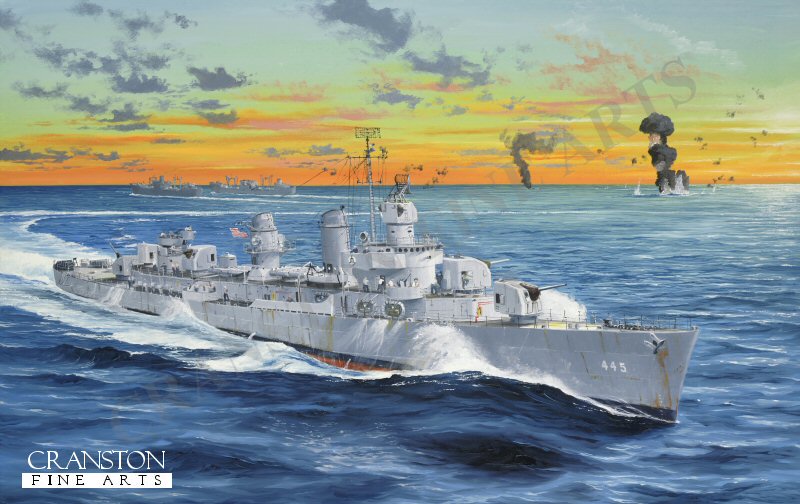
USS Fletcher DD445 by Randall Wilson USS Fletcher riding shotgun for units of a supply group in 1945. Cranston Fine Arts have arranged with the artist Randall Wilson to produce a low cost limited edition of 100 prints only. Numbered only, not signed. A canvas edition also available. |
Break Out by Anthony Saunders. As Me109s from 3./JG77 and Me110s from ZG76 provide aerial cover, the pride of the Kriegsmarine - the battleships Bismarck - together with the heavy cruiser Prinz Eugen, destroyers Z10 Hans Lody and Z16 Friedrich Eckholdt, and a support escort fleet break out from Norwegian waters into the open sea on the evening of 21st May 1941. Heading for the rich pickings of the North Atlantic convoy routes, her ill-fated voyage would last only a few days. After a shattering victory over HMS Hood, Bismarck was caught and sunk by the Royal Navy Home Fleet a few days later on 27th May 1941. There were just 115 survivors from her complement of over 2000 men. |
The Malta Station by Robert Barbour. HMS Unrivalled enters Valetta Harbour, Malta, under the command of Lt. Turner, flying the Jolly Roger signifying completion of another successful patrol. |
Prinz Eugen by Ivan Berryman. The heavy cruiser Prinz Eugen slips quietly through the waters of Kiel Harbour as one of her own Arado Ar.196s flies overhead. In the background, Bismarck, wearing her Baltic camouflage, is alongside taking on supplies. |
HMS Hood Passing Gibraltar by Brian Wood. The pride of the Royal Navy, HMS Hood, passes Gibraltar on her way to join HMS Prince of Wales at Scapa Flow and onto her short and tragic engagement with the German battleship Bismarck. |
Prelude to D-Day by Bill Bishop. Shrouded in secrecy, the fleet gathers alongside the Semaphore tower and under cover of dusk begins to move out to the channel preparing for its daunting task. |
Tenichigo by Randall Wilson. The Yamato was sunk on the 7th of April 1945 by torpedoes and bombs from carrier-borne aircraft while she was on a Kamikaze mission to Okinawa. |
Hunter's Lair by Jason Askew. (P) The experienced crew of a WW2 German U-boat hunt their next target. |
Pedestal Convoy by Anthony Saunders The Pedestal Convoy of August 1942 was one of the most heavily protected convoys in the history of sea warfare. Fourteen of the fastest cargo ships of the time were protected by 4 carriers, 2 battleships, 7 cruisers and 32 destroyers. The destroyer HMS Ashanti is in the foreground of the painting. Also depicted are the carrier HMS Indomitable, with her Hurricanes cirling the convoy overhead, and the cargoe ship Port Chalmers to the right of the picture. |
U.123 - The Atik's Revenge by Ivan Berryman. On 27 March 1942, Q-ship USS Atik (AK 101) received a torpedo hit from the U.123, forward of her bridge structure. The ship caught fire and, as her bow dropped in the water, she developed a list to port. U.123 closed in to finish the ship off, at which point USS Atik uncovered her concealed weapons and raked the U-boat with 50mm fire, killing one of the German crew. U.123 was driven off, but she submerged and fired another torpedo into the Atik's engine room which was the final blow for the brave Q-ship. |
Tribute to Ian Edward Fraser VC by Ivan Berryman. Joined the Royal Naval Reserve in 1939, and served on several destroyers before joining HMS Sahib in 1943 - the same year he was awarded the Distinguished Service Cross for bravery and skill on submarine patrols. He volunteered for sevice aboard HMS Bonaventure - a depot ship for X-Craft midget submarines. Commander of the midget submarine HMS XE-3 in the successful attack on a the Japanese Atago Class heavy cruiser Takao, moored in Johore Strait, Singapore, 31st July 1945. HMS XE-3 is seen here making its way to its target on that day. Fraser and his diver - James Magennis who went out to place the limpet mines - were both awarded the Victoria Cross for this attack. He died on 1st September 2008. |
HMS Duke of York by Randall Wilson. HMS Duke of York keeping station on the starboard bow of USS Intrepid, as air defence ship. |
|
Contact Details |
Sign Up To Our Newsletter!
This website is owned by Cranston Fine Arts. Torwood House, Torwoodhill Road, Rhu, Helensburgh, Scotland, G848LE Contact: Tel: (+44) (0) 1436 820269. Email: cranstonorders -at- outlook.com
|