|
|
|
|
|
|
|
|
|
Cranston Fine Arts  Military Art and Artists World War Two Military Art and Artists World War Two  WW2 Military Print List WW2 Military Print List |
[UP] - Battles - Tanks - Campaigns - Countries - Veteran Signatures - WW2 Military Postcards - WW2 Military Print List - World War Two Regiments |
| Navigation | |
| Page 8 of 18 | Previous .. Page 8 .. Next |
|
|
|
|
|
|
|
|
|
|
|
|
|
|
|
|
|
|
|
|
|
| Navigation | |
| Page 8 of 18 | Previous .. Page 8 .. Next |
| Text for the above items : |
Gold Beach, Normandy, 6th June 1944 by David Pentland. Royal Engineers Churchill AVREs of 6th Assault Regiment, 81st Squadron and DD Shermans of the 4/7th Dragoon Guards. Both units were part of perhaps the most important formation involved in the British and Canadian landings, the 79th Armoured Division or Funnies. Composed of a variety of armoured vehicles, designed to support the beach assault troops, they included mine flails, bunker busters, carpet layers, and amphibious tanks. |
Rearguard at Dunkirk by David Pentland. Northern France, 1st June 1940. Beleaguered troops of the BEF, fight a delaying action against the German encirclement of the doomed town. |
Wittmann on Patrol by David Pentland. Northern France, 22nd May 1940. Sdkfz 222 light armoured cars of the SS Leibstandarte Regiment drive along French lanes on a reconnaissance patrol for the forces of General Heinz Guderian on their advance towards the French coast. |
David and Goliath by David Pentland. Vernon, France, 27th August 1944. Leading 30th Corps assault across the Seine at Vernon, 43rd Wessex Division gained an initial foothold on the east bank. Heroic efforts however by the Royal Engineers of 71st, 72nd and 73rd Field Companies, succeeded in constructing a Class 9 Bailey bridge (David, shown left) and a Second Class 40 bridge (Goliath, shown right) Despite constant enemy fire this amazing feat was achieved in only 2 days, and allowed 15/19th Hussars Cromwells and 4.7th Dragoons Guards Shermans to cross just in time to repulse a serious German counter attack by Tiger IIs of SS Panzer Abteilung 101. |
Stug III by Jason Askew. (P) With production totals greater than any other armoured unit in the German army, the Stug, or Sturmgeschutz III, was a formidable enemy on the battlefield. |
Winter Offensive, Ardennes Forest, Germany, December 1944 by David Pentland. Jagdpanther self propelled 88mm anti-tank guns of Heavy Anti-tank Battalion 519 attached to 6th SS Panzer Army during the ill fated Ardennes offensive. Only the 1st company commanded by Hautmann Erwin Kressmann took part in the campaign. |
Off the Beach by David Pentland. Gold Beach, Normandy, D-Day, 6th June 1944. A PIAT team and riflemen of the 6th Green Howards part of British 50th (Tyne Tees) Division, push inland in the direction of Caen. |
Alpini by David Pentland. Montenegro, Yugoslavia, January, 1942. 75mm Skoda Mountain Gun of 5th Alpine artillery Regiment, 5th Alpini Division, 'Pusteria' in action against Tito's partisans. |
Through Hell to Omaha by Ivan Berryman. Troops of the 5th Ranger Battalion forge ahead through a hail of plummeting shells and crossfire as their British landing craft from HMS Prince Baudouin make their perilous way to Omaha Beach on D-Day, 6th June 1944. |
Scaling the Cliffs at Pointe du Hoc by Brian Palmer. (GL) The American Second Ranger Battalion under the command of Lt. Col. James E. Rudder. During the American assault of Omaha and Utah beaches on June 6, 1944, the Rangers scaled the 100-foot cliffs and seized the German artillery pieces that could have fired on the American landing troops at Omaha and Utah beaches. At a high cost of life, they successfully defended against determined German counterattacks. |
Spearhead by David Pentland. Normandy, France, 1944. U.S. Armoured Infantry and M3 halftracks of the 36th Infantry Regiment, 3rd (Spearhead) Armoured Division, in the Normandy bocage. |
Night Fight, Bollersdorf, East of Berlin, 19th April 1945 by David Pentland. Following a full day of combat Hauptscharfurher Korner of SS Heavy Tank Battalion 503 foiled a night attack by a battalion of Josef Stalin JSII heavy tanks. By the end of the day he had accounted for 76 enemy tanks, over 40 of these on this one day alone. It was his 25th birthday. |
Disaster at Dieppe, France, 19th August 1942 by David Pentland. Under pressure from Stalin to open a second front in Europe, Operation Jubilee was designed ostensibly as a reconnaissance in force on the French coast, to show the feasibility of taking and holding a major defended port for a day, in this case Dieppe. The plan devised by Lord Louis Mountbatten failed due to inadequate naval and air support, carrying out the landing in daylight and general lack of intelligence of the target. Here new Churchill tanks of the 14th Canadian Tank Regiment (The Calgary Regiment), with men of the Royal Hamilton Light Infantry and Fusiliers Mont-Royals, struggle to fight their way off the beach. Only a handful of men penetrated into the town itself, and eventually the remaining troops were ordered to withdraw. Out of 5086 soldiers who landed only 1443 returned. |
Barkmann by David Pentland. Ernst Barkmann of the Das Reich 2nd SS Panzer Division holds his position near St. Lo, Normandy, 26th July 1944 against an American armoured breakthrough. |
LCT 312 by Ivan Berryman. LCT (Landing Craft Tank) 312 is shown unloading a Sherman tank directly onto the beach during the Normandy landings of June 1944. Over 1,000 of these versatile craft were built in the United States, with a small number being constructed in the UK and Canada. |
Ginkel Heide by John Wynne Hopkins. The prints depict the drop of the 4th Parachute Brigade on Ginkle Heath, on the 18th September 1944. The panting was commissioned by Col John Waddy who was the Officer Commanding B Company 156th Parachute Battalion during that momentous drop and subsequent battles. |
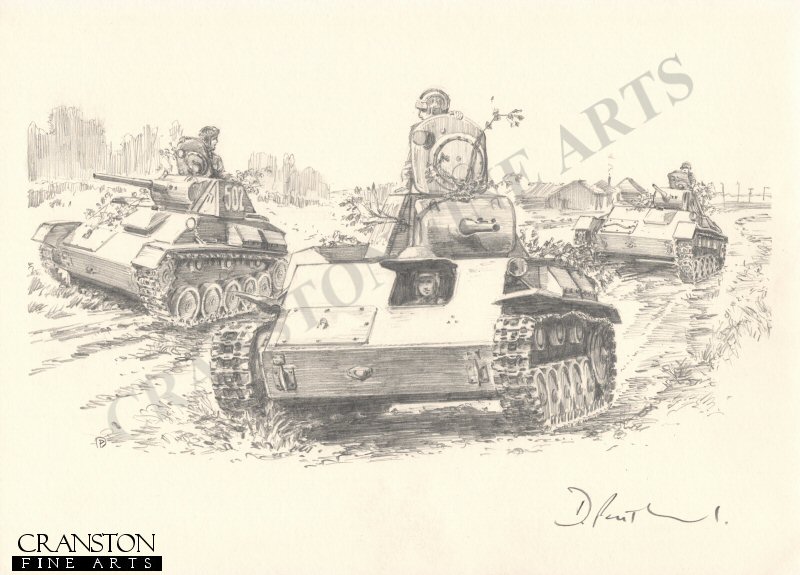
Looking for Trouble by David Pentland. Kursk, Russia, July, 1943. T-70 light tanks of 2nd Tank Army on a reconnaissance patrol near Ponyri-Goreloje. |
Welcome Respite by Nicolas Trudgian. Wherever the GIs went they took their Jeeps with them, and before the war was run the little quarter-ton, 4-wheel drive, utility vehicle was as well known around the world as the Model T Ford. Nicolas Trudgian has painted a compelling image, set back in time when the little Jeep was omnipresent on and around the roads and battlefields of a war-torn world. It is Christmas 1944 and, as a gaggle of 339th FG P-51 Mustangs disturb the peace of this ancient English village, a little Jeep waits patiently outside the pub while her occupants sample the local ale. A wonderfully nostalgic painting that will bring back pleasant memories to many. |
Act of Valor by Simon Smith. After single-handedly destroying a German Mark V Panther tank that had pinned down his unit, First Lieutenant James Maggie Megellas leads his platoon from the 3rd Battalion, 504th Parachute Infantry Regiment, 82nd Airborne towards the Belgian town of Herresbach, 28 January 1945, as the Battle of the Bulge draws to its conclusion. Minutes before, despite being vastly outnumbered in heavy snow and freezing conditions, the platoon had overwhelmed and completely defeated a large force of German infantry in a ferocious frontal assault, without losing a single man. Simon Smith's dramatic image picks up the story as, with the Panther rendered harmless, Megellas readies his men for their final advance into Herresbach. |
Irrepressible Para by Simon Smith. No text for this item |
Arromanches by David Pentland. Normandy, Mid-June 1944. A REME Leyland Retriever mobile workshop truck and M7 Priest SP gun of 33rd Field Regiment, Royal Artillery, 3rd Infantry Division, disembark from an LST at one of the Whale floating roadways that made up the British Mulberry B harbour at Arromanches. |
|
Contact Details |
Sign Up To Our Newsletter!
This website is owned by Cranston Fine Arts. Torwood House, Torwoodhill Road, Rhu, Helensburgh, Scotland, G848LE Contact: Tel: (+44) (0) 1436 820269. Email: cranstonorders -at- outlook.com
|