|
|
|
|
|
|
|
|
|
Cranston Fine Arts  Naval Art and Artists World War Two Countries Naval Art and Artists World War Two Countries  United Kingdom United Kingdom |
[UP] - United Kingdom - United States - Germany - Japan - Italy - Australia - France - Netherlands |
| More Pages : Submarines |
| Navigation | |
| Page 5 of 8 | Previous .. Page 5 .. Next |
|
|
|
|
|
|
|
|
|
|
|
|
|
|
|
|
|
|
|
|
|
| Navigation | |
| Page 5 of 8 | Previous .. Page 5 .. Next |
| Text for the above items : |
HMS Euryalus by Ivan Berryman. HMS Euryalus, a Dido class cruiser, shown off the Bay of Naples. |
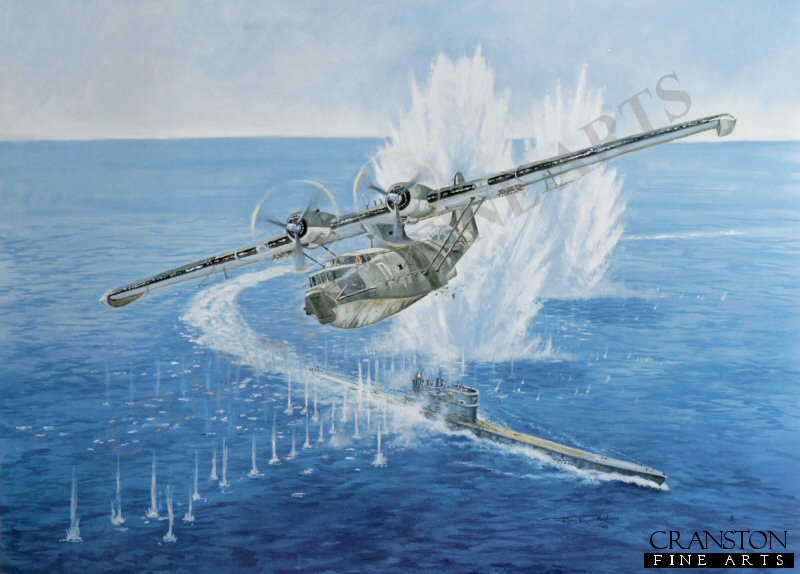
Sinking of U-Boat 347 by Tim Fisher. Flt. Lt. John Alexander Cruickshank in his consolidated Catalina. Winning his Victoria Cross for sinking U-347. |
HMS Hood Engages Bismarck by Ivan Berryman. The moment shortly after dawn on 24th May 1941 when HMS Hood, in company with HMS Prince of Wales, opens fire on the Bismarck, setting in motion one of the greatest sea dramas the world had seen. |
Working Up by Robert Barbour. T class submarine HMS Thorn surfaces during the work up exercises off the west coast of Scotland in late 1941. Taking part is an escort sloop of the Black Swan class and a Sunderland from 201 Squadron, RAF Coastal Command. |
Operation Cerberus - The Channel Dash by Philip West. The Channel Dash (officially known as Operation Cerberus) was one of three operations during the Second World War for which the Swordfish was to become the most famous. Heavily outgunned in the Straits of Dover on this day in February 1942 by the German warships Scharnhorst, Gneisenau and Prinz Eugen, with their accompanying flotilla of destroyers and motor torpedo boats, and with top cover provided by deadly fighter aircraft of the Luftwaffe, all six Fleet Air Arm Swordfish were shot down. Only five of the eighteen aircrew survived. Here we see the Swordfish flown by Sub. Lt. Kingsmill and Sub. Lt. Samples with PO Bunce in the rear, fighting for their lives with his machine gun. |
Catalina Attack by John Wynne Hopkins. D for Donald of 270 squadron, Royal Air Force, out of Freetown, West Africa operating in the Atlantic Ocean. It was during routine operation search that D for Donald surprised U515 on the surface and immediately attacked the submarine. U515 in putting up stiff resistance blew a large hole in the hull of D for Donald and the magazine of the starboard side 0.5 twin Browning was hit and the subsequent shrapnel wounded both blister gunners. U515 escaped but was sunk by an American naval hunter group a year later. D for Donald limped back to base and managed to make the beach before it would sink completely. |
Prelude to Taranto by Ivan Berryman. Prior to the British attack on the Italian battle fleet moored in Taranto Harbour in November 1940, the job of obtaining the very latest photo reconnaissance fell to the maverick pilot Adrian 'Warby' Warburton. Flying a requisitioned Martin Maryland, Warburton undertook a series of breathtakingly low level passes across the ships moored in the harbour, cheating a hail of anti aircraft fire and flak to bring home the vital information to Rear Admiral Lumley Lyster, the flag officer aboard HMS Illustrious. Ships shown moored in the Mar Grande here are Vittorio Veneto (nearest) and Littorio with Duilio and Giulio Cesare in the background. |
HMS Ramillies and HMS Warspite at Normandy by Anthony Saunders. HMS Ramillies and Warspite manoeuvre into position off the coast of Normandy. The major battleships of the Home Fleet, with their massive guns which could deliver gunfire with pinpoint accuracy to 17 miles. they proved invaluable on the day of the biggest seaborne land invasion in history. |
Against All Odds - Attack on the Scharnhorst by Ivan Berryman. Swordfish of 825 Sqn led by Lt-Cdr Esmonde begin their heroic attack on the battlescruisers Scharnhorst and Gneisenau and the heavy cruiser Prinz Eugen as they make their way up the English Channel from Brest during Operation Cerberus on 12th February 1942. Although all the aircraft were lost and no significant damage was done to the German fleet, all the pilots were decorated for their bravery and Lt-Cdr Esmonde received the first Fleet Air Arm VC to be awarded, albeit posthumously. |
The Malta Station by Robert Barbour. HMS Unrivalled enters Valetta Harbour, Malta, under the command of Lt. Turner, flying the Jolly Roger signifying completion of another successful patrol. |
HMS Prince of Wales by Brian Wood. HMS Prince of Wales is shown firing on the Bismarck and in the background a huge black cloud is all that is left of HMS Hood. |
Hudson Attack by Marii Chernev. On October 5th 1942 Lockheed Hudson N of 269 Squadron encountered and sank U-619 which was on its first patrol. |
HMS Dorsetshire (The End of the Bismarck) by Ivan Berryman. The heavy cruiser HMS Dorsetshire is brought up to sink the blazing wreck of the Bismarck with torpedoes at around 10:30 hours on the morning of May 27th 1941. The once proud German ship had been ruthlessly pounded into a twisted and burning wreck by the British battleships Rodney and King George V. HMS Dorsetshire and HMS Maori combed the area of the sinking for survivors, between them picking up a total of 110 out of an original complement of 2,300. |
British Pacific Fleet by Randall Wilson. HMS Howe leads Victorious and Implacable through the Malacca Straits. |
HMS Torbay - Opration Flipper by Ivan Berryman. In foul weather off the coast of North Africa on the night of 14th November 1941, HMS Torbay deploys men of 11 (Scottish) Commando for an audacious attempt to assassinate German General Erwin Rommel. Named Operation Flipper, the attempt saw 26 men from HMS Torbay join just 8 more from HMS Talisman - the rest trapped aboard by the weather - land 250 miles behind enemy lines in Libya, and march to the headquarters for the attack late on 18th November. While the Commandos made it to the target building, their leader, Lt Col Geoffrey Keyes was killed and they discovered Rommel was not there. Retreating to the landing beach to be picked up by HMS Talisman, they were intercepted by Italian forces and captured facing impossible odds, although a few managed to scatter into the desert and escape. Keyes was posthumously awarded the Victoria Cross, HMS Torbay survived the war and was scrapped soon afterwards. |
The Invasion Begins by Commander Rex Phillips. British troops in Royal Naval landing craft approach Sword Beach during the D- Day landings, while overhead Typhoons attack the German heavy gun and machine gun positions defending the beaches. Sword beach was the furthest east of the five Normandy invasion beaches - the others were codenamed Juno, Gold, Omaha and Utah. Sword beach was subdivided into four areas; Queen, Roger, Peter and Oboe beaches, and was a five mile beach from Ouistreham at the mouth of the River Orne on the east stretching west to Lion-sur-Mer. At Sword Beach were the British 3rd Division, the 1st Lancashire Regiment, 2nd East Yorkshire regiment, the 8th Infantry Brigade and 13th / 18th Hussars. The task of taking Caen and the airfields nearby was given to the 3rd Division. Losses on the first day were 630 dead and wounded from a force of 29,000 men. |
Safe Return by Ivan Berryman. The pilot of a Fairey Swordfish MKII guides his aircraft towards the landing ramp of HMS Victorious following a sortie in the Mediterranean Sea 1940 |
Swordfish Strike on U-451 by Jason Askew. (P) U-451 was sunk on 21st December 1941 near Tangiers, in position 35.55N, 06.08W, by depth charges from a British Swordfish aircraft (Sqdn. 812/A). There was just one survivor from the crew of 45. |
HMS King George V by Ivan Berryman. No text for this item |
HMS Courageous by Randall Wilson. Two Stringbags (Fairey Swordfish) pass across the bow of HMS Courageous as she staggers from torpedo strikes launched from a German U-Boat in the Irish Sea. On 17th September 1939 HMS Courageous was struck by two torpedoes from the German submarine U-29 about 190 nautical miles south-west of Dursey Head, Ireland. HMS Courageous sank in less than 16 minutes with the loss of 519 lives, including her commander Captain W T Makeig-Jones. Her total complement was 1,260 officers and ratings and two squadrons of Fairey Swordfish aircraft (48 planes). The sinking of the HMS Courageous was the first U-boat offensive against the Royal Navy, and more importantly, Schuhart's victory prompted the Admiralty to withdraw all three remaining carriers from the Western Approaches. |
HMS Cyclops Prepares to Receive HMS Sceptre by Ivan Berryman Originally constructed as a Home Fleet Repair Ship, HMS Cyclops was later converted into a submarine depot ship and enjoyed a long career, both in the Mediterranean and in home waters. Here she prepares to receive HMS Sceptre. Another S-class submarine is already tethered alongside. |
|
Contact Details |
Sign Up To Our Newsletter!
This website is owned by Cranston Fine Arts. Torwood House, Torwoodhill Road, Rhu, Helensburgh, Scotland, G848LE Contact: Tel: (+44) (0) 1436 820269. Email: cranstonorders -at- outlook.com
|