|
|
|
|
|
|
|
|
|
Cranston Fine Arts  Aviation Art and Artists World War Two Squadrons UK and Commonwealth No.602 Sqn to No.854 Sqn Aviation Art and Artists World War Two Squadrons UK and Commonwealth No.602 Sqn to No.854 Sqn  No.617 Sqn No.617 Sqn |
[UP] - No.602 Sqn - No.603 Sqn - No.604 Sqn - No.605 Sqn - No.607 Sqn - No.609 Sqn - No.610 Sqn - No.611 Sqn - No.613 Sqn - No.615 Sqn - No.616 Sqn - No.617 Sqn - No.619 Sqn - No.620 Sqn - No.625 Sqn - No.630 Sqn - No.644 Sqn - No.761 Sqn - No.818 Sqn - No.825 Sqn - No.854 Sqn |
Apres mois, le deluge - After me, the flood
| Navigation | |
| Page 1 of 5 | Page 1 .. Next |
| No.617 Sqn Aviation Art Prints, Paintings and Drawings Aviation Prints |
|
|
|
|
|
|
|
|
|
|
|
|
|
|
|
|
|
|
|
|
|
| Navigation | |
| Page 1 of 5 | Page 1 .. Next |
| Text for the above items : |
Dam Defenders by David Pentland. Mohne Dam, Ruhr Valley, 16th-17th May 1943. On the fifth and final attempt to breach the Mohne dam, Flt. Lt Maltby was flanked by the aircraft of Gibson and Martin who attempted to suppress the German flak defences. |
The Secret Weapon by David Pentland. RAF Scampton, 16th May 1943. Ground crew deliver the top secret bouncing bombs to the Lancasters of 617 Squadron in preparation for Operation Chastise. |
Third Time Lucky by Ivan Berryman. Standing his aircraft at the height of just 60 feet above the waters of the Mohne, Flt Lt Maltby braves a hail of anti-aircraft fire just seconds before the release of the bouncing bomb that would at last breach the dam on that historic night of the 16th/17th May 1943. |
The Dambusters - Last Moments of the Möhne Dam by Robert Taylor. As they cleared the surrounding hills the valley unfolded to reveal the black waters of the lake glistening in the crystal clear moonlight. And then, away in the distance, they saw the target they had come to destroy - the Möhne Dam. The largest dam in Europe, the fortress-like walls of Möhne held back nearly 140 million cubic metres of water essential to the industry and factories of the Ruhr. The Air Ministry had long ago decided that if the Möhne dam, and the two other major Ruhr dams - the Eder and Sorpe - were destroyed, it could deliver a massive blow to the Nazi war machine. But cracking open the mighty dams would require exceptional flying skills; and so, on 21 March 1943, a new squadron was formed specifically for the task, the only time this ever happened in Bomber Command. Known as 617 Squadron and led by Wing Commander Guy Gibson, it was not only the squadron that was unique, so was the weapon they would be using - Upkeep - a cylindrical, hydrostatic 'bouncing' bomb. The brainchild of Barnes Wallis, Upkeep was designed to skip across the surface of the water, sink against the dam's massive wall, and explode with enormous force at a precise depth. In Robert Taylor's sensational new painting Guy Gibson and Mick Martin draw the enemy's fire as 'Dinghy' Young clears the dam's parapet seconds after releasing his bomb. A few moments later Young's bomb will successfully detonate against the dam leaving it mortally wounded allowing David Maltby in AJ-J to finish the task. With the Möhne Dam breached Gibson, with the remaining crews, will turn south to repeat the operation at the Eder Dam. |
Enemy Coast Ahead by Simon Atack. Lancaster of 617 Sqn carrying its cargo of the Barnes-Wallace bouncing bomb on its way to its target of Germanys western dams. The Dambusters raid was to become one of the most celebrated missions ever carried out. |
The Dambusters by Gerald Coulson. Mick Martin's Lancaster pulls away from the Möhne Dam, his Upkeep bomb exploding behind him sending a huge plume of water into the air. Guy Gibson flies to his right drawing flak from the anti-aircraft guns on the towers. |
Enemy Coast Ahead - The Dambusters by Philip West. Lancasters of 617 Squadron, led by Wing Commander Guy Gibson begin their low level cross channel dash towards the enemy coast on the way to the heart of the Ruhr. The aircraft were arranged in three waves. The first wave comprised three groups of three aircraft at 10 minute intervals and headed towards the Mohne, Sorpe and Eder dams. The second wave of five Lancasters headed direct to the Sorpe whilst the third wave of five, would act as backup. Eight Lancasters failed to return from the raids, a high cost indeed, but the courage and determination displayed by the crews were in the best tradition of the RAF. |
Operation Chastise - The Dambuster Raid by Barry Price. No text for this item |
Gibson VC by Graeme Lothian. The night of the 16th May 1943 saw 19 modified Lancasters of the specially formed 617 squadron set out to breach the Ennepe, Eder, Mohne and Sorpe dams in Westphalia, Germany. The mission was led by Wing Commander Guy Gibson DSO, DFC. Gibsons Lancaster can be seen in the foreground with lights full on to draw enemy fire, as is Mick Martins Lancaster on the far side protecting Dinghy Young, who has dropped his bouncing bomb and is flying through a hail of defensive gunfire. He scored a direct hit, and his was the decisive bomb that breached the Mohne Dam. Of the 19 Lancasters who set out, 5 received damage from enemy defences, 6 returned unscathed and 8 failed to return. Operation Chastise was a huge success especially for the countries morale. 58 decorations were awarded for the raid including a Victoria Cross for Gibson. The squadron were known thereafter as the Dambusters. |
No Way Back by Ivan Berryman. Despite crippling damage to their Lancaster ED925 (G), the crew of AJ-M continued to press home their attack on the Mohne Dam on the night of 16th/17th May 1943. With both port engines ablaze, Flt Lt J V Hopgood forced his blazing aircraft on, releasing the Upkeep bomb just precious seconds too late to strike the dam, the mine instead bouncing over the wall and onto the power station below with devastating results. ED925 attempted to recover from the maelstrom, but the fuel fire was too intense and the aircraft was tragically lost, just two of her crew managing to escape the impact to spend the rest of the war as PoWs. |
Tragedy Above Hamm by Ivan Berryman. Whilst en route to the Ruhr on the night of 16th/17th May 1943 as part of Operation Chastise, Lancaster AJ-C received 20mm hits to the starboard inner engine which immediately burst into flames. Pilot Officer Warner Ottley realised instantly that all hydraulic power was knocked out and the aircraft began a lurid descent toward the ground, Ottley's final words over the intercom being Sorry boys. They got us. When ED910(G) impacted with the ground, its tail sheared off and the rear turret, including Sgt Fred Tees survived the conflagration. Tees was quickly taken prisoner, no doubt mindful of the tragic fact that he had swapped his front turret for the rear with Sgt Harry Strange before take-off. All the other crew members sadly perished. Crew of C for Charlie : Pilot : Plt Off W H T Ottley Flight Engineer : Sgt R Marsden Navigator : Flg Off J K Barrett Wireless Operator : Sgt J Guterman Bomb Aimer : Flt Sgt T B Johnston Front Gunner : Sgt H J Strange Rear Gunner : Sgt F Tees. |
Eye of the Storm - The Dambusters by Philip West. Wing Commander Gibsons aircraft in the foreground and Flt. Lt. Martins in the distance, both draw flak away from Sqn. Ldr. Youngs Lancaster after it has dropped its Bouncing Bomb and makes its escape over the Mohne Dam. Led by Wing Commander Guy Gibson, 19 Lancasters departed their home base in three waves, each aircraft armed with a single bouncing bomb developed by Barnes Wallis. The targets were German dams in the heart of the industrial Ruhr. The resulting attacks breached the Mohne and Eder Dams with attempts also on the Sorpe and Schwelme Dams. For his leadership and courage, Gibson was awarded the Victoria Cross. 34 other men also received decorations. |
The Dambusters by Ivan Berryman. Standing his aircraft at the height of just 60 feet above the waters of the Mohne, Flt Lt Maltby braves a hail of anti-aircraft fire just seconds before the release of the bouncing bomb that would at last breach the dam on that historic night of the 16th/17th May 1943. |
Moment of Truth by Ivan Berryman. (P) The 617 Sqn Lancaster of Guy Gibson (G for George) thunders over the Mohne Dam on the first attack run of the Dambusters raid, 16th - 17th May 1943. After several attacks on the dam, it was finally breached by the innovative bouncing bomb designed by Barnes-Wallis. |
Well on the Way to Make History - the Dambusters by David Pentland. The most famous raid of the second world war, the audacious Dambusters raid by Lancasters of No.617 Sqn was to wreak havoc in Germanys industrial heartland. Two dams will be destroyed on the raid - the Mohne and the Eder, flooding the valleys below and stopping production in their factories, providing an immeasurable morale boost for those back home. Here, two of the modified bombers pass windmills on the Dutch canals as they make their way to the first target, their almighty roar shattering the stillness and disturbing some of the local wildlife. As they approach Germany in the moonlight, the bombers are well on the way to make history. |
Tribute to the 617 Sqn Dambusters Crew of Lancaster AJ-P by David Pentland. The image shows Lancaster AJ-P attacking the Mohne dam. Alongside is the portrait of AJ-P pilot Flt Lt H B Martin. This aircraft was the third to attack the Mohne dam, and although the bomb was dropped successfully, it veered to the side of the dam and exploded off target. The aircraft returned safely. Crew of P for Popsie : Pilot : Flt Lt H B Martin Flight Engineer : Plt Off I Whittaker Navigator : Flt Lt J F Leggo Wireless Operator : Flg Off L Chambers Bomb Aimer : Flt Lt R C Hay Front Gunner : Plt Off B T Foxlee Rear Gunner : Flt Sgt T D Simpson. |
Tribute to the 617 Sqn Dambusters Crew of Lancaster AJ-L by David Pentland. The image shows Lancaster AJ-L lining up for the attack on the Eder dam. Alongside is the portrait of AJ-L pilot Flt Lt D J Shannon. The first aircraft to attempt an attack the Eder dam, AJ-L made several unsuccessful attempts at lining up to drop the bomb, hampered by the difficult approach to the dam. After allowing AJ-Z to drop its bomb, AJ-L made a final successful attack on the dam, its bomb exploding accurately, but failing to cause a breach. The aircraft returned to base safely. Crew of L for Leather : Pilot : Flt Lt D J Shannon Flight Engineer : Sgt R J Henderson Navigator : Flg Off D R Walker Wireless Operator : Flg Off B Goodale Bomb Aimer : Flt Sgt L J Sumpter Front Gunner : Sgt B Jagger Rear Gunner : Flg Off J Buckley. |
First Strike by Ivan Berryman. The Avro Lancaster B MkIII ED932(G), AJ-G, of Wing Commander Guy Gibson was the first aircraft to make an attempt at breaching the Möhne Dam on the night of 16/17th of May 1943 as Operation Chastise got underway. Having already made one 'sighting' run over the target, Gibson turned and began his second run, the flak and 20mm fire from the shore and from the towers of the dam now throwing up a hail of fire. Undeterred, the Upkeep mine was released, skipping across the water as planned, but striking the dam wall off centre with no visible effect. Gibson made several passes over the Möhne, each time escorting the attacking aircraft in an attempt to draw the enemy fire. With the Möhne finally breached, he led the remaining aircraft on to the Eder dam with similar success before returning safely to Manston. |
Operation Chastise - The Dambusters by Philip West. During the night of May 16/17, 1943, 19 Lancasters of the newly formed 617 Squadron carried out daring raids against four dams in the Ruhr. The Primary target was the Mohne dam. Here we see Flt Lt Maltby and crew in AJ-J flying clear of the Mohne before their Upkeep mine exploded against and breached the dam. Operation Chastise became a legend in the annals of the RAF and military history. |
Dam Busters Setting Off by Simon Atack. No text for this item |
Summer Harvest by Gerald Coulson. With the familiar Lincolnshire countryside beckoning, a Lancaster of the famous 617 Dambusters Squadron, makes its final approach after a raid on Germany, late summer 1944. Gerald Coulsons painting Summer Harvest winds the clock back sixty years, recreating a typical East Anglian countryside scene in late 1944. With the sun well above the horizon, a Lancaster comes thundering in on finals after a gruelling night precision bombing mission over Germany. Below, farm workers busy gathering the summer harvest, stop to marvel at the sheer power and majesty of the mighty aircraft, and to dwell briefly on what horrors its crew may have endured on their perilous journey. |
| No.617 Sqn RAF Aircraft details |
 Lancaster Manufacturer : Avro Built : 7377 | Lancaster The Avro Lancaster arose from the avro Manchester and the first prototype Lancaster was a converted Manchester with four engines. The Lancaster was first flown in January 1941, and started operations in March 1942. By March 1945 The Royal Air Force had 56 squadrons of Lancasters with the first squadron equipped being No.44 Squadron. During World War Two the Avro Lancaster flew 156,000 sorties and dropped 618,378 tonnes of bombs between 1942 and 1945. Lancaster Bomberss took part in the devastating round-the-clock raids on Hamburg during Air Marshall Harris' "Operation Gomorrah" in July 1943. Just 35 Lancasters completed more than 100 successful operations each, and 3,249 were lost in action. The most successful survivor completed 139 operations, and the Lancaster was scrapped after the war in 1947. A few Lancasters were converted into tankers and the two tanker aircraft were joined by another converted Lancaster and were used in the Berlin Airlift, achieving 757 tanker sorties. A famous Lancaster bombing raid was the 1943 mission, codenamed Operation Chastise, to destroy the dams of the Ruhr Valley. The operation was carried out by 617 Squadron in modified Mk IIIs carrying special drum shaped bouncing bombs designed by Barnes Wallis. Also famous was a series of Lancaster attacks using Tallboy bombs against the German battleship Tirpitz, which first disabled and later sank the ship. The Lancaster bomber was the basis of the new Avro Lincoln bomber, initially known as the Lancaster IV and Lancaster V. (Becoming Lincoln B1 and B2 respectively.) Their Lancastrian airliner was also based on the Lancaster but was not very successful. Other developments were the Avro York and the successful Shackleton which continued in airborne early warning service up to 1992. |
Lincoln Manufacturer : Avro Built : 624 | Lincoln he first RAF Lincolns joined No. 57 Squadron at East Kirby in 1945. No. 75 (New Zealand) Squadron RAF began re-equipping with Lincolns at RAF Spilsby during August 1945. However, 75 (NZ) Sqn received just three aircraft before VJ Day. In the postwar Royal Air Force, the Lincoln equipped many bomber squadrons. Nearly 600 Lincolns were built to equip 29 RAF squadrons, mainly based in the United Kingdom. They were partially replaced by 88 Boeing Washingtons, on loan from the USAF, which had longer range and could reach targets inside the Iron Curtain. Small numbers remained in use with Nos 7, 83 and 97 Squadrons until the end of 1955, when they were replaced by the first of the V bombers. RAF Lincolns were used in combat during the 1950s, in Kenya against the Mau-Mau, operating from Eastleigh, and also served in Malaya during the Malayan Emergency, against insurgents aligned to the Malayan Communist Party. In Malaya, Lincolns operated from Changi and Tengah, More than 3,000 sorties were flown during their 7 1⁄2-year deployment, with half a million pounds of bombs dropped. This equated to 85% of the bomb tonnage dropped during the Malayan emergency. On 12 March 1953, a RAF Lincoln (RF531 "C") of Central Gunnery School was shot down 20 mi (32 km) NE of Lüneburg, Germany by several Soviet MiG-15s as it flew to Berlin on a radar reconnaissance flight, resulting in the deaths of the seven crew members. In November 1955, four Lincolns of No. 7 Squadron RAF were detached for duties in British territories in the Middle East. In Bahrain, they carried out border patrols of the then Trucial States. When 7 Sqn was disbanded in December 1955, the four detached crews and aircraft became No. 1426 Flight RAF, officially a photographic reconnaissance unit. It was later sent to Aden, carrying out patrols in the lead up to the Aden Emergency. As the RAF Lincolns became unserviceable due to wear and tear, they were replaced by jet aircraft. The Lincolns of Bomber Command were phased out from the mid-1950s and were completely replaced by jet bombers by 1963. The last Lincolns in RAF service were five operated by No. 151 Squadron, Signals Command, at RAF Watton, Norfolk, which were retired on 12 March 1963. From late 1946, Australian-built Lincolns were phased into No. 82 Wing RAAF at RAAF Amberley, replacing the Consolidated Liberators operated by 12, 21 and 23 Squadrons. In February 1948, these units were renumbered 1, 2 and 6 Squadrons respectively; a fourth RAAF Lincoln squadron, No. 10 was formed on 17 March 1949 at RAAF Townsville as a reconnaissance unit. RAAF Lincolns took part in operations in Malaya in the 1950s, operating alongside RAF examples. The RAAF based the B.Mk 30s of No.1 Squadron at Tengah, for the duration of operations in Malaya. The RAAF Lincolns were retired in 1961, with the MR.Mk 31s of No. 10 Squadron being the final variant to see service in Australia. |
 Manchester Manufacturer : Avro | Manchester No profile available |
 Mosquito Manufacturer : De Havilland Built : 7781 | Mosquito Used as a night fighter, fighter bomber, bomber and Photo-reconnaissance, with a crew of two, Maximum speed was 425 mph, at 30,300 feet, 380mph at 17,000ft. and a ceiling of 36,000feet, maximum range 3,500 miles. the Mosquito was armed with four 20mm Hospano cannon in belly and four .303 inch browning machine guns in nose. Coastal strike aircraft had eight 3-inch Rockets under the wings, and one 57mm shell gun in belly. The Mossie at it was known made its first flight on 25th November 1940, and the mosquito made its first operational flight for the Royal Air Force as a reconnaissance unit based at Benson. In early 1942, a modified version (mark II) operated as a night fighter with 157 and 23 squadron's. In April 1943 the first De Haviland Mosquito saw service in the Far east and in 1944 The Mosquito was used at Coastal Command in its strike wings. Bomber Commands offensive against Germany saw many Mosquitos, used as photo Reconnaissance aircraft, Fighter Escorts, and Path Finders. The Mosquito stayed in service with the Royal Air Force until 1955. and a total of 7781 mosquito's were built. |
| No.617 Sqn RAF Pilot and aircrew signature details |
 Flight Sergeant Charles Avey Our estimated value of this signature : £10 | Flight Sergeant Charles Avey Joining the RAF in 1944 he was posted to 617 Sqn as a Mid Upper Gunner on Lancasters and flew on the last 11 Operations of the war, dropping Grand Slam and Tall Boy bombs. |
 Wing Commander John Bell Our estimated value of this signature : £10 | Wing Commander John Bell After initially training as a Navigator he went on to complete most of his 50 ops in Lancasters as a Bomb Aimer with 617 Sqn, including all the raids against the Tirpitz. |
 Tom Bennett DFM Our estimated value of this signature : £45 Died : 2013 | Tom Bennett DFM Born in 1919, Tom Bennett was a specialist navigator with 30 ops with 49 Sqn Lancasters followed by selection for Leonard Cheshires elite Mosquito Marker Force within the legendary 617 Sqn. Following the D-Day landings on 5 - 6th June, there was a very great danger that the Germans would reinforce their troops with their reserves Panzer tank corp. These had been stationed at Calais due to the Germans belief that the invasion would come at that point. The only way to get the Panzer through to the Beachhead at Normandy was via the French Saumur tunnel. 617 squadron were assigned to destroy this and were led by the famous Leonard Cheshire VC OM DSO DFC. He used 3 Mosquitoes as a marker force for the main 617 Bomber Force and the dropping of flares was so accurate that one of the Lancasters put a 12000 tall boy straight through the roof of the tunnel and the tunnel was not reopened until 1946. Thomas Ben Bennett was born in 1919 in Poplar. After a civilian career as a clerk he volunteered for military service in 1939. Called up in the spring of 1940, he was told that he did not qualify for pilot training as his maths was not sufficiently strong to enable him to cope with aerial navigation. Instead he would train as a wireless operator/air gunner. Tom's Morse skills were insufficient, with the result that he only qualified as an Air Gunner. Service life being what it is, he was then offered, and took, an opportunity to re-muster a navigator. (There were later to be a number of times over Germany when he wished he had taken the advice of the Wing Commander at Uxbridge). After an initial course on Ansons and Blenheims at Jurby, Isle of Man, in April 1942 he was transferred to No. 19 OTU, Kinloss, where he would team up with his pilot Gerry Fawke. His first operational posting was to No. 49 Sqn at Scampton in June 1942. He considered himself fortunate in that they had just declared Manchesters non-operational as he arrived and that the Squadron was converting to Lancasters. On an early operation to Duisburg, their aircraft was coned and only violent evasive action by Fawke saved the day. During a low level operation against Wismar in September 1942, he received a slight flesh wound from shrapnel and was admitted to RAF Hospital Rauceby Fawke and Bennett took part participated in the daylight Le Creusot attack of 24 October 1942 During that month Tom was recommended for the DFM and subsequently awarded a commission. Further trips followed, to include Berlin and targets in Italy. The crew were just about to depart on their 30th operation, against Bremen, when they were prevented from taxying out by Charles Whitworth, Scampton's Station Commander, who told them that they would not be going, and that their tour was over. Tom was then screened and posted for duties at No. 1661 CU, thence to HQ No. 5 Group at St Vincents, Grantham, before being sent to No. 1654 CU, Wigsley as an instructor. Promoted to Flying Officer in April 1944, he had just arrived on No. 83 Sqn at Wyton, a Pathfinder Squadron, when he received a phone call informing him that he was to team up with his former captain at the Mosquito Training Unit at Warboys, prior to transfer to 617 Sqn. As one of the Mosquito Marker crews Tom and Gerry Fawke were to help perfect the low level marking technique against increasingly defended targets, starting with the French rail yards of Juvisy and La Chapelle, then targeting targets in Germany, including Munich. Returning to their forward operating base at Manston after the latter trip on 24/25 April, the crew discovered to their chagrin that their markers had hung up and were still there suspended in the bomb bay.Transferring to the Lancaster for Operation Taxable, Tom was one of the key navigators responsible for perfecting the pattern of overlapping orbits and perfect timing that were vital to the operation's success. Such was Tom's desire to see recognition for ALL the Squadron's navigators that he was later to lobby Leonard Cheshire to campaign for a retrospective award, but without success. Reverting to the Mosquito and their marking role, the crew participated in the attack on the Saumur tunnel, and Le Havre. The Squadron then switched to daylight attacks on the large V-weapon sites at Watten, Wizernes, Mimoyecques and Siracourt, before again targeting U-boat pens and port facilities. During one of the latter operations, an attack on the Gueydon at Brest, after diving to low level Fawke opened fire on a vessel with the Mosquitos cannon and machine guns, prompting Tom to comment You've just killed four German sailors in LA PALLICE. Later operations also saw the crew armed with cameras to photograph proceedings, and he made the only known image of one of the Squadron s Mustangs as he used up footage filming Wg Cdr Cheshire formating on his Mosquito. With the Squadron's marker role now firmly established with No. 627 Sqn, Gerry Fawke and Tom returned to the Lancaster. Tom became Squadron Navigation Officer during August 1944, and was responsible for overseeing navigation for the first two Tirpitz operations and the attacks on West Kapelle and the Kembs dam. The latter would be Tom's final operation on the strength of 617 Sqn. Posted as Station Navigation Officer, Woodhall Spa at the end of October 1944, he was still able to keep an eye on his successor and in February 1945 flew with the Squadron on two further operations. He would later recall: I flew 62 trips, that's why I tell people I'm lucky to be alive. But I lost a lot of friends and you always remember them as they were - young men.Post war Tom remained in the RAF, serving with the RAF Delegation in Greece in 1949 and later with No. 38 Squadron, flying Lancasters on Maritime Reconnaissance in the Mediterranean. His final posting saw him as Wing Adjutant of the RAF's Initial Training School before he left the Service, as a Squadron Leader, in March 1955. |
  Squadron Leader Ken Brown CGM RCAF Our estimated value of this signature : £85 Died : 2002 | Squadron Leader Ken Brown CGM RCAF Born 20th August 1920. Joined the Canadian Air Force in 1941, and joined No.617 Sqn in 1943. Pilot and Captain of Lancaster AJ-F, he attacked the Sorpe Dam. Ken Brown died 23rd December 2002. |
Warrant Officer William Jock Burnett Our estimated value of this signature : £15 | Warrant Officer William Jock Burnett Jock Burnett (Flight Engineer) volunteered at the age of 18 as a Direct Entry in Edinburgh F/E and served in the RAFVR from 25th May 1943 until 19th February 1947 following a F/E course at St Athans, South Wales. On passing out from this course Jock was posted to Swinderby on Stirlings heavy conversion unit 1660 before being transferred to Syerston and Lancasters. In early August 1944 Jock joined 617 Sqn at Woodhall Spa and was subsequently posted with the squadron to Waddington and Digri, India. He completed 30 missions, all with Lawrence Benny Goodman as the pilot. Notable raids Jock took part in were on the Tirpitz, 29th October 1944, dropping the Grand Slam 22,000 bomb on the Arnsberg Viaduct, 19th March 1945, and the attack on Berchtesgarten Eagles Nest, 25th May 1945. |
Wing Commander Alistair J. Byford MA RAF Our estimated value of this signature : £10 | Wing Commander Alistair J. Byford MA RAF Officer Commanding 31 Squadron. He has flown nearly 3000 hours including 10 operational deployments. Piloted 617 Squadron Tornado during the Gulf War. |
Wing Commander Charles C Jock Calder DSO* DFC Our estimated value of this signature : £55 Died : 1997 | Wing Commander Charles C Jock Calder DSO* DFC Twice mentioned in dispatches. Nos 78, 76, 158 and 617 Squadrons. Born 12th July, 1920. Joined RAF early 1940. Training E.F.T.S. Prestwick, S.F.T.S. Little Rissington, O.C.U. Abbingdon. Joined 78 Whitley Squadron approx May/June 1941. Some three months later posted to 76 Halifax Squadron as deputy Flight Commander. Awarded D.F.C. Nov/Dec 1941 posted as O.C. 76 Squadron Training Flight. Approx June 1942 transferred to Riceal to form Halifax O.C.U. Promoted to Squadron Leader. Approx August 1943 appointed O.C. 158 Squadron, promoted to Wing Commander. March /April screened and posted as C.F.I. Marston Moor O.C.U. Volunteered tojoin 617 Squadron. Application approved approx September 1944. Remained with 617 until screened approx January 1945. Awarded bar to D.S.O. He was Mentioned in Despatches for the first time on 2nd June 1943. He was Mentioned in Despatches for a second time as Acting W/Co on 14th January 1944. On 13th June the London Gazette published the notification that he was to be awarded the DSO for service with 158 Squadron. The citation for this reads.. This officer has completed a second tour of operations and has displayed the highest qualities of skill and gallantry throughout. He has displayed the greatest determination in pressing home his attacks and has achieved much success. On one occasion, in an operation against Frankfurt, two engines became unserviceable. In spite of this, Wing Commander Calder flew the aircraft back to this country after cleverly outmanoeuvring a fighter which had closed in to attack. This officer is an efficient and forceful squadron commander, whose genius for leadership has contributed in good measure to the success of the formation he commands. Having completed his second Tour he was posted to a training instructional role for a while but served with 617 Squadron in the later months of the War. He piloted the aircraft that dropped the first of the 22,000lb Grand Slam bombs - the biggest high-explosive bomb developed by any country during the war - to wreck the Bielefeld railway viaduct in Germany. He was awarded the Bar to the DSO for service with 617 Squadron, Gazetted on 5th June 1945. The citation reads.. Since being awarded the Distinguished Service Order, this officer has completed many sorties. Throughout these operations he has shown the greatest resolution and the successes obtained are a splendid tribute to his great skill and courage. Wing Commander Calder led the squadron on the operation when the first 22,000 Ib. bomb was dropped over Germany. The target was the viaduct at Bielefeld and complete success was achieved. This officer has rendered much loyal and devoted service. He died on 17th May 1997 aged seventy eight years old. |
  Flight Lieutenant J Castagnola DSO DFC Our estimated value of this signature : £50 | Flight Lieutenant J Castagnola DSO DFC Joining the RAF in 1941 he graduated as a pilot after completing his training in America. Returning to England he joined 51 Squadron in early 1943 flying from RAF Snaith. Born in 1922 in Islington, Cass as he was known to all, enlisted in 1941 and trained in North America. Returning to England he crewed up at OTU and after completing their HCU course the crew, captained by a newly commissioned Cass, joined 57 Squadron in December 1943 for their first tour of operations. They were to be blooded with a series of attacks against Berlin, completing three operations against this target in four nights during January 1944. In all Cass was to visit the Big City eight times during his tour. During the Nuremberg operation of 30/31 March 1944 his Lancaster's rear turret guns froze up but a burst from the mid-upper caused an approaching Me 210 to break away. On return his gunners also claimed one Ju 88 destroyed and another damaged. On 5 April 1944 the crew were one of six attached along with their aircraft to the Squadron at Woodhall Spa, to provide an H2S capability. After an initial trip as passenger with Fg Off Fearn for the attack against the Luftwaffe Depot at St Cyr on 10 April to observe the Squadron's methods, Cass found himself non-operational for a month as the Squadron trained intensively for Operation Taxable. Teamed up with Nick Knilans he completed the D-Day deception operation and three nights later he was operating against the Saumur railway tunnel. Unable to carry Tallboy, his H2S equipped aircraft was loaded with thousand pounders to be aimed at the adjacent railway bridge across the Loire. His next three trips were as an additional member of Knilans'crew. By July Cass had been posted back to 57 Sqn at East Kirkby and would complete his first tour with them.He was not away from Woodhall for long, arriving back on the Squadron on 15 August to start his second tour. This was to be much more satisfying. With his trademark 'operationally battered' cap, Cass and his crew soon proved themselves a popular and valuable asset to the Squadron. Starting with a trip to Brest on 27 August and now carrying Tallboy they were part of the high level force for the attack on the Kembs Dam, and took part in all three operations against Tirpitz, claiming a direct hit in the middle of the superstructure during the final attack. During the attack on Bergen on 12 January 1945 his aircraft came under fighter attack and Cass dived to within the range of the flak batteries; the fighter deigned to follow. Heading out to sea he spotted Ian Ross' aircraft at low level, on fire and under fighter attack. With his bomb aimer manning the front turret and without thinking of his own safety Cass dived to offer whatever assistance he could. He was successful in driving the fighter away, but Ross was forced to ditch, while Cass circled overhead dropping an emergency radio wrapped in Mae Wests when it was seen that Ross' dinghy had not deployed. Climbing to 500 feet they signalled the ditched Lancaster's position and remained in the area, seeking cloud cover when a German fighter came too close. With fuel running low he was eventually forced to leave the stricken crew to their fate. The remaining months saw a new routine develop, railway viaducts replacing U-boat pens as targets during February and March, before returning to April's target list, along with other naval targets during the last month of hostilities. After a total of 62 operations Cass' war came to an end on 19 April 1945 with an attack on the island fortress of Heligoland. The latter part of 1945 saw him as the Squadron's Inspector Pilot as they worked up for 'Tiger Force' – the RAF's projected contribution to the Pacific War but, with the squadron prepared to go overseas to India, in January 1946 he was posted to RAF Snaith, to conduct aircrew training. Having been awarded the DFC for his time on 57 Sqn, Cass was to receive a bar in March 1945 for his service with 617 and a further award of the DSO in October 1945.Awarded a permanent commission in 1947, he was posted to the Central Flying Establishment, RAF West Raynham, flying Mosquitos, Vampires and Meteors, before transferring to the Empire Test Pilots School, RAE Farnborough, in March 1950. After qualifying as a test pilot his experience was put to good use for four years at the Aeroplane and Armament Experimental Establishment, Boscombe Down. Cass transferred to fighters in April 1954 and served in the Middle East and Germany before becoming Officer Commanding No. 41 Sqn, Biggin Hill, flying the Hunter F 5. In keeping with a number of pilots following their fighter tour, at the beginning of 1958 he was sent on a radar control course prior to being posted to Neatishead radar station, Norfolk, as Control Executive. After a final tour as a Staff Officer with HQ No. 13 Group, at Ouston, he left the RAF in November 1961 as a Squadron Leader, joining British Airways as a captain on Comets and Tridents until his retirement in 1980. We have learned that James Castagnola has died, but have no information as to when. |
  Flight Lieutenant George Chalmers DFC DFM Our estimated value of this signature : £65 Died : 2002 | Flight Lieutenant George Chalmers DFC DFM George Alexander Chalmers was born on February 12 1921 at Peterhead in Scotland. He was educated at Aberdeen Academy before working briefly at a local Crosse & Blackwell factory and joining the RAF as a boy entrant. After boy's service and qualifying as a wireless operator and air-gunner, Chalmer joined the RAF in 1938. Geogre Chalmers was posted to No 10, a two-engine Whitley bomber squadron at Dishforth, Yorkshire, from where he took part in leaflet-dropping operations over Germany after the outbreak of war. In August 1940 Chalmers transferred to No 7, the RAF's first four-engine Stirling bomber squadron which was operating from Leeming. There followed a spell with No 35, a four-engine Halifax bomber squadron, with which Chalmers was fortunate to survive an attack on the battle cruiser Scharnhorst at La Rochelle - his captain managed to make base despite being severely wounded and piloting a badly-damaged aircraft. When he joined 617 Squadron he was a Flight Sergeant and served as wireless operator on Lancaster AJ-O during the Dambusters raid which was piloted by Bill Townsend. Awarded the DFM for his part in the attack on the Ennepe Dam he was commissioned a few months later and awarded the DFC after 65 operations. In 1946 Chalmers was granted an extended service commission, and served in No 617 and No 12 Squadrons until 1950, when he was posted to No 38, a Lancaster squadron in the Middle East. He was released as a flight lieutenant in 1954, and served in the Reserve until 1961. Meanwhile, he had joined the civil service at Harrogate, where he worked for the Ministry of Defence dealing with the RAF's technical requirements. In this period his advice was much valued in the sphere of flight refuelling. On his retirement from the MoD in 1984, the company Flight Refuelling hosted a farewell party for him at which he was hailed as an expert in specialised spares procurement, especially in relation to a refuelling system of outstanding value used by the RAF in the Falklands conflict. Sadly, George Chalmers passed away in August 2002 aged 81. |
  Group Captain Leonard Cheshire VC OM DSO** DFC* Our estimated value of this signature : £75 Died : 1992 | Group Captain Leonard Cheshire VC OM DSO** DFC* One of the most courageous and determined bomber leaders of World War II, Leonard Cheshire flew four operational tours, starting in June 1940 with 102 Squadron on Whitley bombers at RAF Driffield. In November 1940, he was awarded the DSO for getting his badly damaged aircraft back to base. He completed his first tour in January 1941, but immediately volunteered for a second tour, this time flying Halifaxes with 35 Squadron. He became Squadron Leader in 1942, and was appointed commanding officer of 76 Squadron later that year. Leonard Cheshire ordered that non-essential weight be removed from the Halifax bombers in a bid to increase speed and altitude, hoping to reduce the high casualty rates for this squadron. Mid-upper and nose turrets were removed, and exhaust covers taken off, successfully reducing the loss rate. In July 1943 he took command of 617 Squadron. During this time he led the squadron personally on every occasion. In September he was awarded the Victoria Cross for four and a half years of sustained bravery during a total of 102 operations, leading his crews with careful planning, brilliant execution and contempt for danger, which gained him a reputation second to none in Bomber Command. Sadly, Leonard Cheshire died of motor neuron disease on 31st July 1992, aged 74. |
Flight Lieutenant Neil Cobb Our estimated value of this signature : £15 | Flight Lieutenant Neil Cobb Piloted Tornado aircraft of 617 Sqn during the Gulf war. |
Warrant Officer Colin Cole Our estimated value of this signature : £35 Died : 2016 | Warrant Officer Colin Cole As a Wireless Operator, he flew on Wellingtons, Stirlings and Ansons and flew 18 Ops on Lancasters with 617 Sqn including raids to sink the Tirpitz and the final raid of the war in Europe on Berchtesgaden. Colin enlisted at 18 in 1942 and joined the Royal Air Force. He underwent intensive training at Warrington and a number of training facilities at Blackpool and Yatesbury. As well as studying to be a wireless operator he also learned to be an air gunner. This was because it was an 'insurance policy' of sorts that if the aircrew onboard the Lancaster Bomber lost their first gunner the 'wireless op' would take over. Colin and his fellow aircrew were first involved in several practice bombing raids. At this time he was also carrying out a role as an inspector of the aircraft, specifically ensuring the batteries and electronics were up to scratch. He was sent on his first operation aboard a modified Lancaster bomber. The Lancasters had been specially modified with the removal of their mid-upper gun turrets and other equipment to lighten them, and they flew with a crew of six rather than the usual seven men. Carrying extra fuel and the 12,000lb 'Tallboy' bomb it was to carry. At 3am on November 12th, as part of a force of 18 Avro Lancasters of 617 Squadron and 13 from 9 Squadron, Colin and the rest of the Lancaster crew left the Scottish base and headed into the night across the North Sea to Tromso on a 2,200 mile round trip, taking 13 hours in total. Initially they flew low at only 1,000ft to avoid enemy radar but 100 miles from that target the entire aerial assault climbed up to their bombing altitude of 14,000ft. Colin and the crew of the modified Lancaster Bomber delivered their payload bang on target, and along with the rest of the bombers were successful in sinking the German Navy's flagship. He flew 18 missions as a wireless operator aboard Lancaster bombers, targeting shipping, U-boat pens, viaducts and cities on the German mainland. Ironically, one was the town of his grandparents - Koblenz. Colin was demobbed in 1946. After the war, he flew missions to India to dispose of surplus weapons and flew in the very Lancaster Bomber flown by Guy Gibson, the wing commander who led Operation Chastise, the Dambusters raid. Colin Cole passed away in May 2016 aged 93. |
Squadron Leader Lawrence Curtis DFC* Our estimated value of this signature : £40 Died : 2008 | Squadron Leader Lawrence Curtis DFC* Joining the RAF in 1939, he was posted as a wireless operator firstly to 149 Squadron and then 99 Squadron on Wellingtons. He then joined OTU on Whitleys before moving firstly to 158 Squadron, and then 617 Squadron on Lancasters, where he was Unit Signals Leader for 18 months. After bomber operations he joined Transport Command in 1944. He died on 21st June 2008. |
Flying Officer C B R Fish Our estimated value of this signature : £30 | Flying Officer C B R Fish Leaving university early he joined the RAF in November 1941 to train overseas and qualified as a navigator in the summer of 1942, remaining with OTU for a period. Due to his expertise in high altitude bombing he was called up to 617 Sqn in July 1944 on Lancasters and took part in many of the squadrons precision bombing raids, including the attack on the Tirpitz. He remained with 617 Sqn until he left the RAF in 1946 to return to university. |
Flight Liutenant M B Flatman Our estimated value of this signature : £25 | Flight Liutenant M B Flatman Joining the RAF in 1942, with pilot training in the USA, Mark Flatman is unusual in that his first operational posting was direct to 617 Squadron in September 1944. The final Tirpitz operation was his first as Captain of Aircraft, having done three operations as second pilot, including the previous Tirpitz attempt with Tony Iveson. He was to stay with 617 Squadron until November 1946. Granted an extended service commission he went on to the Bomb Ballistic Unit at Martlesham Heath flying Lancasters, Lincolns and Mosquitoes on experimental work. He left the RAF in 1949 to return to farming, for which he was originally trained. |
  Squadron Leader L S Benny Goodman Our estimated value of this signature : £40 Died : 2021 | Squadron Leader L S Benny Goodman Benny Goodman (Pilot) volunteered for aircrew at 18 years of age and was called up in 1940. After basic training he went to RAF Abingdon - a Whitley OTU - for what he was told would be straight through training. This did not materialise and he found himself in the role of a Ground Gunner. In 1941, a posting eventually came through to the Initial Training Wing followed by Elementary Fyling School at Peterborough and an instructors course at Woodley, Reading; then to Clyffe Pyparde, a holding unit. A sea journey to Canada followed and Service Flying Training School on Ansons. On completion he was posted to Kingston, Ontario, to instruct Acting Leading Naval Airmen on the Royal Navy tactics of the time, e.g. jinking after take off, dive bombing, etc. Eventually he returned to the UK and OTU on Wellingtons at Silverstone and Heavy Conversion Bomber Unit at Swinderby on Stirlings, followed by a short course at the Lancaster Conversion Unit. After an interview Benny and his crew were surprised and delighted to find they had been selected for 617 squadron - this was in 1944 and they had stayed together as a crew on 617 squadron until the war in Europe ended. He completed 30 missions - all with Jock Burnett as his flight engineer. Notable raids Jock took part in were on the Tirpitz, 29th October 1944, dropping the Grand Slam 22,000 bomb on the Arnsberg Viaduct, 19th March 1945, and the attack on Berchtesgarten Eagles Nest, 25th May 1945. Benny Goodman died in July 2021. |
  Sergeant Raymond E. Grayston Our estimated value of this signature : £65 Died : 2010 | Sergeant Raymond E. Grayston Ray Grayston had been serving in 50 Squadron when he was posted to 617 Squadron in March 1943. The flight engineer of Les Knights Lancaster AJ-N, they attacked and successfully breached the Eder Dam, Ray was shot down on 16th September 1943, and was taken to Stalag Luft III as a POW. Sadly, we have learned that Ray Grayston passed away on 15th April 2010. |
 Flight Lieutenant S V Grimes Our estimated value of this signature : £15 | Flight Lieutenant S V Grimes Wireless Operator with No.617 Sqn. |
Squadron Leader Malcolm Mac Hamilton DFC* Our estimated value of this signature : £60 Died : 2008 | Squadron Leader Malcolm Mac Hamilton DFC* After joining Coastal Command in 1943, Mac converted to Lancasters, and was posted to Bomber Command, joining 619 Squadron at Woodall Spa for his first tour. Here he flew sorties mainly to Berlin andthe Ruhr. For his second tour he joined Cheshires 617 Squadron, again at Woodall Spa, where he flew precision operations, including the raids on the Saumur rail tunnel, the U-boat pens, V1 sites and V2 rocket bases, and the raids against the German battleship Tirpitz. He died in April 2008. |
Group Captain Bob Iveson AFC Our estimated value of this signature : £15 | Group Captain Bob Iveson AFC Serving with 1 Squadron as Harrier Flight Commander during the Falklands War, he led the first low-level attacks against the runway at Port Stanley. He was later shot down by Argentine Forces but ejected before the plane impacted and survived. He was picked up by helicopter three days later, having evaded capture and was subsequently awarded the RAF Escaping Trophy. He subsequently led 617 Sqn through the first Gulf War. |
  Squadron Leader Tony Iveson DFC Our estimated value of this signature : £45 Died : 2013 | Squadron Leader Tony Iveson DFC Tony Iveson fought in the Battle of Britain with RAF Fighter Command, as a Sergeant pilot, joining 616 Squadron at Kenley flying Spitfires on 2 September 1940. On the 16th of September, he was forced to ditch into the sea after running out of fuel following a pursuit of a Ju88 bomber. His Spitfire L1036 ditched 20 miles off Cromer in Norfolk, and he was picked up by an MTB. He joined No.92 Sqn the following month. Commissioned in 1942, Tony undertook his second tour transferring to RAF Bomber Command, where he was selected to join the famous 617 Squadron, flying Lancasters. He took part in most of 617 Squadrons high precision operations, including all three sorties against the German battleship Tirpitz, and went on to become one of the most respected pilots in the squadron. He died on 5th November 2013. |
Flight Sergeant Ken Jenkinson Our estimated value of this signature : £10 | Flight Sergeant Ken Jenkinson Initially on Lancasters with 57 Sqn, as Radio Operator to pilot Ian Ross, he remained with the crew when they joined 617 Sqn and their aircraft crash landed in Russia after the first raid on the Tirpitz. |
  Flight Lieutenant Edward Johnson Our estimated value of this signature : £65 Died : 2002 | Flight Lieutenant Edward Johnson He joined the RAFVR early in the war, serving with 50 and 106 Squadrons. When he joined 617 Squadron in 1943 he was the bomb aimer on Lancaster AJ-N piloted by Les Knight on the Dambusters raid. During that raid they first attacked the Mohne Dam and then went on to attack and actually breach the Eder Dam, for which he was awarded the DFC. Later in 1943 he was shot down but evaded capture and during a two month journey returned to England via Holland, France, Spain and Gibraltar. Sadly, Edward Johnson died 1st October 2002. |
  Squadron Leader George L. Johnson DFM Our estimated value of this signature : £45 Died : 2022 | Squadron Leader George L. Johnson DFM Joining the RAF in 1940, George Johnson served with 97 Squadron before joining 617 Squadron. Bomb aimer on American Joe McCarthys Lancaster AJ-T, they attacked the Sorpe Dam, for which he was awarded the DFM. Commissioned a few months later, George retired from the RAF in 1962. The last surviving Dambuster, he died aged 101 on 7th December 2022. |
 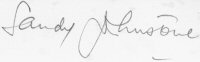 Air Vice Marshal Sandy Johnstone CB DFC AE DL Our estimated value of this signature : £60 Died : 2000 | Air Vice Marshal Sandy Johnstone CB DFC AE DL Early in 1938, Alexander Vallance Riddell Johnstone, known as Sandy, was a civilian navigation instructor at Scottish Aviation, moving later to the Civil Air Navigation School at Prestwick. In August 1939 he was called to full-time service with 602 Squadron. After some Spitfire engagements off the Scottish coast, he received command of 602 - he was still only 24 - and led it south to the tiny airfield at West Hampnett, in West Sussex, where it was stationed throughout the Battle of Britain. Sandy was in command of no. 602 squadron during the critical days of the Battle of Britain, flying with the squadron before the war though to 1941, when he was posted to the Middle east, he also served with 229 and 249 squadrons in Malta during the Islands most fateful days of the war. Sandy became a successful author and resided near Ipswich in Suffolk. Sandy Johnstone died 13th December 2000, aged 84. |
Squadron Leader Terry Kearns Our estimated value of this signature : £60 Died : 1996 | Squadron Leader Terry Kearns New Zealander Derek Terry Kearns joined the RNZAF in December 1940, transferring to England in 1941 to join 75 (NZ) Squadron, flying Wellingtons. In 1942 he took part in the first 1000 bomber raids before joining 156 Squadron Pathfinders. After a period as an instructor, he joined 617 Squadron at Warboys on operations. He flew the Mosquito FBVI on precision low-level target marking throughout 1944. He took part in most of 617s major operations, including raids on the Samur rail tunnel, and the V1 rocket sites. He died in 1996 aged 75. |
Flight Lieutenant Steve Kennedy Our estimated value of this signature : £10 | Flight Lieutenant Steve Kennedy Navigator, 617 Squadron Tornado during the Gulf War. |
  Flt Lieutenant Bob Knights DSO, DFC Our estimated value of this signature : £45 Died : 2004 | Flt Lieutenant Bob Knights DSO, DFC A member of the elite 617 Dambusters squadron, Bob Knights had a key role on the night before D-Day. With the rest of the squadron he flew on Operation Taxable which simulated the approach of the invasion across the Pas de Calais by dropping metal strips of window to a very precise pattern. The enemy was completely deceived and kept most of their best troops on the wrong side of the Seine. Bob Knights had already flown a full operational tour with 619 Squadron Lancasters, including eight trips to Berlin, before volunteering for 617 Squadron. Under Cheshire he flew on some of the squadrons most challenging precision operations and later under Willie Tait took part in the attack that finally destroyed the Tirpitz. Seconded to BOAC in December 1944 he stayed with the airline after the war for a 30 year long career. He died 4th December 2004. |
  Air Commodore John Langston Our estimated value of this signature : £35 Died : 2014 | Air Commodore John Langston Originally serving as a Navigator with 630, 189 and 246 Sqns, he then volunteered for 617 Sqn becoming a Flight Engineer, taking part in many operations including the viaduct bombing raids on Armsberg and Bielefeld in 1945. He died on 11th August 2014. |
Corporal Kenneth Lucas Our estimated value of this signature : £30 Died : 2011 | Corporal Kenneth Lucas Ken Lucas joined the RAF in June 1940, and trained as ground crew for bomber Command. He was sent first to 49 Squadron at RAF Scampton, before transferring to 617 Squadron upon its formation, Involved in all the major servicing of the aircraft before the raid including fitting the motors that drove the belt that spun the bomb, and attaching the critical lamps to the underside of the aircraft. Sadly, Ken Lucas passed away in January 2011. |
 Air Marshal Sir Harold (Mick) Martin KCB CB DSO* AFC RAAF Our estimated value of this signature : £80 Died : 1988 | Air Marshal Sir Harold (Mick) Martin KCB CB DSO* AFC RAAF Born 27th February 1918, Australian Mick Martin joined the RAF in 1940 and had flown tours with 455 Squadron RAAF and 50 Squadron RAF before joining Guy Gibson at 617 Squadron. Pilot of AJ-P, Mick Martin was Deputy Leader of the Dams Raid and flew in Gibsons lead group. Third aircraft to attack the Mohne Dam, he was awarded the DSO for his part in the raid. Mick Martin later served with Leonard Cheshire, and went on to a distinguished career after the war. ADC to the Queen in 1963, he eventually retired from the RAF as an Air Marshal in 1974. Mick Martin died 3rd November 1988. |
 Flight Lieutenant Joe C McCarthy Our estimated value of this signature : £70 Died : 1998 | Flight Lieutenant Joe C McCarthy In March 1943, a special Royal Air Force (RAF) unit, 617 Squadron, was created to try a new tactic--low altitude bombing using deep penetration bombs that weighed from 9,500 to 22,000 pounds. Their first targets were three dams in the Ruhr industrial area of western Germany: the Mohne, the Eder, and the Sorpe. These dams supplied water for Ruhr steel mills and hydroelectric power. Twenty Avro Lancaster bombers were specially modified for this mission to carry a new, rotating skip bomb that would bounce across the lake, sink, and then explode at the base of the dam. So secret was the dambusting mission, that the pilots and navigators were briefed only the day before as to the actual targets. The three dams were struck, and two were breached, on the night of 16 May 1943. 'Joe' McCarthy, from Long Island, New York, was an original member of 617 Squadron. He joined the Royal Canadian Air Force (RCAF) in 1941 and soon transferred with his crew to RAF Bomber Command. From 1941 until late 1944, he flew the Hampden, Manchester, Lancaster, and Mosquito bombers and compiled a total of 80 combat missions. As Officer Commanding, German Aircraft Flight, he tested and flew over 20 different German aircraft, which had been taken from captured German airfields back to Farnborough for extensive engineering evaluation. During this period, McCarthy flew the first British operational jet, the Meteor, and the experimental Windsor bomber. Upon returning to Edmonton, Canada, he continued flight testing a variety of aircraft for cold weather operations as well as the experimental Canadian flying wing. During 28 years in the RCAF, he flew 64 different British, American, German, and Canadian aircraft. Later assignments included base executive officer for an F-86 NATO installation in France; Commander, Flying Training School, RCAF Station Penhold, Canada; and Commanding Officer of the 407 Maritime Squadron, flying the P2V Neptune. From 1961 to 1962, he was Chief of Air Operations for the United Nations' forces in the Congo, and from 1963 to 1966, worked in plans and policy for CINCLANT/CINCLANTFLT. Wing Commander McCarthy's final assignment was as base operations officer for two maritime squadrons flying the Argus antisubmarine warfare aircraft in Nova Scotia. He retired from the RCAF in 1969 and, after a second career in real estate, fully retired in 1986. Passed away 6th September 1998. |
  Flight Sergeant Grant S McDonald RCAF Our estimated value of this signature : £45 Died : 2012 | Flight Sergeant Grant S McDonald RCAF Grant McDonald was the rear gunner on Lancaster AJ-F flown by Ken Brown. On the way to the Ruhr, the gunners shot up and damaged three trains in an eventful trip before reaching the Sorpe Dam. Sadly, we have learned that Grant S McDonald passed away in May 2012. |
 Flight Lieutenant A M McKie Our estimated value of this signature : £20 Died : 2008 | Flight Lieutenant A M McKie Born in Crewe in July 1922, Alex McKie joined the RAF in 1938 as an apprentice, and was selected for pilot training in 1942. After training, he joined No.106 Squadron flying Lancasters as a navigator. With this squadron, he flew eight raids to Berlin. Completing 30 operations, he was awarded the DFM, before volunteering in June 1944 to join No.617 Squadron, a squadron which by this time was famous for the legendary Dambusters raid. During a raid on the German battleship Tirpitz in Norway, Mckie and his crew were forced to crash-land in neutral Sweden after losing two engines. After blaming their intrusion into Sweden on faulty navigation, they were repatriated. Sadly, Alex McKie passed away on 1st August 2008. |
Flight Lieutenant Steve Morris Our estimated value of this signature : £10 | Flight Lieutenant Steve Morris Navigator, 617 Squadron Tornado during the Gulf War. |
  Squadron Leader Les Munro DSO DFC RNZAF Our estimated value of this signature : £60 Died : 2015 | Squadron Leader Les Munro DSO DFC RNZAF New Zealander Les Munro was the Captain and pilot of Lancaster AJ-W assigned to attack the Sorpe Dam, but was forced to turn back en-route to the target after heavy flak damage over Holland had rendered his aircraft unable to carry on with the operation. Squadron Leader Les Munro, who has died aged 96, was the last surviving pilot to have taken part on the Dambusters raid, which attacked the Ruhr Dams in May 1943. His Lancaster was one of the first to take off on the night of May 16. Their target was the Sorpe Dam. Flying at very low level over the Dutch island of Vlieland, the bomber was badly damaged by anti-aircraft fire. The radios and electrical system were disabled but, crucially, so was the intercommunication system between members of the crew. Without this it was impossible to carry out the precise attack from a height of 60 feet, so with great reluctance, Munro turned for his home base at Scampton, near Lincoln, still with his bouncing bomb on board. John Leslie Munro was born on April 5 1919 at Gisborne, New Zealand, where his Scottish father had emigrated in 1903. He worked as a farmer before joining the Royal New Zealand Air Force in July 1941. He trained initially in New Zealand and then in Canada, where he completed his qualification as a pilot. On arrival in England he trained on bombers before joining No 97 Squadron, which had recently been re-equipped with the Lancaster. After an operation to drop mines in the sea-lanes to German occupied ports, Munro attacked industrial cities in Germany during the so-called Battle of the Ruhr when Essen, Dusseldorf and Cologne were among his targets. He also flew on two raids to Berlin and attacked targets in Italy. He and his crew were approaching the end of their tour of operations (30 sorties) when volunteers were called for to form a new squadron for a special operation. Munro discussed it with his crew and they agreed to apply. A few days later, on March 25, they arrived at Scampton to join X Squadron on its formation, later to become No 617. Soon after leaving No. 97 Squadron, Munro was awarded the DFC for pressing home his attacks with great courage and determination. Within days of arriving at Scampton, all the crews were practising intensive low-level flying including runs over lakes and reservoirs when high-tension cables, barrage balloons and birds were an ever-present hazard. During a trial flight with the Upkeep bouncing bomb designed by Barnes Wallis, Munro was flying below the prescribed height of 60 feet when a great plume of water made by the bomb as it made its first bounce damaged the tailplane of his Lancaster. After the Dams Raid, Munro remained on No 617. The squadron suffered further heavy losses and morale was badly affected. Under the leadership of its new commanding officer, Wing Commander Leonard Cheshire, Munro was made a flight commander. The other two flight commanders were Dave Shannon, an Australian, and the American Joe McCarthy and these three, under Cheshires inspiring leadership, created one of the most effective squadrons to serve in Bomber Command. Cheshire described his three flight commanders as the backbone of the squadron. Of the three, the slow speaking, taciturn New Zealander was the least flamboyant, but his rock steady dependability and utter reliability were an inspiration to his young crews. Cheshire was dissatisfied with the marking of targets by the Pathfinder Force and he developed his own low-level marking technique that proved highly successful. Munro dropped flares from high level and Cheshire dived beneath them to accurately mark the targets for the following bombers. On the eve of D-day on June 5 1944, No 617 flew Operation Taxable, a complex flight requiring extremely accurate flying, navigation and timing. Munro, with Cheshire as his co-pilot, was flying one of the lead aircraft, which flew a series of orbits as it advanced across the English Channel towards the Pas de Calais dropping window (reflective metal strips) to simulate an amphibious landing force approaching the area. This deception created doubt in the Germans minds as to where the Allied landing was taking place and delayed the despatch of reinforcements to Normandy. After the landings, the squadron flew in support of troops establishing the bridgehead. On the night of June 8 , it had a spectacular success when Munro dropped one of the new 12,000-lb Tallboy bombs, which completely destroyed the Saumur railway tunnel. On the following nights he dropped Tallboys on the E-boat pens at Le Havre and Boulogne before attacking the V-weapon sites at Wizernes and Mimoyecques. After this latter raid, his 55th, he and his fellow flight commanders were retired. He had recently been awarded the DSO, his citation concluding with the words, His achievements have been worthy of the greatest praise. Munro finished the war in command of a Bomber Defence Training Flight. He returned to New Zealand and left the RNZAF in February 1946 as a squadron leader. Munro made a major contribution to community life in New Zealand and was Mayor of Tekuiti from 1978 to 1995. He was awarded the Queens Service Order in 1981 and appointed Commander of the New Zealand Order of Merit in 1997 for services to local government and community. Munro retained strong links with his old squadron and made a number of trips to the United Kingdom on special anniversaries. He was present when the Queen dedicated the Bomber Command Memorial in Green Park in 2012. In 2015 he placed his medals with an auction house to raise money for the maintenance of the memorial. At the last minute, Lord Ashcroft stepped in to stop the sale, offering to donate £75,000 to the memorials upkeep if Munro gifted his medals to the Museum of Transport and Technology in Auckland. Squadron Leader Les Munro, born April 5 1919, died August 4 2015. |
 Sergeant Stefan Oancia DFM Our estimated value of this signature : £60 Died : 1999 | Sergeant Stefan Oancia DFM Born in Stonehenge, Saskatchewan, Canada in 1923, Sgt. Stefan Oancia enlisted in the RCAF on the 1st ofAugust 1941. Trained at No.2 ITS (graduated 4 December 1941), No.3 AOS (graduated 13 March 1942), No.2 BGS (graduated 25 April 1942) and No.1 ANS (graduated 25 May 1942) and was the bomb aimer on F/Sgt. Kenneth W Brown's Lancaster ( AJ-F Freddie). He survived the raid and the war and was awarded the DFM, presented at Buckingham Palace on 22nd June 1943. Sadly he passed away on the 15th of May 1999. |
Corporal Beck Parsons Our estimated value of this signature : £15 | Corporal Beck Parsons Vital to the whole Dambusters operation was the complete dedication by the ground crew of 617 Squadron. Personified by Beck Parsons. Joining the RAF in 1940, he trained as an electrician and worked with Avro Manchesters with 207 Squadron at Waddington. In March 1943 he was posted to 617 Squadron at Scampton where he flew with Barnes Wallis during the tests on the bouncing bomb. As Electrical NCO Beck was responsible for the electrics on B flight at the time of the raid, together with Top Maintenance on five of the Lancasters, including those of Guy Gibson and Mick Martin. |
M/Sig R D Pearson Our estimated value of this signature : £15 | M/Sig R D Pearson Joined the RAF in 1943 to begin training as an Air Gunner. After the usual short attachments at various training stations eventually ending up at No 2 AGS Dalcross. Air firing was carried out from an Avro Anson. There was always a mad rush to be first aboard the aircraft on every detail, not from enthusiasm, but from trying to avoid winding up the undercarriage after take off. M/Sig Pearson went from Dalcross to Kinloss to join a crew flying Whitleys and several months later ended up at 158 Sqdn Lissett to commence operations on Halifaxes. After half a tour and very happy at Lissett his crew were posted onto a PFF Sqdn, 635 Sqdn Downham Market. His first operation, and very nearly his last, was a daylight raid on Hamburg. On the bombing run, they had the misfortune to be selected by the pilot of a ME262 as his victim. He was not spotted until he was dead astern and blazing away with the four 30mm cannon in the nose. Evasive action was given and the pilot promptly stood the Lanc on its nose. Unfortunately not all the cannon shells missed and they lost quite a piece of fuselage leaving ammo belts hanging out in the slipstream. After regaining level flight, they were attacked again by another ME262, but this time they were lucky. Both ME pilots decided to push off and find some other sitting duck! Despite these attacks, they carried on and bombed, making their way home across the North Sea, not a pleasant journey. The pilot received an immediate award of the DFC. M/Sig Pearson finished the war out at Downham Market and after the war in Europe ended was posted to 83 Sqdn Conningsby for Tiger Force training and operations against the Japanese. Fortunately the war in the east ceased just as they were ready to depart. He was demobbed in May 1947, but was not happy out of uniform so was back in again at the end of 1949 as an A/G flying on Lincolns at 9 Sqdn. Binbrook. He had a short detachment with 617 Sqdn at Shallufa, Egypt and at the end of 1952 was posted onto B29 aircraft with 15 Sqdn. Coningsby. After six months he was posted to Little Rissington on a Link Trainer course and then to FTS Syerston as a Link instructor to Naval cadet pilots. In 1955, he was required to either remuster to a ground trade or take another aircrew trade. He was posted to Swanton Morley to take training as an Air Signaller and from then to St Mawgan 228 Sqdn on Shackletons. Next came a posting to Northolt in a drawing office drawing En-Route charts and Terminal Approach Procedures. Back to flying in 1961 and a posting to 224 Sqdn Gibraltar and then to Air Traffic Control School at Shawbury. On completion of this course came a posting to RAF Lyneham as Local Controller and thence to RAF Colerne as Approach Controller. He left the service in 1968. |
Warrant Officer J D Phillips Our estimated value of this signature : £30 Died : 2014 | Warrant Officer J D Phillips Having qualified as a Flight engineer, he was one of the first crews to join 617 Sqn following the Dams raids and completed operations against the mighty Tirpitz Battle Ship. He died in April 2014. |
Flt Lt Arthur F Poore DFC Our estimated value of this signature : £45 Died : 2016 | Flt Lt Arthur F Poore DFC Flt. Lt. Arthur Poore D.F.C. (Pilot) volunteered for the R.A.F.V.R. in December 1939 aged 19 and joined the R.A.F. in May 1940. After gaining his wings he was fortunate to be posted as a staff pilot at No 2 School of Air Navigation in Cheshire where, for two years he gained many hours flying experience and map reading skills. He was subsequently posted to 106 Lancaster Squadron and after 23 raids over Germany was selected to join 617 Squadron. On completion of his second tour of ops. he was promoted to Acting Squadron leader and transferred to No. 1 Lancaster Finishing School at Syerston, Notts. as a Flight Commander. Finally he was posted to 511 Squadron at Lyneham, Wilts. to fly York airliners to and from the UK and Singapore or Ceylon. He died on 15th November 2016. |
  Flight Lieutenant Bill Reid VC Our estimated value of this signature : £80 Died : 2001 | Flight Lieutenant Bill Reid VC Volunteering for RAF aircrew in 1940, Bill Reid learned to fly in California, training on the Stearman, Vultee and Harvard. After gaining his pilots wings back in England he flew Wellingtons before moving on to Lancasters in 1943. On the night of Nov 3rd 1943, his Lancaster suffered two severe attacks from Luftwaffe night fighters, badly wounding Reid, killing his navigator and radio operator, and severely damaging the aircraft. Bill flew on 200 miles to accurately bomb the target and get his aircraft home. For this act of outstanding courage and determination he was awarded the Victoria Cross. Died 28th November 2001. |
Flight Lieutenant Harold Riding Our estimated value of this signature : £25 | Flight Lieutenant Harold Riding Originally joining 106 Sqn as a WOp/AG he transferred to 617 Sqn where he did a full tour during from late 1943. He was the only person in the RAF to be promoted from ACI directly to Pilot Officer in only one day. |
Harold Roddis Our estimated value of this signature : £15 | Harold Roddis Flight Mechanic on the 617 Squadron Dambuster aircraft. |
 Flying Officer Dave Rodger Our estimated value of this signature : £60 Died : 2004 | Flying Officer Dave Rodger Born in Sault Ste marie, Ontario on February 23rd 1918, he son of a Scots carpenter, David Rodger was an avid collector of aeroplane magazines as a boy, that began his interest in flying. David Roger went to the local technical school, then worked for Algoma Steel while serving in the Canadian Militia. Rodger joined the Royal Canadian Air Force in October 1941 and trained as an air gunner before being commissioned as pilot officer, and then arriving in England in 1942. David Rodger converted to Lancaster bombers, and joined No 97 Squadron at Woodhall Spa near Lincoln, and it was here he teamed up with McCarthy. During their time with 97 squadron they attacked the main industrial cities on the Rhur and also Hamburg and Berlin. By the time they joined No 617 Squadron, they were recognised as an experienced crew. Rodger and McCarthy had already completed more than 20 bombing raids together when they were selected to join No 617 Squadron, forming at RAF Scampton in March 1943 under the command of Wing Commander Guy Gibson. David Rodger was the rear gunner in Big Joe McCarthy's Lancaster, which attacked the Sorpe Dam during Operation Chastise, the Dam Buster raid of May 16th 1943. On the night of the raid their aircraft was unservicable due to an engine problem, so they took the reserve aircraft which had been fitted with the upkeep bouncing bomb, but not had time to be fitted with the crucial spoptlights which were used to keep the aircraft at the height of 60 feet. As McCarthy took the bomber across the coast at 100ft, Rodger, in the rear turret, was soon in action trying to douse the searchlights before having a lively exchange with a light flak gun. By the time they arrived at the Sorpe, McCarthy's men were the only survivors of the team charged with attacking the dam, which was shrouded in mist as they arrived. With a tall church spire on the approach and a hill to be avoided after the attack, McCarthy had great difficulty getting into position to drop the mine. The lack of the height-finding spotlights made the job almost impossible. The crew made nine dummy attacks before releasing their weapon accurately at last. But the force of the explosion was insufficient to breach the earth dam, and McCarthy and his men set course for base. After the success of the Dam raids 617 squadron now under the command of Wing Commander Leonard Cheshire specialised in the attack of pinpoint targets, and Cheshire and his four senior crews from the dam buster raid developed daring and accurate low-level target-marking techniques. Rodger was appointed the gunnery leader of the squadron in September. Rodger then attacked targets in Italy, and made pinpoint raids against viaducts and the huge concrete constructions associated with the V-1 rocket programme in the Pas de Calais. In addition to their marker role, the Lancasters of No 617 carried the massive 12,000-ton Tallboy bomb, which was used to devastating effect against V-sites and railway tunnels. During the night of June 5 1944, 16 Lancasters of No 617 carried out a unique operation, dropping a dense screen of 'window' (foil strips) which advanced slowly across the Channel to simulate a large convoy of ships approaching the French coast between Boulogne and Le Havre, north of the real invasion area. After 14 months on No 617, McCarthy and his crew were finally rested in July 1944. Rodger, who had flown 50 bombing operations, including 24 with No 617, was awarded the DFC for his calm resolution in the face of the heaviest opposition, which has been an inspiration to his crew. Rodger returned to Canada in September 1944, where he married, and was released from the RCAF the following year. He returned to work at Algoma Steel, where he became a superintendent. Always a keen outdoorsman, he loved fishing and played his last game of ice hockey at 84. David Rodger died on September 1st 2004 in Canada aged 86. |
Flying Officer Dave Rodger DFC RCAF Our estimated value of this signature : £60 Died : 2004 | Flying Officer Dave Rodger DFC RCAF Canadian Dave Rodger joined the RCAF in 1941, and was posted to 97 Squadron before joining 617 Squadron in March 1943. He was rear gunner in the Lancaster of Joe Mccarthy, AJ-T, that attacked the Sorpe Dam. Sadly, Dave Rodger died on 1st September 2004. |
Flight Lieutenant N R Nicky Ross DSO DFC AE Our estimated value of this signature : £45 Died : 2008 | Flight Lieutenant N R Nicky Ross DSO DFC AE Nos 40, 103 and 617 Squadrons. Born 1 st August, 1917 at Greenock. Joined RAFVR at Edinburgh 12/7/39. Trained at 11 EFTS, Perth gained wings at 2 FTS Brize Norton, completed training at 20 OTU Lossiemouth Dec 1940, Joined 40 Squadron, 22/1141 as Sgt Pilot on Wellingtons at Wyton and Allconbury. Completed 1st tour 3/7/41 and screened at 27 OTU Lichfield, participating in the three Thousand Force raids on Cologne, Essen and Bremen in 1942. Commenced 2nd tour with 103 Squadron, at Elsham Wolds as Warrant Officer Pilot on Lancasters, 27th March 1943 completing end June. Awarded DFC 517/43. Took crews and Lancaster to Wright Field, Dayton, Ohio via Gander to do experimental work for USAAF ( dropping two Bren Gun Carrier type vehicles by parachute from various heights to target zone. Returned to England and commenced third tour as P/ 0 with 617 Squadron October 1943 at Coningsby and Woodhall. Spa until July 1944. As Flying Officer was awarded DSO (Immediate award). Released from Service asF/Ltin 1946. Nicky Ross passed away on 18th April 2008. |
  Squadron Leader David J Shannon DSO* DFC* RAAF Our estimated value of this signature : £80 Died : 1993 | Squadron Leader David J Shannon DSO* DFC* RAAF Born 27th May 1922 in Australia, Dave Shannon joined the RAAF in 1941, and trained as a pilot. He flew an extended tour of 36 operations with 106 Squadron RAF before being chosen for 617 Squadron. Pilot of Lancaster AJ-L in Gibsons group, he was called off as he began his run on the Mohne Dam after the breach became apparent, but flew on and was the first pilot to attack the Eder Dam. Awarded a DSO for the Dams operation, he later served as Deputy to Leonard Cheshire, flying Mosquitos on what was by then his third tour. He later served with 511 and 246 Squadrons, and worked in the oil industry after the war. David Shannon died on 8th April 1993. |
Squadron Leader Bob Sinclair Our estimated value of this signature : £10 | Squadron Leader Bob Sinclair Navigator, 617 Squadron Tornado during the Gulf War. |
Flt Lt Ron Smith DFC AE Our estimated value of this signature : £10 | Flt Lt Ron Smith DFC AE Air Gunner, 617 Squadron. |
  Sergeant Frederick E. Sutherland RCAF Our estimated value of this signature : £45 Died : 2019 | Sergeant Frederick E. Sutherland RCAF Doc Sutherland was the front gunner on Les Knights Lancaster AJ-N that went to the Mohne Dam, and then successfully attacked and breached the Eder Dam. Shot down four months later, he managed to evade capture and escape back to England with the help of the Resistance movements, returning through Holland, France and Spain. He died on 21st of January 2019. |
  Group Captain J B Willie Tait DSO*** DFC* ADC Our estimated value of this signature : £40 Died : 2007 | Group Captain J B Willie Tait DSO*** DFC* ADC One of Bomber Commands most outstanding leaders, James Brian -Willie- Tait was one of only two RAF officers who had the distinction of being awarded three Bars to his DSO, as well as a DFC and Bar. On the night before D-Day Tait was the 5 Group Master Bomber directing from the air the massed attack by Lancasters on the German defences in the Cherbourg peninsula. By then Tait had already flown more than 100 bomber sorties with 51, 35, 10 and 78 Squadrons. A Cranwell-trained regular officer, he was very much in the Cheshire mould: quiet, bordering on the introspective. He was to go on to command the legendary 617 Dambusters Squadron and lead it on one of its most famous raids which finally destroyed the German battleship Tirpitz. In July 1944 when Leonard Cheshire was replaced by Wing Commander J B Willie Tait, 617 Squadron discovered that it had acquired a Commanding Officer very much in the Cheshire mould. Quiet, bordering on introspection, Tait, who was a Cranwell-trained regular officer, had already flown over 100 bombing operations with 51, 35, 10 and 78 Squadrons before joining 617. Tait had also received a DSO and bar and the DFC. He was 26. In the best traditions of 617 Squadron, Tait wasted no time in adapting to the Mustang and Mosquito for low level marking. He appointed two new Flight Commanders including Squadron Leader Tony Iveson DFC. Although involved in many of 617 Squadrons spectacular operations, Taits name is always associated with the destruction of the Tirpitz. An earlier attack on the ship by the squadron on 15th September 1944 had caused severe damage but Tirpitz was still afloat. On 29th October the Squadron was frustrated on the second attack by cloud over the target. The final attack was launched in daylight on 12th November 1944. Leading a mixed force of 617 and 9 Squadron Lancasters, Tait achieved complete surprise and had the satisfaction of seeing the Tirpitz destroyed at last. He had led all three attacks. On 28th December 1944 Tait received a third bar to his DSO, becoming one of only two RAF men to achieve this distinction. It coincided with his leaving 617 Squadron. Tait served in the post-war RAF, retiring as a Group Captain in 1966. He died 31st May 2007. |
Flight Lieutenant Greig Thomson Our estimated value of this signature : £10 | Flight Lieutenant Greig Thomson Piloted Tornado aircraft of 617 Sqn during the Gulf war. |
  Warrant Officer F L Tilley Our estimated value of this signature : £25 | Warrant Officer F L Tilley After training as a Flight Engineer he volunteered for 617 Sqn taking part in all the raids against the Tirpitz, but at the end of 1944 was forced to crash land in East Germany after being badly shot up and injured on a mission. |
  Flight Lieutenant Bill Townsend CGM DFM Our estimated value of this signature : £85 Died : 1991 | Flight Lieutenant Bill Townsend CGM DFM Pilot and Captain of Lancaster AJ-O, he attacked the Ennepe Dam. Transferring to the RAF from the Army in 1941, Bill Townsend served a tour as a pilot with 49 Squadron, before joining 617 Squadron, at the time a Flight Sergeant. As part of 617 Squadron Bill Townsend flew Lancaster ED-886 codenamed AJ – O for Orange in the famous dambuster raid of May 1944. Flight Sergeant Townsend flew his bomber and crew in the third wave of the famous raid. After the first two dams (Mohne and Eder) were breached, O for Orange was tasked to attack the Ennepe dam. With no anti-aircraft firing at them, they had time to do three trial runs before they released their bomb, but it failed to damage the dam. Forced to fly back at tree top level by enemy action, his Lancaster was the last to return. It limped home short of one engine. He was awarded the Conspicuous Gallantry Medal for his courageous actions in the raid. Bill Townsend was later promoted to Flight Lieutenant. He had been a pupil at Monmouth and after the war studied at Lincoln College, Oxford. He became a business man and a civil servant after his studies. FLt/Lt Townsend passed away in April 1991 , there with a flypast by 617 Tornadoes at his cremation on the 15th April 1991 |
Flight Lieutenant Murray Vagnolini Our estimated value of this signature : £10 | Flight Lieutenant Murray Vagnolini Completing his first tour as a Wireless Operator with 61 Sqn, he flew with 617 Sqn dropping the 12,000 lb 'Tallboy' and 22,000 lb 'Grand Slam' bombs. The war ended halfway through his second operational tour. |
Flight Lieutenant Murray Valentine Our estimated value of this signature : £10 | Flight Lieutenant Murray Valentine Completing his first tour as a Wireless Operator with 61 Sqn, he flew with 617 Sqn dropping the 12,000 lb Tallboy and 22,000 lb Grand Slam bombs. The war ended halfway through his second operational tour. |
Squadron Leader E Gray Ward DFC Our estimated value of this signature : £40 | Squadron Leader E Gray Ward DFC After joining the RAF in November 1940, Gray Ward trained as a pilot. His first operational squadron was 50 Squadron flying Lancasters, before he joined 57 Squadron as a Flight Commander. In late 1944 he was selected to join 617 Squadron, and took part in the 22,000lb 'Grand Slam' raids on the Bielefeld and Arnsberg viaducts. |
Flight Lieutenant Fred Watts DFC Our estimated value of this signature : £40 Died : 2007 | Flight Lieutenant Fred Watts DFC Fred Watts joined the RAF in 1940, and qualifying as a pilot was posted to 630 Squadron in 1943 flying 15 operations on Lancasters out of East Kirby. He joined 617 Squadron in April 1944 and took part in many of the precision operations that the Squadron was renowned for, including raids on V1 sites, V2 rocket bases, and all three attacks on the Tirpitz. He left 617 Squadron in March 1945 to join 83 Pathfinder Squadron for Far East deployment with Tiger Force but VJ-day brought disbandment of the Force before it could be despatched. He stayed on in the RAF after the end of the war, retiring in 1964. He died 6th August 2007. |
 Sergeant Douglas E Webb Our estimated value of this signature : £65 Died : 2002 | Sergeant Douglas E Webb Mr Webb flew 27 missions as a gunner on Lancaster bombers before being selected in March 1943 for the 617 Squadron, which attacked the Mohne, Sorpe, and Eder dams - flooding the German war industry. He passed away in 2002. |
Flight Lieutenant Paul Wharmby Our estimated value of this signature : £10 | Flight Lieutenant Paul Wharmby Piloted Tornado aircraft of 617 Sqn during the Gulf war. |
Flying Officer Dave Wilson Our estimated value of this signature : £10 | Flying Officer Dave Wilson Navigator, 617 Squadron Tornado during the Gulf War. |
|
Contact Details |
Sign Up To Our Newsletter!
This website is owned by Cranston Fine Arts. Torwood House, Torwoodhill Road, Rhu, Helensburgh, Scotland, G848LE Contact: Tel: (+44) (0) 1436 820269. Email: cranstonorders -at- outlook.com
|


