|
|
|
|
|
|
|
|
|
Cranston Fine Arts  Aviation Art and Artists World War Two Squadrons UK and Commonwealth No.270 Sqn to No.438 Sqn Aviation Art and Artists World War Two Squadrons UK and Commonwealth No.270 Sqn to No.438 Sqn  No.270 Sqn No.270 Sqn |
[UP] - No.270 Sqn - No.272 Sqn - No.274 Sqn - No.303 Sqn - No.305 Sqn - No.308 Sqn - No.315 Sqn - No.332 Sqn - No.350 Sqn - No.357 Sqn - No.401 Sqn - No.402 Sqn RCAF - No.404 Sqn RCAF - No.405 Sqn RCAF - No.412 Sqn RCAF - No.414 Sqn RCAF - No.418 Sqn RCAF - No.422 Sqn RCAF - No.433 Sqn RCAF - No.438 Sqn RCAF |
| No.270 Sqn Aviation Art Prints, Paintings and Drawings Aviation Prints |
|
| Text for the above items : |
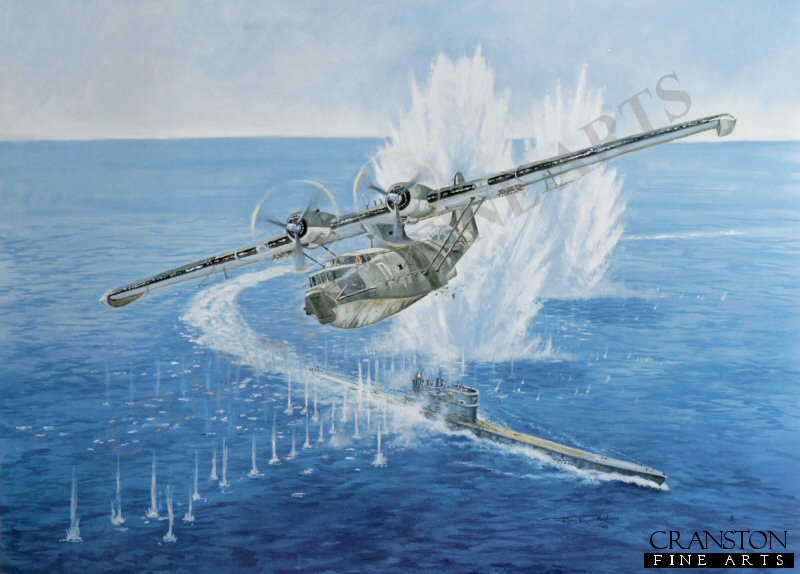
Catalina Attack by John Wynne Hopkins. D for Donald of 270 squadron, Royal Air Force, out of Freetown, West Africa operating in the Atlantic Ocean. It was during routine operation search that D for Donald surprised U515 on the surface and immediately attacked the submarine. U515 in putting up stiff resistance blew a large hole in the hull of D for Donald and the magazine of the starboard side 0.5 twin Browning was hit and the subsequent shrapnel wounded both blister gunners. U515 escaped but was sunk by an American naval hunter group a year later. D for Donald limped back to base and managed to make the beach before it would sink completely. |
| No.270 Sqn RAF Aircraft details |
 Catalina Manufacturer : Consolidated Built : 3305 | Catalina Built by the Consolidated Aircraft Company and designed by Isaax M Ladden. the Catalina first flew on the 28th march 1935. and first flew with the US Navy in October 1936. In 1935 the cost of each Catalina was $90,000 and just over 4,000 were built. The Catalina was used in various maritime roles. but it was designed initially as a maritime patrol bomber. Its long range was intended to seek out enemy transport and supply ships. but was eventually used in many roles including Convoy escort,, anti submarine warfare and search and rescue. In its role as a search and rescue aircraft it probably is best remembered for many thousands of aircrews shot down in the Pacific and less extend in the Atlantic and Mediterranean. The Catalina was the most successful flying boat of the war and even served in a military role until the early 1980's some are still used today in aerial firefighting. |
 Walrus | Walrus No profile available |
| No.270 Sqn RAF Pilot and aircrew signature details |
Sydney Hillier Our estimated value of this signature : £40 | Sydney Hillier Sydney Hiller was a member of the crew of Catalina D for Donald of 270 Squadron. The squadron was based for most of the war at Freetown, West Africa. He was a member of the crew when his aircraft launched a surprise attack on u-boat U-515. |
Alex Morrison Our estimated value of this signature : £35 | Alex Morrison Alex Morrison was a member of the crew of Catalina D for Donald of 270 Squadron. The squadron was based for most of the war at Freetown, West Africa. He was a member of the crew when his aircraft launched a surprise attack on u-boat U-515. |
 Flight Lieutenant Graham Stevens Our estimated value of this signature : £10 | Flight Lieutenant Graham Stevens With No.230 Sqn, flew Sunderlands against the Japanese. Called up in 1941, he completed his pilot training with the US Navy in Pensacola, Florida and was selected to fly Catalina flying boats in the maritime reconnaissance role. Inititally posted to 270 Squadron in West Africa as a 2nd Pilot, he and his crew were tasked with patrolling over the South Atlantic gathering information on enemy maritime activity. As the war in Europe drew to a close, he completed a Captains conversion course and re-trained to gly the Short Sunderland. As victory over the Japanese approached he joined 230 Squadron in Madras to begin what was the most satisfying period of his service, piloting repatriation flights for Allied POWs from Singapore to begin the first leg of their journey home. |
|
Contact Details |
Sign Up To Our Newsletter!
This website is owned by Cranston Fine Arts. Torwood House, Torwoodhill Road, Rhu, Helensburgh, Scotland, G848LE Contact: Tel: (+44) (0) 1436 820269. Email: cranstonorders -at- outlook.com
|