|
|
|
|
|
|
|
|
|
Cranston Fine Arts  Military Art and Artists Featured Current Military Artists Military Art and Artists Featured Current Military Artists  David Pentland David Pentland |
[UP] - Chris Collingwood - David Pentland - Mark Churms - Brian Palmer - Graeme Lothian - Jason Askew - Terence Cuneo - David Rowlands |
| More Pages : Tank Index - World War One - World War Two - Modern Wars - Ancient Era - Medieval Era - US Marines - The SAS - Original Paintings - Original Drawings - Postcards |
| David Pentland |
One of Europe's Leading Military and Aviation Artists, David Pentland has produced a wealth of Paintings for Cranston Fine arts, who are proud to have David as one of their leading Artists. As you browse down his wonderful work you may be interested to know that many of the Paintings are still available, and to a collector his work would certainly be a valuable addition. David's Paintings have gone up in value over the past 2 years, and have seen a growth in value of nearly 100%.
|
| Navigation | |
| Page 3 of 16 | Previous .. Page 3 .. Next |
|
|
|
|
|
|
|
|
|
|
|
|
|
|
|
|
|
|
|
|
|
| Navigation | |
| Page 3 of 16 | Previous .. Page 3 .. Next |
| Text for the above items : |
Welcome Reinforcements by David Pentland. St Mere Eglise, Normandy, 6th June 1944. Anti-tank guns of 80th AA battalion and glider troops of 325th GIR, 82nd Airborne, land in the fields near St Mere Egise, during the early hours of D-Day. |
Turning the Tables, Kurland, Baltic Coast, 25th January - 3rd February 1945 by David Pentland. During the Fourth Battle of Kurland, Major Josef William Sepp Brandner, commander of Sturmgeschutz Brigade 912, personally counterattacked a soviet breakthrough, then with only his headquarters of 3 guns continued without infantry support to pursue and rout the enemy units. By the end of this action he had destroyed his 57th tank, his final tally rose to 66 by the wars end. |
The Hunters by David Pentland. The Fezzan, Libya, North Africa, November, 1942. The Italian Reparto Celere 3 of the 'Raggruppamento Sahariano AS', was the first unit to be equipped with the unique Camionetta 42 'Sahariana'. The platoon was used for patrols and had its first clashes with the LRDG on 17 November, when it lost one Sahariana, and on 25 November, when it succeeded in destroying four out of the eight enemy vehicles it encountered. |
In the Gully by David Pentland. Goose Green, Falkland Islands, 28th May 1982. British Paratroops of 2 Para trapped in a gorse gully finally break the main Argentine line of defence, opening the way to the final assault on Darwin and Goose Green. Despite being outnumbered, exhausted, and forced to attack over open ground under fire from enemy machine guns, artillery and aircraft, 2 Para succeeded in reaching their objective and giving the British Task Force its first much needed land victory. |
Mr Churchill's Tank by David Pentland. Normandy, France, 1944. British Churchill Mk VII tanks of 147 Regiment, 34th Tank Brigade, Royal Armoured Corps, move through a deserted Normandy farmyard in the dense Normandy Bocage. |
The Machine Guns - Battle of Amiens, France, 8th August 1918 by David Pentland. A German machine gun team defend against the British 3rd Corps attack on the high ground north of the Somme. This was to be the start of the final Allied offensive of the war. |
Awaiting Orders, Normandy, July 1944 by David Pentland. British 25pdr armed Sexton of B Troop, 431 Battery, 147th (Essex Yeomanry) Royal Artillery Field Regiment - 8th Armoured Brigade awaiting their first orders of the day. |
The Falaise Gap, Normandy, 12th - 20th August 1944 by David Pentland. After almost two months of continuous fighting in the front line, remnants of the 12th SS Panzer Division, Hitler Jugend, fall back under incessant air attacks by allied fighter bombers for their final battles in France. In their defense of the northern flank of what is to become the Falaise Gap the new Jagdpanzer IV in particular is to prove a formidable foe to the attacking British and Canadian tanks. |
Morris and Hillman by David Pentland. Near Caen, D-Day, 6th June 1944. Vickers heavy machinegun team of the British 3rd Division, Monty's Ironsides, in action against the German strong points Morris and Hillman. The division comprised of the 2nd East Yorkshires, 1st South Lancashires, 1st Suffolks, 2nd Lincolnshires, 1st King's Own Scottish Borderers, 2nd Royal Ulster Rifles, 2nd Warwickshires, 1st Norfolks, and 2nd King's Shropshire Light Infantry. |
Moving Forward by David Pentland. Kursk, Russia, July 1943. Su-76 self propelled guns moving north of Kursk. |
Dragoons at Arras by David Pentland French Somua S35 tanks, 1st Light Mechanised Division, Arras, France, 22nd May 1940. Somua S35 tanks of the 18th Regiment of Dragoons taking part in the successful attack on German held Mont St. Eloi, during the battle for Arras. |
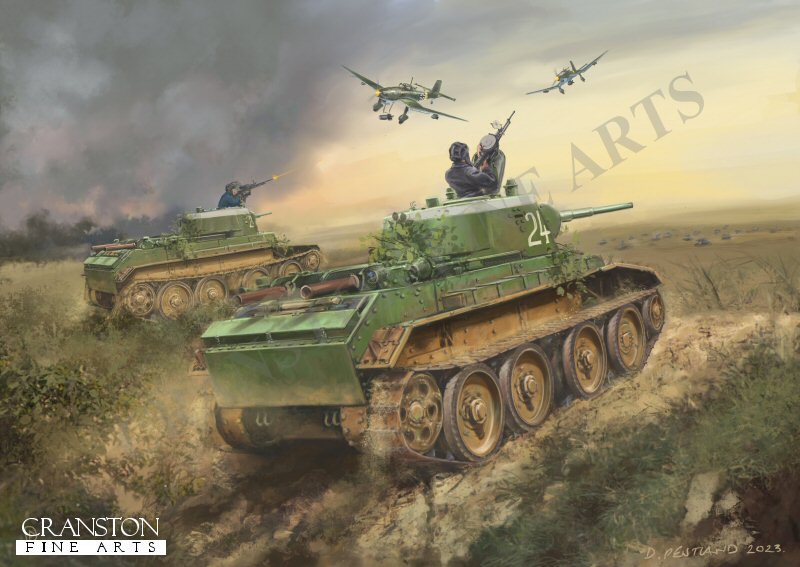
Under Attack by David Pentland Soviet Bt-7 tanks fend off a Stuka attack, Russia, June 1941. The Bt-7 model 1937 was an innovative design. With it’s Christie suspension, impressive speed, mobility, and a 45mm gun, it was a good tank for it’s time. Only supplanted by the even better T34. |
Under New Management by David Pentland Finnish T-26 Tanks en-route to Karhumaki, January, 1942. Developed from the Vickers 6 Ton Tank the Soviet T-26 was one of the most successful tank designs of the 1930s. Many were captured by Finnish forces during the Winter War of 1939-40 and although nearly obsolote were still welcomed by the Finns, and used throughout the continuation war. |
Assault on Courcellette, The Somme, 15th September 1916 by David Pentland. The village of Courcellette dominated the Somme battlefield, and it was the Canadian Corps who were given the task of taking the strongpoint. They were however aided by a new weapon, six tanks of No.1 Section, C Company, Heavy Tank Battalion. The Mark Is were commanded by Captain A. M. Inglis in C5 Creme de Menthe and supported the 31st (Alberta) Battalion in the successful assault in and around the villages Sugar Factory. |
Holding the Line by David Pentland. Vielsalm, Belgium, 22nd December 1944. Men of the 508th PIR, along with the rest of the 82nd Airborne Division were rushed to the Ardennes and deployed in an attempt to halt the onslaught of 6th SS Panzer Army, specifically Kampfgruppe Peiper. |
Wittmann at Villers Bocage, Normandy, 0900 hrs, June 13th 1944 by David Pentland. While other Tigers of his command struck northwest and decimated the tanks and half tracks of the Sharpshooters and Rifle Brigade parked along the road towards point 213 and Caen, Haupsturmfuhrer Michel Wittmann attacked on his own to the south east. Driving his panzer into the village of Villers Bocage. he proceeded to destroy the Stuart and Cromwell tanks of Viscount Arthur Cranleys 4th County of London Yeomanry the Sharpshooters RHQ. Although subsequently immobilized in the village center, the battle between the British 7th Armoured Division Desert Rats and Wittmanns 101st Heavy Tank Battalion continued for a full day, and blunted the British threat to the German line. |
D-Day Recce by David Pentland. Juno Beach, Normandy, 6th June 1944. Sdkfz 232 armoured cars of 12th SS Reconnaissance Battalion commanded by Obersturmfuhrer Peter Hansmann observe the Canadian beachhead at Juno Beach. His small team was tasked with finding out if an invasion was actually underway and it drove some 80km, arriving at the coast near Tracy at 7.30 in the morning to witness the landings in progress. |
Springing the Trap, North of Malinava Latvia, 22nd July 1944 by David Pentland. Six Tiger I tanks including Albert Kersher and Lt. Otto Carius, of 2nd Company. Heavy tank Battalion 502, prepare to take up ambush positions for the soon to arrive soviet tank brigade. In the ensuing encounter, the Tigers destroyed the entire column of 28 Josef Stalin IIs. |
The Kaisers Battle, Operation Michael, France, 21st March 1918 by David Pentland. German Stosstruppen of the 18th Army, having broken through the British lines near St Quentin, engage secondary trench lines occupied by men of the 9th Battalion Royal Inniskilling Fusiliers (36th Ulster Division) . Similar attacks occurred right across the BEFs front, where the new tactics of short bombardments, infiltration, close air support, and non persistent gas had ripped open the British lines. |
Panthers in the Fog by David Pentland. Mortain, France, 7th August 1944. Panther tanks of 1st SS Panzer Division 'Leibstandarde' attack units of US 30th Infantry Division in Mortain under cover of heavy fog. Following the successful American breakthrough at St. Lo, and the virtual collapse of the western half of the German line, Hitler ordered an immediate counterattack between Mortain and Avranches to halt the US forces. 'Operation Luttich' was the code name given to this last major German counterattack in Normandy. Initially successful the operation was doomed to failure once the weather cleared and the US air support was brought to bear. |
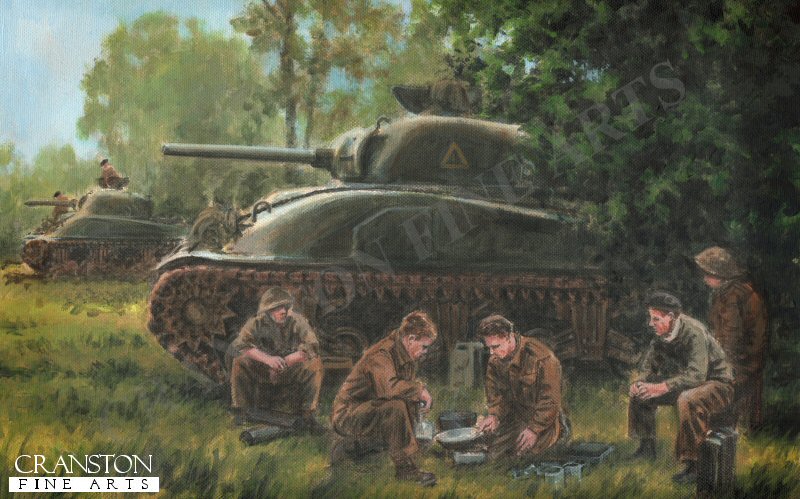
Teatime by David Pentland. Colomby-Sur-Thaon, Normandy, 11th June 1944. British Sherman MkII's of 4th Armoured Brigade, enjoy a tea break prior to being sent to support Canadian troops against an expected German attack. The Brigade consisted of the 2nd Dragoon Guards The Scots Greys, 3rd County of London Yeomanry The Sharpshooters, and the 44th Royal Tank Regiment. |
|
Contact Details |
Sign Up To Our Newsletter!
This website is owned by Cranston Fine Arts. Torwood House, Torwoodhill Road, Rhu, Helensburgh, Scotland, G848LE Contact: Tel: (+44) (0) 1436 820269. Email: cranstonorders -at- outlook.com
|