|
|
|
|
|
|
|
|
|
Cranston Fine Arts  Military Art and Artists Medieval History  Medieval Postcards |
[UP] - Vikings - Battle of Hastings - Richard the Lionheart - Battle of Bouvines - William Wallace - Robert the Bruce - The Black Prince - Battle of Crecy - Battle of Poitiers - Owain Glyndwr - Battle of Agincourt - Joan of Arc - War of the Roses - Battle of Flodden - The Tudors - Mary, Queen of Scots - Samurai - Legend of King Arthur - Medieval Postcards - Medieval History Print List |
| Navigation | |
| Page 2 of 6 | Previous .. Page 2 .. Next |
|
|
|
|
|
|
|
|
|
|
|
|
|
|
|
|
|
|
|
|
|
| Navigation | |
| Page 2 of 6 | Previous .. Page 2 .. Next |
| Text for the above items : |
King Edward II's Retreat from Bannockburn by Jason Askew. (PC) Knowing that the battle of Bannockburn was lost, the Earl of Pembroke and Sir Giles d'Argentan led King Edward the 2nd from the field in much haste. King Edward and his bodyguard had to fight their way through the Scots, who barred their escape. King Edward had one horse killed under him, and only the heroic resistance of the earl of Pembroke's bodyguard prevented the Scots from capturing the English King. |
Unholy Land by Ivan Berryman. (PC) The Knights Templar, clad in distinctive white mantles adorned with red crosses. These skilled warriors protected Christian pilgrims across the Holy Land and were one of the most powerful military assets during the crusades. |
The Roman IX Legion by Chris Collingwood. (PC) Note that the title of this image has changed since the postcard edition was printed - it has the title Roman Legion. |
(Detail from) The Battle of Bannockburn by Mark Churms (PC) With the full might of Englands Army now gathered to do battle before the besieged Stirling Castle, the young Edward II Plantagenate is confident of victory over the enemy. To the west of the Bannockburn, Robert Bruce, King of Scots kneels to pray with his men and commends his soul to God. The Scottish battle lines are prepared. The Cavalry is in reserve to the rear behind the spearmen and archers (known as Flower of the forest) in tightly packed Schiltrons patiently awaiting the coming onslaught. Unknown to the English, the open marshy ground of no mans land conceals hidden pits and trenches, major obstacles for any mounted charge. Despite Cliffords and de Beaumonts premature and unsuccessful attempt to relieve the castle the day before, years of victory have taught the brave English knights to regard their Scottish foes with contempt. So, without waiting for the bowmen to effectively weaken the enemy lines the order is hurriedly given to attack! With one rush hundreds of mounted knights led by the impetuous Earl of Gloucester thunder headlong through the boggy ground straight for the impenetrable forest of spears and into defeat and death. With dash and courage the knights try to force a way through the mass of spears but the Scots stand firm. The momentum of the charge is lost and there is no room to manoeuvre. Everywhere horses and men crash to the ground, casualties amongst the English are horrific. Robert Bruce seizes the moment and orders the exultant army to advance. The Englishmen are slowly pushed back into the waters of the Bannockburn. All discipline is lost as the soldiers and horses madly scramble for the far bank of the burn. Many drown or perish in the crush to escape the deadly melee. Edward II, with his army destroyed, flees with his bodyguard for the safety of Stirling Castle but is refused refuge and has to fight his way south to England. For Robert Bruce and Scotland victory is complete. Text by Paul Scarron-Jones. |
SPQR (For the People of Rome) by Chris Collingwood. (PC) Depicting Legio II Augusta, 1st Century AD, (showing a Legionary, Centurian and a Conucen Trumpeter) |
The Battle of Thermopylae by Brian Palmer. (PC) Depicting the last stand of the 300 Spartans who fought to the death against an overwhelming Persian Army. |
The Battle of Loudon Hill 1296 by Mike Shaw. (PC) In 1296 an English convoy escorting a shipment of looted gold was passing through the Irvine valley to the port of Ayr. It was led by an English Knight by the name of Fenwick, who in 1291 had killed the father of William Wallace, Sir Malcolm. Wallace, who was fighting a guerilla war on the English invaders, planned an attack at Loudon Hill where the road on which Fenwicks convoy was travelling had to pass through a steep gorge. Wallace had about fifty men and Fenwick close to one hundred and eighty. The Scots blocked the road with debris and attacked on foot. The English charged, but the Scots held firm. Fenwick armed with a spear, turned his horse in the direction of Wallace, who in turn felled Fenwicks horse with his claymore. The unhorsed Englishman was no match on the ground where he, along with one hundred of his convoy, met their deaths. |
Thermopylae 480BC, Spartan and Thespaian Hoplites. By Chris Collingwood. (PC) So Tell The Spartans, Stranger passing by that here, Obedient to their laws, we lie. In 480 BC the Spartans tried to defend the pass at Thermopylae against the Persians led by Xerxes. The Persian fleet had sailed along the coastline from northern Greece into the Gulf of Malia on the eastern Aegean Sea towards the mountains at Thermopylae. The Greek General and King Leonidas led the Greeks and tried to defend the pass of Thermopylae. All the defending Spartans were killed during the Battle of Thermopylae. Their defence and courage provided inspiration to the Greeks, and the following year the Greeks won battles against their old enemy the Persians. |
Pollice Verso (Thumbs Down) by Jean Leon Jerome (PC) A classic image depicting a victorious gladiator, about to dispatch his opponent, as an excited crowd give him the thumbs down! |
The Last Knight by Ivan Berryman. (PC) No text for this item |
Marcellus' Duel With Virdumarus by J.H Valda (PC) In 222 B.C. a notable encounter, famous ever after in song, drama and story, took place between the Romans and Gauls at Clastidium near Pavia. In the course of the battle the consul Marcellus singled out the Gallic leader Virdumarus, and slew him with his own hand, thus gaining what was called the spolia opima a guerdon that fell only to two other generals in the whole history of Rome. Historical book plate published in 1914. |
Julius Caesar by Ivan Berryman. (PC) Julius Caesar was a Roman general renowned for his military prowess. He achieved notable victories in the Gallic Wars (58-50 BC), expanding Roman territory to include present-day France and Belgium. Caesars conquest of Gaul culminated in the decisive Battle of Alesia. His subsequent Civil War against Pompey (49-45 BC) saw him triumph in battles like Pharsalus and Munda, ultimately leading to his dictatorship over Rome. His military successes laid the groundwork for the transition from the Roman Republic to the Roman Empire. |
The Roman War Machine by Chris Collingwood. (PC) A Centurion orders the formation of a shield wall. Note that the title of this image has changed since we printed the postcard version - it has the title Roman Wall. |
Robert the Bruce by Chris Collingwood. (PC) In 1306 Robert the Bruce was crowned King of the Scots. In 1309 Bruce controlled most of Scotland north of the Firth and Clyde. Over the next few years Bruce conquered the English Garrisons of Perth, Dundee, Roxburgh, Dumfries and St. Andrews, leaving only Stirling in English hands. On 24th June 1314 Robert the Bruce defeated the English army at Bannockburn. The war dragged on until the peace treaty was signed in 1328, recognising Robert the Bruce as King Robert I of Scotland, and Scotland an independent Kingdom. He died the following year. |
No Place to Hide by Ivan Berryman. (PC) Spartan helmets were forged from bronze, enclosing the head in a seamless curve of metal that left only narrow slits for eyes and a thin gap for breath. The crest often made of horsehair-ran from brow to nape, a tall plume that added height and presence on the battlefield. |
Frithiof's Courtship by August Malmstrom. (PC) Frithiof's Saga tells the story of Frithiof, a heroic Viking who embarks on a journey filled with adventure, love, and betrayal. Written in 14th century Iceland, but taking place in Norway during the 8th century, the saga narrates bow Frithiof falls in love with the beautiful Princess Ingeborg, but their romance is thwarted by her father, King Ring, who demands that Frithiof prove his worth by completing a series of heroic deeds. |
Sun in Splendour by Chris Collingwood. (PC) Soldiers of the Yorkist cause c.1461. Crossbowman, Man at arms and knight with the standard of the Sun in Splendour. |
Battle of Bosworth by Brian Palmer. (PC) In 1485, the Lancastrian contender for the throne of England, Henry Tudor, sailed from France with a small force of mainly continental mercenaries determined to wrestle the crown from Richard III. Gathering many supporters along the way he eventually arrived at Bosworth with an army numbering 5000 against Richards 8000. Things began well enough for Richard but it became apparent during the battle that the neutral Stanley Brothers, Sir William Stanley and Lord Thomas Stanley and their men who had remained on the sidelines, had elected to fight for Henry. Richard charged for Henry in person but was overwhelmed and killed. He was the last English King to die in battle. Although not the final battle of the War of the Roses, the victory for Henry at Bosworth secured the crown and began the Tudor dynasty. |
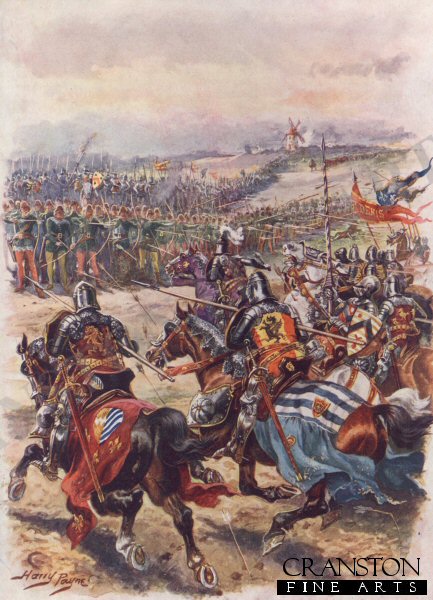
Charge of the French Cavalry, Battle of Crecy by Harry Payne. (PC) Battle of Crecy. One of the battles fought during the Hundred Years War, on 26th August 1346. On 12th July Edward III landed in Normandy with his army and marching north plundered the countryside. King Philip VI assembled an army to stop Edward and tracked them across the Somme River. When Edward reached Crecy he stopped and ordered his army to take up defensive positions. King Philip surveyed the English positions and decided to postpone his attack until August 27th. However, the French vanguard pressed forward too far and so committed the entire army to the battle. The hired Genoese crossbowmen began the assault but came under severe attack from the English longbows and so fled to the rear. King Philip then ordered his cavalry to charge resulting in a huge loss of horse and man under the barrage of arrows which rained down on them. By the end of the night after several unsuccessful assaults the French army was reduced by a third and King John of Luxemburg was dead. Edward then turned towards Calais. |
Gods Work by Ivan Berryman (PC) A key stratagem of the Knights Templar was the Squadron Charge in which a group of knights and their armoured warhorses would charge towards enemy lines at full speed. This displayed their ferocity and sheer determination and would often break a hole in enemy lines, allowing the tides of battle to change in favour of the Knights Templar forces. |
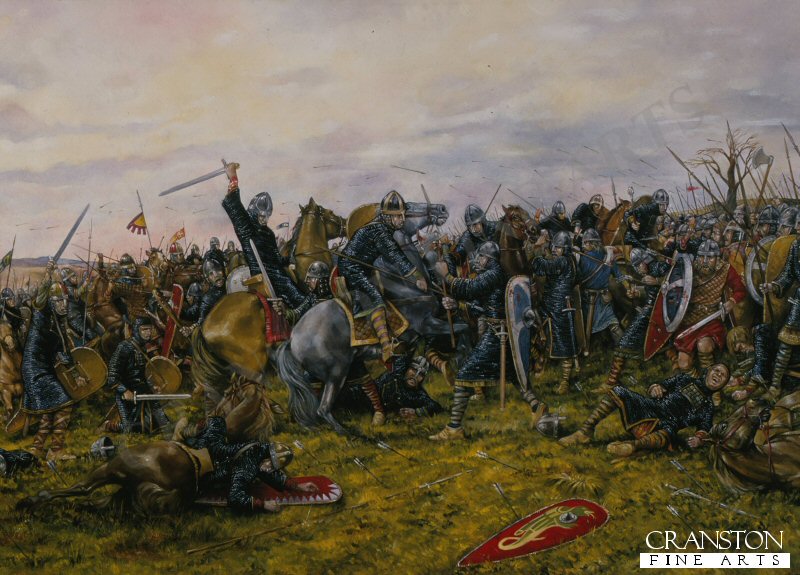
Battle of Hastings by Brian Palmer. (PC) The Battle of Hastings: While King Harold II was defeating the Norse invasion at the battle of Stamford Bridge in the north, the Norman invasion led by the Norman Duke William landed in the south. A Norman force of 7,000 warriors sailed across the English Channel in 450 flat boats and landed at Pevensey in Sussex on September 28th. The following two weeks saw the Norman army organising and raiding the local area for supplies. On hearing of the invasion, King Harold marched south from York to London, a distance of 200 miles, in seven days. And on October 13th with his army of 7,000 men took up position on Senlac Hill, 8 miles north of Hastings. Harold took this position as this was the direct route for London. The following day, the Normans attacked the village (which is now the town of Battle). The Battle of Hastings was a battle between King Harolds infantry and the Norman cavalry and archers. The Saxon line threw back the first charge of Norman knights and as the knights began retiring, the Saxons began to pursue the cavalry but a counter attack by Williams disciplined knights cut down the Saxon infantry. King Harold reformed his line before the second Norman cavalry attack was launched. For many hours King Harolds Saxon infantry held their ground against the repeated cavalry charges, both sides suffered heavy losses. As the evening progressed the battle turned the Normans way, William feigned a withdrawal of his cavalry, the Saxon infantry again could not resist to break ranks and pursue the cavalry. Halfway down the hill Williams knights turned and charged the Saxon infantry. King Harold at this time was mortally wounded from an arrow in the eye and the victory was won by the Normans. Each side lost a quarter of their men and during the fighting William the Conqueror had three horses killed under him. Later he ordered the building of Battle Abbey on the battlefield. The way was clear to London and William the Conqueror was crowned King of England on Christmas day at Westminster Abbey. |
|
Contact Details |
Sign Up To Our Newsletter!
This website is owned by Cranston Fine Arts. Torwood House, Torwoodhill Road, Rhu, Helensburgh, Scotland, G848LE Contact: Tel: (+44) (0) 1436 820269. Email: cranstonorders -at- outlook.com
|