|
|
|
|
|
|
|
|
|
Cranston Fine Arts  Military Art and Artists 19th Century Military History Military Art and Artists 19th Century Military History  American Civil War American Civil War |
[UP] - Crimean War - Wars in India - Austro-Prussian War - Franco-Prussian War - Second Afghan War - Zulu War - American Civil War - Anglo-Persian War - Wars in Africa - Boer War - 19th Century Regiments |
| More Pages : Confederate Regiments - Union Regiments - General Grant - General Lee - Battle of Gettysburg - Battle of Kennesaw Mountain - Battle of Antietam - Postcards |
| Navigation | |
| Page 4 of 5 | Previous .. Page 4 .. Next |
|
|
|
|
|
|
|
|
|
|
|
|
|
|
|
|
|
|
|
|
|
| Navigation | |
| Page 4 of 5 | Previous .. Page 4 .. Next |
| Text for the above items : |
The Patriots of 61 by Keith Rocco. For many Americans, the early months leading up to, and during, the first year of the Civil War, were months spent in a flurry of patriotic activities. Few have expressed these times better than H.E. Sterkx, In the beginning patriotism became the prevailing emotion of the day and it affected old and young alike with the determination to do something, almost anything to help. Some designed flags for the republic, others made banners and delivered presentation speeches for local military units, and there were still many more who dedicated themselves to the tremendous task of encouraging men to enlist in the armed forces. It was a time like no other-- because it offered a rare opportunity for females to participate in public affairs. The roles which women played in supporting the war -north and south- through their domestic talents were noted, and honored, and praised at the time. Today, however, they are often overlooked. For the vast majority of women, contributions to the war effort required traditional, domestic skills--sewing flags, or uniforms, knitting socks, and providing foodstuffs, extra blankets and a myriad of items from home. Many soldiers noted that it was these goods--along with letters of encouragement--that allowed them to continue on when the realities of war overwhelmed them. The Patriots of 61 were the War Workers of 1862-65, ministering to the physical, medical, psychological, and spiritual needs of soldiers. |
The Battle of Cedar Creek - October 19th 1864 by Louis Kurz Confederate General Jubal Early launched a surprise attack on Union forces commanded by General Philip Sheridan, initially achieving significant gains and pushing the Union troops back. However, Sheridan, who was away from the battlefield at the start of the battle quickly rallied his forces and led a counterattack that turned the tide, securing a crucial victory in the Shenandoah Valley. |
Sheridans Final Charge At Winchester - September 19th, 1864 by Henry Alexander Ogden The Battle of Winchester, fought on September 19, 1864, was part of the Valley Campaigns of the American Civil War, where Union General Philip Sheridan faced Confederate General Jubal Early. Sheridans forces initially struggled but turned the tide with a decisive cavalry charge led by his cavalry commander General Wesley Merritt, which broke the Confederate lines. |
Battle on the Potomac (Battle of Antietam) No text for this item |
Grant and His Generals by Ole Peter Hansen Balling (PC) Left to right: Thomas C. Devin, George A. Custer, Hugh J. Kilpatrick William H. Emory, Philip H. Sheridan, James B. McPherson, George Crook Wesley Merrill, George H. Thomas, Gouverneur Kemble Warren, George G. Meade, John G. Parke, William T. Sherman, John A. Logan Ulysses S. Grant, Ambrose E. Burnside, Joseph Hooker Winfield Scot Hancock, John A. Rawlins, Edward O. C. Ord Francis Preston Blair Jr. Alfred H. Terry, Henry W. Slocum Jefferson C. Davis, Oliver O. Howard, John M. Schofield, Joseph A. Mower. |
The Battle of Wilson's Creek - August 10th 1861 by Louis Kurz The Battle of Wilson's Creek occurred near Springfield, Missouri. General Nathaniel Lyon, commanding Union forces, faced a larger Confederate army led by Generals Benjamin McCulloch and Sterling Price. Despite Lyon's aggressive tactics and initial successes his forces were ultimately overwhelmed by the Confederate numbers and coordination. Lyon was killed in action, and the Union retreated. |
Lions of the Hour by Keith Rocco. The VMI Cadets at the battle of New Market, May 15th, 1864. Throughout that Sunday, May 15th, 1864, the Federal and Confederate armies fought over possession of Jacob Bushong's orchard and wheat field near the town of New Market, Virginia.Suffering the combined effect of the Union muskets and artillery's canister rounds, the center of the rebel line, companies from 51st, 30th and 62nd Virginia regiments evaporated. Confederate General Breckinridge quickly realized his options: repair the gap in his line or fall back. With the VMI cadets as his only available reserve, he hesitated. 'Put the boys in,' he commanded at last, 'And may God forgive me for the order.'The cadets moved forward in characteristic parade ground precision, suffering their first casualties as they descended the slope leading towards Bushong's Farm. The fire intensified around the outbuildings and the mud pulled at their boots. Struggling forward through the churned up barnyard, they crossed the white farm fences, reaching the rail fence on the north edge of the orchard. Letting loose a volley, the fresh, excited cadets filled the gap in the faltering Confederate line.Once again the Confederate forces moved forward. Sigel attempted to organize a counterattack but unsupported, this force collapsed and retreated to the north followed closely by the deterioration of the entire Union line. The Confederates now rushed into the wheat field and through the position just moments before defended by Union cannoniers.The cadets briefly engaged the few remaining Federals of Von Klieser's Battery still attempting to defend their cannon. Six foot two inch Oliver Evans jumped up on the captured cannon, madly waving the VMI flag as the cadets cheered wildly.'Well done, Virginians,' was Breckinridge's praise, delivered on the battlefield evermore associated with the cadets of VMI. |
Bringing Up the Guns by Gilbert Gaul. No text for this item |
Bloodied But Unbeaten (The Battle for the Dunkard Church During the Battle of Sharpsburg, September by Chris Collingwood. Described as the Deathknell of the Confederacy - Sharpsburg (Antietam to the North) was a savage bloodletting for both sides. It was said to be the bloodiest day of the American Civil War. In the painting, below the Dunkard church confederate General John Bell Hoods Texas Division - or what was left of it- stand in line of battle. In the distance Union Major General John Sedgwicks division can be seen advancing on the rebel lines. During the ghastly four hour struggle the Confederates managed to hold and then repel the bloodied remnants of Sedgwicks division back to the east woods and at about 10.30am, the carnage around the Dunkard church had ended. Eventually though, the Confederate forces were in retreat, loosing Sharpsburg to the Union but prepared to fight on for two and a half more years, bloodied but unbeaten. |
2nd Virginia Cavalry 1861, by Jim Lancia. No text for this item |
2nd US Cavalry 1862 by Jim Lancia. Formed in 1836 as the Second Dragoons, the regiment served in Florida during the Seminole wars until 1842, then on the Louisiana and Arkansas frontier, in the war with Mexico from 1846 through 1848, on the frontier again from Kansas to New Mexico, in the Mormon Campaign of 1858, and then eastward in 1861 for the American Civil War, which is our period of interest. During the conflict the regiment (renamed Second Cavalry 3 August 1861) served at: First Bull Run (Manassas VA) July 21, 1861 (Company K) Wilson's Creek MO August 10, 1861 (Company C). Defenses of Washington DC Fall-Winter 1861-1862. Val Verde NM February 21, 1862 (Company G). Shiloh TN April 6,7, 1862 (Company C). Peninsula Campaign VA June - August 1862. Antietam Campaign MD September 1862. Fredericksburg VA December 13, 1862. Chancellorsville VA Campaign (Stoneman's Raid) May 1863. Gettysburg PA Campaign (numerous battles) June - August 1863. Wilderness to Petersburg Campaign (numerous battles) May - July 1864. Shenandoah Valley VA Campaign (numerous battles) August - November 1864. Patrol of the lower Shenandoah and central Potomac valleys December 1864 - April 1865. |
Sheridan's Ride. No text for this item |
The Battle of Stones River - December 31st 1862 by Louis Kurz The Battle of Stones River, was marked by its intense combat and high number of casualties on both sides. Union General William S. Rosecrans's forces faced off against Confederate General Braxton Bragg's army near Murfreesboro, Tennessee. Despite heavy casualties and a challenging winter environment, the Union forces ultimately secured a strategic victory. |
1st Texas Infantry by Jim Lancia. No text for this item |
First Day at Gettysburg by James Alexander Walker. No text for this item |
Kearsarge Sinking The Alabama - June 19th, 1864 by Henry Alexander Ogden The USS Kearsarge sank the CSS Alabama on June 19, 1864, off the coast of Cherbourg, France, during a fierce naval battle in which the Kearsarge's superior firepower proved decisive. This victory marked a significant blow to the Confederate naval campaign and helped diminish the effectiveness of Confederate commerce raiders. |
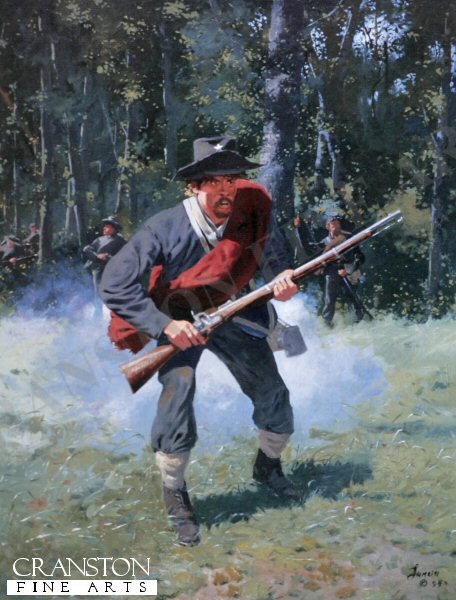
Berdans Sharpshooters 1864 by Jim Lancia. No text for this item |
The Iron Brigade, 2nd Wisconsin Volunteer Infantry Regiment, Brawner's Farm, August 1862 by Chris Collingwood. The Iron Brigade initially consisted of the 2nd, 6th, and 7th Wisconsin Volunteer Infantry Regiments, the 19th Indiana, Battery B of the 4th U.S. Light Artillery, and was later joined by the 24th Michigan. This particular composition of men, from the three Western states, led it to be sometimes referred to as the 'Iron Brigade of the West'. They were known, throughout the war, as the 'Black Hats', because of the black, 1858 model Hardee hats issued to Army regulars, rather than the blue kepis worn by most other Union Army units. Battle of Second Manassas, Brawner's Farm, August 28, 1862. In order to draw Pope's army into battle, Jackson ordered an attack on a Federal column that was passing across his front on the Warrenton Turnpike on August 28. In a fierce firefight in which the opposing lines were scarcely 100 yards apart, Jackson's men locked horns with the Midwesterners of Brig. Gen. John Gibbon's Black Hat Brigade, known thereafter as the Iron Brigade. The fight at the Brawner Farm lasted several hours and resulted in a stalemate. Convinced that he had trapped Jackson. Pope concentrated the bulk of his army against him. On August 29th, Pope launched a series of assaults against Jackson's position along an unfinished railroad grade. The attacks were repulsed with heavy casualties on both sides. At noon, Longstreet arrived on the field from Thoroughfare Gap and took position on Jackson's right flank. On August 30th, Pope renewed his attacks, seemingly unaware that Longstreet was on the field. When massed Confederate artillery devastated a Union assault by Fitz John Porter's command, Longstreet's wing of 28,000 men counterattacked in the largest, simultaneous mass assault of the war. The Union left flank was crushed and the army driven back to Bull Run. Only an effective Union rearguard action prevented a replay of the First Manassas disaster. Pope's retreat to Centreville was precipitous, nonetheless. The next day, Lee ordered his army in pursuit. This was the decisive battle of the Northern Virginia Campaign. |
Grant and His Generals by Balling. No text for this item |
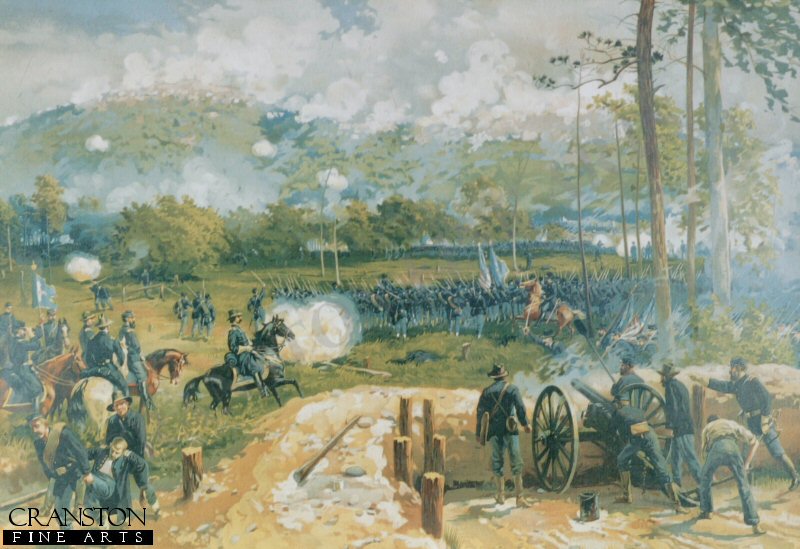
The Battle of Kennesaw Mountain. No text for this item |
53rd New York Volunteers Officer (DEpineuil Zouaves) 1861 by Richard Knotel Copyright Anne S K Brown Collection. |
|
Contact Details |
Sign Up To Our Newsletter!
This website is owned by Cranston Fine Arts. Torwood House, Torwoodhill Road, Rhu, Helensburgh, Scotland, G848LE Contact: Tel: (+44) (0) 1436 820269. Email: cranstonorders -at- outlook.com
|