|
|
|
|
|
|
|
|
|
Cranston Fine Arts  Aviation Art and Artists World War Two Aircraft More Aircraft Initials T to Z Aviation Art and Artists World War Two Aircraft More Aircraft Initials T to Z  Tempest Tempest |
[UP] - Ta152 - Tempest - Tigercat - Tomahawk - Twin Mustang - Typhoon - Val - Vega - Veltro - Ventura - Vindicator - Waco - Warhawk - Wellington - Whirlwind - Whitley - Wildcat - Yak-3 - Zero |
| Tempest Aviation Prints |
|
|
|
|
|
|
|
|
|
|
|
|
|
|
| Text for the above items : |
Bug Killer by Ivan Berryman. Equipped with the experimental Monica IIIE detection device, Hawker Tempest EJ535 was deployed to the Fighter Interception Unit at Newchurch for evaluation in July 1944. Originally developed as the AN/APS 13, Monica had been intended as a rear-looking device to warn crews of attacks from behind. Now modified to face forward, it became a valuable aid in the battle against Hitler's terror weapons, notably the V-1 Flying Bomb. In the hands of the Fighter Interception Unit's then Commanding Officer Joseph Berry, this became a winning combination with no fewer than 52 Doodlebugs falling to Berry's guns - on one occasion, seven V1s being shot down by Berry in a single night. |
Raging Tempest by Ivan Berryman. Developed from the hawker Typhoon, the first hawker Tempest MkV took to the air during September 1942 and immediately showed great promise as a most versatile aircraft. During the build up to Overlord in 1944, Tempests raged across northern France softening up the enemy defences and blocking or destroying arterial supply routes. This Hawker Tempest V is engaged in knocking out a German train as part of Roland Beamont's No.3 Squadron operations prior to D - Day. |
Tempest Moon by Ivan Berryman. Three 501 Sqn Hawker Tempests roar low across the North Sea outbound from Bradwell Bay, Essex, on their way to attack a German airfield at Bad Zwischehhan and nearby rail yards on the night of 2nd October 1944. The trio comprised of Sqn Ldr Joseph Berry, flying EJ600 (SD-F), Flt Lt E L 'Willy' Williams (SD-L) and Flt Lt C A 'Horry' Hansen. Berry was to lose his life on this mission, his aircraft being hit by ground fire from soldiers manning a radar station east of Veendam. |
Foob Fairbanks - The Terror of the Rhine by Ivan Berryman. Flying his last mission with his old mount, Hawker Tempest EJ762, fresh from repair after being damaged by flak, David Fairbanks found himself embroiled in a fierce battle with Messerschmitt Bf109s on 17th December 1944. In the course of the combat, Fairbanks shot down two of the enemy aircraft and damaged another before returning safely. |
Hawker Tempest Mk V JN751 R-B. by M A Kinnear. Aircraft History: JN751 was built at Hawkers Langley factory and delivered to No. 20 MU at Aston Down 20th February 1944. Delivered to No.486 (NZ) Squadron initially, and subsequently received by No.3 Squadron, it became the personal aircraft of Wing Commander R P Beamont. On 8th June 1944, it became the first Tempest to shoot down and enemy aircraft (Bf109G-6, JN751 was hit in the starboard wing by a cannon shell in this combat) and during June/August it shot down over 30 V-1 flying bombs. On 1st September, following an engine failure on take-off, JN751 made a forced landing at Langley. Repaired 2nd September, Wing Commander Beamont collected the aircraft from Langley on 5th September and returned to Newchurch - this was his last flight in JN751. Returned to No.20 MU on 3rd October 1944, it was delivered to No.287 Squadron at Hornchurch on anti aircraft co-operation duties. On 18th May 1945, whilst trying to avoid a fog bank JN751 crashed on the Isle of Sheppey, killing the pilot, Flight Sergeant P.C.A. Redstone. Wing Commander Roland P Beamont, CBE, DSO and bar, DFC and bar, DFC (USA), DL: Born on 10th August 1920, Roland Beamont joined No87. Squadron in France during November 1939. Returning to England 20th May 1940 (having destroyed a Do17 and an Me109) he went on to destroy a further three enemy aircraft during the Battle of Britain. In June 1941 he was posted to No79 Squadron as a Flight Commander. In December 1941, he went to Hawker Aircraft Limited as a Service test pilot flying Hurricanes. On 29th June 1942, he was posted as Flight Commander to Hawker Typhoon equipped No.609 (WR) squadron at Duxford, and took command of the squadron in October. He returned to Hawker Aircraft during May 1943, to test fly the Tempest. In February 1944, he was tasked with forming the first Tempest Wing, No.150 at Castle Camps and later Newchurch. When leader of the five squadron Tempest Wing No.122 over Germany on 12th October 1944, Roland Beamont was shot down by ground fire, and became a POW. During his time with Nos 150 and 122 Wings he destroyed one Bf109, one Fw190, one Ju88 on the ground and thirty two V1 flying bombs. After the war Roland Beamont became Chief Test Pilot for English Electric, test flying the Canberra, P1, Lightning and TSR2 aircraft. He was the first British pilot to fly a British aircraft at Mach 1 in level flight, and later at Mach 2. After serving as Director of Flight operations for the Tornado test programme he retired and became a respected author. |
Tribute to Flt Lt Pierre Clostermann by Ivan Berryman. One of the most notable pilots of 3 Squadron was the Frenchman Pierre Clostermann who enjoyed much success flying Spitfires with the Free French 341 Alsace Squadron before moving to 602 and 274 Squadrons RAF. Once on the strength of 3 Squadron, however, he quickly got to grips with the mighty Hawker Tempest V in which he downed two Focke-Wulf Fw.190D-9s on 20th April 1945, just two of the confirmed 12 aircraft destroyed whilst flying the Tempest, plus 6 shared and two probables. He is shown here flying Tempest V NV724, bearing the legend Le Grand Charles and the Squadron badge on the tailfin. |
Lull Before the Storm by Keith Aspinall. The Tempest of Wing Commander Roland Beamont DSO and Bar DFC and Bar, June 1944. |
The Dash for Home by Ivan Berryman. (PC) Drop tanks gone and light on fuel, two Hawker Tempest Vs of 3 Sqn based at RAF Coltishall and its satellite base of RAF Matlask, race at low level across the mist-filled fields of southern England on their way home. Nearest aircraft is JN817 (JF-H) with JN765 (JF-K) slightly ahead. |
Tribute to Sqn Ldr David Fairbanks by Ivan Berryman. Whilst flying with other Hawker Tempests of 274 Sqn on 11th February 1945, Sqn Ldr David Fairbanks spotted a lone Arado Ar234 of the Kommando Sperling 1 (F) / 123 flown by Hauptmann Hans Felde returning to its base at Rheine. A desperate chase commenced through the cloudbase until the German jet prepared to land, whereupon Fairbanks sent 4U+DH down in flames after a single short burst of his four 20mm cannon. |
Overturning the Odds by Keith Woodcock With all his ammunition spent on other interceptions, Wing Commander Beamont in his Hawker Tempest MKV tips a German flying VI bomb to its destruction with his wingtip during the summer of 1944. |
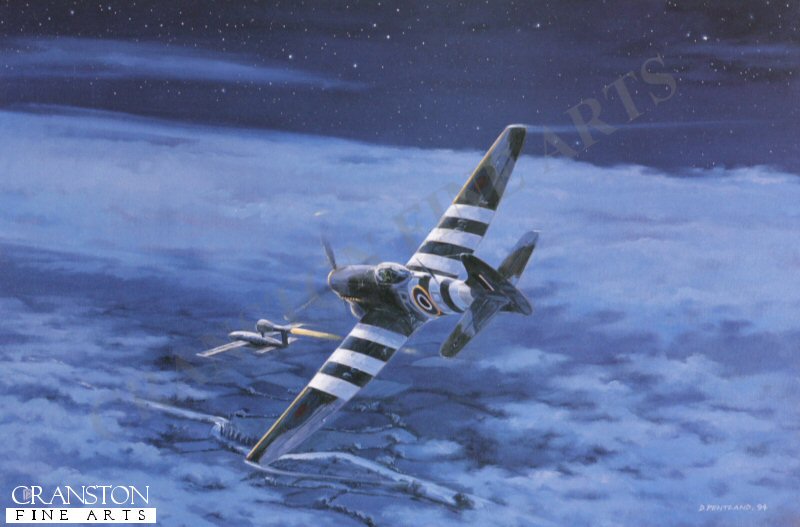
A Buzz for Beamont by David Pentland. Wing Commander Roland Beamont in his personal Tempest V, intercepted and downed his first V1 Buzzbomb on the night of June 22nd, 1944, over south east England. As Commander of 150 wing and others he went on to shoot down a total of 30 V1 flying bombs, 8 enemy aircraft and 35 locomotives destroyed plus one minesweeper sunk. |
The Final Show by Robert Taylor. In May 1944 Wing Commander Roland 'Bee' Beamont led three squadrons of Hawker Tempests into operations for the first time. Flying from RAF Newchurch in Kent, one of the advanced landing grounds constructed in preparation for the invasion of France, they formed 150 Wing RAF. The far-sighted Beamont had almost single-handedly overseen the transformation of the Hawker Typhoon into the most potent ground attack aircraft of its day before turning his attention to its successor - the Tempest. With thinner wings, greater range, improved ailerons, a redesigned windscreen and all-round 'rear vision' canopy it was a significant improvement on the Typhoon. Through the last year of the war the unwavering pilots who flew these two mighty aircraft became the scourge of the German Army, blasting their way through armoured formations, destroying airfields, shipping, barges, bridges, trains, marshalling yards, rail hubs, anything to support the advancing British and Canadian armies as they battled their way through Belgium and the Netherlands towards the Rhine. And, as an increasingly desperate enemy fought back with V-1 'Doodlebug' flying bombs, the Typhoon and Tempest pilots destroyed those too - 150 Wing alone accounting for 638 V-1s destroyed. As the remnants of Hitler's once-fabled army collapsed under the onslaught, many high-ranking Nazis were faced with a choice - go down fighting or cut and run. Many chose to run, heading north to the Baltic coast with one aim in mind - a last-chance passage to neutral Sweden. The Tempest pilots of 150 Wing were amongst those tasked with stopping their escape. Some of the greatest pilots of the RAF flew this iconic aircraft and this painting depicts the final combat of the war for one such pilot - the legendary fighter Ace Pierre Clostermann. A Flight Commander with 3 Squadron, Clostermann is at the controls of his distinctive Tempest Le Grand Charles during a strafing raid against the heavily defended seaplane base at Grossenbrode, on the coast to the north of Lübeck. Having just destroyed two Dornier Do18 flying boats on the water, he now helps finish off a Bf109 and a Fw190 that have tried to pounce from above. |
The Exterminator by Stan Stokes. By mid-1941 it was clear that Hitlers plans to invade Britain were in disarray. The RAF had fought the Luftwaffe to a standoff, and many of Germanys top pilots had been killed or captured. Not willing to admit defeat in his campaign against Britain, Hitler approved the development of a pilotless terror weapon, the VF-1 Vergeltungswaffe (retaliation weapon). Designed by the Feiseler Company, the small pilotless Fi-103 was at times referred to in Britain as the doodlebug, buzz bomb, or farting fury. These flying bombs were inexpensive to build and were capable of carrying an 1870-pound warhead. The Fi-103 was powered by a ram-jet engine, and utilized three air driven gyroscopes to orient the aircraft. A rudimentary pre-set propeller device was utilized to determine when the VF-1 would land. Lacking the accuracy necessary to make it an effective weapon against military targets these doodlebugs were primarily targeted at large population centers. Therefore, they were primarily used as civilian terror weapons, and the RAF was given the assignment of providing the defense against these terror weapons. Early testing revealed many problems with the VF-1, and it was not until March 1944 that most of these problems had been worked out. The final VF-1 production models were capable of speeds in excess of 400 MPH . The high speed of the VF-1, coupled with its small size and large warhead, made it difficult for the RAF to shoot down these doodlebugs. The doodlebug had strong sheet steel skin which deflected machine gunfire, making it necessary to utilize cannon fire. Cannons had more than twice the range of machine guns, but the attacking fighters had to get in close to hit these small, fast targets. If the pilot got in too close the explosion of the VF-1s heavy warhead often disabled the attacking fighter. An alternative was to deflect the doodlebug by maneuvering alongside it, and then by executing a gentle banking maneuver, flip the VF-1, and disrupt its gyros. Generally, this caused the doodlebug to crash in an unpopulated area with little damage. Less than 10% of the buzz bombs were destroyed in this manner, and this technique was only utilized when the pilot had depleted his ammunition. One of the top buzz-bomb exterminators was Wing Commander Roland Beamont who destroyed 32 doodlebugs during his tour of duty. He flew the Tempest V with 150 Wing, which he commanded. The three squadrons of 150 Wing were credited with destroying 630 buzz bombs between June and August of 1944. The Hawker Tempest was the fastest interceptor available, and provided its pilots a highly stable platform for its four 20mm cannon. The Meteor, the RAFs first jet, was utilized briefly as a buzz bomb interceptor, but with only nine kills, it was withdrawn as being unsuitable for this purpose. As depicted in Stan Stokes painting appropriately entitled The Exterminator, Wing Commander Beamont is depicted flying his Tempest V through the debris created by a successful hit on a buzz bomb in July, 1944. The action takes place southeast of London over the tranquil English countryside. |
Typhoon and Tempest Aces of World War Two. Hawker Typhoon and Tempest - two aircraft types with widely differing reputations. The former was a technical nightmare redeemed as a ground attack machine, whilst the latter proved to be the most superlative low and medium level fighter to see service with the RAF, and arguably any air force, during the latter stages of World War 2. With 246 enemy aircraft destroyed by the Typhoon and 239 by the Tempest, over 40 aces flew one or both types in combat, and men like Foob Fairbanks and Johnny Baldwin attained double-figure scores with the Hawker fighters. |
| Top Aces for : Tempest | ||
| A list of all Aces from our database who are known to have flown this aircraft. A profile page is available by clicking the pilots name. | ||
| Name | Victories | Info |
| Pierre H Closterman | 26.00 | The signature of Pierre H Closterman features on some of our artwork - click here to see what is available. |
| James Francis Edwards | 16.50 | The signature of James Francis Edwards features on some of our artwork - click here to see what is available. |
| David C Fairbanks | 12.50 | |
| James Douglas Lindsay | 7.00 | The signature of James Douglas Lindsay features on some of our artwork - click here to see what is available. |
| Joseph Berry | 3.00 | |
| Tempest Pilot and aircrew signature details |
 Major Bill Allen Our estimated value of this signature : £25 | Major Bill Allen Commissioned in November 1943, Bill Allen was posted to England, joining the 55th Fighter Group based at Wormingford, on May 15th 1944. Posted into the 343rd Fighter Squadron the following day, Bill flew his first combat mission on 14th June 1944. He flew both P38 Lightnings and P51 Mustangs through his tour, becoming an Ace in one day on 5th September 1944, when he shot down 5 German aircraft whilst flying his P51 'Pretty Patty II'. |
Flying Officer (Acting Flt/Lt) Bill Anderson Our estimated value of this signature : £15 | Flying Officer (Acting Flt/Lt) Bill Anderson Flying Officer (Acting Flt/Lt) Bill Anderson flew with 16 Sqn from 1943 until the war was over. He trained in Georgia, USA, before becoming attached to 16 Sqn at Benson, flying missions over France and Germany. Bill flew many different types of aircraft beginning with a PT17 Stearman in the USA; others include Tiger Moths, Typhoons, Tempest, Harvards, Lysanders, Hurricanes and Oxfords. |
  Wing Commander Roland Bee Beamont CBE DSO DFC DL Our estimated value of this signature : £65 Died : 2001 | Wing Commander Roland Bee Beamont CBE DSO DFC DL One of World War IIs great characters, Bee flew Hurricanes with 87 Squadron, later leading a Tempest Wing. He had 8 victories plus a further 32 VIs destroyed. After the war he became a highly respected Chief Test Pilot.Wing Commander Roland Beamont, one of the RAFs top buzz bomb interceptors, was born in Enfield England on August 10, 1920. Educated at Eastborne College, Beamont accepted a short service commission with the Royal Air Force in 1938. He commenced flying in 1939 at the the No. 13 Reserve Flying School at White Waltham. His initial duty was with the Group Fighter Pool at St. Athan where he learned to fly the Hurricane. Beamont was soon posted with the No. 87 Squadron which was part of the Advanced Air Striking Force in France. Seeing action in both France and Belgium prior to the Allied withdrawl, Beamont rejoined 87 Squadron in England during the Battle of Britain. In the spring of 1941 Beamont was awarded the Distinguished Flying Cross after destroying five enemy aircraft. As Commanding Officer of 609 Squadron, Beamont pioneered both day and night ground attack missions utilizing the Typhoon. Beamont was credited with destroying 25 trains in a three month period. He was then made responsible for organizing and commanding the first Tempest Wing at Newchurch. Three days after D-Day Bearnont shot down an Me-109, marking the first aerial combat victory for the Hawker Tempest. In the summer of 1944 Beamont destroyed 32 buzz bombs prior to leading his wing to a Dutch Airfield at Volkel on the Continent. In October of 1944 Beamont was shot down during a ground attack mission over Germany, and he remained a prisoner of war until wars end. Following repatriation Beamont became an experimental test pilot with the Gloster Aircraft Company, which had developed the RAFs first jet aircraft. Turning down a permanent commission with the RAF, Beamont then joined English Electric Company in Wharton as the Chief Test Pilot for the B3/45 (Canberra) jet bomber program. He managed all prototype testing on the Canberra, and in the process set two Atlantic speed records. Later Beamont was involved with the supersonic P1/Lightning program, and became the first British pilot to fly at twice the speed of sound. From 1965 until 1970 he was a founding member of Britains highly succesful Saudi Arabian export program. For several years prior to his retirement in 1979, Beamont was Director of Operations for British Aerospace and Panavia where he was in charge of flight testing for the Tornado. Since his retirement Beamont has authored nine books, and published numerous magazine articles. He is a Fellow of the Royal Aeronautical Scociety and an Honorary Fellow of the Society of Experimental Test Pilots in America. He died 19th November 2001. A Clipped Signature is Available |
Flying Officer John Byrne Our estimated value of this signature : £40 | Flying Officer John Byrne With the RAF since 1938, Byrne flew Hurricanes, Spitfires, P-47s, Tempests and Typhoons during WWII. Upon joining 197 Sqn in March 1944 he flew Typhoons during one the squadrons most hectic periods in the run up to D-Day and throughout the subsequent Allied invasion, mostly on low-level bombing missions. In total Byrne completed over 150 combat operations and finally left the RAF in 1946. |
  Colonel Pierre Clostermann CDLL MM CdeG DFC* Our estimated value of this signature : £55 Died : 2006 | Colonel Pierre Clostermann CDLL MM CdeG DFC* One of the RAFs best known fighter pilots, with more than 20 victories, Clostermann was a Free French officer and later the author of a classic book about World War Two flying, The Big Show. Clostermann came to Britain via the United States and was first in action with 341 (Alsace) Squadron on Spitfires in 1943. By D-Day he was with 602 Squadron, also on Spitfires, and flew a patrol over the beaches late in the afternoon of June 6th. On June 14th he became the first French pilot to land in liberated France. Rested in July 1944, Clostermann returned to action in January 1945 and from 4th March was flying Tempests with 274 Squadron. His first Tempest score was a Bf 109 on his second day during a cannon test. In the middle of March 1945 he was posted as a Flight commander to No 56 Squadron. With this unit he destroyed a Bf109 in the air. On 8th April he was transferred to No 3 Squadron as A Flight commander where he on 20th April scored two Fw190D-9s. Clostermanns final score in Tempest is at least 12 destroyed, 6 shared and 2 probables. He was awarded the DSO and DFC and Bar in addition to French, Belgian and American decorations. Post war he achieved world-wide fame with The Big Show, and other books, and enjoyed a substantial career in politics and the aviation industry. Pierre Clostermann passed away on 22nd March 2006. |
  Flight Lieutenant Bill Green Our estimated value of this signature : £40 Died : 2014 | Flight Lieutenant Bill Green In December 1936, Bill Green joined the Auxiliary Air Force as an aero engine fitter with 501 Squadron at Filton, near Bristol. Shortly before the start of the Second World War, he was given a rare chance for an engine fitter. In 1938 he joined a scheme to recruit NCO pilots, qualifying as a Flight Sergeant and re-joined 501 at Bristol in July 1940. Sgt Bill Green had completed just 10 hours of dual flying - with an instructor. In October, he was sent for further flying instruction and on October 30th he had his first solo flight in a Magister aircraft. After more training - and getting married on June 3rd - he flew a Hurricane for the first time on August 8th 1940, when the Battle of Britain had been raging for a month. He flew from Kenley throughout the Battle of Britain until November, surviving being shot down twice, before being posted to 504 Squadron. After a spell instructing on Spitfires and Tomahawks, he converted to Typhoons, and from November 1944 served with 56 Squadron on Tempests. He flew more than 50 missions in Tempest fighter aircraft with 56 Squadron. He was shot down over Germany on February 22nd 1945 and spent the last three months of the war as a prisoner of war. After the war, Green enjoyed a hugely successful business career, ending up as the managing director and chairman of Crown Paints, before retiring on his 60th birthday. Flight Lieutenant Bill Green, who has died aged 97, was twice shot down flying a Hurricane during the Battle of Britain; five years later he was taken prisoner after again being shot down, this time over Germany. Green had less than 200 hours' flying time, and just seven hours in the Hurricane, when he joined No 501 Squadron and was pitched into the fighting at the height of the Battle of Britain in August 1940. On August 24, flying from Hawkinge in Kent, his squadron was scrambled to intercept a raid against the nearby airfield at Manston. Green closed in to attack an enemy dive-bomber when his aircraft was hit by the airfield's anti-aircraft fire. His Hurricane was badly damaged and the engine stopped - but he managed to glide to Hawkinge, where he discovered half the undercarriage had been shot away. He crash-landed and scrambled from the wrecked aircraft. Five days later his squadron was orbiting over Deal at 20,000ft when a large force of Messerschmitt Bf 109 fighters attacked the formation. The windscreen of Green's aircraft was shattered and the engine damaged. With no control, he was forced to bail out. His parachute failed to stream correctly and the main canopy became entangled around his legs. He fought to release it and fell thousands of feet before it finally opened fully. Within seconds he hit the ground. He had been wounded in the leg and his days in the Battle were over. The son of a regular soldier, William James Green was born in Bristol on April 23 1917 and attended St Gabriel School. He left at 14 to work in a cardboard box factory specialising in packages for shoes and small goods, there he met the girl who would become his wife. Green was an enterprising boy and he designed a new, larger box. Receiving no encouragement from his manager, he took it to Mardon, Son & Hall, where he was offered a job. The company encouraged workmen to join auxiliary military units, and Green joined No 501 Squadron of the Auxiliary Air Force, stationed at nearby Filton. He trained as an aero-engine fitter and two years later volunteered to be a pilot. He was mobilised at the beginning of the war and completed his training before returning to No 501. After recovering from his wounds, he was posted to No 504 Squadron, based at Filton. One night he was cycling home when German bombers attacked Bristol in force and the city suffered heavy damage. Over the next few days Green flew standing patrols over the city and on a number of occasions chased enemy bombers away. He spent three years as a flying instructor before, in late 1944, joining No 56 Squadron, flying the RAF's most powerful piston-engine fighter, the Tempest. The squadron was based at Volkel in the Netherlands and he flew low-level strafing attacks against trains, motor transport and supply columns. On February 22 1945 he came under fire from two friendly fighters but evaded them, only to be shot down near Osnabruck by intense anti-aircraft fire. I should have zigged when I zagged he said later. Green bailed out and was captured. His prison camp near Nuremberg was soon evacuated and the PoWs marched south to Stalag 7A, a large camp at Moosburg near Munich. On April 29 the US Seventh Army liberated that camp, and within two weeks Green was back in England. He was released from the RAF in December and received the Air Efficiency Award. Green returned to the cardboard box industry, then, in 1960, joined Reed International, rising to be chairman. Green admired the work of the Salvation Army and achieved great contentment in religious activities. In June 2012, aged 95, he flew in a two-seat Spitfire from Goodwood airfield. Bill Green married, in 1940, Bertha Biggs; she died in 2008, and he is survived by their son and daughter. Flight Lieutenant Bill Green, born April 23 1917, died on November 7 2014. |
Flying Officer Tom Hannam Our estimated value of this signature : £20 | Flying Officer Tom Hannam Flying Officer Tom Hannam qualified as a pilot in October 1942 having been trained by the US Army Air Forces in Georgia, Alabama and Florida. Returning to the UK and after Operational Training Unit he joined 222 (Natal) Squadron, which was equipped with Spitfires Mark Vs in January/February 1943 aged 21. Most operational sorties were on sweeps, high cover for bombers and ships convey patrols. At the end of September he was shot down over Normandy and spent the next three months avoiding capture by the Germans. Eventually arriving in Gibraltar he was flown home on 23 December 1943. After a brief period he rejoined 222 Squadron to take part in the invasion of Europe and went through Northern France, Belgium and Holland. In December 1944, with the war in Europe no more than 5 months from its end, the Squadron converted onto Tempests Mark Vs and returned to Europe supporting the crossing of the Rhine near Nijmegen and then into Germany. Operational flying covered attacks on airfields, trains, road transport, tanks and rocket sites. When the war in Europe ended he became a flying instructor on Tiger Moths for a short period. Tom returned to civilian life a little older but very much wiser. |
  Flight Lieutenant James Kyle DFM Our estimated value of this signature : £45 | Flight Lieutenant James Kyle DFM James Kyle joined the RAF in 1941 and trained as a pilot in Dallas, Texas, before returning home to become a member of 197 Typhoon Fighter Squadron at Drem upon its formation. In March 1943 the Squadron moved to Tangmere, and he became one of a precious few survivors of a full tour of operations, being awarded the DFM in 1944. He was demobilised in 1947 as a flight commander with 80 Tempest Fighter Squadron in Germany. He spent some years away from the service but the urge to fly never left and he rejoined the RAF in 1951 and became a Qualified Flying Instructor. He retired in 1974 after 30 years service. A Clipped Signature is Available |
 Wing Commander James Lindsay DFC Our estimated value of this signature : £25 | Wing Commander James Lindsay DFC Born in September 1922, James 'Doug' Lindsay joined the RCAF in February 1941, training on Harvards. He was posted to the UK, arriving in March 1943 and joining 403 Sqn in October that year. In his first tour, he claimed 5 Me109s as well as 2 Fw190s, plus another damaged. Of the Me109s he shot down, three of these were in a single minute, earning him a DFC. For his second tour, he rejoined 403 Sqn in April 1945, claiming a probable Fw190 during his short time with this squadron before he moved to 416 squadron until the end of the war in Europe. After the war he stayed with the air force, and in 1952 served during the Korean war with the USAF. He flew F-86 Sabres with the 39th Fighter Squadron of the 51st Fighter Wing, claiming victories over two MiG-15s and damaging 3 others. In 1953, he returned to the UK with No.1 Fighter Wing leading Sabres in formation at the Queen's Coronation. He retired in 1972, having flown more than 30 different types of aircraft (excluding different Mks). These included, Harvard, Anson, Master, Spitfire, Typhoon, Tempest, Hurricane, Mustang, Beaufort, Beaufighter, Oxford, Dakota, Tiger Moth, Vampire and Sabre. |
  Flight Lieutenant Derek Lovell Our estimated value of this signature : £40 Died : 2019 | Flight Lieutenant Derek Lovell Volunteered for the RAFVR in January 1941. He trained in Canada on Tiger Moths and Oxfords. He received his wings in April 1942 and was posted to Central Flying School. Following graduation, he taught Fleet Air Arm trainees on Harvards. He returned to the UK in March 1943 and flew Masters at AFU and Hurricanes at OTU. He taught Lancaster crews fighter evasion prior to posting to 84 GSU to fly Typhoons. He joined 197 Squadron at Needs Oar Point in the New Forest in June 1944 and was involved in close support operations and tactical dive bombing and low level bombing throughout the Normandy campaign and on through to VE-Day. He completed 135 operations and in August 1945 was posted to an OTU to instruct on Typhoons and Tempest Vs. He was demobbed in June 1946 and flew weekends in the VR on Tiger Moths and later Chipmunks. He was called up on the G Reserve in July 1951 and flew Harvards, Spitfire XXIIs and then Vampire Vs. He stood down in September as the Korea situation eased. He passed away on March 1st, 2019. A Clipped Signature is Available |
W/O Bill Macia Our estimated value of this signature : £35 | W/O Bill Macia Flew Typhoons and Tempests with 3 Squadron and took part flying to intercept V1 rockets and the advance through Europe. |
| Tempest Squadron details |
No.16 Sqn RAF Country : UK Known Codes : , EE, EG, KJ, UG, | No.16 Sqn RAF Operta aperta - Hidden things are revealed |
No.183 Sqn RAF Country : UK Disbanded 15th November 1945 Known Codes : , HF, | No.183 Sqn RAF Gold Coast Versatility |
No.213 Sqn RAF Country : UK Disbanded 31st December 1969 Known Codes : , AK, | No.213 Sqn RAF Irritatus lacessit crabro - The hornet attacks when roused |
No.222 Sqn RAF Country : UK Disbanded 30th June 1964 Known Codes : , CZ, ZD, | No.222 Sqn RAF Natal Pembili bo |
No.247 Sqn RAF Country : UK Disbanded 31st December 1963 Known Codes : , HP, ZY, | No.247 Sqn RAF China-British Rise from the east |
No.26 Sqn RAF Country : UK Disbanded 1st April 1976 Known Codes : , XC, HL, RM, | No.26 Sqn RAF N Wagter in die Lug - A guard in the sky |
No.274 Sqn RAF Country : UK Disbanded 7th September 1945 Known Codes : , JJ, | No.274 Sqn RAF Supero - I oversome |
No.287 Sqn RAF Country : UK Disbanded 15th June 1946 Known Codes : , KZ, | No.287 Sqn RAF C'est en forgeant - Practice makes perfect |
No.3 Sqn RAF Country : UK Known Codes : , QO, JF, J5, OP, | No.3 Sqn RAF Tertius primus erit - The Third shall be first |
No.33 Sqn RAF Country : UK Known Codes : , SR, NW, RS, 5R, TN, | No.33 Sqn RAF Loyalty |
No.349 Sqn RAF Country : UK Disbanded 24th October 1946 Known Codes : , GE, | No.349 Sqn RAF Belgian |
No.485 Sqn RNZAF Country : New Zealand Disbanded 26th August 1945 Known Codes : , OU, | No.485 Sqn RNZAF Ka whawhai tonu - We will fight on |
No.486 Sqn RNZAF Country : New Zealand Disbanded 7th September 1945 Known Codes : , SA, | No.486 Sqn RNZAF Hiwa hau Maka - Beware of the wild winds |
No.5 Sqn RAF Country : UK Known Codes : , 7B, MR, OQ, QN, | No.5 Sqn RAF Frangas non flectas - Thou mayst break but shall not bend me |
No.501 Sqn RAF Country : UK Disbanded 10th March 1957 Known Codes : , SD, RAB, ZH, | No.501 Sqn RAF County of Gloucester, City of Bristol (Auxiliary) Nil time - Fear nothing |
No.54 Sqn RAF Country : UK Known Codes : , KL, DL, HF, | No.54 Sqn RAF Audax omnia perpeti - Boldness to endure anything |
No.56 Sqn RAF Country : UK Known Codes : , US, LR, ON, | No.56 Sqn RAF Punjab Quid si coelum ruat - What if heaven falls |
No.6 Sqn RAF Country : UK Known Codes : , JV, NI, XE, ZD, | No.6 Sqn RAF Oculi exercitus - The eyes of the army |
No.8 Sqn RAF Country : UK Known Codes : , HV, RT, YO, | No.8 Sqn RAF Uspiam et passim - Everywhere unbounded |
No.80 Sqn RAF Country : UK Disbanded 28th September 1960 Known Codes : , W2, AP, EY, GK, YK, | No.80 Sqn RAF Nil nobis obstare potest - Nothing can stop us |
|
Contact Details |
Sign Up To Our Newsletter!
This website is owned by Cranston Fine Arts. Torwood House, Torwoodhill Road, Rhu, Helensburgh, Scotland, G848LE Contact: Tel: (+44) (0) 1436 820269. Email: cranstonorders -at- outlook.com
|