|
|
|
|
|
|
|
|
|
Cranston Fine Arts  Aviation Art and Artists World War Two Aircraft More Aircraft Initials N to S Aviation Art and Artists World War Two Aircraft More Aircraft Initials N to S  Stirling Stirling |
[UP] - Nakajima - Nate - Nick - P-11c - Pete - Petlyakov Pe-2 - Piaggio P.108 - Sally - Sea Otter - Seafire - Shiden-Kai - Skua - Skytrain - SM79 - SM81 - Stearman - Stirling - Sturmovik - Sunderland - Superfortress - Swordfish |
| Navigation | |
| Page 1 of 2 | Page 1 .. Next |
| Stirling Aviation Prints |
|
|
|
|
|
|
|
|
|
|
|
|
|
|
|
|
|
|
|
|
|
| Navigation | |
| Page 1 of 2 | Page 1 .. Next |
| Text for the above items : |
Preparing To Go - Crew of a Short Stirling by Ivan Berryman. The crew of MkIII Short Stirling WP-M of No.90 Squadron RAF prepare for a flight test on the morning of 3rd July 1943. Aircraft BK718, with designation WP-M, of No.90 Squadron RAF was lost over Germany in the early hours of 4th July 1943. Six of the seven crew were lost in the crash, the rear gunner surviving to be taken prisoner. Stirling WP-O was also lost on the same mission, with the loss of all seven crew. The crew of Stirling WP-M, BK718: Sgt Hugh Murray, Flight Engineer - Sgt Robert Freeland, Air Bomber - P/O Geoffrey Smith, Air Gunner - Sgt Oliver Beard, Wireless Operator - P/O Andrew Gilmour, Navigator - F/Lt Robert Platt, Pilot - Sgt I. H. Norris, Air Gunner. |
Outbound from Mildenhall by Ivan Berryman. Short Stirling III EH990 is depicted heading out over the North Sea on the evening of 7th October 1943, on a mine-laying sortie off the Frisian Islands. LS-K was piloted, on this occasion, by Fl/Sg Thomas Robertson Ewen, RAFVR on his first - and sadly only - mission as pilot, his aircraft falling victim to a marauding enemy night fighter. |
Sterling Service by Philip West. The Short Stirling won the distinction as the RAFs first purpose built four engine monoplane bomber. A strong, highly complex design it gained a reputation as a pilots aircraft to fly being agile for a big bomber and demonstrating great character. Well over 2000 Stirlings provided stout service for the RAF in a variety of extremely important roles throughout WW2. |
Guardian Moon by Ivan Berryman. Bomb doors open and ready for the vital drop, Short Stirling III EH990 prepares to lay her deadly cargo of mines off the coast of the Frisian Islands on the night of 7th October 1943. LS-K failed to return from the perilous mission, the aircraft believed to have been the victim of a German night fighter. |
Tribute to the Crews of the Stirling by Graeme Lothian. Outward bound, Stirling III of 199 Squadron based at Lakenheath, Suffolk, heads out on another night of operations in August 1943. EE953, Sqd letters EX - E of 100 group is piloted by F/L Tom Austin DFC who finished his tour by the end of October 1944, winning the DFC with his bomb aimer F/O Jack Lawrence. Nicknamed the Queen of the Skies, the Stirling was the 1st four engined bomber to enter service with the RAF in 1941. The cockpit stood a massive 22.5 feet from the ground and had an operational ceiling of only 12,000 feet, well within the range of the enemy AA guns. By September 1944 other bombers were taking the brunt of the attack to the Germans and the Stirlings were used mainly for glider towing especially for D-day and Arnhem. |
MacRobert's Reply by Ivan Berryman. Short Stirling N6086 MacRobert's Reply of 15 Sqn is shown during the bombing raid on the French Harbour of Brest on 18th December 1941. British bombers had been dispatched to bomb the German battleships Gneisenau and Scharnhorst that were docked there, an action that earned N6086's skipper Fl Off Peter Boggis a DFC. Stirling W7428 is also shown with her port wing ablaze, one of two Stirlings lost on this operation. The subject of the RAF's attention can be seen amid the smoke - Gneisenau in drydock and Sharnhorst alongside. |
Stirling Mine Laying by Keith Aspinall. Stirling Q-OJ of No.149 Sqn is shown minelaying in the Batlic. It was on precisely this type of mission - minelaying in the Baltic that aircraft W7639 (shown) was lost on 8th December 1942. Developing technical problems, the aircraft turned for home, but crashed in Suffolk, killing all seven crew on board. The crew were : P/O J Philp BEM, Sgt W S Hughes, Sgt G E Hills, Sgt C W Higgins, Sgt F Craven, Sgt T H Harris, and Sgt T G Williams. |
Tugs of War (Stirling & Gliders) by Ivan Berryman. Wearing the distinctive black and white identification stripes of the D-Day operations of June 1944, Airspeed Horsa MkII assault gliders, towed by their Short Stirling MkIV tugs of No.620 Squadron, make their way across a moody English Channel en route to Normandy during the tumultuous Operation Overlord. |
Close Encounter by Iain Wyllie. On the 10th of June 1941 en route to Emden, Stirling MG-D of No.7 Sqn was intercepted by two Me-109s. The aircraft piloted by Flying Officer G B Blacklock DFM returned safely to base after shooting down one of the fighters. |
The Long Way Home by Ivan Berryman. (PC) On the night of 12/13th August 1942, Short Stirling RF325 was attacked by a Bf.110 night fighter over the Ardennes in Belgium whilst returning from a bombing raid. Damaged and low on fuel, Sqn Ldr G A Watt nursed his stricken aircraft across the English Channel before making a forced landing at Broadstairs in Kent. This was a scenario faced by hundreds of Bomber Command aircrew throughout World War II and this painting is intended as a tribute to them all, symbolising the loneliness and vulnerability of the heavy bomber as it went about its unenviable task on an almost nightly basis and in the face of impossible odds. |
Teamwork by Philip West. As night falls, Short Stirlings of XV Squadron based at Mildenhall, Cambridgeshire, await their crews for yet another nocturnal mission. One of the almost forgotten Bomber Command aircraft that made a very significant contribution to the war effort. |
Stirling Work by Ivan Berryman. Tribute to the ground crew of Bomber Command. Ground crew inspect and prepare the engines of a Stirling bomber as it is refuelled in preparation for that nights mission. |
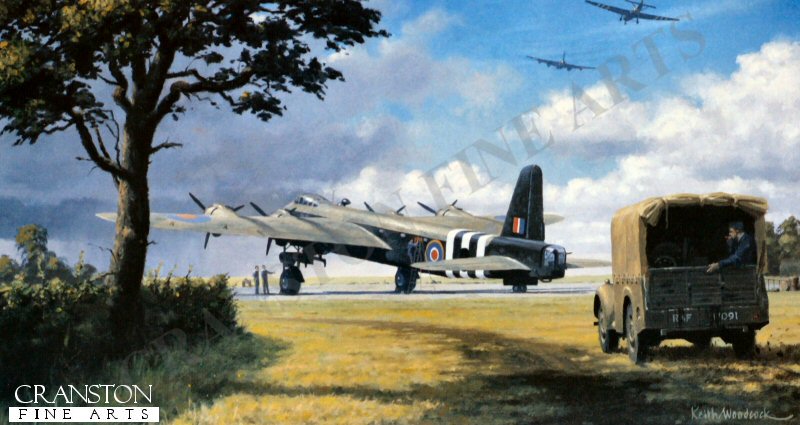
Stirlings Ready by Keith Woodcock. Stirling bombers of 7th Squadron Bomber Command of the Royal Air Force made ready for their next mission by the squadron's ground crew. A fitting tribute to all the ground crews of Bomber Command. |
Stirlings of No.90 Squadron by Ivan Berryman. The Short Stirlings WP-M and WP-O, aircraft numbers BK718 and EH907, fly together en route to Cologne in the late evening of 3rd July 1943. Aircraft BK718, with designation WP-M, of No.90 Squadron RAF was lost over Germany in the early hours of 4th July 1943. Six of the seven crew were lost in the crash, the rear gunner surviving to be taken prisoner. Stirling WP-O was also lost on the same mission, with the loss of all seven crew. The crew of Stirling WP-M, BK718: Sgt Hugh Murray, Flight Engineer - Sgt Robert Freeland, Air Bomber - P/O Geoffrey Smith, Air Gunner - Sgt Oliver Beard, Wireless Operator - P/O Andrew Gilmour, Navigator - F/Lt Robert Platt, Pilot - Sgt I. H. Norris, Air Gunner. |
Short Stirling MkI R9257 MG - C. by M A Kinnear. Aircraft History: R9257 was one of a batch of 150 Mk I Stirlings delivered to the RAF by Short Brothers between January 1942 and January 1943. Initially with Telecommunications Flying Unit, R9257 went to No.7 Squadron, where it eventually became the personal aircraft of Hamish Mahaddie and his crew from 8th February 1943 until he completed his operational tour with the PFF (Path Finder Force) at the end of March 1943. The aircraft then went on to No.1657 Heavy Conversion Unit at Stradishall, before being sent to No.214 Squadron. On 12th August 1943, whilst leaving RAF Chedburgh for a raid against Turin, R9257 swung on take off and the undercarriage collapsed. The aircraft was categorised as damaged beyond repair (DBR). R9257 replaced Hamish and his crews earlier Stirling MK I, R9273 also MG- C which had been attacked six days earlier by a Ju88 nightfighter. After evading the attack, they managed to bring the aircraft home. Next morning, Hamish counted 174 cannon shell holes in the aircraft - which he named C for Colander. Group Captain Thomas G Hamish Mahaddie DSO, DFC, AFC, CzMC: Born in Keith, Edinburgh on 19th March 1911, he joined the RAF as part of the 17th Entry at Halton in January 1928 and trained as a metal rigger, after which he was posted to Cranwell on ground servicing duties. In 1933 he boarded a troopship bound for the Middle East where he joined No.4 FTS at Abu Suier for pilot training. Gaining his wings in 1935, his first air crew posting was to No.55 Squadron at Hinaidi flying Westland Wapitis and on his return to England in 1937, he joined No.77 Squadron flying Whitleys from Driffield. During World War II he completed a tour of operations with No.77 Squadron before moving to Kinloss to instruct with No.14 OTU. On completing another tour, this time with No.7 Squadron (which he joined on 2nd August 1942) at Oakington on Stirlings, he joined HQ Staff of No.8 (Pathfinder) Group and Group Captain Mahaddie finished the war as Station Commander at RAF Warboys, home of PFF Navigation Training Unit. In June 1945 he was appointed to command No.111 Wing in Germany followed by a spell at the Staff College, Haifa in 1947. His postwar duties also included two tours of duty at the Air Ministry, as OC Flying Wing at Binbrook, and also as Station Commander at Sylt and Butzweilerhof in Germany. He finally retired from the RAF in March 1958 and became involved with the film industry as an aviation consultant working on many films including the Battle of Britain - for which he amassed an incredible number of Spitfires, Hurricanes, Messerschmitts and Heinkels. Thomas Hamish Mahaddie passed away on 16th January 1997. |
Stirling - 1940s by Barry Price. No text for this item |
The Night Shift by Philip West. The Short Stirling was the RAFs first four-engined bomber to enter service and it served throughout WWII in many roles including bomber, minelayer, troop carrier and glider-tug. The lack of power produced by its engines severely limited the loads carried by Stirlings. On long-range trips such as Italy, even with a greatly reduced bomb load the aircraft could barely clear the Alps. Despite very large losses due to its operational limitations, those that flew this big, agile aircraft, came to respect and look upon it with it with affection. |
Stirlings by Keith Woodcock. Flight crew prepare to get their Stirling ready for departure on another mission. This superb image is a fitting tribute to the Stirling bomber of Bomber Command and all the crews that flew in and also worked on this magnificent aircraft. |
McRobert's Reply by Geoff Lea. MacRobert's Reply was the name given to a Short Stirling bomber of No 15 Squadron, serial N6086. The Stirling was paid the donation of 25,000 pounds by Lady MacRobert in commemoration of her three sons, all of whom were killed whilst serving with the RAF. The eldest son Alasdair died in a flying accident in 1938, whilst Roderick and Iain were both killed in action during 1941. On October 1941 MacRobert's Reply was handed over to No.15 Squadron at RAF Wyton, with Lady MacRobert attending the naming ceremony. The Stirling had the MacRobert coat of arms painted on the nose, and the code LS-F. The Stirling flew twelve missions between October 1941 and January 1942, before accidentally swinging on take off and colliding with a damaged Spitfire at RAF Peterhead on 7th February 1942. The aircraft was written off. |
Stirling - The Heavy Brigade by Keith Woodcock. The Royal Air Force Short Stirling used by bomber command during World War Two. This aircraft carries the code AA-K of No.75 Squadron. |
Stirlings Outward Bound by Robert Taylor. SOLD OUT (June 2009) |
| Stirling Pilot and aircrew signature details |
Wg. Cdr. F H P Austin OBE RAF Our estimated value of this signature : £10 | Wg. Cdr. F H P Austin OBE RAF Joined the RAF in September 1932 as an aircraft apprentice. After three years at Cranwell he was posted to No16 (AC) Squadron and trained as an Air Gunner. In 1937, he joined No. 36 (TB) Squadron in Singapore and in January 1939 he returned to the UK for training as an Air Observer. He was promoted to Sergeant and joined 149 (B) Squadron at Mildenhall. He flew his first operational sortie on 4th September 1939 (Kiel Canal) and continued operating with the squadron until his captain (Wg. Cdr. P. I. Harris DFC) was selected to command No7 Squadron. After aircraft familiarisation on Stirling aircraft he arrived at Oakington in October 1940. Now commissioned he was a crew member on the very first Stirling Operation on 10th February 1941, targeting oil tanks at Rotterdam. In September 1941, he was selected for Specialist Armament training, followed by spells as Chief Armament Instructor at Moreton-in-Marsh and Wellesbourne Mountford. Posted to Air Headquarters in India, in September 1945 and subsequently moved to the RAF Staff College in Haifa in 1946. After a flying refresher course he served with the Bomber Command Development Unit at Marham until 1948. After an exchange posting with RAAF HQ Melbourne he returned to the UK in January 1954 on promotion to Wg. Cdr. (Admin) at RAF Kinloss. His final posting was to the Supreme HQ Allied Powers Europe in 1959, retiring in 1965. |
  Flight Lieutenant Tom Austin DFC AE Our estimated value of this signature : £40 | Flight Lieutenant Tom Austin DFC AE After joining the RAF in 1941 Tom Austin qualified as a pilot on Harvards, then converted into Halifaxes. During the war years other aircraft he flew included Wellingtons, Stirlings and Lancasters. While flying Wellingtons as part of 199 Squadron during a raid over Dortmund, his aircraft was badly damaged but Tom managed to limp home, crash landing at Mildenhall. |
Warrant Officer Dennis Baker Our estimated value of this signature : £10 | Warrant Officer Dennis Baker Originally a Halton Brat, Dennis qualified as a Flight Engineer serving with 75 Sqn on Stirlings. Shot down on his third operation returning from Frankfurt on 3rd December 1942, he was held as a PoW for nearly three years in camps including Stalag Luft I, Lutz VI and 357. |
The Lord Mackie of Benshie CBE DSO DFC Our estimated value of this signature : £45 | The Lord Mackie of Benshie CBE DSO DFC George Mackie joined the RAF in February 1940, training as a Navigator in Bomber Command. He first joined 15 Squadron in 1941 flying Wellingtons, before going to the Middle East to join 148 Squadron. He later served with 149 Squadron on Stirlings, and 115 Squadron on Lancasters. Squadron Leader George Mackie completed three full tours on heavies, the last two as aircraft Captain. |
  Group Captain Graham Baptie Blacklock OBE DFC Our estimated value of this signature : £40 Died : 2011 | Group Captain Graham Baptie Blacklock OBE DFC On completion of a tour of operations on the Wellington in July 1940, Blacklock joined three other pilots at Boscombe Down to form the Stirling Development Flight. Once they had become used to flying the ungainly aircraft, the small team left for an airfield in Yorkshire as the nucleus of No 7 Squadron, as it was re-equipping with the Stirling. On February 10 1941 three of the bombers took off to attack oil storage tanks at Rotterdam, the RAF's first bombing operation in the Second World War by a four-engine bomber. Blacklock flew as a second pilot, but all his subsequent operations were as a captain. He bombed Berlin on the night of April 9th, but most of No 7 Squadron's operations during this period were in daylight, sometimes with a fighter escort but on other occasions relying on cloud cover to mask their outbound route. On June 28th three Stirlings took off for a daylight attack on Bremen. One soon turned back, but Blacklock and his flight commander pressed on despite the lack of cloud. As they approached the target, they were attacked by nine enemy fighters. Blacklock skilfully manoeuvred his aircraft to allow his gunners to engage the enemy; at least one was shot down, and probably a second. On the return flight, he realised that the second Stirling had been severely damaged and he turned back to escort it. Eventually the crippled aircraft was forced to ditch near the Frisian Islands, and, despite the threat of more enemy fighters appearing on the scene, Blacklock orbited the spot for 10 minutes looking for survivors. The Stirling had, however, disappeared along with its crew. Blacklock was awarded an immediate DFC. On July 23rd there was a report that the battlecruiser Scharnhorst had left Brest for La Pallice, and three Stirlings – flown by the three original pilots to join No 7 Squadron – were sent to attack with armour-piercing bombs. They encountered heavy flak and were attacked by fighters, forcing an escape at very low level. This was the last daylight raid by the Stirlings, and Blacklock completed his tour of operations at night attacking industrial centres in the Ruhr. On August 28th, after his last operation to Duisburg, he was rested, having completed two full tours. Graham Baptie Blacklock, always known as Gerry, was born on June 23rd 1914 near Skipton, Yorkshire, and educated at Queen Mary's Royal Grammar School, Clitheroe. In 1931 he joined the RAF as an aircraft apprentice and trained as a metal rigger. After service in England and at the RAF's aircraft depot at Aboukir, near Alexandria, he volunteered for pilot training during the rapid expansion of the Service prior to the Second World War. He was posted to No 99 Squadron to fly the Heyford, a biplane bomber he described as 'a mechanical praying mantis'. In 1938 it was replaced by the Wellington, and on the outbreak of war the squadron moved to the Rowley Mile on Newmarket racecourse. Operations during the Phoney War were limited, but an attack on December 14th 1939 met with disaster when six of the 12 Wellingtons were shot down. Blacklock, however, returned safely. He continued to fly North Sea sweeps and also dropped leaflets on German cities. After the German invasion of Norway he attacked Stavanger airfield, and on May 10th bombed the recently captured airfield at Rotterdam. On May 23rd his squadron was diverted to support the retreating British Expeditionary Force, before attacks were resumed against oil targets in Germany. At the end of his tour he was awarded a DFM. After completing his time on the Stirling, Blacklock, as an ex-aircraft apprentice, was well-qualified to establish the formal training of a new aircrew category, the flight engineer. For the remainder of the war he filled numerous technical training appointments. After the war he was an instructor on bombers before being appointed to the Far East to survey potential staging posts on the Indian Ocean islands of Gan, Diego Garcia and Christmas Island. At the works and finance branch of the Air Ministry in 1956, he helped to relocate RAF forces from Egypt to Cyprus. In October 1958 he conducted a survey of Ascension Island. On promotion to group captain, Blacklock commanded the RAF airfield at Hullavington, where the RAF's air electronic officers were trained. He took retirement in 1961. In addition to his gallantry awards, Blacklock was appointed OBE in 1953. Group Captain Blacklock died on 28th April 2011. A Clipped Signature is Available |
  Squadron Leader Peter Boggis DFC Our estimated value of this signature : £60 Died : 2010 | Squadron Leader Peter Boggis DFC Flying Officer Peter Boggis, at the remarkably early age of 22, was the first pilot to fly MacRobert's Reply and did so with much distinction, courage and skill. He had proved himself an exemplary pilot, having flown 15 operational sorties. He took control of the bomber and joined Squadron XV in September 1941. Boggis flew many bombing raids over Europe in MacRobert's Reply, attacking Pilsen, Nuremberg, Cologne and, in a daylight raid on the port of Brest, destroying many German battleships. That sortie was particularly hazardous: casualties were high and the trip home was interrupted by much enemy gunfire. While flying over the Channel at almost sea level, Boggis heard his rear gunner shout that there were six aircraft on their tail. 'They were Halifaxes' Boggis later recalled with relief. 'They were a welcome sight. They opened up their formation in invitation and gratefully we climbed and were enfolded in their midst. We returned in grand style.' The manipulation of the Stirling bomber required much care. Their maximum bomb payload was 8,000lb so movement at take off and landing was, at best, cumbersome. They usually flew at 15,000ft which made them easy prey for enemy fire. For the Brest mission, his last with the squadron, Boggis was awarded the DFC for his bravery and skill: his flying under extremely dangerous conditions was highly commended. Boggis was transferred to a training squadron for the remainder of the war. A few months later, the original MacRobert's Reply had an accident with a Spitfire on take-off at Peterhead. The badge on the nose was preserved and transferred to another Stirling. That, in turn, was shot down over Denmark in May, 1942. But the tradition of naming a plane in the RAF MacRobert's Reply has lasted to the present day, with Bucaneers and Tornado aircraft carrying the name. After the war, Boggis took command of the squadron at Stradishall in 1947 and he retired from the RAF with the rank of squadron leader in 1967. Peter Boggis died on 2nd June 2010. A Clipped Signature is Available |
Flight Lieutenant George Britton Our estimated value of this signature : £30 | Flight Lieutenant George Britton Joining the RAF in 1941, George trained on Wellington and Stirlings as a Wireless Operator and Air Gunner. Converting to Lancasters he was posted to 90 Squadron for his first operational tour, and then to 186 Squadron, still on Lancasters. George then found himself designated to be an Intelligence Officer at Lossiemouth, interrogating Italian POWs Finally, before leaving the service in 1946, he served in Sunderland flying boats, flying to West Africa, Europe and Scandinavia. |
Warrant Officer Ron Brown Our estimated value of this signature : £10 | Warrant Officer Ron Brown Initially served as a Fitter on Hurricanes and Harvards, then joined Aircrew in 1942 and served as a Flight Engineer on Stirlings with 218 Squadron where he towed gliders on D-Day. He went on to complete another Tour with 75 Squadron on Lancasters, completing 64 Operations by the end of the War. |
Air Commodore Wilf Burnett DSO OBE DFC AFC Our estimated value of this signature : £50 Died : 2006 | Air Commodore Wilf Burnett DSO OBE DFC AFC Canadian Wilf Burnett joined the RAF before the war and at the outbreak of hostilities was flying Hampdens. He completed his first tour of 30 operations in September 1940, flying with 49 Sqn at Scampton. His crew had bombed invasion barges in the Channel ports, mined enemy waters, operated against the Ruhr, and taken part in the first raids against Berlin. In July 1941 he was posted to 408 (Goose) Sqn RCAF, at Syerston, where one night in January 1942, returning from Hamburg, their Hampden crashed in extreme weather. Wilf was the sole survivor, and he was hospitalised. Recovering he was accepted to command 138 (Special Duties) Sqn at Tempsford who were engaged in dropping agents and supplies to the Resistance in occupied countries flying Halifaxes, later Stirlings. He died 26th November 2006. A Clipped Signature is Available |
Warrant Officer William Jock Burnett Our estimated value of this signature : £15 | Warrant Officer William Jock Burnett Jock Burnett (Flight Engineer) volunteered at the age of 18 as a Direct Entry in Edinburgh F/E and served in the RAFVR from 25th May 1943 until 19th February 1947 following a F/E course at St Athans, South Wales. On passing out from this course Jock was posted to Swinderby on Stirlings heavy conversion unit 1660 before being transferred to Syerston and Lancasters. In early August 1944 Jock joined 617 Sqn at Woodhall Spa and was subsequently posted with the squadron to Waddington and Digri, India. He completed 30 missions, all with Lawrence Benny Goodman as the pilot. Notable raids Jock took part in were on the Tirpitz, 29th October 1944, dropping the Grand Slam 22,000 bomb on the Arnsberg Viaduct, 19th March 1945, and the attack on Berchtesgarten Eagles Nest, 25th May 1945. |
A R Charlesworth Our estimated value of this signature : £15 | A R Charlesworth Volunteered at the age of 18 in 1942 and trained as a pilot in Canada. On returning to England in spring of 1942, he trained on Whitley Bombers and converted to Stirlings in January 1945. He took part in the Rhine Crossing towing a Horsa glider, which was his last operation. He joined 299 Sqdn at Shepherds Gove in April 1945 and was heavily engaged in towing gliders (Horsas) and supply drop training. Before the end of the European was, he flew Stirling [Vs supplying our advancing armies through Europe and completed one operational supply drop to Denmark underground forces. He left the RAF in 1947. |
Flight Lieutenant Gordon Clark DFM Our estimated value of this signature : £10 | Flight Lieutenant Gordon Clark DFM Initially served in the Army, but transferred to RAF pilot training crashing his Tiger Moth on his first solo flight! He transferred to become a Bomb Aimer on Stirlings with 149 Sqn at Lakenheath, completing 28 ops with Bomber Command. |
Warrant Officer Colin Cole Our estimated value of this signature : £35 Died : 2016 | Warrant Officer Colin Cole As a Wireless Operator, he flew on Wellingtons, Stirlings and Ansons and flew 18 Ops on Lancasters with 617 Sqn including raids to sink the Tirpitz and the final raid of the war in Europe on Berchtesgaden. Colin enlisted at 18 in 1942 and joined the Royal Air Force. He underwent intensive training at Warrington and a number of training facilities at Blackpool and Yatesbury. As well as studying to be a wireless operator he also learned to be an air gunner. This was because it was an 'insurance policy' of sorts that if the aircrew onboard the Lancaster Bomber lost their first gunner the 'wireless op' would take over. Colin and his fellow aircrew were first involved in several practice bombing raids. At this time he was also carrying out a role as an inspector of the aircraft, specifically ensuring the batteries and electronics were up to scratch. He was sent on his first operation aboard a modified Lancaster bomber. The Lancasters had been specially modified with the removal of their mid-upper gun turrets and other equipment to lighten them, and they flew with a crew of six rather than the usual seven men. Carrying extra fuel and the 12,000lb 'Tallboy' bomb it was to carry. At 3am on November 12th, as part of a force of 18 Avro Lancasters of 617 Squadron and 13 from 9 Squadron, Colin and the rest of the Lancaster crew left the Scottish base and headed into the night across the North Sea to Tromso on a 2,200 mile round trip, taking 13 hours in total. Initially they flew low at only 1,000ft to avoid enemy radar but 100 miles from that target the entire aerial assault climbed up to their bombing altitude of 14,000ft. Colin and the crew of the modified Lancaster Bomber delivered their payload bang on target, and along with the rest of the bombers were successful in sinking the German Navy's flagship. He flew 18 missions as a wireless operator aboard Lancaster bombers, targeting shipping, U-boat pens, viaducts and cities on the German mainland. Ironically, one was the town of his grandparents - Koblenz. Colin was demobbed in 1946. After the war, he flew missions to India to dispose of surplus weapons and flew in the very Lancaster Bomber flown by Guy Gibson, the wing commander who led Operation Chastise, the Dambusters raid. Colin Cole passed away in May 2016 aged 93. |
Warrant Officer James Coman DFC Our estimated value of this signature : £10 | Warrant Officer James Coman DFC As a WOP/Air Gunner he flew with both 149 and 90 Squadrons on Wellingtons, Stirlings and Lancasters completing 52 Ops including one of the first raids on Berlin made in a Wellington. |
Miss Lettice Curtis Our estimated value of this signature : £20 | Miss Lettice Curtis Joined the Air Transport Auxiliary (ATA) in July 1940 having been taken on to ferry Tiger Moths. Although we were later allowed to ferry other training types such as Oxfords and Masters, it was not until the autumn of 1941 that women were allowed to fly operational aircraft types. I flew my first Hurricane in August 1941 and my first Spitfire a couple of weeks later. After a brief course on a Blenheim I was cleared to fly without any further training, twin-engine bombers up to the Wellington. In November 1943 I was sent on a Halifax course, which due to unserviceability and bad weather closed, restarting in February 1943 at Pocklington where I was cleared for ferrying Halifaxes. After that without further training, I ferried Lancasters and over 100 Stirlings. In November 1945 I ferried 14 Liberators. |
Flying Officer George Dann Our estimated value of this signature : £15 | Flying Officer George Dann As a Pilot, George flew Stirlings with 620 Squadron, originally on bombing raids and then later flying special Operations for SOE. George flew 3 Operations over Arnhem and later flew Halifax bombers in Palestine. |
Flight Lieutenant Frank Diamond DFC AE Our estimated value of this signature : £60 Died : 2007 | Flight Lieutenant Frank Diamond DFC AE At the outbreak of war Frank was serving with the Territorial Army, transferring to the RAF in May 1941 and training as a navigator on flying Boats. In 1943 he completed a full tour on Stirlings, and in 1944 joined the Pathfinder Force as a navigator on Mosquitos with 571 Squadron, Light Night Strike Force. At the end of the war he joined Transport Command returning the wounded from Europe. Frank Diamond passed away in September 2007. |
Warrant Officer Les Ellingham Our estimated value of this signature : £10 | Warrant Officer Les Ellingham As a WOP/Air Gunner Les was originally at 218 Sqn on Stirlings, and as a founder member of the Pathfinder Force was transferred to 7 Sqn. On his 17th Operation Les was shot down and was then on the run for 5 weeks in Paris. He was betrayed by a Frenchman, and spent time in Fresnes Prison in the hands of the Gestapo, before finishing the War in Stalag Luft IVb |
  Group Captain William Farquharson DFC Our estimated value of this signature : £35 Died : 2012 | Group Captain William Farquharson DFC William Farquharson was a pilot with 115 Squadron and flew Lancasters with 195 Squadron. William Farqharson was born om September 28th 1919 in Malacca, Malaya. His father was a police officer in the Colonial Service. His early schooling was in Malaya and Australia, and he completed his education at Harris Academy, Dundee, and later went to the Birmingham Central Technical College. In January 1941 William Farqharson enlisted in the Royal Air Force to become a pilot. William Farqharson joined No 115 Squadron in July 1942 and flew his first bombing operations in the Wellington before the squadron converted to the four-engine Stirling. Farqharsons first sorties were to drop mines in the Kattegat, the Baltic and off the French Biscay coast. Farquharson also bombed targets in Germany and in northern Italy, the latter involving very long flights over the Alps. On April 20 1943 he and his crew attacked Stettin at low level in full moonlight. Dissatisfied with the first attempt, he made a second bombing run despite heavy opposition. His Stirling was badly damaged, but he then made a third run to photograph the results of his attack before turning for the long flight home. He was awarded his first DFC. After a period training bomber crews, Farquharson returned to operational flying in October 1944 when he joined No 195 Squadron. Bomber Command was concentrating on attacks against the German oil industry and he bombed many targets in the Ruhr. Farquharson and his crews also wre involved in Operation Manna these humanitarian operations which saw them dropping food to the starving population in the Netherlands and also took his Lancaster to Belgium and France for Operation Exodus to pick up prisoners of war recently released form German PoW camps. In total William Farqharson completed 63 operations as a pilot in Bomber Command. He recalled on one occasion the engine of his Wellington caught fire and he ordered his crew to bail out. As the last man left, he realised that the aircraft would be too low for him to survive a jump and he was forced to crash land into the tops of some trees before hitting a farm in the Cotswolds. The wings sheared off and he ended up, badly concussed, in the fuselage section. The farmer's son rushed into the house shouting, there's an aeroplane in the greenhouse. On another occasion his bomber was damaged by anti-aircraft fire. On landing he discovered a large piece of shrapnel embedded in the parachute he had been sitting on. Farquharson remained in the RAF and much of his early service was involved in training pilots. After attending the Central Flying School he commanded flying training squadrons and in 1953 led a large formation of aircraft in the Coronation Flypast. Later he was the chief instructor at an advanced flying school equipped with the Meteor jet fighter. After appointments in the Far East and as station commander at RAF Episkopi in Cyprus, Farquharson was appointed air attaché in Warsaw at the height of the Cold War. There all his activities were closely monitored by the secret police. Having shown no previous interest, he suddenly became an expert in birdwatching when he 'discovered' that the most interesting sites were close to military airfields. After retiring from the RAF in 1976, Farquharson worked in the sales division of a company manufacturing flight simulators and was for a period of time chairman of the Bomber Command Association. He was later made an honorary vice-president and worked hard seeking recognition for his fellow veterans. With his wife, a former WAAF operations officer on his bomber station, he was able to attend the unveiling of the Bomber Command Memorial by the Queen in July 2012. Sadly Group Captain Bill Farquharson, died on September 20th 2012. A Clipped Signature is Available |
  Squadron Leader L S Benny Goodman Our estimated value of this signature : £40 Died : 2021 | Squadron Leader L S Benny Goodman Benny Goodman (Pilot) volunteered for aircrew at 18 years of age and was called up in 1940. After basic training he went to RAF Abingdon - a Whitley OTU - for what he was told would be straight through training. This did not materialise and he found himself in the role of a Ground Gunner. In 1941, a posting eventually came through to the Initial Training Wing followed by Elementary Fyling School at Peterborough and an instructors course at Woodley, Reading; then to Clyffe Pyparde, a holding unit. A sea journey to Canada followed and Service Flying Training School on Ansons. On completion he was posted to Kingston, Ontario, to instruct Acting Leading Naval Airmen on the Royal Navy tactics of the time, e.g. jinking after take off, dive bombing, etc. Eventually he returned to the UK and OTU on Wellingtons at Silverstone and Heavy Conversion Bomber Unit at Swinderby on Stirlings, followed by a short course at the Lancaster Conversion Unit. After an interview Benny and his crew were surprised and delighted to find they had been selected for 617 squadron - this was in 1944 and they had stayed together as a crew on 617 squadron until the war in Europe ended. He completed 30 missions - all with Jock Burnett as his flight engineer. Notable raids Jock took part in were on the Tirpitz, 29th October 1944, dropping the Grand Slam 22,000 bomb on the Arnsberg Viaduct, 19th March 1945, and the attack on Berchtesgarten Eagles Nest, 25th May 1945. Benny Goodman died in July 2021. |
Warrant Officer Richard Basher Hearne Our estimated value of this signature : £20 | Warrant Officer Richard Basher Hearne 'Basher' Hearne joined the RAF in 1942 and trained as a Flight Engineer. His first operational posting was to 622 Squadron at Mildenhall in Suffolk, equipped with Stirlings, and then, in November 1943, he transferred to 15 Squadron, also flying from the same base. The squadron re-equipped with Lancasters the following month. |
W/O J W Hill Our estimated value of this signature : £20 | W/O J W Hill Joined 196 Squadron on his 18th birthday, 25th November 1939, having cycled ten miles to the nearest recruiting office, hoping to enlist as an air gunner. However there were no vacancies and they eventually contacted him to suggest becoming a ground gunner. After square bashing on Blackpool promenade, he found himself guarding West Raynham aerodrome in Norfolk, where they were regularly strafed by German aeroplanes, flying extremely low. He then decided he would like to get his own back and volunteered for aircrew, this time as a pilot. After ACRC, Lords cricket ground, then ITW Scarborough, he found himself crossing the Atlantic in a convoy. There were numerous ships, containing budding aircrews, evacuated children and Italian prisoners of war. The fact that he had to sling his hammock at the very front of the ship, below the waterline, did nothing to boost his confidence, but they did have a number of destroyers for protection. Eventually, they docked at New York and then trans-shipped by rail to Moncton, New Brunswick, the holding terminal. His first experience of flying was at 32 EFTS Bowden, Alberta, where he flew Stearmans. He then moved on to Weyburn, Saskatchewan, where he obtained his wings, flying Harvards. Then it was back to England, this time travelling solo on a fast liner. He flew Tiger Moths at Banff, Scotland, then moved to twin-engine Oxfords, followed by Wellingtons. This was where he crewed up – he did one bombing raid on Wellingtons. Next he moved to 1665 Heavy Conversion Unit at Woolfox Lodge, flying Stirlings, then joined 196 Squadron on 5th November 1943. At the time of joining the Squadron, Stirlings were taken off bombing, and joined 38 group, assisting glider pilots with circuits and bumps, interspersed with operations to France, dropping supplies to the maquis. These trips were done at low level on moonlit nights, the theory being that they would be too low for both fighters and ground gunners to get at them. The biggest problem seemed to be avoiding high ground. On the night of 5th June, D-Day minus one, he dropped paratroopers near Caen, close to the now famous Pegasus Bridge. Then on D-Day itself, he towed a heavy Horsa glider to the Caen beachhead. During June he dropped more containers in the area. In September he made various trips to Arnhem. On one trip, due to fog over the North Sea, his glider became detached, finishing up in the sea. Luckily he later learnt the occupants were picked up by Air-Sea Rescue. These trips were done at a very low level, making them sitting ducks for the ground gunners. Aircraft losses were very severe: on one day, less than half the squadron got back to base, although some put down at other aerodromes. On one day, in addition to the gunners, there were German fighters overhead. He would have to take the decision to dive to the deck, lifting over the high-tension cables; the aeroplane escaped relatively lightly, with not much damage. He left the Squadron on completion of his tour in 38 group, on 6th June 1945. He then went back to 1665 HCU, this time as an instructor. Apart from a course on Oxfords at 7 FIS, he finished flying on 25th September 1945 and was demobbed on 27th March 1946, having completed a total of 1,021 hours flying. |
 Gunnery Leader Sgt Alistair Lamb Our estimated value of this signature : £35 | Gunnery Leader Sgt Alistair Lamb Alistair Lamb, born in Stirling, Scotland, joined the Royal Air Force in March 1944 and went to No.7 Gunnery School at Stormydown in Wales. In August 1944 he went to Market Harborough and started training in Ansons before moving on to Wellingtons. Alistair went to H1654 heavy conversion unit at Wigsley flying in Stirlings and Lancasters. In March he joined No.15 Squadron at Mildenhall and participated in amongst other operations Operation Manna dropping food supplies to the Dutch, on the 30th April 1945 over Rotterdam, 2nd May 1945 over The Hague and 7th May 1945 at Valkenburg. Sgt Alistair lamb and the rest of the crew also took part in Operation Harken Project, photography of U-Boat Pens at Farge. After the war Sgt Alistair Lamb stayed with 15 Squadron at RAF Wyton on Lincolns until August 1947 when he left the RAF and joined the Civil Service. Alistair Lamb still lives in his home town of Stirling. |
Squadron Leader Reg Lewis DFC Our estimated value of this signature : £15 | Squadron Leader Reg Lewis DFC Reg Lewis was a navigator in Bomber Command, first with XV Squadron, and then 214 Squadron, both on Stirlings. In August 1943 he was posted to 138 (Special Duties) Squadron based at Tempsford. Here he flew Halifaxes, dropping agents and arms into occupied Europe. In February 1944, after flying agent Francis Cammaerts over France, Reg was shot down but evaded capture and made his way to and over the Pyrenees into Spain, and home. |
Flt Lt R Livermore Our estimated value of this signature : £20 | Flt Lt R Livermore Was part of 299 Air Support Squadron in Norfolk. He flew six ops. on Stirlings, taking supplies to the French resistance - dropping 24 containers at a time by parachute at night, each one full of supplies, including guns and ammunition. They had to arrive at the target area within a five minute period, or else the resistance would leave for fear of a trap being set by the Germans. When the resistance were satisfied they were watching the correct aircraft they would flash they torches on and off as both a signal and also to pinpoint the drop zone. Flt. Lt. Livermore also towed gliders behind his Stirling aircraft during the Rhine crossing. |
Sqn Ldr W E Bill Lucas DFC Our estimated value of this signature : £15 | Sqn Ldr W E Bill Lucas DFC Born in 1917, Bill Lucas volunteered for aircrew early in 1940 and after training as a fighter pilot he became, due to the high demand, a bomber pilot and joined 9 Squadron (Wellingtons) in August 1941. After 14 missions over Germany Bill converted to Stirlings and completed a further 26 operations, this time with 15 Squadron at Wyton. After two years instructing at 19 OTU Kinloss he was selected to join Pathfinder Force in October 1944 to fly Mosquitoes with 162 Squadron at Bourn, Cambridgeshire, where he remained until war end to complete 41 more missions making 81 in total. Bill attained the rank of Squadron Leader and was awarded the DFC and a Mention in Despatches. The most memorable of his missions must be the first 1000 bomber raid on Cologne on May 30 1942, as this seems to have struck a lasting memory in the minds of the general public. After the war Bill pursued a career in the insurance industry and also began to pick up the pieces of a serious athletic activity with the Belgrave Harriers which resulted in selection for the 5000 metres at the Olympic Games at Wembley in 1948, but at the age of 32 he was not in his own words 'very successful'. Bill says his greatest regret was missing the games in Helsinki in 1940 and the cancelled games in 1944. 'These should have been the best athletic years of my life.' |
  Group Captain Hamish Mahaddie DSO DFC Our estimated value of this signature : £70 Died : 1997 | Group Captain Hamish Mahaddie DSO DFC Group Captain Thomas Gilbert 'Hamish' Mahaddie. DSO, DFC, AFC.. CzMC. Nos 7, 55, and 77 Squadrons. Born In Keith, Edinburgh, on 19 March 1911. He joined the RAF as a part of the 17th Entry at Halton in 1928 and trained as a metal rigger, after which he was posted to Cranwell on ground servicing duties. In 1933 he boarded a troopship bound for the Middle East where he joined No 4 FTS at Abu Suler for pilot training. He gained his wings in 1935 and his first air crew posting was to No 55 Squadron at Hinaldi flying Westland Wapitis. On his return to England in 1937 he joined No 77 Squadron flying Whitleys from Driffield. During World War II he completed a tour of operations with No 77 Squadron before moving to Klnloss to instruct with No 14 OTU. He completed another tour, this time with No 7 Squadron at Oakington on Stirlings, before joining HQ Staff of No 8 (Pathfinder) Group. Group Captain Mahaddie finished the war as Station Commander at RAF Warboys, home of PFF Navigation Training Unit. In June 1945 he was appointed to command No 111 Wing in Germany followed by a spell at the Staff College, Haifa, In 1947. His postwar duties also included two tours of duty at the Air Ministry, as OC Flying Wing at Binbrook, and also as Station Commander at Sylt and Butzwellerhof in Germany. He finally retired from the RAF in 1958 and has since been involved with the film Industry as an aviation consultant specialising in electronics for all three services. Hamish Mahaddie died 16th January 1997. A Clipped Signature is Available |
  Group Captain Roy D Max Our estimated value of this signature : £55 Died : 2007 | Group Captain Roy D Max Group Captain Roy Max, who has died aged 88, Roy Max was born on November 24 1918 at Brightwater, near Nelson in New Zealand. After attending Nelson College he learned to fly at the local aero club when he was 18. travelled from New Zealand to join the RAF and received a short servcie commission in August 1938 as a pilot and survived the crippling losses of bombers deployed to France at the outbreak of the Second World War; already a veteran at 24, he was made a wing commander and appointed to command No 75 (NZ) Squadron, the first Commonwealth squadron in Bomber Command. Shortly after the declaration of war in September 1939 No 103 Squadron, equipped with the Fairey Battle, deployed to France. in May 1940 along with the other 9 Fairy Battle squadorns. took part in action against the german Offensive But the Fairy battles were outclassed by the german fighters. On one occassion a force of 70 fairey Battle aircraft took part in a bombingmission on bridges at sedan a total of 41 aircraft were lost., Captain Roy Max dived on a group of enemy tanks in a valley and found that the guns were shooting down on him. His aircraft was hit and unable to climb. Although he and his gunner were wounded, he managed to land on a French airfield. Returning to operations a few days later, he was told that he had been awarded the Croix de Guerre and the news reached his parents and newspapers in New Zealand. In the chaos of the collapsing French administration, however, the paperwork was lost and he never received the medal. By the middle of June No 103 had lost 18 aircraft and nine crews, and Max was lucky to survive when a German fighter strafed the airfield as he was standing on the wing refuelling his aircraft. He jumped into a trench and watched his bomber burst into flames with all his belongings inside it. In the sole surviving aircraft he took off for a maintenance unit near Nantes, where a number of other Battles were found. Ground crew were loaded into the cramped cockpit of Max's aircraft and he headed towards England. He navigated using a map torn from a calendar, skirting the Channel Islands and landing at the first airfield he came to after crossing the English coast in order to determine where he was; he then pressed on to Abingdon. Roy Max his squadorn but now 103 squadron was now equipped with Wellington bombers, and Max flew on the squadron's first operation bombing the docks at Ostend in December 1940. Roy Max also attacked targets in the Ruhr. in March 1941 Roy Max spent some time ferrying Amercina built Hudson bombers form the Us to England, after this he re joined 103 squadron. On July 24th 1941 a 100 boomber day light raid took place against the german naval ships at Brest, Roy Max was leading a section of Wellingtons with no fighter escort, and losses were heavy. But he pressed home his attack, and his bombs were seen exploding on a dry dock. He was awarded the DFC. In July 1943 Max's short service commission was completed, and he reverted to the RNZAF as a squadron leader. Almost immediately he was informed that it had been decided that a native New Zealander should command No 75 (NZ) Squadron and he was promoted to wing commander. Max began operations on August 19 1943, flying the Stirling bomber from an airfield near Cambridge. The Battle of Berlin was under way and the Stirling, unable to climb to the higher levels of the Lancaster and Halifax, suffered heavy losses. Roy Max as the squadorn Commnader flew operations with his crew but, was not expected to fly on every sortie. The Stirling was eventually withdrawn from long-range bombing operations, and Max and his crews flew mining sorties and parachute drops to resistance groups. After converting to the Lancaster and flying a few more operations in support of the impending D-Day landings, his tour ended in May 1944, when he was awarded the DSO, an award that he always claimed belonged to his air and ground crews. Max returned to New Zealand to command a flying training airfield near Christchurch. In 1947 he accepted a permanent commission in the RAF, returning to England as a flight lieutenant. Having attended a course at the RAF Flying College he commanded the bomber squadron at the Aeroplane and Armament Experimental Establishment at Boscombe Down, where the new jet bombers for the RAF were being tested. After commands in Germany and Italy and other Air ministry Jobs, in 1965 he became ADC to the Queen and finally retiring form the RAF in November 1968. Sadly on the 1st July 2007 Roy Max passed away. |
Flg Off Jim Pinning Our estimated value of this signature : £20 | Flg Off Jim Pinning volunteered and was called up for Air Crew duties in April 1942. After some Pilot training in S Rhodesia and returning to England, Jim qualified as a Flight Engineer, joining Flying Officer David Coster and crew at Conversion Unit flying Stirlings. After a course at Lancaster Finishing School, a posting to IX Squadron, Bardney resulted. On his seventh trip Jim flew in WS.T LM448 (as illustrated in 'Preparing for the Tirpitz') on the final Tirpitz raid, but as the result of heavy flak damage causing a loss of fuel and power a course was set for Sweden where, after evading enemy fighters over Norway, a crash landing was made. After returning to England the crew re-joined the Squadron and Jim completed 22 ops. by the end of the war. After cancellation of the Tiger Force destined for the Far East, Jim joined Squadron Leader (Jock) Blair for the Squadron's brief visit to India. |
 Flight Sergeant Gerald Prettejohns Our estimated value of this signature : £15 | Flight Sergeant Gerald Prettejohns Joining the RAF in 1943, he flew as a Flight Engineer serving with 106 Sqn before moving to 9 Sqn. He completed a full tour on Stirlings and Lancasters including raids against the Tirpitz. |
F/O Tom Sawyer Our estimated value of this signature : £10 | F/O Tom Sawyer Flew Whitleys with 10 Sqn from Leeming and then Halifaxes with 102 Sqn from Driffield - he completed 35 Operations, and then moved on to training aircrew on Stirlings towing gliders. |
Warrant Officer Don Say DFC Our estimated value of this signature : £25 | Warrant Officer Don Say DFC Joined the RAFVR in March 1939 and was sent for Aircrew training to Calgary and Hamilton in Canada in 1941. He qualified as Observer (armaments) aimer and served first on Vickers Wellingtons with 466 Sqdn (Aus) completing 20 operations before moving on to 196 Sqn for a further ten operations over France and Germany on Stirlings. After six months as Instructor, his second tour of 23 operations in Lancasters was with 514 Sqn. The picture evoked memories of a daylight operation on oil refineries at Bordeaux on 4th August 1944. Crossing the Cornish coast on return at very low level, everyone reported nude sunbathers running for cover, as 300 Lancasters roared overhead. His total war service was six and a half years between 1939 and 1945, completing two operational tours. He was awarded the DFC in 1944. |
Flight Sergeant Ray Swift Our estimated value of this signature : £20 | Flight Sergeant Ray Swift Upon completing his training as a WOP/Air Gunner he was posted to 138 Sqn with whom he completed 46 Ops on Stirlings before transferring to Lancasters with 218 Sqn. |
 Flt Lt Ken Thomas DFC Our estimated value of this signature : £20 | Flt Lt Ken Thomas DFC Originally joined the RAF as a mechanic, but went on to complete his pilots course. Ken completed 30 Operations flying Stirlings and Lancasters for 622 Sqn at Mildenhall. |
  Sgt George B Thomson Our estimated value of this signature : £40 | Sgt George B Thomson George Thomson was trained on Stirlings and Wellingtons before converting to Lancasters and joining No.15 Sqn. He flew most of his missions on Lancaster LS-P, including missions to Stettin and Paris rail yards. While on the Paris mission, LS-M developed engine problems and was left behind by the rest of the squadron. Luckily, two P-38 Lightnings high above spotted the the struggling Lancaster and came down to escort the bomber back to base at Mildenhall. On the night of 12th September 1944, George was Navigator on Lancaster NF958 (LS-M) of No.15 Sqn, his usual aircraft LS-P grounded with engine trouble. This was to be his first and last mission on this aircraft as it was lost in the skies above Mannheim when it was attacked by the Messerschmitt Bf.110G-2 of Ofw Ludwig Schmidt of II/NGJ 6. Five of the seven crew of the aircraft, including George, managed to escape from the burning aircraft but two did not manage to escape the inferno. The aircraft came down in the vicinity of the railway station in Wieblingen, south of Mannheim. Having escaped the aircraft, he did not however manage to evade the enemy, and he was taken into captivity until the end of the war.First Op : I suppose all aircrew looked forward to their first operational flight with some trepidation, but in my own case I didn't have time to think about it, as this tale will tell. Having completed my navigation training I moved on to No. 11 O.T.U at Westcott, in December 1943, flying in Wellingtons and where I crewed up; from there it was on to 1657 Conversion Unit at Stradishall, where we flew Stirlings, then to NO.3 L.F.S. at Feltwell where we converted to Lancasters. Three rounds of circuits and bumps and one 'Bullseye' and then posted to Mildenhall in June 1944 to join XV Squadron. Arriving at Mildenhall, on my first day I reported to the Navigation Office. The Navigation Leader, F/Lt. Jack Fabian, a New Zealander, greeted me warmly enough, but was somewhat perplexed by the fact that he had another Scottish Navigator to deal with. As he said, there were already Scots known as 'Jock', 'Haggis', and 'Bagpipes', so henceforth he would call me 'Tommy'. As I was leaving his Office, he threw a fastball at me - 'Would I like to do an Op that night with a crew whose navigator had gone sick?' I was somewhat nonplussed and replied to the effect that I would have preferred to do my first Op with my own crew. To my surprise he simply said - 'That's O.K. Tommy, there will be plenty opportunities later on. 'Four days later we did a loaded climb and for some reason or another thought that we would perhaps do one or two more exercises before seeing our names on the Battle Order. Next day there seemed to be nothing on so we went our individual ways, with the Flight Engineer and myself deciding that we would go to the Camp Cinema that night. We were settled in our seats, and the big movie had just started - 'The Picture of Dorian Grey' - when a message flashed up on the screen for Sgts Howarth and Thomson to report to the Briefing Room immediately. We hurriedly left the Cinema and made our way to the Briefing Room, wondering what this was all about, when we met the aircrews coming out and getting aboard transport to be taken to their aircraft. Jack Fabian was at the door, and he handed me a Navigations Bag with the comment - You'll fmd everything in there; just follow the plane in front until you get sorted out.' We got transported out to the aircraft where the other members of the crew were already aboard, and I was still unpacking my bag as we trundled to the runway, taking off at 22.57. By the time we were in the air I had unfolded the chart and found where the target was - a 'P' Plane site at L Hey - the route there and back had already been plotted so, in effect, I was being spoon fed for my first Op. We encountered slight flak on route and were attacked by a Ju88 over the target, forcing the Bomb Aimer to ask the Pilot to go round again. On the second run in to the target another aircraft crossed our path, again forcing a re-run as before, but eventually having unloaded our bombs we headed back home, landing at base two and a half hours after take-off. To my surprise neither I nor the Flight Engineer were challenged as to why we had been at the Cinema, nor did we get a satisfactory explanation from the other crew members as to why they had not made contact with us after seeing the Battle Order for that night. Four nights later we were on our second Op to another 'P' Plane site, encountering three attacks by Me110s, one of which was damaged by our Rear Gunner. From then on, we never met another fighter until our twentieth Op on 12th September 1944, when we were attacked twice as we turned on to the last leg to the target, Frankfurt. The second attack caused severe damage to the aircraft and set part of the incendiary load alight, forcing us to abandon the plane, and when we bailed out the Flight Engineer and I landed in the same field, but we didnt get to the Cinema that night! Caught Napping It was our twentieth operation, the target was Frankfurt and the date was 12th September 1944. I was flying as Navigator in Lancaster LS-M (NF 958), the other members of the crew being FIO N.R. Overend (pilot) a New Zealander; J.D. Jones (Bomb Aimer); R.E. Kendall (Wireless Operator); RJ. Howarth (Flight Engineer); H. Beverton (Mid-upper Gunner) and 1. Spagatner (Rear Gunner). We flew low level across France, only starting our climb when we crossed the German border. At 22.45 as we turned on to the last leg into the target there was a cry of 'Port Go' from the Rear gunner; immediately we plunged into that sickening corkscrew known to all Bomber aircrew, and as we levelled out there was an almighty bang from underneath the Wireless Operators position. Flames rapidly broke through into the fuselage and we realised that we had been hit in the bomb bay, and the incendiary load was alight. The pilot struggled with the controls for a moment or two but, as the flames began to spread across the port wing, he gave the order to bail-out. B.J., the Flight Engineer, went first through the nose hatch, followed by myself, then the Bomb Aimer, while the two Gunners exited through the rear door. I estimate that we baled out at around 12,000 feet, and in the darkness of the night it seemed a long way down. Shortly after we had escaped the aircraft blew up, throwing out the Wireless Operator, who remembers nothing of that incident, and killing the Pilot. Hitting the ground, I realised that there was another parachutist on the corner of the field in which I had landed, and making my way to him found it to be B.J. our Flight Engineer. Neither of us were injured in any way, so burying our chutes we decided to make tracks and get as far away as we could from the scene of our landing. That night we simply headed in a southwest direction, keeping to fields and avoiding any roads. At one point we came to a large enclosed area, surrounded by high fencing, which we had to go around. Eventually, as dawn approached we found ourselves on the bank of a fast flowing river - there was a bridge downstream, with the occasional vehicle crossing it. The heavily wooded area on the other bank looked most inviting but prudence dictated that we should stay where we were, as the chances of being spotted as we crossed the bridge were too high for our liking. As daylight came we could see that we were on the edge of a farm, the buildings of which could be seen some two hundred yards from were we were lying in long grass - fortunately the steep bank on which we lay hid us from the farm but we kept a watchful eye in case anyone came in our direction. The day passed slowly. We had one Escape Kit between the two of us - B.J. had left his in the aircraft - so we had a couple of Horlicks tablets and risked sharing a cigarette, being careful to blow the smoke into the long grass. It proved to be a very long day, as we lay there waiting for darkness to fall. As night came so too did the rain. And how it rained! We made our way to the bridge and got across it without any difficulty, then dived into the woods we had seen. And still it rained; so much so that we were obliged to seek shelter, and there was precious little about. An upturned tin bath, which we came across, when held over our heads provided only token cover, and the noise of the rain falling on it forced us to discard our primitive shelter. A thicker clump of trees provided some relief from the rain and we remained there for much of our second night, only resuming our escape attempt when it got a bit lighter. We were following a main road, while staying within cover of the trees, and there seemed to be only military vehicles passing from time to time. As it got lighter we decided to call a halt and get some rest - in any event, we had had little sleep so far. A clump of low scrub provided enough shelter and so we lay down and went to sleep. It would be difficult to say that we slept well. Periodically, we would waken up and check that there was no one approaching our hideout. The occasional noise of traffic could be heard on the road some distance away - it seemed possible that this was a main route to the south and we took the decision to follow it. We were encouraged to believe that we might yet get out of Germany, and, with luck, get back to Britain. Up to this point the lack of food had not been of great concern. We still had some Horlicks tablets and a chewy bar in the Escape Kit. We also had a fishing line and a hook, but could not imagine us sitting by a stream while we dangled the line in the expectation that we might catch a fish. Some matches, a water bottle and water purification tablets completed our equipment. I had in my possession a pencil, which when broken open revealed a miniature compass, while B.J. being a pipe-smoker had a tobacco pouch, which, he proclaimed had a map inside. Ripping open the pouch, we were somewhat disappointed to find a map of southern France, and we had a long way to go before it would be of any practical use to us. Late that afternoon we decided that it would be safe enough to begin walking, provided we stayed within cover of the woods, so off we set. It was slow progress as we constantly had to be on the alert, and every now and then we would stop and listen for any unwelcome sounds. Gradually, as it got darker within the woods, we edged our way nearer to the road and at times walked along it in an endeavour to cover a greater distance. It was a single track road, and not, as we had imagined, a major thoroughfare; it also ran fairly straight so that we could hear, and even see, any approaching vehicle, whereupon we would dive into cover and remain hidden for a suitable period. We continued walking throughout the night, albeit at a fairly slow pace, and as daylight came we found that we were nearing some open country, with a few buildings set well back from the road. Then we had some good fortune by coming across apple trees growing by the roadside. We hastily filled our pockets and made our way across a field towards an old barn where we though we might find cover for that day. We approached the barn with caution, but it did seem to be disused and sure enough when we got inside we had the firm impression that nobody had been in it for some considerable time. A ladder led up to a hayloft and we settled down there, taking turns to sleep and keep watch. During one of my watch periods I came across a bundle of old newspapers and magazines - I could not read them but I thumbed through the pages looking at the odd photographs. Amazingly, I came across a map, which was part of a an advert for a petrol company, and it covered the very area we were in. It was somewhat rumpled, and torn in places, but I stuffed it into my pocket, feeling sure that it would prove useful in the days that lay ahead. Feeling refreshed, we ate some of the apples and as dusk settled over the countryside we continued on our way. So far as I could judge we had covered some 50 to 60 miles, and were south of Mannheim and heading in the direction of Karlsruhe. We were still making slow progress, keeping to fields, passing through wooded areas, and trying at all times to remain invisible. This night we again experienced rain, and as it got heavier we decided that there was no alternative but to seek shelter yet again. This proved to more difficult than we had expected, but eventually we came to a bridge over an autobahn and took shelter below it at a point as high up from the autobahn as we could find. It proved to be just right for our purpose for, while we could watch the odd vehicle that passed along the road they were unable to detect our presence in the darkness. Thus passed a few miserable hours. As dawn approached we thought it best to get away from this location, so returned to the fields and continued our walk. We were getting a bit blase by this time, and took the decision to continue walking through the day. As events were to prove this was a day we would not forget in a hurry. At one point we could see workers in a distant field, but if they saw us they took no notice. Boldness overcame us and we ventured on to a quiet country road in an endeavour to cover a greater distance. Some miles on our way we spotted a civilian type truck parked by the roadside. There did not appear to be anyone with it so we approached it carefully, possibly thinking that we might be able to use the vehicle to get us further on our way. There was no obvious way that we could have got it started, which led us to abandon the idea of driving off in style, Before leaving the truck, however, we had noticed a packet lying beside the driver's seat; on closer examination we found it to contain two chunks of bread and some sausage. We could not pass up the opportunity to vary our diet a little, and to this day I wonder what the driver thought about his missing lunch, if that is what it was. The decision to keep to the road was almost our downfall, for turning a bend in the road a few miles on, we saw ahead a group of houses on either side of the road, with one or two women and children actually within sight of us - indeed, it seemed that they had observed our approach. What to do? Walk on, we agreed! So, putting on a bold front we walked straight ahead at a steady but not fast pace - we nodded to the women as we passed and kept going. My spine was tingling but we dared not look back. Another bend in the road and we were out of view of the women. Heaving sighs of relief we stepped out a bit faster to get as far away as we could from the hamlet we had passed through. It is perhaps worth mentioning that we had taken the decision not to remove any badges from our uniforms, which meant that we were still wearing our flying badges and our stripes, and yet we had not been recognised. Later in the day we came across a workmans hut by the roadside and as it was deserted we took the decision to rest for a while inside. It stood back a little from the road, and behind it was a thinly spaced wood. A knothole in the wall facing the road gave us the advantage of viewing anyone approaching. Then the unexpected happened. An army vehicle drew up alongside. As we watched, the driver and a woman got down from the cab. Hell! Were they coming to the hut? Fortunately, they passed behind and went into the wood, re-emerging some ten minutes later. The purpose of their visit was all too obvious, and we watched them climb back into the truck and drive off. If they were satisfied, so too were we! That was enough excitement for one day, and certainly more than we had experienced in our travels thus far. To avoid another encounter with any of the local population, we kept to the fields and woods for the remainder of that day, and chose to spend the night as 'babes in the wood' once again. Starting out the next day it was quite apparent that we were suffering from a lack of nourishment. We both felt a bit light headed from time to time and as the day wore on we realised that we needed to find another lorry with a supply of bread and sausage. No such luck, however! Taking it easy, and resting for longer periods in between walking meant that it was going to take longer to get out of Germany than we had imagined. Never mind, just keep going and hope for the best. Later in the day we came across a vast potato field and filled our pockets in preparation for a bean feast that night. We still had a few apples we had gathered earlier in the day and this gave us the prospect of a better repast. The hours of darkness came at last - we were still walking and had returned to a quiet country road on which we saw neither persons nor vehicles. When we came across another hut, again set back a little from the road, we claimed it as our own for the night. There was an added bonus in that this hut contained a stove; ideal for roasting our potatoes, so B.J. foraged for some wood while I went off to find a stream we could hear nearby in order to fill the water bottle. In my wearied state I misjudged the bank and finished ankle deep in the stream. Returning to the hut I took off my shoes and hung my socks above the stove, now alight, and waited for the potatoes to roast. They were excellent, and the apple desert finished off our evening meal. Before settling down to sleep I went out of the hut to relieve myself and to my horror saw flames spouting two or three feet high out of the chimney. A dead giveaway to any passing traffic, so out went the fire and we turned in for our rest. The next morning was sunny and warm. We resumed our trek and by this time I was estimating that we had covered a fair distance although by no means sure where we were having run off the map I had earlier acquired. Still, we were in reasonably good heart and feeling a bit stronger after our meal the night before. Nevertheless we were walking at a slower pace and we took time to rest more often. The result was that we had probably covered little more than a dozen miles during that day. As evening came we found another road heading in what we though would be the right direction - it led us into the outskirts of a town of some size, so far as we could judge in the dark, and we were wondering what to do next when we heard approaching footsteps. Diving into a garden of a house, we hid behind shrubs until the figure passed, then re-emerged to continue on our way, still wondering what action to take. A little further on we spied a railway yard and decided to investigate. Would there be any trains that might take us out of Germany? We never did get the answer to that question as we were suddenly confronted by a uniformed person who took a great interest in us. He spoke to us, obviously asking questions, but as we could not understand a word we just stood our ground and shrugged our shoulders. Bemused perhaps, our questioner eventually lost interest and wandered off. We wasted no time in getting out of that yard and hightailing it down the road with a view to getting as far as we could out of that town, a town we were later to learn was called Rastatt. We walked at a fair pace and when we judged that we were a good few miles out of the town we looked for some place where we could lie up for the rest of the night. There were woods on both sides of the road, but which to choose? We chose to go right and when we were some little distance away from the road we found a hollow under some low scrub, which we settled in for our resting place, and soon we were asleep. I must have slept soundly until I was rudely shaken awake by B.J. who whispered in my ear, 'Look whose coming!' I did look and my heart sank immediately, for there were four German soldiers bearing down on us with rifles and fixed bayonets. There was no chance of escape, and as I looked around I spied an elderly man standing well back watching proceedings - he had in his arm a bundle of wood and it was all too obvious that he had come across us as he searched for wood, and reported us to the military. As events were to prove he had not had far to go to turn us in, for we had selected as our resting place a spot some two hundred yards from a German Army camp, which we had not seen through the trees while it was dark. We had truly been caught napping! We were taken back to this camp two or three officers appeared and scrutinised us at close quarters before removing our shoes, presumably to avoid us making a run for it. We stood there not knowing what would happen next. The most senior officer, or so he appeared, stood looking at us in some amusement. Eventually a truck was brought along, we were invited to get aboard - we had no choice - and we were driven back into the town we had walked through the previous evening. What appeared to be the local county jail was our destination, where we were searched then placed in separate cells. I was surprised that the search they made of us had been carried out in a careless manner, for they had missed my escape kit box, which was by now near empty, and a knife I had in my possession. After about an hour in the cell, the door was opened and an officer and senior N.C.O. entered. The officer stood and looked at me while the N.C.O. snapped 'English?' at me. I do not know what prompted me to say 'No', but that was my reply, whereupon the N.CO. shouted 'American?' Again I answered 'No'. The N.C.O. looked puzzled, but the officer smiled and said in almost faultless English, 'Well if you are not English and not American, what are you?' 'Scottish,' I replied. At this the officer turned and said a few words to the N.C.O. who then left the cell and I was left alone with the officer. Curiously, he did not try to interrogate me. Instead, he explained that he had gone to Oxford University pre-war, which no doubt explained his near perfect English. He did say, however, that an Austrian Regiment had picked us up, and that for me the war was over. A few minutes later the N.C.O. returned bearing a tray with a plate of meat and potatoes on it, together with a mug of coffee, then they left me to enjoy my first real meal in eight days. The following day I met up with B.J. when we were moved to another prison some miles away. I was a little amused to learn that when the German officer and N.C.O. had confronted B.J. in his cell, and asked if he was English he had acknowledged the fact, only to be left alone without anything to eat - it was some hours later before he received some bread, cold meat and coffee. Obviously, being Scottish paid off! Eventually we were taken to Frankfurt and found ourselves in Dulag Luft for interrogation. By this time the attack on Arnhem had taken place and the number of airborne prisoners was such that we were soon moved out to our Prison Camp, Stalag Luft VII in Upper Silesia, which we reached after a train journey occupying several days. At this time we met up with our Bomb Aimer and Wireless Operator, and were more than pleased on arrival at the Camp to find that Spagatner, our Rear Gunner had got there before us. As we were later to have confirmed, the Pilot had indeed been killed in the aircraft, and our Mid-upper Gunner had also been killed, but how and when we never did learn. |
F/Lt Geoffrey Ware, DFC AE FCA Our estimated value of this signature : £15 | F/Lt Geoffrey Ware, DFC AE FCA Started his RAF career in December 1940 at No 1 Receiving Wing Babbacombe, then No 4 Initial Training Wing at Paignton. A long wait in the Liverpool area during which it was sunbathing or fatigues, led to a five-week trip in convoy to South Africa. There followed an enthralling year in what was then Southern Rhodesia for Elementary Flying Training on Tiger Moths and Service Flying Training on Harvards leading to the award of Wings. Instead of being sent to the Middle East, as was normal, a fast, unescorted trip took a boatload of fledgling pilots and navigators back to the UK. It appeared that the strategy of the war had changed and the emphasis was then on the build up of Bomber Command and therefore he was converted to multi-engined aircraft on Oxfords at South Cerney and on Wellingtons at further conversion to Stirlings at Waterbeach, plus two further crew members (making a crew of seven) and on to an operational tour with XV Squadron at Bourn and the award of the WC. It may be appropriate here to mention that the navigator was Brian E.B. Harris, DFC who has provided pictures and information to the authors of 'Oxford's Own' (a history of XV Squadron) and 'The Stirling'. He has also produced a video tape called 'Remember The Stirling'. Brian is now the Chairman of 7he Stirling Project' which is a charity devoted to trying to build a Stirling aircraft for display purposes. (for further details tel: 01483 892626) Following the appropriate training F/Lt Ware became an Instructor at an Operational Training Unit and was Mentioned in Dispatches. After the War was over he transferred to Transport Command and spent the rest of his time in the RAF flying Liberators, mostly empty, to Karachi, and returning with 26 passengers, mostly troops. It was not easy to give up flying completely and he remained with the RAFVR and the RAux AF until they closed down, as a relief from and transition to, training to be a Chartered Accountant. |
| Stirling Squadron details |
No.101 Sqn RAF Country : UK Known Codes : , SR, LU, MW, | No.101 Sqn RAF Mens agitat molem - Mind over matter |
No.138 Sqn RAF Country : UK Disbanded 1st April 1962. Known Codes : , NF, AC, | No.138 Sqn RAF For Freedom |
No.149 Sqn RAF Country : UK Disbanded 31st August 1956 Known Codes : , TK, LY, OJ, | No.149 Sqn RAF East India Fortis nocte - Strong by night |
No.15 Sqn RAF Country : UK Known Codes : , LS, DJ, EF, QR, ZA, | No.15 Sqn RAF Aim sure |
No.158 Sqn RAF Country : UK Disbanded 31st December 1945 Known Codes : , DK, NP, | No.158 Sqn RAF Strength in unity |
No.171 Sqn RAF Country : UK Disbanded 27th July 1945 Known Codes : , 6Y, | No.171 Sqn RAF Per dolum defendimus - Confound the enemy |
No.190 Sqn RAF Country : UK Disbanded 21st January 1946 Known Codes : , G5, L9, 6S, | No.190 Sqn RAF Ex tenebris - Through darkness |
No.196 Sqn RAF Country : UK Disbanded 16th March 1946 Known Codes : , ZO, 7T, | No.196 Sqn RAF Sie fidem servamus - Thus we keep the faith |
No.199 Sqn RAF Country : UK Disbanded 15th December 1958 Known Codes : , EX, | No.199 Sqn RAF Let tyrants tremble |
No.214 Sqn RAF Country : UK Disbanded 28th January 1977 Known Codes : , BU, CW, QN, UX, | No.214 Sqn RAF Federated Malay States Ulter in umbris - Avenging in the shadows |
No.218 Sqn RAF Country : UK Disbanded 23rd August 1963 Known Codes : , HA, SV, XH, | No.218 Sqn RAF Gold Coast In time |
No.295 Sqn RAF Country : UK Disbanded 31st October 1948 Known Codes : , EE, 8E, PX, XH, 8Z, | No.295 Sqn RAF In caelo auxilium - Aid from the skies,/i> |
No.299 Sqn RAF Country : UK Disbanded 15th February 1946 Known Codes : , 5G, X9, | No.299 Sqn RAF |
No.46 Sqn RAF Country : UK Disbanded 31st August 1975. Known Codes : , FH, PO, RJ, XK, | No.46 Sqn RAF Uganda We rise to conquer |
No.51 Sqn RAF Country : UK Known Codes : , C6, MB, MH, TB, UT, LK, | No.51 Sqn RAF Swift and sure |
No.513 Sqn RAF Country : UK Disbanded 21st November 1943 Known Codes : , CS, | No.513 Sqn RAF |
No.570 Sqn RAF Country : UK Disbanded 28th December 1945 Known Codes : , E7, V8, | No.570 Sqn RAF Impetum deducimus - We launch the spearhead |
No.620 Sqn RAF Country : UK Disbanded 1st September 1946 Known Codes : , D4, MOHC, QS, | No.620 Sqn RAF Transport Command Dona ferentes adsumas - We are bringing gifts |
No.622 Sqn RAF Country : UK Disbanded 30th September 1953 Known Codes : , GI, | No.622 Sqn RAF Bellamus nocta - We make war by night |
No.623 Sqn RAF Country : UK Disbanded 6th December 1943 Known Codes : , IC, | No.623 Sqn RAF |
No.7 Sqn RAF Country : UK Known Codes : , MG, LT, XU, | No.7 Sqn RAF Per diem per noctem - By day and by night |
No.72 Sqn RAF Country : UK Disbanded 12th November 1981 Known Codes : , RN, SD, | No.72 Sqn RAF Basutoland Swift |
No.75 Sqn RAF Country : UK Disbanded 15th October 1945 Known Codes : , AA, FO, JN, | No.75 Sqn RAF New Zealand Ake ake kia kaha - For ever and ever be strong |
No.90 Sqn RAF Country : UK Disbanded 1st March 1965 Known Codes : , WP, JN, TW, WO, XY, | No.90 Sqn RAF Celer - Swift |
|
Contact Details |
Sign Up To Our Newsletter!
This website is owned by Cranston Fine Arts. Torwood House, Torwoodhill Road, Rhu, Helensburgh, Scotland, G848LE Contact: Tel: (+44) (0) 1436 820269. Email: cranstonorders -at- outlook.com
|